Facebook ads for gyms are Meta campaigns that promote a trial, class pass or membership offer to people inside a gym's radius on Facebook and Instagram, routed to an Instant Form or landing page. The gym converts the enquiry into a booked intro and paying member. Leads are cheap and low intent, so profitability depends on the offer, follow-up speed and membership value, not cost per lead. Meta's health and personal-attribute rules restrict weight and body hooks. Cost per joined member against lifetime value decides whether to scale.
A gym campaign can show a $6 cost per lead in Ads Manager and still lose the gym money, because the numbers that decide profitability are not in Ads Manager. They sit in the gym's CRM: how many leads answered the phone, how many booked an intro, how many showed up, and how long they stayed a paying member.
That gap is why so many owners conclude Facebook ads "don't work for gyms" after a three-month test. The leads were real, and often cheap. The measurement stopped at the form fill, one step before the part that pays the rent.
What follows is what Meta actually restricts for fitness advertisers, what the channel really costs against current Facebook ad benchmarks by industry, which offers convert to members, and how to build a campaign for a tight local radius.
Why a Gym Is a Different Meta Ads Problem
Intent is absent. Nobody scrolling Reels after dinner is shopping for a gym. On Google someone announces the need by typing it; on Meta you create the moment. That is why offer-led ads carry these campaigns and a generic "join now" brand post rarely books anyone.
The audience is tiny. A single-location gym draws from a few miles of drive time, which leaves a small addressable audience against Meta's guidance that delivery generally works best in the millions. Fewer auction opportunities, faster frequency, and creative that fatigues sooner than owners expect. Rotate genuinely different concepts rather than headline tweaks, and watch for the signals that an ad has fatigued.
The product is low-ticket and recurring. One membership is worth very little on the day someone joins and a great deal over its lifetime. Wodify's 2024 benchmark, drawn from roughly 5,000 fitness businesses and 880,000 clients, put average revenue per member at $126 a month against an average engagement length near 16 months. A lead priced against the first month looks terrible; priced against the lifetime it can look excellent. Cost per lead is the wrong lens.
A human converts the lead. Gym leads are cheap and lukewarm, so the front desk and the follow-up decide the outcome. Gymdesk's 2026 benchmark found free-trial conversion of 85.4% where software follow-up was recorded, against 70.8% with manual follow-up. Same leads, different close, no targeting change involved.
What Meta Restricts for Fitness Advertisers
Gyms are not a Meta Special Ad Category. The categories are Housing, Employment, Financial Products and Services, and Social Issues, Elections or Politics, and general fitness is on none of them, so you keep normal radius targeting, age targeting and lookalikes. What binds instead is the health and personal-attribute rules, and they account for most fitness rejections.
The Personal Attributes Rule Is Why Your Ad Got Rejected
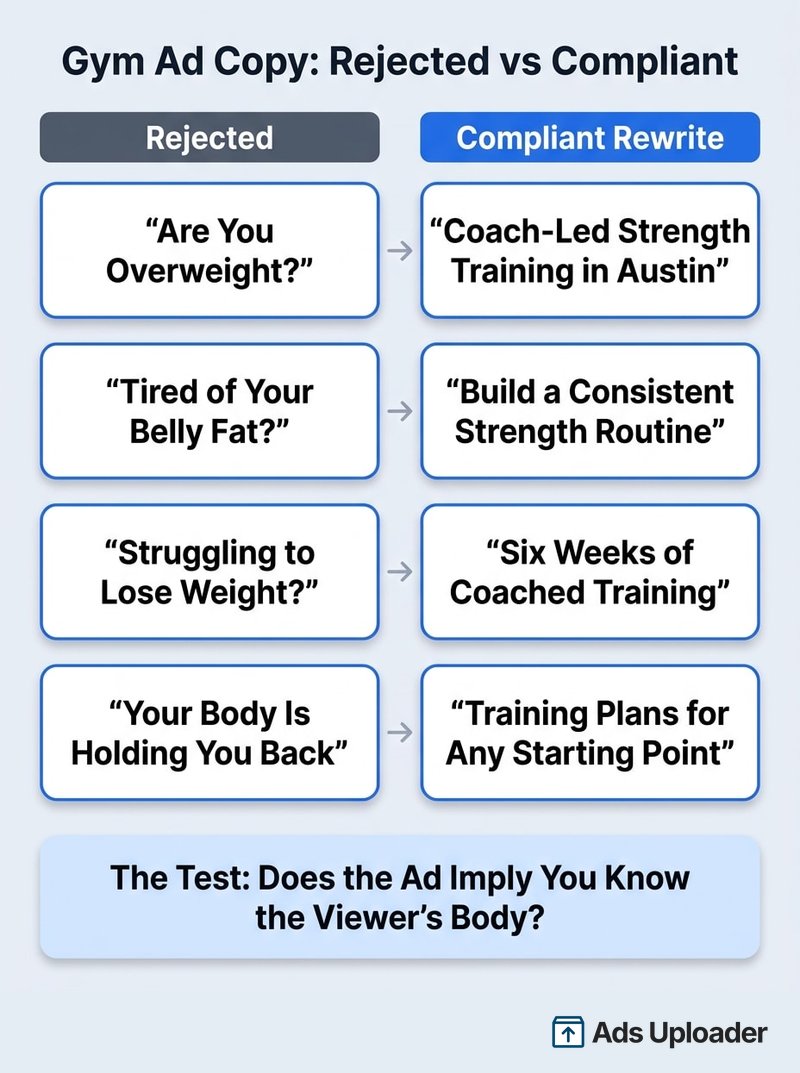
Meta's policy is one sentence: ads must not contain content that asserts or implies personal attributes. Physical and mental health are protected characteristics, and the classic gym hook is built on exactly the assumption the policy forbids: that the advertiser already knows something about the viewer's body.
It is widely misread as a ban on the word "you". It is not. "Book your first session" is fine. The test is whether the ad sounds as though it knows the viewer is overweight, unfit or insecure. Describe the service and let readers who need it recognise themselves.
| Copy that gets rejected | Why it fails | Compliant rewrite |
|---|---|---|
| "Are you overweight?" | Implies a physical attribute | "Coach-led small-group strength training in Austin." |
| "Tired of your belly fat?" | Implies a body characteristic | "Build a consistent strength routine with a coach." |
| "Struggling to lose weight?" | Implies a health condition | "Six weeks of coached training and accountability." |
| "Your body is holding you back." | Implies negative self-perception | "Training plans built around your starting point." |
| "Fix your bad knees." | Implies a medical condition | "Ask about our low-impact class options." |
The right-hand column follows one pattern: name the service and its location, and let the audience self-select. Campaigns rarely lose performance from the change, and it removes the single most common reason fitness ads get pulled.
Weight-Loss Claims and Before-and-After Photos
Meta's health and wellness standards tell advertisers to avoid negative self-perception, body shaming, guaranteed or unrealistic results, pinched-fat or zoomed-in body imagery, and sensational health claims. "Lose 20 pounds in six weeks" carries claim, body-image and substantiation risk all at once.
Before-and-after images have genuinely shifted, recently enough to warrant care. A policy update reported as taking effect 22 July 2026 moved enforcement from format-based to claims-based, meaning a before-and-after should no longer be rejected purely for being one, and weight-loss claims remain restricted to adults 18 and over. Two caveats: that change surfaced through a policy tracker rather than a dated public Meta changelog, so confirm it in the live policy before you rely on it; and a permitted format does not make a given image compliant, because a comparison can still fail if it shames the viewer or promises a guaranteed result.
Meta's review also covers the headline, any text inside the image or video, your lead-form questions and the destination page. Moving "Are you overweight?" into the image or the landing page does not cure the violation, and Meta re-reviews live ads, so something that ran for three weeks can still be pulled.
Keep the Lead Form and Tracking Clean
Meta's standards prohibit collecting health information through a lead ad without prior permission, which rules out asking for current weight, BMI, injuries, diagnoses, medications or reproductive-health details as a lead-quality tactic. Keep the form to name, contact details, preferred location, program of interest and a preferred time, and do any health screening later through a proper consented process.
The same logic applies to your pixel and Conversions API. Meta can restrict data sources it classifies as health and wellness, so avoid sending weight, BMI, injury or condition data through events, URLs or custom parameters, and avoid condition-revealing event names. A general gym is not a medical provider, but Events Manager can still flag a dataset, and the fix is to appeal a wrong classification rather than rename events to slip past it.
What Gym Facebook Ads Actually Cost
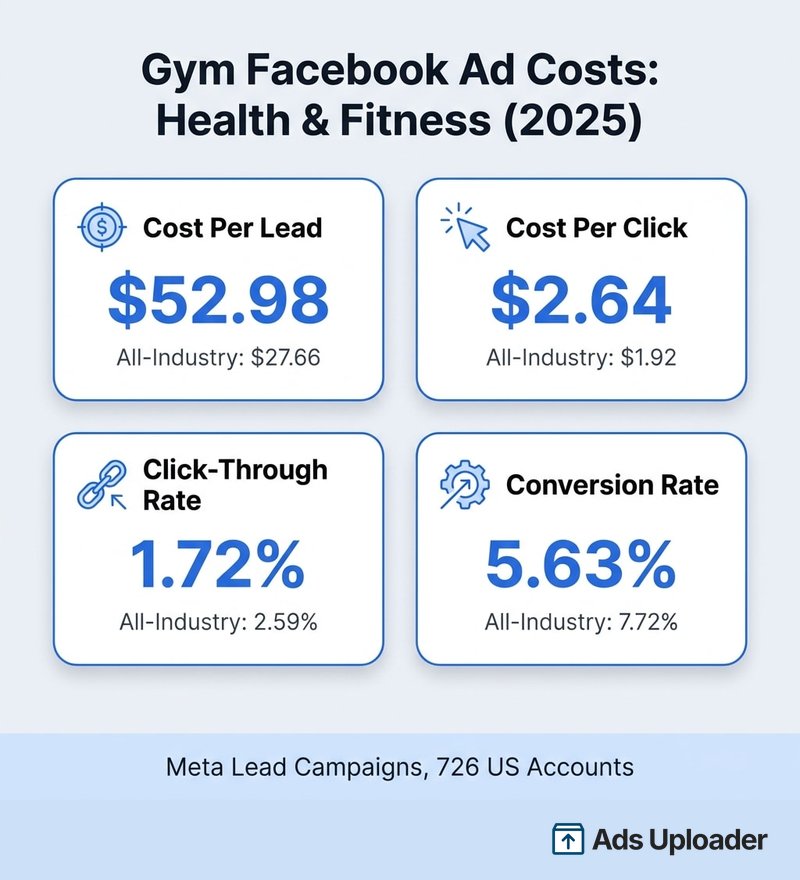
The most useful current benchmark is WordStream and LocaliQ's 2025 Facebook advertising benchmarks, which report a Health & Fitness category rather than gyms alone, across 726 US lead campaigns running April 2024 through June 2025.
| Meta lead campaigns | Health & Fitness | All-industry median |
|---|---|---|
| Cost per lead | $52.98 | $27.66 |
| Cost per click | $2.64 | $1.92 |
| Click-through rate | 1.72% | 2.59% |
| Conversion rate | 5.63% | 7.72% |
Health & Fitness is broader than gyms, so read it as a proxy rather than a gym census. The prior year's report showed a $57.40 Health & Fitness cost per lead, so leads look slightly cheaper in the newer sample, though the advertiser mix changed between editions. The closest gym-specific figure, an older LocaliQ row, put social cost per lead at $58.56 for health clubs and gyms and $77.48 for personal trainers, but it draws on 2020 to 2021 data and is a sanity check, not a planning number. A defensible first-pass planning range is roughly $40 to $60 per lead, stress-tested from $30 to $75, replaced with your own trailing data as soon as you have volume.
On seasonality, the common belief that January costs always spike is not supported. Gupta Media's tracker shows Meta CPM at $8.27 in January 2025, about 24% below the December 2024 holiday peak of $10.83, while still running above the previous January. Fitness demand does climb: Adjust reported fitness-app installs 46% above average on 1 January 2025, and Planet Fitness's own filings note that member joins run higher in January. So plan for stronger intent and more competing gyms, but do not assume January automatically means your most expensive impressions. Compare January against both the December before it and the January before it, and judge the month on members joined, not CPM.
From Lead to Joined Member: the Math That Decides the CPL
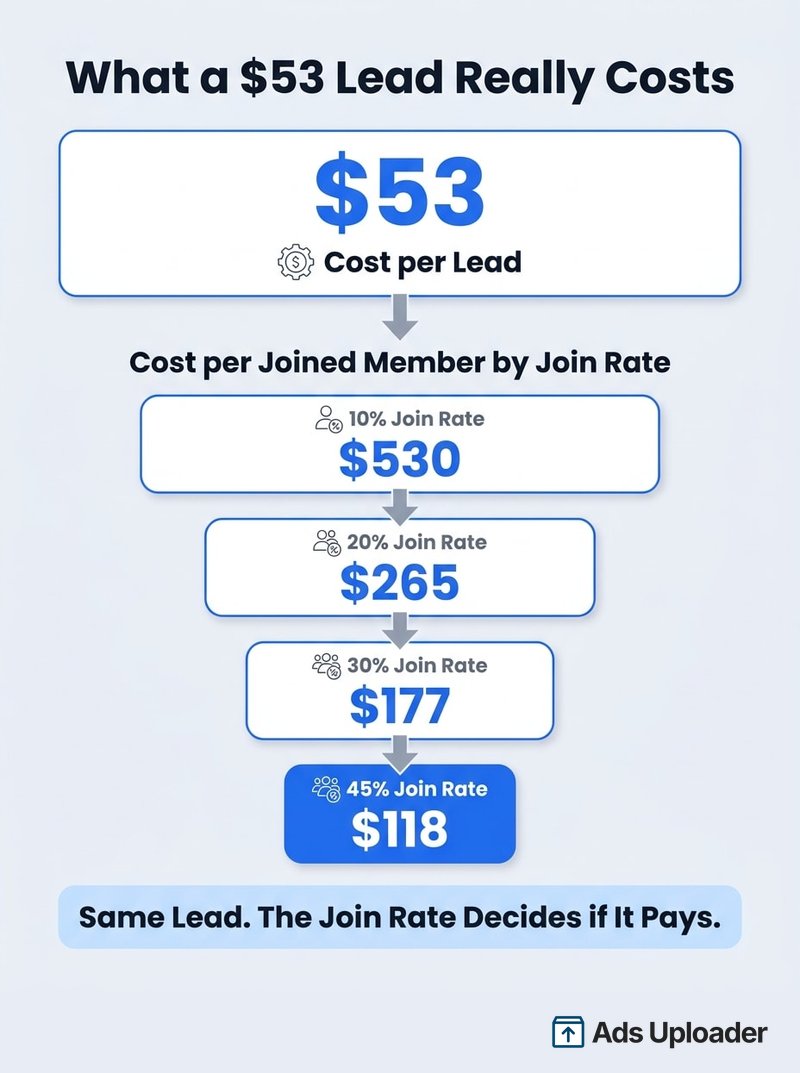
A cost per lead means nothing until you attach a conversion rate to it. Take the $52.98 Health & Fitness median and vary only how often a lead becomes a paying member:
| Lead-to-member rate | Media cost per joined member |
|---|---|
| 10% | $530 |
| 20% | $265 |
| 30% | $177 |
| 45% | $118 |
Now put that against member value. If a member contributes $45 a month and you want the acquisition cost repaid within six months, your allowable acquisition cost is $270, and at a 20% join rate your maximum affordable cost per lead is about $54. A $40 lead is attractive and a $70 lead is not. Change the join rate to 40% and a $60 lead becomes a bargain; drop it to 5% and even a $15 lead loses money. Same ad, opposite verdict, decided by the join rate and the membership value rather than anything in Ads Manager.
Member value varies enormously by model, which is why a blended target is a trap. Planet Fitness runs on average dues near $19.51 a month; the Health & Fitness Association's 2024 figure for US dues averaged $69 with a $38 median; Wodify's coached studios averaged $126 a month with a lifetime value it reported near $1,290. A big-box gym at $20 a month and a coached studio at $126 a month cannot tolerate the same acquisition cost, so they cannot chase the same cost per lead.
Two levers move the join rate more than any targeting change. The first is speed to first contact: a Harvard Business Review audit of 2,241 companies found the average web lead waited 42 hours for a response, and firms that made contact within an hour were far more likely to qualify a lead than those that waited even one hour longer. It is old, cross-industry data, but the direction is clear, and a lead that sits overnight is often a lead lost. Wiring lead ads straight into a CRM so the follow-up fires within minutes is the highest-return change most gyms can make. The second lever is show rate, which is a reminder process rather than a media problem: free-trial attendance can fall below 50% when nobody chases the booking.
Offers That Convert, by Type
The useful version of "have a strong offer" is that the offer, the friction and the viable cost per lead all move together.
Free class or day pass. The volume play. It removes friction and produces the cheapest, largest lead count, which is also its weakness: a cheap lead with no commitment becomes an expensive no-show. It works when you have class capacity, a defined booking process and fast follow-up. Gymdesk found 73% of roughly 175,000 tracked free trials eventually converted, with half of those conversions inside ten days, so the follow-up window is short.
Free trial or free week. Only worth running with a booked intro attached, because an unbooked "free week" is a coupon nobody redeems. Wodify recorded 36.9% of completed trials converting to paid, but the denominator is people who actually showed up, which is the number a booking and reminder process protects.
Paid challenge or kickstart. A deposit or a modest fee, often for a six-week program, filters out tyre-kickers and recovers some onboarding cost. There is no public head-to-head study proving it beats a free trial, so treat it as a hypothesis and judge it on cost per joined member, not cost per lead. Keep the positioning on coaching, consistency and community; "lose 20 pounds in six weeks" reintroduces the claim and body-image risk from the policy section.
Founding-member or limited-spots. Best kept honest and reserved for a genuine pre-opening, a new location or a real capacity limit. Invented deadlines and fake scarcity are both a trust problem and a policy problem.
Personal training and coaching. Higher ticket and a longer decision, which supports a much higher cost per lead. The LocaliQ figure had personal-trainer leads near $77 against gym leads near $59, and that is fine when the lifetime value is a multiple of a membership.
Build Your Own Swipe File
Stop scrolling the Ad Library by hand. Search, filter, and save proven ads with a free Chrome extension built for media buyers.
Get Ad Library Helper FreeFree Chrome extension • Built by Ads Uploader
Building the Campaign
Objective and Structure
For member acquisition the right objective is Leads, running to Instant Forms, calls or Messenger. Traffic optimises for clicks rather than enquiries, and Awareness suits a launch, not a booking. Structure matters more than usual because the audience is small. Meta's guidance is that delivery stabilises after roughly 50 optimisation events in seven days, and almost no single gym generates 50 members a week. At the Health & Fitness median that many leads would cost around $2,649 a week, so the answer is not to spend uneconomically to feed the algorithm; it is to optimise to a neutral, higher-volume event such as a generic lead, consolidate rather than fragment, and improve quality through the form and the follow-up. A tiny local audience split across four offers and eight ad sets will not leave the learning phase in any of them.
Targeting a Local Radius
Location is the control that genuinely holds. Meta treats the serviceable area, minimum age, language and excluded custom audiences as strict controls even when Advantage+ audience expands the rest, so set the geography carefully and let Meta handle the interests. Resist stacking fitness interests on top of a catchment that is already small; geography is doing the real constraint. Advantage+ is now on by default for eligible Leads campaigns, and Meta reports a 10% lower cost per qualified lead from it, though that figure is platform-wide rather than gym-specific. Because Meta infers location from several signals rather than running a live geofence, out-of-area leads will happen, so ask for a postcode on the form and analyse invalid leads separately. Exclude current members where you have a lawful basis and reliable data; for a gym the member list is more useful as an exclusion and a lookalike seed than as a target.
Instant Form or Landing Page
Instant forms produce more leads at lower cost. Meta's Instant Form case study for the gym chain GymNation reported 64% more leads and a 39% lower cost per lead than the same campaign linking to a website form, and Meta's broader testing found instant forms around 20% cheaper per qualified lead. What none of that establishes is a lower cost per joined member. Instant forms win on volume and cost because they remove friction; a landing page wins on qualification because it has room for credentials, class times, pricing context and a real booking calendar, and it tends to produce fewer but better-prepared enquiries. Run them as separate test cells on the same offer and creative, and judge them on shows and joins rather than cost per lead.
Creative and Copy That Survive the Feed and the Reviewer
Real footage of your actual gym beats stock photography, and it carries less policy risk than a zoomed-in body shot. The concepts that work are unglamorous: class energy, a coach talking to camera, a facility tour, a "what your first visit looks like" explainer, an everyday member's story told without a body-shaming setup, in the mould of the testimonial ad examples we collected. Show a range of real people rather than only shredded models, which both reads as more honest and avoids intimidating the beginner who is your actual buyer.
Put the offer and the location in the first line of the primary text, before the truncation point, and keep the copy on the service rather than the viewer's body. Favour placement-native vertical video: Meta's split tests found 9:16 video with audio produced materially lower cost per result than static image ads, though that is a platform-wide finding, not a gym guarantee, so test it rather than assume it.
Tracking, Retargeting and Scaling
Most gyms track the lead and stop, which is exactly the mistake that makes a cheap campaign look profitable and a profitable one look expensive. Report by campaign, offer and location down the full funnel: cost per lead, valid-contact rate, booking rate, show rate, join rate, cost per joined member, and 30 and 90-day retention. Track cohorts by join month, because a campaign can look strong at signup and fall apart after early cancellations and failed payments.
Retargeting earns its place here: video viewers, page and landing-page visitors, people who opened an Instant Form without submitting, and leads who never booked are all warm audiences worth a second, third or fourth touch. Keep the retargeting copy off the reason someone is in the audience, though, because "still struggling with your weight?" is a personal-attributes risk even when you believe the person raised the goal themselves.
Scaling is simple to state and hard to rush: raise budget only after cost per joined member has held inside your allowable range through at least one full sales cycle, and before you push spend, check lead validity, response time, appointment availability, show rate and sales capacity. A sudden jump in cost per lead is usually a creative or auction issue; a rising cost per member with a stable cost per lead is a lead-quality, follow-up or offer problem, and no budget increase fixes that.
Real Gym Facebook Ads Running in 2026
The offers above are easier to picture next to live ones. Every ad here was pulled from the Meta Ad Library on 8 September 2026, and each card shows the advertiser's real creative and verbatim copy with a link to its Library entry, so you can open it and check it is still running. The Library shows creative, copy and dates, not spend or results, so read these as construction, not proof of performance.
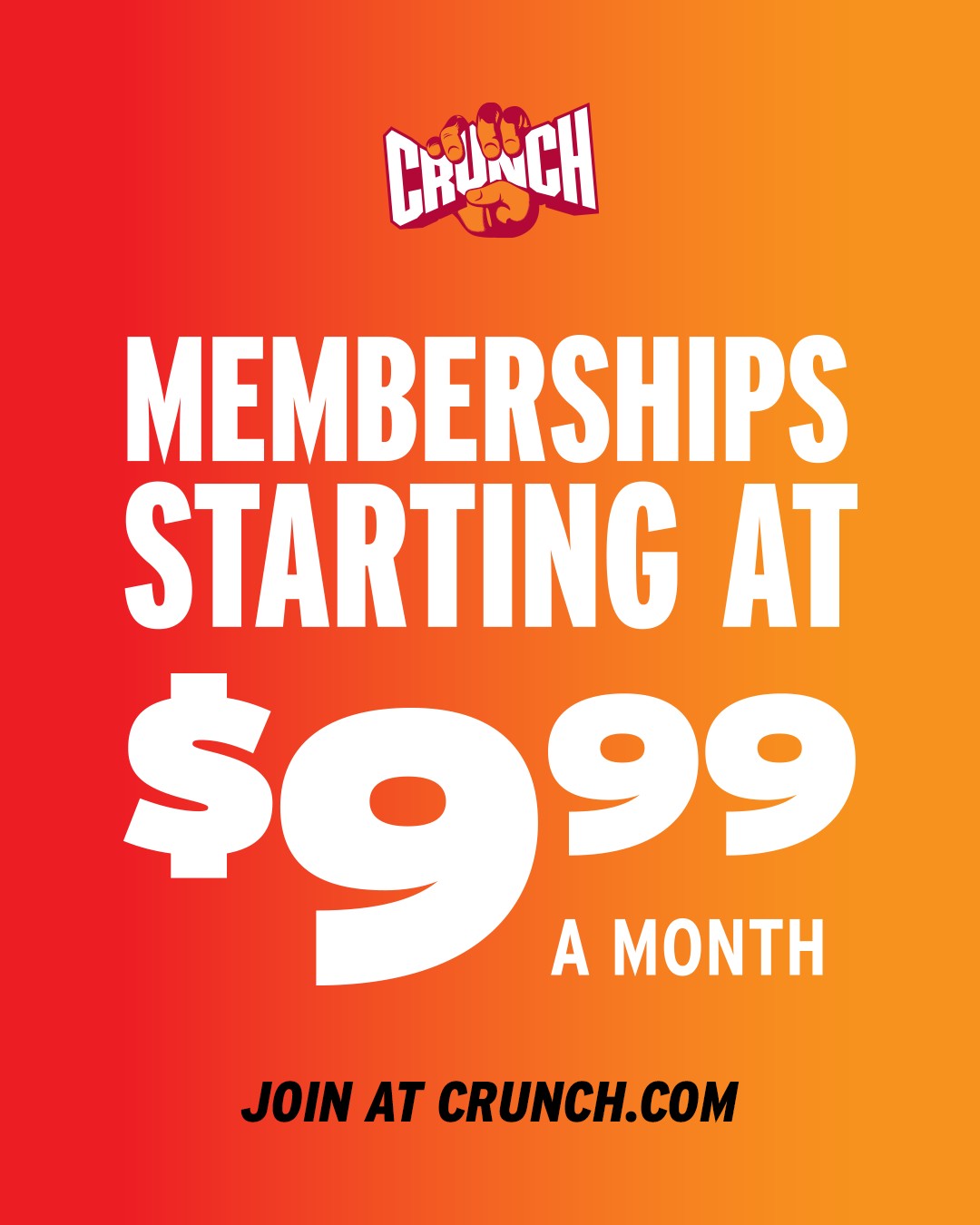
The big-box play is a low headline price with the value stacked first. Crunch lists the amenities, then lands the number, "Memberships start at $9.99/mo", so the price reads as a deal rather than a warning. Copy the order: prove the value, then show the price.

The same membership runs as a short video built on the join friction rather than the price, "Join today for $1 down". A dollar-down offer removes the sign-up-fee objection that stalls big-box joins, and it keeps the deal in the copy while the video sells the room.

Planet Fitness runs the belonging angle through a creator instead of a brand static, a first-person Partnership Ad opening "I thought the gym was only for people who already knew what they were doing". The objection-first hook is the thing to copy. It is also a live lesson in the health rules: the spoken track mentions weight loss and a GLP-1, which is exactly the personal-attribute and health-claim territory to keep out of your own primary text and lead form even when a paid creator raises it.

An independent gym leads with the anti-contract angle and a concrete trial rather than a vague one, "no long-term commitment. Try 3 sessions free". Naming a specific number of sessions beats "free trial" because it sets the expectation and routes to a low-friction sign-up.

A boutique studio sells convenience and a niche audience, "Only 30 Minutes. No Class Times. Women Only", then stacks a $14-a-week offer, free gloves and "Limited FREE Trial Spots". Naming the audience in the hook is the qualifier: it filters the click before it costs you, which is the cheapest lead-quality lever in the vertical.

The challenge is a different entry point altogether, a dated event rather than a membership: "The Ultimate Fitness Competition. 30 Minutes. 5 Stations... complete as close to 500 total points as possible. September 12th." A real date is honest urgency, and a low-commitment competition is an easier first yes than a contract, with the membership sell coming after.

Frequently Asked Questions
Save Hours on Creative Testing
Stop uploading ads one by one. Bulk process unlimited creatives with automatic media matching and direct API publishing.
Try Ads Uploader FreeNo credit card required • 7-day free trial
Do Facebook Ads Work for Gyms?
They can, but "working" has to mean joined members below your allowable acquisition cost, not cheap form fills. Meta's GymNation case study reported 64% more leads at a 39% lower cost per lead when the ad opened an Instant Form rather than linking to the website. That proves the channel produces enquiries cheaply. Whether it produces profit depends on how many leads book, show and join, which lives in the CRM.
How Much Do Facebook Ads Cost for a Gym?
The closest current benchmark is WordStream and LocaliQ's 2025 Health & Fitness figures for Meta lead campaigns: a $52.98 median cost per lead, $2.64 cost per click, 1.72% click-through rate and 5.63% conversion rate. Health & Fitness is broader than gyms, so treat it as a proxy. An older gym-specific LocaliQ row put social cost per lead at $58.56, from 2020 to 2021 data. Plan around $40 to $60 per lead.
What Is a Good Cost per Lead for a Gym?
There is no universal number, because a lead's value depends on how often it becomes a member. The correct ceiling is your allowable acquisition cost multiplied by your lead-to-member rate. If a member is worth $270 in acquisition cost and you join 20% of leads, your maximum cost per lead is about $54. The same $60 lead is excellent at a 40% join rate and disastrous at 5%.
How Much Should a Gym Spend per Month?
Work backward from capacity. To add ten members a month at a 20% lead-to-member rate you need about 50 leads, which at the $52.98 median is roughly $2,649 in monthly media. At a 10% join rate the same ten members cost about $5,298. Add creative, software and staff time for a fully loaded acquisition cost, and spend less if your team cannot follow up within the hour.
Why Do My Gym Facebook Ads Keep Getting Rejected?
Usually the Personal Attributes policy, which prohibits ads that assert or imply a viewer's physical or health characteristics, so "Are you overweight?" gets pulled. Other common causes are guaranteed outcome claims, idealised before-and-after imagery, sensitive health questions in the lead form and landing pages that do not match the ad. Meta reviews the image text, form questions and destination page, not just the primary text.
Can a Gym Use Weight-Loss Before-and-After Photos?
Possibly, but they stay high-risk. A reported July 2026 shift moved enforcement from format-based to claims-based, so a before-and-after should no longer be rejected purely for being one, and weight-loss claims are limited to adults 18 and over. It can still fail when it shames the viewer or promises guaranteed results. That change came through a policy tracker rather than a dated Meta changelog, so verify the live policy first.
Free Trial or Paid Challenge, Which Converts Better?
No credible public head-to-head study settles it. Free trials have the most published evidence: Wodify recorded 36.9% of completed trials converting, and Gymdesk found 73% of around 175,000 tracked free trials became members. A paid challenge adds checkout friction but filters for intent. Judge them on cost per joined and retained member, because a cheaper lead that never shows up is the more expensive option.
How Do I Target Locally for a Gym?
Set your real serviceable area as a strict location control and keep the audience broad inside it rather than stacking fitness interests. Meta treats location and minimum age as controls even when Advantage+ expands everything else, so geography does most of the work. Ask for a postcode on the form to spot out-of-area leads, and judge different radii on joined members rather than clicks.
The Short Version
Gyms are not a restricted vertical on Meta the way housing and recruitment are; there is no Special Ad Category and you keep full local targeting. What binds instead is the Personal Attributes rule, which rules out the body and weight hooks fitness copy has always leaned on, and the health rules on claims, imagery and lead-form data.
On economics, the current proxy is roughly $53 per lead for Health & Fitness, but that number is meaningless on its own. Attach a join rate and a membership value to it and the same lead can print money or lose it. A $60 lead is a bargain at a 40% join rate and a disaster at 5%.
So measure to the end of the chain. Cost per lead tells you almost nothing; cost per joined member against lifetime value tells you whether to scale. And before you touch targeting, wire the follow-up so the first contact happens within the hour, because for a gym the front desk closes more members than the auction ever will.