Facebook ads by industry describes how Meta ad costs and performance vary across verticals like dental, real estate, gyms, solar, and ecommerce. Current 2025 US benchmarks put the median lead-objective cost per lead at $27.66 and traffic cost per click at $0.70, but individual industries range from a $3.16 restaurant lead to a $76.71 dental lead. The right benchmark depends on your campaign objective and your business model, and a number only means something once you carry it through to a booked, closed customer rather than a raw lead.
The same $30 cost per lead is a triumph for a dentist and a disaster for a pizza shop. That single fact is why "what do Facebook ads cost by industry" is one of the most searched and least usefully answered questions in paid social. Most benchmark pages hand you a table and walk away, leaving you to reassemble your own vertical from four separate metric charts and guess what to do about it.
This page does the opposite. It is organized by industry, and each section pairs the current 2025 to 2026 benchmark with the part nobody publishes: which objective fits, which offer converts, which policy rules apply, and why the number is what it is. First, the one skill that makes every table below usable.
How to Read Facebook Ads Benchmarks by Industry
Before any number helps you, three things have to line up. Get them wrong and you will chase a benchmark that was never yours to hit.
The objective decides the number. A Traffic campaign is optimized for people likely to click, and its all-industry cost per click sits around $0.70. A Leads campaign is optimized for a form fill, call, or message, and its cost per click is $1.92, with a cost per lead of $27.66. Those are not the same event, so comparing a Traffic CPC to a Leads CPC tells you nothing. Always read a benchmark next to its objective.
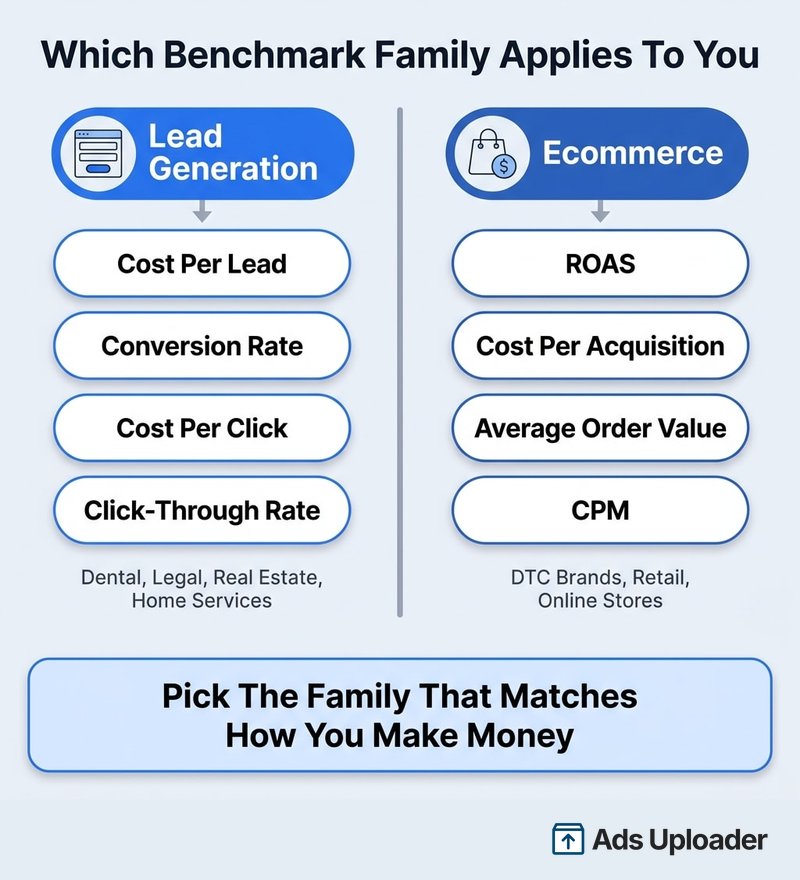
Your business model decides which dataset applies. There are two incompatible benchmark families in circulation. Lead-generation verticals like dental, legal, and home services report cost per lead and lead conversion rate, drawn from LocaliQ and WordStream's 2025 report across 726 US lead campaigns. Ecommerce brands report purchase cost per acquisition, return on ad spend, and average order value, drawn from Triple Whale's 2026 study of more than 40,000 brands. A restaurant lead and a Shopify purchase are different measurements. Pick the family that matches how you actually make money.
A benchmark is a diagnostic, not a target. The number tells you where to look, not what to score. A below-average click-through rate points at creative. A high cost per click points at audience or auction pressure. A weak conversion rate points at the landing page or the offer. The industry average is a starting hypothesis, and the whole game is beating it once you know which lever is holding you back.
One more caution before the tables. Each metric is medianed on its own, so a published median cost per lead will not equal the median cost per click divided by the median conversion rate. And the widely circulated older WordStream figures, the ones showing Fitness at a 14.29% conversion rate or Technology at a $55.21 cost per action, come from campaigns that ran between November 2016 and January 2017. Treat those as history, not as a 2026 planning number.
Facebook Ads Cost by Industry: The Benchmark Table
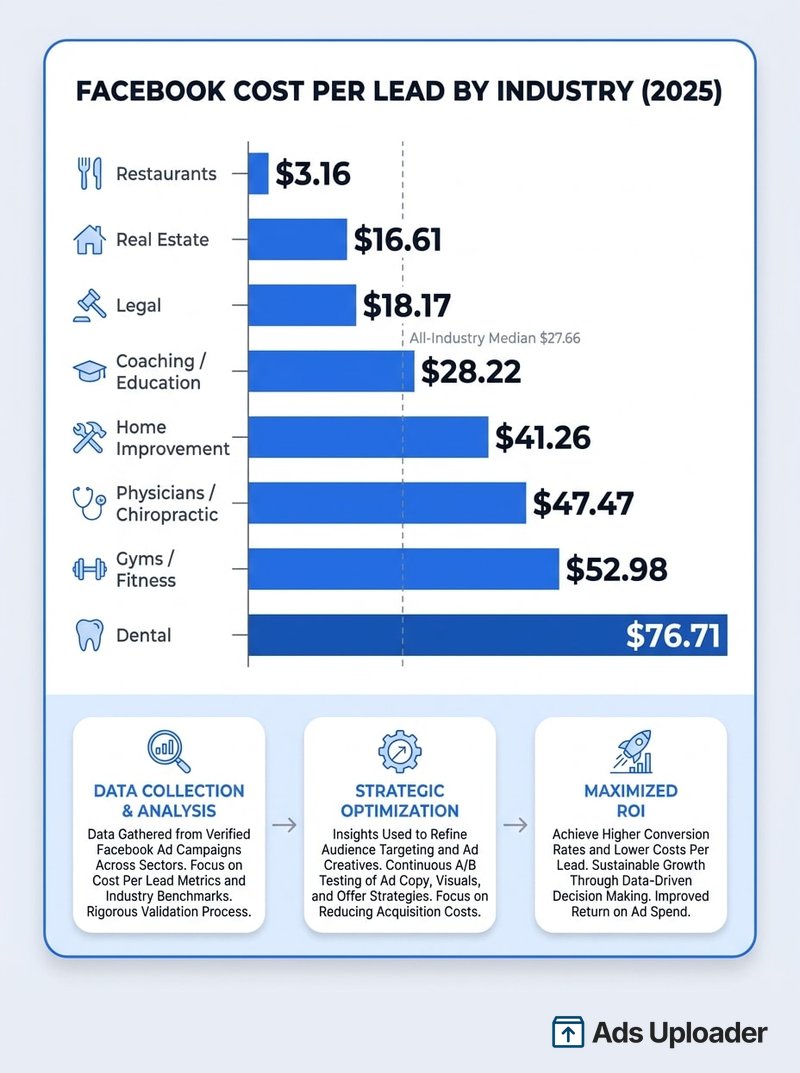
Here is the current lead-generation picture, organized so you can find your vertical and read it across. All figures are 2025 medians for the Leads objective from LocaliQ's report, updated October 2025. Where a row is marked a proxy, the exact vertical was not isolated in the data, so a broader category stands in.
| Industry | Avg CPC | Avg CPL | Avg CTR | Avg CVR | Notes |
|---|---|---|---|---|---|
| Restaurants and Food | $0.74 | $3.16 | 2.97% | 18.25% | Exact |
| Real Estate | $1.57 | $16.61 | 3.75% | 9.53% | Exact (Housing category) |
| Legal and Attorneys | $4.10 | $18.17 | 2.11% | 10.53% | Exact |
| Education and Coaching | $1.65 | $28.22 | 1.86% | 10.08% | Exact (proxy for coaching) |
| Home Improvement and Solar | $2.23 | $41.26 | 1.94% | 5.22% | Exact (proxy for solar) |
| Physicians and Chiropractic | $2.23 | $47.47 | 3.02% | 4.51% | Exact (proxy for chiropractic) |
| Gyms and Fitness | $2.64 | $52.98 | 1.72% | 5.63% | Exact (Health and Fitness) |
| Dental | $9.78 | $76.71 | 1.05% | 6.38% | Exact |
| All industries | $1.92 | $27.66 | 2.59% | 7.72% | Leads-objective median |
A few things jump out. Dental has the most expensive lead at $76.71 and the highest cost per click at $9.78, yet it is not a bad vertical, because implant and full-arch cases carry the ticket size to absorb it. Restaurants sit at the opposite end with a $3.16 lead, but a cheap form fill is not a paid cover. Legal has one of the strongest conversion rates at 10.53%, and real estate combines a low $16.61 lead with a high 3.75% click-through rate, though it pays for that with Housing-category targeting limits covered later.
For businesses running the Traffic objective instead, the whole scale shifts down: travel clicks average $0.51, real estate $0.91, and physicians $0.82, against an all-industry Traffic CPC of $0.70. Most of these campaigns run as Facebook lead ads, which collect the lead inside Meta rather than on your site.
Local Health and Wellness Verticals
These verticals share three traits: a small local audience, a human who converts the lead by phone, and health rules that restrict what your copy can say.
Dental
Dental is the most expensive lead on the board and often the most defensible. A single implant root averages around $2,143 before the crown, and All-on-4 cases run into five figures, so a $76.71 lead is trivial against that math once you measure to the end of the chain. The trap is judging a hygiene campaign on the same target as an implant campaign. Run Leads for consultations, lead with a new-patient exam or an implant assessment, and keep your form questions non-clinical. Meta's Personal Attributes policy will reject hooks like "Are your missing teeth embarrassing you?" because they imply knowledge of the viewer's condition, so describe the service and let readers recognize themselves, a pattern our dental Facebook ads guide breaks down procedure by procedure.
Chiropractic and Physicians
Chiropractic was not isolated in the data, so use the Physicians and Surgeons row ($47.47 per lead, 3.02% click-through rate) as a broad planning bound rather than a chiropractic fact. The offer that works, as our guide to Facebook ads for chiropractors lays out, is an educational consultation or exam, never a promised cure. Copy that asks "Do you have chronic back pain?" trips the same personal-attributes wire as the dental example; "Chiropractic consultations for people exploring back-pain care" does not. Keep your marketing pages separate from patient intake systems, and reconcile booked and showed appointments inside your practice software rather than sending condition-specific events back to Meta.
Gyms and Fitness
Health and Fitness averages $52.98 per lead, which is close to a full month of the roughly $65 average US gym membership. That single comparison tells you the whole strategy: acquisition barely breaks even on the first month, so visit-to-member conversion and retention decide whether the channel works, which is the math our guide to Facebook ads for gyms walks through. Run a free class, a short trial, or a time-bounded challenge with clear terms, and lead with member-perspective footage and "every starting point is welcome" messaging rather than body-image pressure, which violates policy and repels the beginners you want. Put class booking immediately after the form. The forms behind these offers are worth engineering carefully, from field design to qualification logic.
High-Ticket Home and Local Services
Here the ticket sizes are large, the sales cycles are long, and a lead that looks alarmingly expensive is usually fine. The discipline is qualification, not cheap volume.
Solar
No reliable solar-specific public benchmark exists, so the $41.26 Home Improvement lead is only a proxy. That is acceptable because a residential PV system runs around $23,600 at recent benchmark pricing, and even a modest lead-to-install rate justifies a high cost per lead. Offer a site-specific quote or savings estimate, never "free solar", which the FTC has explicitly warned against; our collection of solar Facebook ad examples shows what the compliant version looks like. Two policy notes matter: financing offers pull you into the Financial Products and Services category, and you should confirm current federal tax-credit eligibility before advertising any 2026 incentive, because the residential clean-energy credit terms changed. Measure surveyed, quoted, approved, and installed, plus gross profit per install.
Home Improvement, HVAC, and Roofing
The broad category lead is $41.26, but the service line changes everything. An HVAC replacement averages around $7,500 and a roof replacement close to $9,608, so quote rate and sold-job rate matter far more than the headline lead cost. Storm-damage roofing and a planned remodel should never share one target. Use form qualifiers that screen out-of-area and wrong-service leads before they hit your team, then book immediately. Project walkthroughs, time-lapse footage, and genuine before-and-after material carry the creative.
Build Your Own Swipe File
Stop scrolling the Ad Library by hand. Search, filter, and save proven ads with a free Chrome extension built for media buyers.
Get Ad Library Helper FreeFree Chrome extension • Built by Ads Uploader
Real Estate
Real estate has one of the friendliest raw profiles on the board, a $16.61 lead with a 3.75% click-through rate, and one of the strictest rulebooks. Property and mortgage ads are a Housing Special Ad Category, which strips ZIP targeting, lookalikes, and detailed audience selection and locks age and gender to broad. You plan around that by leaning on broad delivery and compliant geography, and by judging leads on appointments and closed transactions rather than form volume, which our full guide to real estate ads for Facebook walks through campaign by campaign.
Automotive
Automotive splits cleanly. Dealership sales campaigns run on Leads or Sales for test drives, trade-in valuations, and inventory inquiries, with creative built around the actual vehicle, price context, and a walkaround, or around a catalog feed as our guide to Facebook automotive inventory ads explains. Service and repair campaigns run on calls or booking conversions, with seasonal maintenance offers and technician videos. The current data only gives Traffic clicks here, $0.79 for vehicles for sale and $0.81 for repair, so build your own lead target from account history. Note that vehicle financing can trigger the Financial Products and Services category even though the car ad itself is not financial.
Coaching, Courses, and B2B SaaS
Two very different businesses that share a Meta reality: the click is cheap, the qualified lead is not, and the offer decides everything.
Coaches, Consultants, and Courses
Education and Instruction averages $28.22 per lead with a strong 10.08% conversion rate, a reasonable proxy for coaching even though high-ticket programs were not isolated. Cold audiences convert on a webinar, diagnostic, template, or short workshop; warm audiences convert on an application or consultation, a funnel our guide to Facebook ads for coaches builds out step by step. A $5,000 to $25,000 coaching program almost always needs a landing page, a qualification step, and a sales call rather than a direct checkout, so do not benchmark it against the $34.33 average order value of low-ticket e-learning ecommerce. Founder-led video with a clear point of view and a verifiable result outperforms polished brand creative here, and broad problem-aware prospecting usually beats narrow interest stacks.
SaaS and B2B Software
Facebook ads do work for B2B and SaaS, with a caveat about where. They are strong for retargeting site visitors, trial users, content viewers, and CRM contacts, and for self-serve or SMB products with a large addressable market. They are weak as the primary cold channel for a narrow enterprise buyer defined by job title or named account, where LinkedIn's deterministic targeting usually wins the first touch. Expect raw Meta leads around $40 to $80 and genuinely qualified leads above $150; the definition matters more than the headline. Lead magnets like a benchmark report or calculator produce cheaper, higher-volume leads, while demos and trials produce fewer, higher-intent ones. Connect campaign, lead, and opportunity IDs into your CRM and judge cost per opportunity and pipeline dollar, not cost per signup, the measurement model our guide to Facebook ads for SaaS companies is built around.
Which Industries Are Restricted on Meta
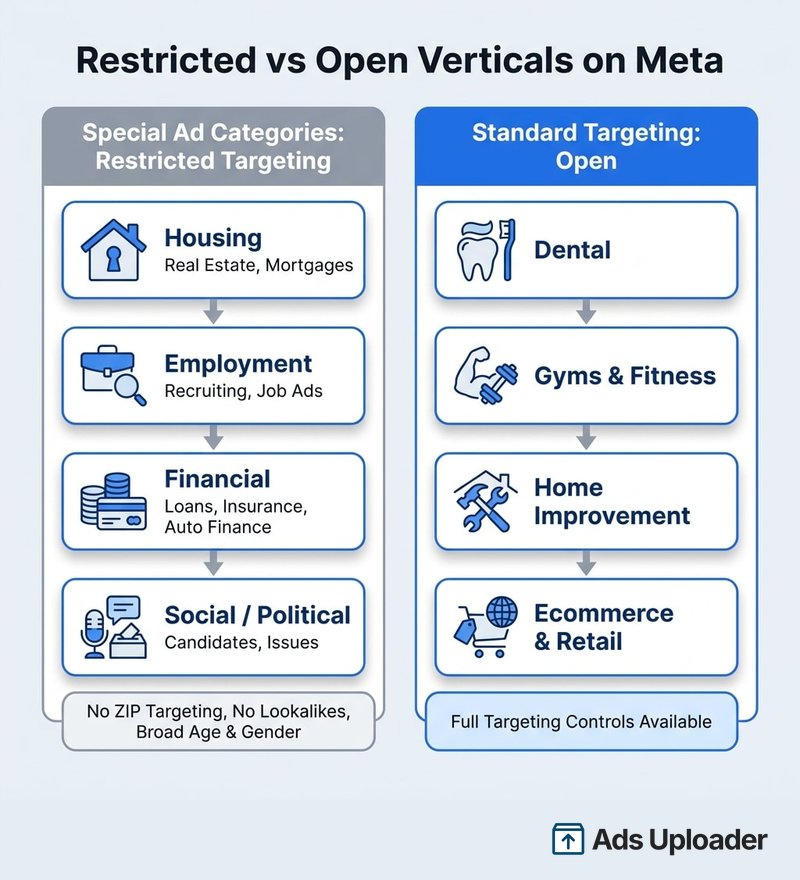
Some verticals are constrained before you write a single ad. Meta's four Special Ad Categories are not bans, they are restricted-targeting buckets, and they catch more industries than people expect.
| Special Ad Category | Industries it catches |
|---|---|
| Housing | Real estate, rentals, mortgages, home and mortgage insurance, some housing repairs |
| Employment | Job listings, recruiting, internships, job boards, some certifications |
| Financial Products and Services | Loans, credit cards, banking, investments, insurance, auto and solar financing |
| Social Issues, Elections or Politics | Candidates, parties, ballot measures, regulated social-issue ads |
When your ad falls into Housing, Employment, or Financial, Meta fixes age to a broad range and gender to all, removes ZIP-code targeting, imposes a minimum radius, and disables lookalikes and saved audiences. Special Ad Audiences, the old workaround, were discontinued, and enabling Advantage+ does not override these limits. The overlaps are the part that surprises advertisers: a mortgage ad implicates both Housing and Financial, auto financing is Financial even on a vehicle ad, and dental, gym, or solar financing can all pull an otherwise unrestricted business into the Financial bucket. Health and wellness verticals face a different constraint, the Personal Attributes rule, plus patient-data limits that make uploading a customer list genuinely risky for covered entities. A policy update reported as effective 22 July 2026 moved before-and-after enforcement from format-based to claims-based, so a before-and-after is no longer rejected purely for being one, though misleading or negative-self-perception framing still is. Verify that in Meta's live policy before you rely on it.
Travel, Hospitality, and Ecommerce
Travel and Hotels
Travel has the cheapest clicks on the platform, a $0.51 traffic CPC and a 2.76% click-through rate, because destination creative stops the scroll. But no current lead or booking benchmark exists for travel or hotels specifically, so measure to booking value, not landing-page views. Run Sales when a booking engine passes reliable revenue and Leads for custom, group, or high-ticket itineraries, as our guide to Facebook travel ads explains. Hotels should track booking revenue across the booking-engine domain and separate new guests from returning ones, evaluating against roughly $160 average daily rate and 62% occupancy rather than a generic cost per lead, a setup our guide to Facebook ads for hotels walks through.
Ecommerce and Retail
This is the other data family entirely. Ecommerce advertisers optimize for Sales, and the 2026 medians are a $38.99 cost per acquisition, a $15.06 CPM, a 1.88 return on ad spend, and a $73.36 average order value. A 1.88 ROAS can still lose money after product cost, shipping, discounts, and returns, so measure new-customer acquisition cost and contribution margin, not platform ROAS alone. Broad and Advantage+ Sales prospecting plus dynamic catalog retargeting carry most accounts, and CPMs spike hard in Q4, with Black Friday historically running well above the annual average.
Running Ads Across Multiple Industries
If you buy for an agency or a multi-brand portfolio, the real challenge is not any single benchmark, it is holding a consistent structure across a dozen clients who each sit in a different vertical with a different objective, offer, and rulebook. Standardize what you can. A shared campaign structure and budget approach makes results comparable across accounts, and consistent naming makes them reportable by client and offer afterward. When you are launching the same creative concept across many accounts and audiences, doing it by hand in Ads Manager is where the hours and the naming errors go, which is exactly the problem bulk uploading Facebook ads solves.
The benchmark then becomes a monitoring tool. Track each client against its own vertical median, and treat a gap the day it opens as a diagnostic prompt rather than a monthly surprise.
Save Hours on Creative Testing
Stop uploading ads one by one. Bulk process unlimited creatives with automatic media matching and direct API publishing.
Try Ads Uploader FreeNo credit card required • 7-day free trial
Real Facebook Ads by Industry in 2026
The benchmark rows above tell you what each vertical costs. These eight ads, pulled live from the Meta Ad Library on 9 September 2026, show what a working ad in that vertical actually looks like: the offer, the format, and the compliance line each business has to stay behind. Every card below shows the advertiser's genuine creative and verbatim copy, with a footer that links back to the ad so you can check it yourself. The Ad Library exposes creative and copy, not spend or results, so read these as construction, not proof of performance. They run roughly from the highest-ticket lead-gen verticals down to ecommerce and software.
Here is what a working dental ad looks like. Nuvia leads with the one number that reframes the whole decision, "permanent teeth in 24 hours" against a "10+ months" status quo, which is exactly how a high-ticket implant practice earns its $76 lead. Copy the mechanism-first hook, but note the compliance line: a health vertical cannot target or imply a viewer's condition, and any "24 hours" claim has to be substantiable, so the promise sits on the practice, never on "you."

Here is what a working gym ad looks like. YouFit inverts the usual "join now" pitch into a free membership when you buy personal training, which turns the ad into a trial offer rather than a hard sell, and the creative is member-perspective video rather than aspirational body imagery. That framing is both smart and safe: fitness ads that pressure people about their bodies violate policy, and the walk-around-the-gym testimonial is the thing to copy.

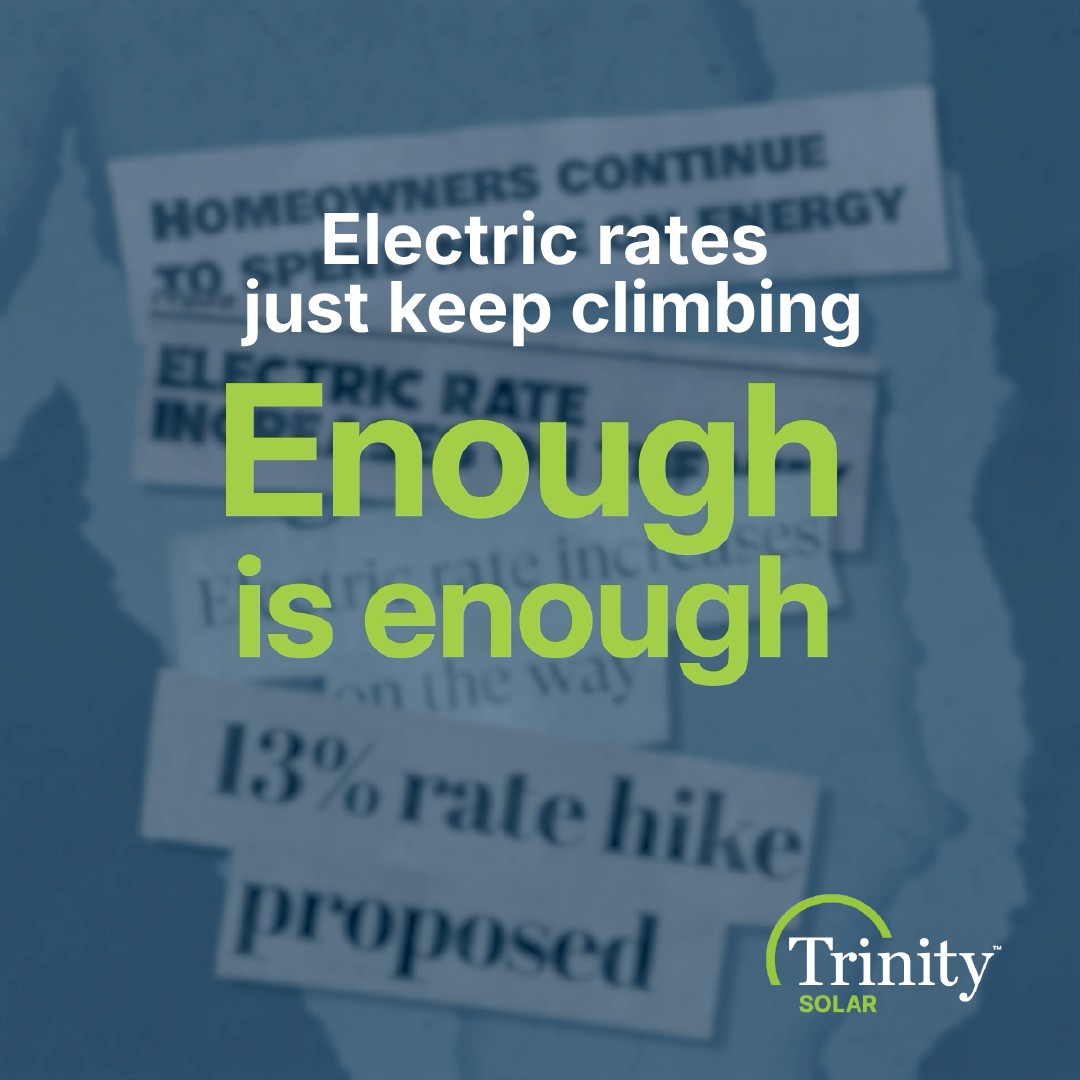
Here is what a working solar ad looks like. Trinity opens on the pain ("Tired of high electric bills?"), promises to lower the monthly payment, and asks only for a free consultation, which is the right ask for a $23,000 install that no one buys off a form. Two things to copy and one to watch: the offer is a consultation, not "free solar," which the FTC has warned against, and the moment the copy mentions financing or lowering monthly payments the ad can pull you into the Financial Products Special Ad Category, so plan targeting around that.

Here is what a working real estate ad looks like. Sheldon Swain runs the classic seller-lead angle in six words, "Sell your home for TOP DOLLAR," with a Book now button that routes straight to an appointment. Copy the appointment-first CTA, but remember the constraint behind the friendly $16 lead: property ads are a Housing Special Ad Category, so ZIP targeting, lookalikes, and detailed audiences are off, and you judge these on booked listings, not form volume.


Here is what a working legal ad looks like. Stephens Law spends its whole message on credibility, "The Difference Maker," a named attorney, a track record, and a free case evaluation, because at a $4.10 click and an $18 lead the personal injury auction rewards trust over cleverness. Copy the free-evaluation offer paired with a specific proof point (the named partner and results), which is what separates a real firm ad from the interchangeable ones.


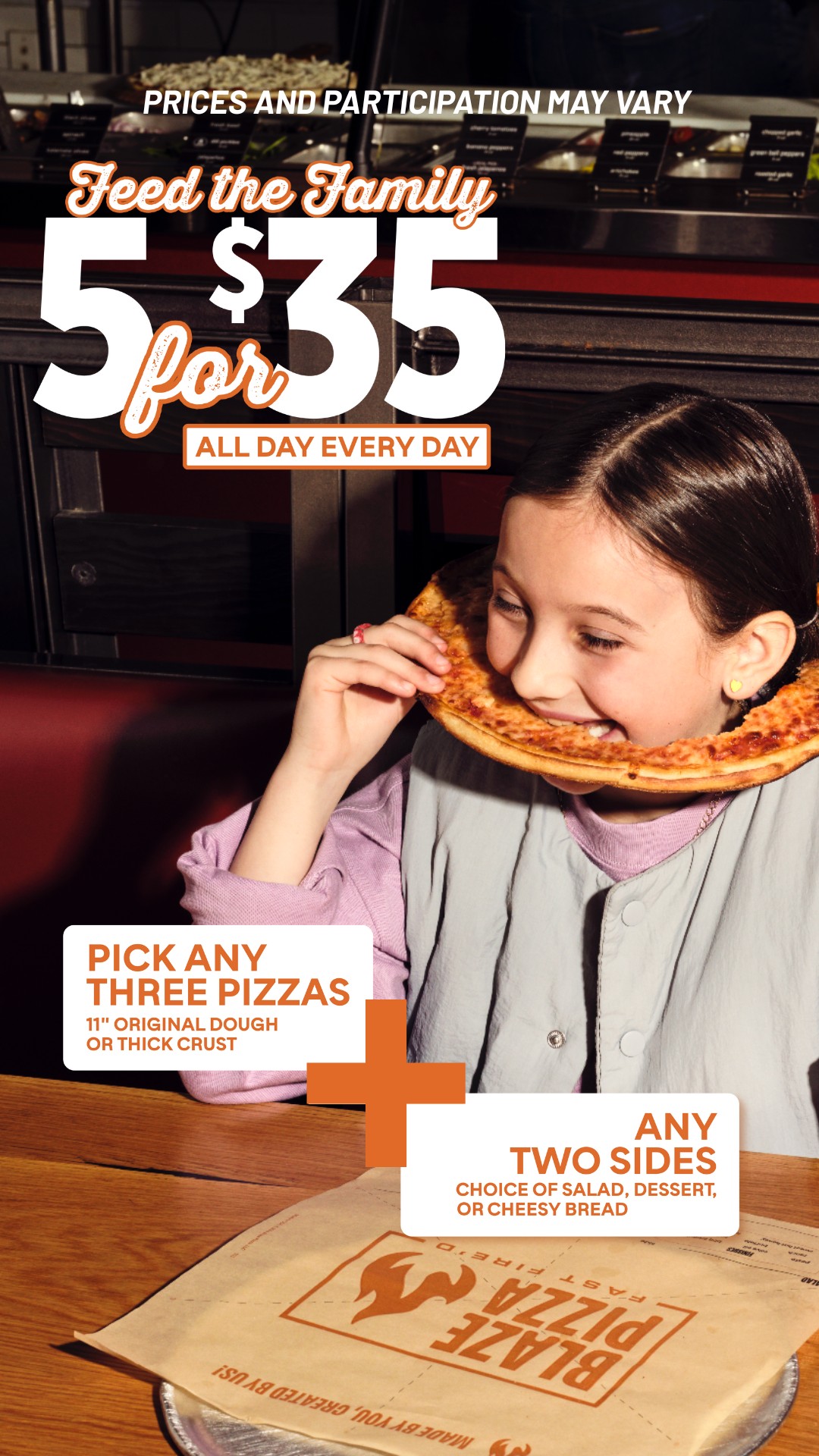
Here is what a working restaurant ad looks like. Blaze Pizza sells a concrete bundle, "3 pizzas and 2 sides starting at $35," with an Order now button, which is the right move for a $3 vertical where the whole game is turning a cheap impression into an actual order. Copy the specific price-anchored offer and the "prices and participation may vary" disclaimer, and note that a national chain running a limited-time deal is a template any local restaurant can shrink to one location.

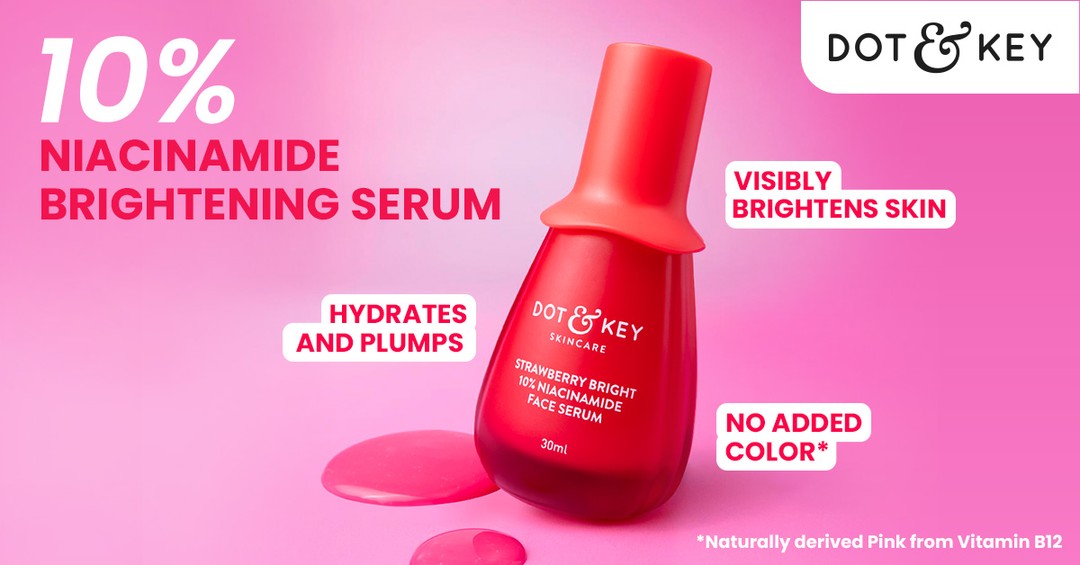
Here is what a working ecommerce ad looks like. Dot & Key runs a product-launch ad built for the cart, not a form: a named new product, three benefit bullets a shopper scans in a second, then four credibility ticks (clinically proven, dermatologically tested). Copy the benefit-then-proof structure, because in the ecommerce family this ad lives in, ROAS and average order value are decided by how fast the creative communicates the product, not by lead quality.

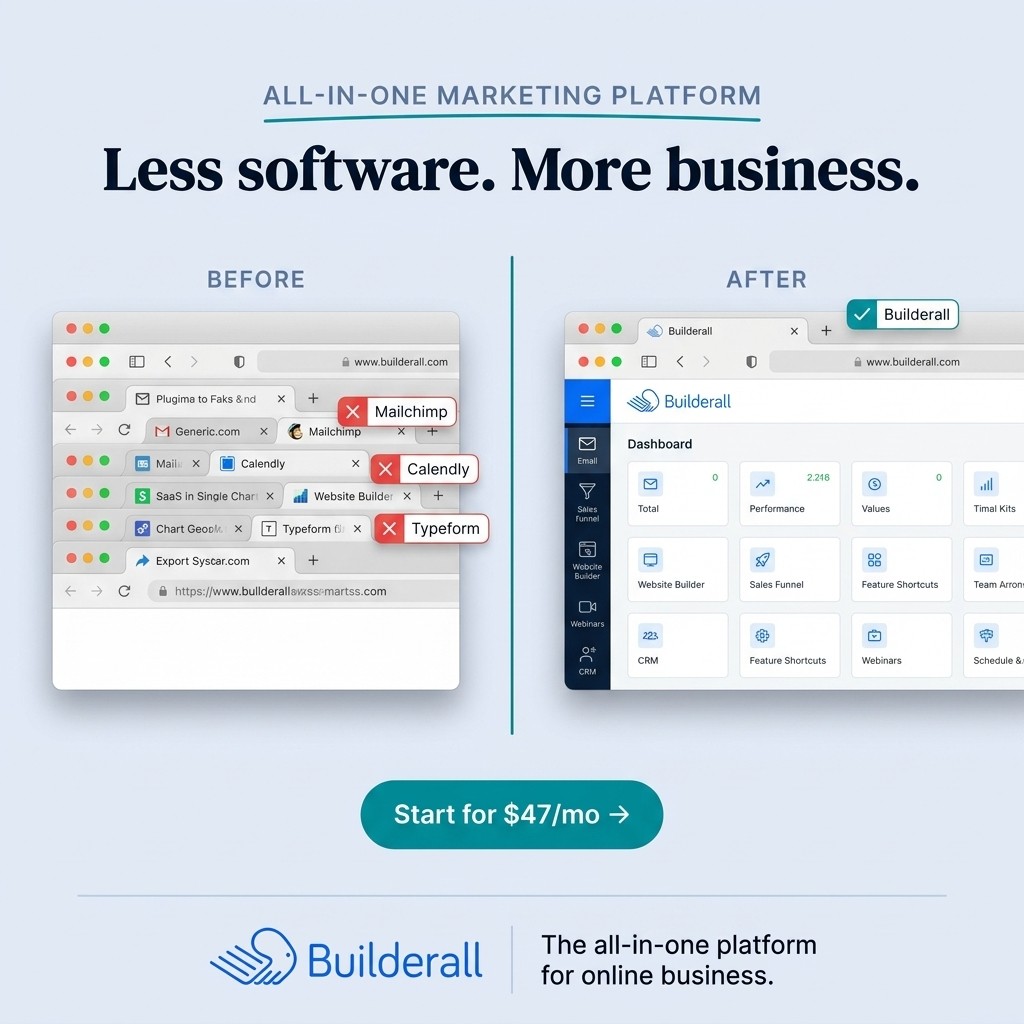
Here is what a working SaaS ad looks like. Builderall opens on a pain the buyer feels every month ("running your business across 5+ subscriptions?"), lists the scattered tools, then positions one platform as the fix and prints the price ("Start for $47/mo"). Copy the problem-stack-consolidation structure and the upfront price, which pre-qualifies clicks and is exactly how a low-ticket B2B tool keeps its self-serve signup cost sane.

Frequently Asked Questions
What Industries Perform Best and Worst on Facebook Ads?
On raw 2025 cost per lead, restaurants were cheapest at $3.16 and real estate next at $16.61, while dental was most expensive at $76.71 and health and fitness at $52.98. But that ranks lead price, not profit. A $77 dental implant lead routinely beats a $3 restaurant form fill once ticket size and close rate are included, so judge a vertical by qualified customer acquisition cost and lifetime value.
What Is the Average Cost per Lead on Facebook by Industry?
The current all-industry median for Leads campaigns is $27.66, up about 21% year over year. Published verticals range from $3.16 for restaurants to $76.71 for dentists, with health and fitness at $52.98, home improvement at $41.26, education at $28.22, legal at $18.17, and real estate at $16.61. These are lead costs, not ecommerce purchase costs.
Which Industries Have the Highest and Lowest CPC?
For Leads campaigns, dentists are highest at $9.78 and attorneys next at $4.10, while restaurants are lowest at $0.74. For Traffic campaigns everything is cheaper, with finance around $1.22 at the top and shopping near $0.34 at the bottom. Never rank cost per click without noting the objective.
Are Any Industries Restricted or Banned on Facebook Ads?
No mainstream industry is banned, but Housing, Employment, Financial Products and Services, and Social Issues are restricted Special Ad Categories that lose ZIP targeting, lookalikes, and detailed audiences. Separately, specific products such as certain crypto services, deceptive lending, and unsubstantiated health or earnings claims can be prohibited or permission-gated regardless of industry.
Do Facebook Ads Work for B2B and SaaS?
Yes, particularly for retargeting and for self-serve or SMB products with a broad market. Meta is cheaper for reach than LinkedIn but less precise for a narrow enterprise buyer. Raw SaaS leads often run $40 to $80 while qualified leads exceed $150, so measure opportunities, pipeline, and won revenue rather than signups.
How Much Do Facebook Ads Cost for Dentists, Real Estate, and Gyms?
Dentists average $76.71 per lead, $9.78 CPC, 1.05% CTR, and 6.38% conversion rate. Real estate averages $16.61 per lead, $1.57 CPC, 3.75% CTR, and 9.53% conversion rate, under Housing restrictions. Gyms fall under Health and Fitness at $52.98 per lead, $2.64 CPC, 1.72% CTR, and 5.63% conversion rate.
Why Are My Costs Higher Than the Industry Benchmark?
Most often you are comparing different objectives, destinations, or conversion definitions. Beyond that, check a more competitive market or season, Special Ad Category limits, Q4 CPM inflation, creative fatigue, a weak offer, a low-converting landing page, or budget fragmented across too many ad sets. A cost above benchmark is fine if the leads book and close.
The Short Version
Facebook ads by industry is really a question about two things: which benchmark actually applies to you, and what the number means once you carry it past the lead. Read every figure next to its objective, use the lead-gen family if you sell through a sales team and the ecommerce family if you sell through a cart, and treat the median as a diagnostic rather than a target.
The vertical decides more than the cost. It decides the objective, the offer, the creative, and the rules you have to work inside, from the Personal Attributes limits on health verticals to the Special Ad Category restrictions on real estate and finance. A $77 dental lead and a $3 restaurant lead are both perfectly normal once you know the ticket size and the close rate behind them.
So find your row, then ignore the temptation to chase the cheapest lead on the board. The right cost per lead for your industry is the one that produces booked, closed, profitable customers, and that answer lives in your business, not in the benchmark.