Testimonial Facebook ads use a customer, creator or expert vouching for a product rather than the brand's own claims. They run as customer-on-camera video, reposted user content, single five-star quotes, aggregate review counts, expert endorsements, press badges and before-and-after stories, routing to a form or a site. Under FTC rules a testimonial is an endorsement: it must be genuine, substantiated, and disclose any paid or material connection. The strongest ones name a specific outcome instead of vague praise, and show the proof rather than just typing it.
Every testimonial ad guide lists the same formats. Almost none show you a real one that is running right now, with an ID you can open and check. So this is a teardown of twelve live ads, pulled from the Meta Ad Library on 8 September 2026, each rendered exactly as it ran, with its advertiser name and archive ID.
They are grouped by how they stage their proof, because that is the decision you actually make: whether the customer speaks on camera, whether a five-star row sits in the copy, whether a press badge carries the trust. After the examples there are two sections worth more than the ads themselves: what separates a testimonial that converts, and the FTC and Meta rules several of these very ads are leaning on.
How These Testimonial Ads Were Pulled
Each ad below is one entry from our wider library of Facebook ad examples.
Everything here came from the Meta Ad Library, filtered to the United States and to active ads, retrieved on 8 September 2026. I searched testimonial and social-proof language, then went advertiser by advertiser to see the variants each was running. Every card below is the genuine creative and the verbatim copy, and the Library ID in each footer links straight to the ad.
Two limits matter, and they are the reason the usual version of this post is misleading. First, for ordinary commercial ads the library shows creative, copy, start date and platforms. It does not show spend, impressions, cost per lead or conversion rate. So nobody can honestly attach a performance number to a specific competitor ad, and this article does not. What follows is a read on creative and offer construction. Presence in the library proves an ad was live when I checked, nothing more.
Second, and specific to this topic: the library shows you the ad, not the proof behind it. A "⭐⭐⭐⭐⭐ 300,000+ reviews" line is a claim the advertiser typed, not a figure Meta verified, and a named quote from "Joyce U." is unverifiable by design. Treat each example as a study in how the social proof is staged, not whether it is true.
The Testimonial Formats That Actually Run
Across the pull, testimonial ads split first on a single question: is the proof in the creative, or only in the copy? Proof-in-creative ads put a customer on camera or paste a review screenshot into the image. Proof-in-copy ads run a product shot, a sale banner or brand art, and stack the stars, quotes and review counts in the primary text above it. For ads that are supposed to sell on trust, a surprising share never render the proof visually at all.
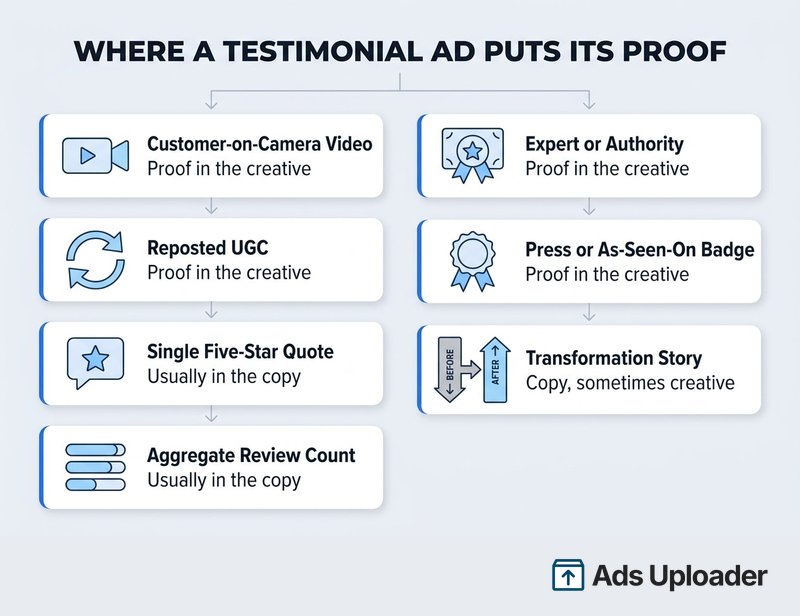
| Format | Where the proof sits | Best for |
|---|---|---|
| Customer-on-camera video | In the creative | Cold audiences that need to trust a face |
| Reposted UGC | In the creative | DTC, feed-native authenticity |
| Single five-star quote | Usually the copy | Fast, testable static creative |
| Aggregate review count | Usually the copy | Volume and category leadership |
| Expert or authority | In the creative | High-skepticism, medical, B2B |
| Press or "As Seen On" badge | In the creative | Borrowed third-party credibility |
| Transformation story | Copy, sometimes creative | High-consideration, coaching, health |
The useful part of this frame is that it tells you what each ad is actually asking the viewer to believe, and who has to sign off on it. A five-star row you typed is a claim about other customers. A customer on camera is a claim you filmed. The rules apply to both, but the second one is far harder to fake and far easier to defend.
Customer-on-Camera Video
The format every guide recommends first, because a real person's face and tone carry what written copy cannot. Two live examples show the range, from a nationwide dealership's wall of happy buyers to a single parent filmed on her sofa.
Vernon Auto Group: A Wall of Happy Buyers
The dealership version of social proof, and one of the most repeatable formats there is. The copy hands the credibility straight to third parties: "See why so many customers love Vernon Auto Group... Don't take our word for it though, read our tens of thousands 5 star reviews online and see why our customers keep coming back!" CTA: Learn more. The creative is a real buyer photographed at the happiest moment of the purchase, standing beside a new car with a red delivery bow, holding an "I love Vernon Auto Group" sign.

What to take from it. The proof is a customer, caught at delivery, and you do not have to press play to get it. A rolling reel of real buyers taking delivery is cheaper and more convincing than any produced spot, and it scales endlessly for a local or regional business. Notice the copy does the honest thing and points to the off-platform reviews rather than inventing an on-creative number.
Yorkshire College Planning: A Parent Filmed on the Sofa
Running since September 2025, which for a lead-gen video is a long time to stay live. The copy is two lifted quotes, "We were being punished for saving for our kids" and "Mike showed me how someone that makes a six figure salary would be able to save money," then "Real parent testimonial" and a workshop link. The headline is "Cut Your SAI for $100k+ Families: LIVE WORKSHOP!" and the CTA is Learn more.
The creative is a handheld talking-head video of a woman in her fifties on a dark leather sofa, a framed Pike Place Market print behind her, with a burned-in caption reading "The amounts would just come in lower and lower." No studio, no brand overlay, and the video walks through her frustration filling out the FAFSA.

What to take from it. The two strongest lines from the video double as the ad's hook, so the copy and the creative say the same thing. It routes to a free workshop, not a store, which is the right destination for a considered service where the testimonial's job is to earn a webinar signup rather than a card. The homey, unpolished framing is a choice, not a budget limit: it reads as a genuine client, which is exactly what a financial-planning pitch needs.
Celebrity and Expert Endorsements
Two ads that swap the everyday customer for a more recognizable voice, in opposite directions: a celebrity positioned as a member, and a credentialed professional positioned as a user.
Ladder: Hilary Duff as a Member, Not a Spokesperson
The copy is a single quote: "I shifted to strength training, and everything changed for me - how I feel. How I move. How I perform in every area of my life." Attribution: "Hilary Duff, Ladder member." Headline: "Start Your Free Trial, No Credit Card." CTA: Sign up.
The poster frame is a clean studio shot of Duff in a black sports bra against a plain backdrop, smiling down at her phone, framed as scrolling rather than as a glossy commercial. Watch the video, though, and it is a montage of Ladder's celebrity members: the audio opens on Mel B ("As a working mom, I couldn't get a routine down..."), so one ad carries several famous faces under a single member quote.

What to take from it. The word "member" is doing the work. The ad casts celebrities as customers, which keeps it in testimonial territory rather than pure spokesperson territory. That framing only holds if it is true, and the FTC treats a misrepresented relationship as deceptive, so "member" needs to mean they actually use it. The no-credit-card free trial then lowers the ask right after the aspirational proof.
UpToDate: A Physician Vouching for a Professional Tool
This is B2B: clinical decision-support software, from a page with over half a million likes. The copy is plain: "Dr. Atul Ganatra shares the benefits of having a personal subscription to UpToDate." Headline: "Make more confident clinical decisions." CTA: Subscribe.
The opening frame is an interview title card, near-white with a thin green rule, reading "What would you tell someone considering an UpToDate subscription?" It is the question-card format of a filmed customer interview, and the physician's answer is concrete: it "saves a lot of time. I don't have to hunt at 15 places to look up the research material."

What to take from it. Expert endorsements cluster in medical and B2B for a reason: the audience is skeptical and a peer's judgment transfers credibility better than a slogan. The persuasion here is relevance, not fame. A named practitioner recommending a tool practitioners use is a different thing from a famous face holding a product. The interview-card structure is also worth copying: it makes an edited answer feel like a genuine question being answered rather than a scripted line.
The Designed Single-Review Ad
The most common DTC template in the pull, and the one where the proof most often lives in the copy while the creative does something else entirely. Three variations on the same move.
Seora Skincare: One Quote, Three Kinds of Proof
The primary text opens with the review: "⭐⭐⭐⭐⭐ 'Started seeing results in two days!!! Struggled with dark spots my entire life. This product is the TRUTH!!', Joyce U.", then a stack of ingredient and benefit ticks. Headline: "Buy 1 Get 1 FREE." Link description: "Over 100,000+ Glowing Customers."
The creative does not show the review at all. It is a designed product image with a faux nav bar, the pink tube on a smear of cream, and large serif text reading "AS SEEN IN ESSENCE," plus "Over 2 Million Tubes Sold" and "Sold Out 12 Times This Year."

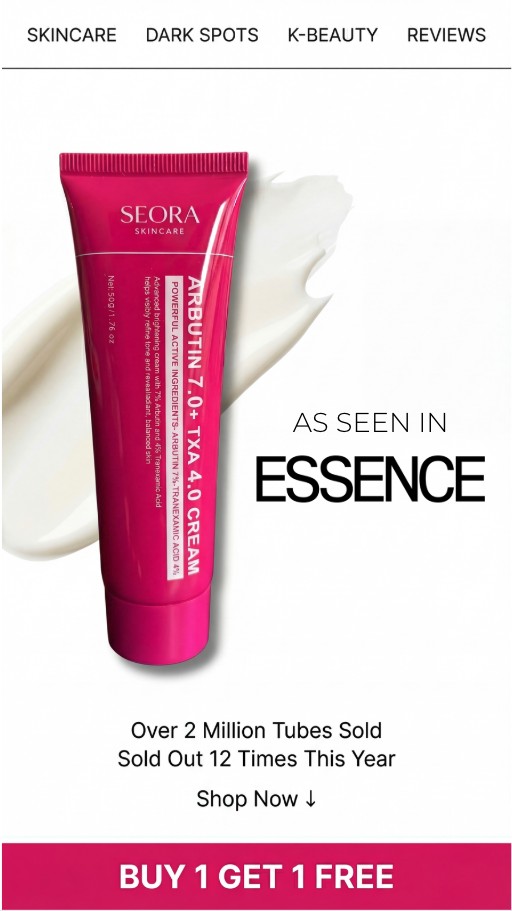
What to take from it. This is one ad running three separate proof mechanisms: a five-star customer quote in the copy, a press mention in the creative and sales volume in the creative. None of the three is verifiable from the outside, and the star row sits in text where it is fastest to write and easiest to change. That is the template most of the DTC pull follows: a row of five star emoji at the top of the primary text, a short first-person quote, and an attribution as a first name plus a last initial. It is calibrated to feel real and stay unverifiable, which is precisely the zone the FTC's rules are written for.
GlowRight: The Quote as the Headline
Here the headline is the testimonial: "Never Thought I'd Love a Light This Much!", with the link description carrying the scale claim, "★★★★★ 300,000+ Happy Customers." The body adds two more customer quotes about the product lighting up a kids' reading nook. The creative is a UGC demo clip of a gold sconce being switched on, with the caption "it's as easy as just plugging them in." No review is shown on screen.

What to take from it. Putting the quote in the headline slot is the tightest possible testimonial ad, because the hook and the proof are the same words. But watch the numbers: the ad claims "300,000+ Happy Customers" in the link description for a product ("Halo Lux") most shoppers have never heard of, and nothing on the page substantiates it. A round, unverifiable customer count sitting in the exact spot the FTC's substantiation standard reaches is a liability dressed as a flourish.
Build Your Own Swipe File
Stop scrolling the Ad Library by hand. Search, filter, and save proven ads with a free Chrome extension built for media buyers.
Get Ad Library Helper FreeFree Chrome extension • Built by Ads Uploader
God Is Above: A Named Quote, Stacked With Scale
A faith-niche DTC ad for a Bible-verse jar. The copy leads with a named five-star quote, "⭐⭐⭐⭐⭐ 'this jar brings my family together' - Michelle M.", then stacks the scale: "80,000+ Amazing Customers," trees planted, a money-back guarantee. The headline reads "Loved by 200,000+ Christians Around the World" and the link description "Trusted by 80,000+ Families." The creative is a UGC video of a child opening the jar, captioned "This is how your kids fall in love with God's word."

What to take from it. A narrow niche can out-convert a broad market when the proof is specific to it: the named quote does the emotional work and the counts do the scale work. But note the two different numbers running in the same ad, "200,000+ Christians" in the headline against "80,000+ customers" in the copy. That drift between a big headline figure and a smaller body figure is exactly what the compliance section below warns about, because both are claims the advertiser has to be able to back.
Aggregate Social Proof and Review Screenshots
When one quote is not enough, advertisers reach for scale: a big round number, a store screenshot, or a named-platform rating. Four ads show the range, from the sloppy to the genuinely checkable.
Andy okay: The Numbers Never Touch the Image
The copy carries the proof: "202.000 Happy customers," "More than 11,000 5-star reviews," and a list of named non-profit partners including WWF and Make-A-Wish. Headline: "82% OFF Real Gallery Art, For Charity." The creative is a piece of the actual product, a textured oil-painting-style print of a black cat peeking over an orange wall with hand-lettered text ("Always be yourself, unless you can be Batman, then always be Batman"), and no stars or counts anywhere on it.


What to take from it. This is textbook copy-side social proof. The image sells the product's charm and the proof stack lives entirely in the text, which is a reasonable split when the creative's job is to stop the scroll and the copy's job is to justify the click. The named charity partners are the strongest element, because a specific, checkable partner ("Make-A-Wish") is harder to fake than a round customer count. One tell worth noting for your own targeting: the European decimal formatting in "202.000" gives away an international operator running US ads.
Cheers: A Real Store Screenshot, and a Real Disclaimer
This is the densest proof stack in the pull, running as branded content from the founder's page. The copy claims "#1 After-Alcohol Aid on Amazon w/ 10,000+ 4 & 5 star reviews," "50 million doses sold," "Available in 35,000 retail locations," and "Seen on the season finale of Shark Tank," and it closes with the line most of this vertical skips: "*These statements have not been evaluated by the FDA. This product is not intended to diagnose, treat, cure, or prevent any disease."
The creative is a founder UGC video, the CEO with a beer and a toddler beside him, with a store screenshot composited over it showing a "CHEERS OFFICIAL SHOP" header with a verified check, an "AS SEEN ON SHARK TANK" roundel, and a rating line reading "4.2 ★ (1.3K) · 42.8K sold."

What to take from it. This is the only featured ad where a genuine review-screenshot element sits inside the creative, and it is notable that the rating shown, 4.2 stars, is not a perfect five. A real, slightly imperfect number reads as more credible than a flawless one. It is also the clearest compliance example in the pull: a supplement making next-day claims carries an explicit FDA disclaimer and a money-back guarantee, which is what this category is supposed to do and what most of its competitors do not.
TubShroom: The Review Count Is the Whole Ad
Running since 2024, which is a long life for a single creative. The entire hook is the number: "TubShroom Has Over 120,000 5-Star Reviews 🤩 Say goodbye to Clogged Drains Forever!" The creative is a UGC clip titled "Testing Amazon's Choice products, part 15," a pair of hands fitting the drain protector, and the review count appears nowhere on screen. The link points to a urlgeni.us redirect rather than a clean domain.

What to take from it. When a product genuinely has that much review volume, the count can carry the ad on its own, and the years of longevity suggest this hook keeps earning its slot. Two things a media buyer should copy carefully, though: the proof is asserted in copy over a demo that never shows it, and the destination is a link shortener, which quietly costs trust for no reason. If you are going to lead with a number that big, make the click feel as legitimate as the claim.
The Free Website Guys: Borrowed Authority, by the Platform
A service ad that stacks named platforms and press: "the #1-rated free website service on TrustPilot, Clutch, G2, and GoodFirms," "1,000s of 5-star reviews," "Forbes rated THIS the #1 way," then a "What people are saying" block quoting HubSpot, Hostinger and WP Mayor with five-star strings. The creative is a hand holding a sticky note reading "WE BUILD FREE WEBSITES FOR SMALL BUSINESSES" in front of a laptop showing "Rated #1 out of 45,000+ web agencies, 5.0 out of 5."

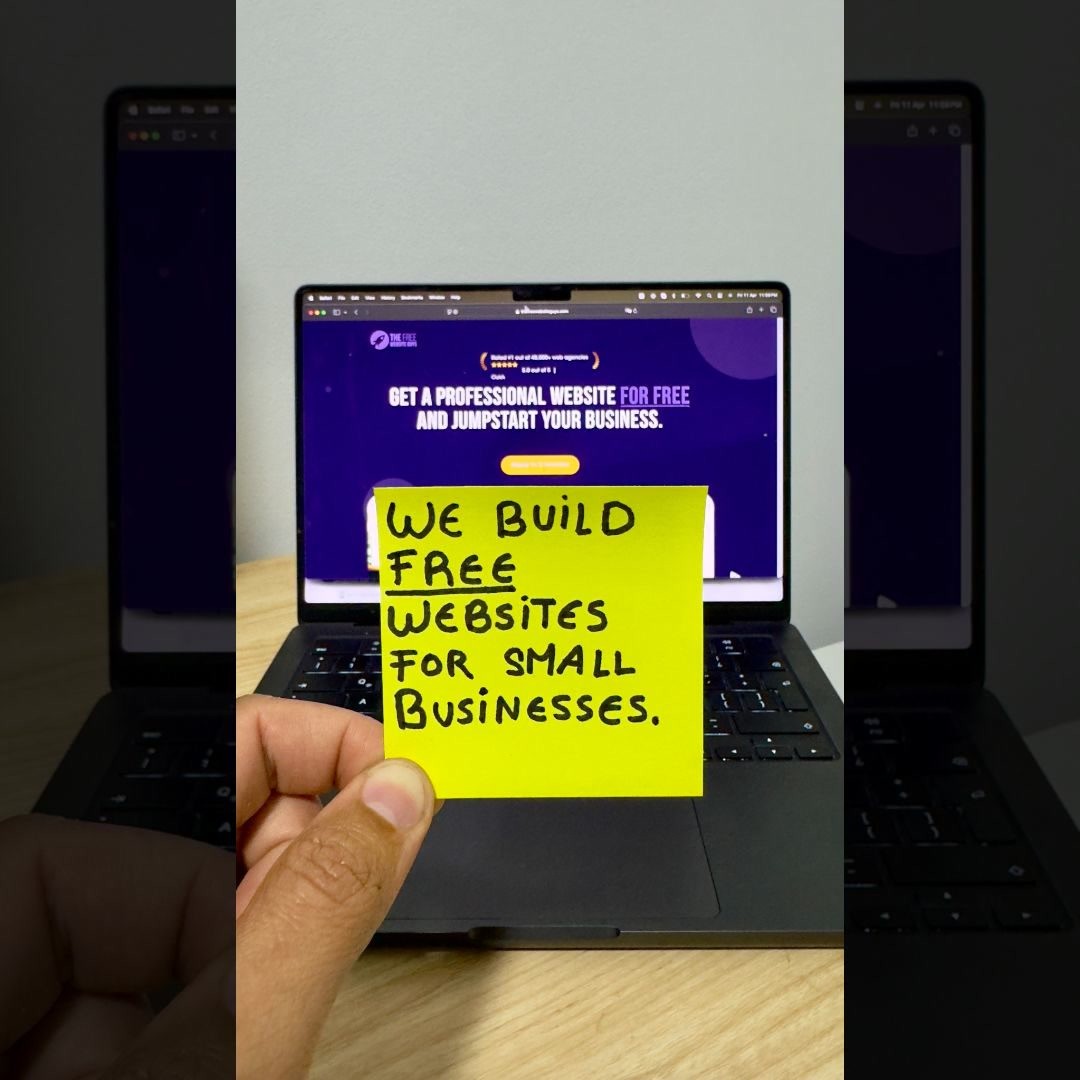
What to take from it. This is the strongest species of proof in the pull, because it names checkable sources. A Trustpilot or G2 rating can be looked up, unlike "300,000+ happy customers." The flip side is exposure: every one of those rankings and press quotes is a claim the advertiser has to be able to substantiate on demand, and the FTC's rules on quoting third parties and named endorsers apply to each one, not just the customer reviews.
Transformation and Before-and-After Stories
The format built on visible change: fitness, skincare, home improvement. It is also the one Meta's health rules restrict most, which shapes how advertisers show it.
WarriorBabe: The Transformation Is Told, Not Shown
Active since May 2025. The copy is a customer's story: "This Warrior Babe completely reshaped her body in just two and a half years by building muscle and shedding body fat. And get this, she's 60 years old!... Cheryl's journey shows how increasing caloric intake, focusing on protein, and committing to strength training can transform your body. No shortcuts, just dedication and smart planning."
Here is the honest flag: the creative is not a side-by-side before-and-after panel. It is a podcast audiogram video, a black-and-white gym shot of a laughing, muscular woman with an animated audio waveform, a running timer, and "The Macro Hour" branding with Apple Music and Spotify badges. The transformation is narrated in the episode, not displayed, and the woman on screen is the show's host rather than the customer being described.

What to take from it. Telling the arc instead of showing two panels is partly a creative choice and partly a policy one. Side-by-side body transformations are the exact imagery Meta's health and wellness rules scrutinize, and routing the proof through a podcast segment sidesteps that while keeping the story. It also borrows the format of a testimonial without putting the subject on camera. The "No shortcuts, just dedication" line is the closest thing to a results-vary disclaimer, though, as the rules section explains, that phrasing does less work than advertisers think.
What the Rest of the Pull Shows
The twelve above are not the whole picture. A few patterns from the ads that did not get their own section:
- The designed single-review creative is a genre. A row of five star emoji, a short quote in quotation marks, and a first-name-plus-initial attribution recurs across beauty and DTC pages (Azure Boutique's batana oil, Plié shapewear, the tongue-in-cheek HaloSphere lamp). The attribution style is tuned to feel real and stay unverifiable.
- Round counts are common, named platforms are rarer and stronger. "11,000 5-star reviews," "over 100,000+ glowing customers," "300,000+ happy customers," "50 million doses sold." A minority name a checkable source instead, such as a Trustpilot rating or a store screenshot, which is exactly why The Free Website Guys and Cheers read as more defensible than the round-number ads.
- Production value predicts who is behind it. Phone-shot UGC talking heads dominate supplements and home goods, designed single-review graphics dominate beauty, and polished studio films signal a celebrity or a large brand.
- Disclosure is inconsistent. Some advertisers run branded content cleanly, with a founder's page or a paid-partnership setup. Others present influencer or UGC content as organic customer love with nothing at all.
- The "story" native ad is the edge case. The "changed my life" search surfaced long first-person narratives from pseudo-editorial pages such as an "Arthritis Support Community." They read as testimonials but are advertorials, and the first-person voice is a copywriting device, not an identified customer. That is the line between a genuine testimonial and a manufactured story, and it is where the FTC's fake-review rule lives.
What Separates a Testimonial Ad That Converts
Set the compliance question aside for a moment and ask what actually persuades. The honest answer is that there is no public 2026 dataset measuring testimonial-ad ROI on Meta specifically, so anyone quoting you a fixed lift is guessing. What the research does support is a set of principles worth testing.
Specificity beats praise. Broader social-proof research consistently ties informational value, the sense that a review tells you something useful, to purchase intention more strongly than generic enthusiasm. "I closed three clients in my first week" gives a buyer something to picture; "great product, highly recommend" does not. Put the concrete detail early, because the first line can get truncated.
Corroboration beats the miracle. In BrightLocal's February 2026 survey of just over a thousand US adults, the single most persuasive factor was a review being backed up by other reviews, at 56%, ahead of a high star rating at 42%. Several believable proof points defend better than one spectacular result, and they are far easier to substantiate.
An identifiable, visible source helps. In the same survey, 35% found a named reviewer persuasive and 36% valued a photo or video. That is one reason the customer-on-camera ads above are stronger than the copy-only star rows: the source is a face, not initials.
Match the detail to the stage. A 2025 experiment found abstract, easy-to-process praise did better at the initial screening stage while concrete detail mattered more as people neared a final choice. In practice, a punchy quote can suit a cold-audience hook, and a fuller story suits retargeting.
None of this is a formula. "Real face plus a number plus a pain point always wins" is a hypothesis, not a law, and the correct way to settle it is a controlled test that holds the audience, offer and landing page constant and reads a real business metric rather than click-through alone.
The Rules Testimonial Advertisers Keep Breaking
This is the section the other guides skip, and it is where several of the ads above are exposed. Two bodies of rules apply: the FTC's, which is federal law, and Meta's, which is a condition of running the ad at all. Meta approval is not a finding of legal compliance.
A testimonial is an endorsement, and it must be real. The FTC's Endorsement Guides, revised effective July 2023, treat a testimonial as an endorsement whenever consumers read it as someone else's view. The named customer must be real and must have had the experience shown, and a truthful quote can still be deceptive if the headline or landing page inflates it into a claim you cannot support. If you present a person as an actual customer, they should be one.
Objective numbers are claims you must be able to prove. GlowRight's "300,000+ Happy Customers," Seora's "Over 2 Million Tubes Sold," and The Free Website Guys' platform rankings are all measurable assertions, and the FTC's substantiation standard requires a reasonable basis for them before the ad runs. A round customer count with no visible source is the easiest of these to write and the hardest to defend, so if you are going to claim a number, keep the query that produced it.
"Results not typical" does not fix an exceptional result. This is the trap in every transformation ad. If a testimonial implies a result buyers can generally expect, you must either have proof it is representative or clearly state the result people should actually expect. "Individual results may vary" does not change the ad's net impression, and contrary to a common belief the safe harbor for that disclaimer was removed back in 2009, not recently. WarriorBabe's "no shortcuts, just dedication" is closer to good practice than most, but a "60-year-old built 20 pounds of muscle" story still needs substantiation about typical outcomes.
Fake and incentivized reviews are now a rule with penalties. The FTC's Consumer Reviews and Testimonials Rule became enforceable on 21 October 2024, with a maximum civil penalty above $53,000 per violation. It bans fabricated reviews and testimonials, including ones from people who never used the product or from AI-invented identities, undisclosed insider reviews from employees, and incentives conditioned on leaving a positive review. Honest reviews and AI tooling are not banned; fake identities, fabricated experiences and sentiment-for-pay are. The pseudo-editorial "story" ads noted above sit uncomfortably close to this line.
Disclose a material connection where the endorsement appears. If the endorser was paid, gifted a product, given a commission, employed by you or related to you, that connection has to be disclosed clearly and conspicuously, in the same place and language as the endorsement. A UGC clip like GlowRight's, presented as a customer just sharing a light they love, is exactly where an undisclosed paid relationship becomes a risk, and Ladder's celebrity "member" framing only holds if the paid relationship is clear where the endorsement appears, not stranded after "more" or in a hashtag block.
Get written permission first. There is no single federal right-of-publicity law, but state laws vary and some are strict. New York requires prior written consent to use a living person's name, likeness or voice in advertising, and California imposes liability for knowing use without it. A public review is not permission. Get a scoped release covering the exact testimonial, paid-social use, editing and platforms before it runs, and remember that consent and truthfulness are separate: a signed release does not make an unsubstantiated claim lawful.
Meta's own rules catch two things. The Personal Attributes policy means a testimonial hook that implies the viewer's condition gets rejected. "I struggled with acne for years" describes the speaker and is lower risk; "Are you embarrassed by your acne?" implies you know the viewer's insecurity and is higher risk. And the health and wellness policy, changed effective 22 July 2026, no longer bans side-by-side transformations outright but still requires 18+ targeting for most health and weight products and still rejects appearance-inferiority hooks and sensational timed-result claims.
Save Hours on Creative Testing
Stop uploading ads one by one. Bulk process unlimited creatives with automatic media matching and direct API publishing.
Try Ads Uploader FreeNo credit card required • 7-day free trial
Meta's Native Testimonial Feature
There is one place where "testimonial" is a literal Meta product rather than a creative concept, and no listicle explains it. Meta introduced creator testimonials for Instagram partnership ads in early 2025. The testimonial appears as a sponsored featured comment attached to a partnership ad, delivered in Instagram feed and reels, with the partner's own words vouching for the brand.
The mechanics, as reported at launch and worth verifying against Meta's current help pages before you rely on them: the creator needs a professional Instagram account and an established presence, the advertiser needs the partnership-ad permission, and there are two permission paths. A creator can enable a partnership ad code and hand it over, or the advertiser can request account-level permission, which notifies the partner. Turning off permission for new code use does not necessarily stop an already-running ad, but creators can review active partnership ads and use a Stop Ad control. Because the creator supplies the short testimonial text, they author the endorsement itself, which is cleaner than lifting a quote, though you should still get contractual approval of the final creative.
Building and Scaling Testimonial Ads
The operational reality of this vertical is the same one that shows up everywhere: one testimonial concept becomes many ads. Some advertisers run the same customer quote across dozens of variants; others geo-swap or persona-swap the same story. Once you have a proof point that works, you will want it against several hooks, audiences and placements, including as carousels that stack multiple customers.
That has two consequences. First, you need a launch process that can produce those variants without hand-building each one, or you will quietly stop testing because shipping is too much work. Second, you need naming you can still read three weeks later, because "testimonial video 4 copy 2" tells you nothing about whether the named-customer version beat the star-rating version. A consistent naming convention that encodes the proof type, the source and the hook is what makes a testimonial matrix analyzable instead of just large, and it pairs with a bulk launch workflow when the variant count climbs.
Then measure past the click. Because there is no reliable public benchmark, the only honest read on whether a testimonial creative works is a controlled comparison against your existing best ad, judged on a real outcome such as cost per qualified lead, not on click-through rate alone.
Wrapping Up
Twelve live ads, and a fairly consistent picture:
- Show the proof, do not just type it. The strongest ads put a customer on camera or a real screenshot in the frame. The weakest stack unverifiable stars in the copy over a product shot.
- Be specific, and corroborate. A concrete outcome backed by several believable proof points beats one miracle result, and it is easier to defend.
- Name and show a real source. A face and a name persuade more than initials, and a checkable Trustpilot rating beats a round "300,000+ customers."
- Clear the rules before you scale. A testimonial is an endorsement: it must be real and substantiated, fake and sentiment-for-pay reviews are now a rule with penalties, material connections must be disclosed, and you need written permission first.
- Build for the matrix. One good testimonial becomes many ads, so set up naming and launch before you have forty you cannot read.
The advertisers doing this well are not the ones with the most stars. They are the ones whose proof is specific enough to be checked.
Frequently Asked Questions
What Is a Testimonial Ad?
A testimonial ad is paid creative that uses a customer, creator or expert's stated opinion, experience or result to sell a product, rather than the brand's own claims. Review screenshots, customer selfie videos, a founder reading a quote, featured comments and before-and-after stories all count. Under the FTC's Endorsement Guides it is treated as an endorsement whenever consumers read it as reflecting someone other than the advertiser.
Do Testimonial Ads Work on Facebook?
They can, but read the evidence carefully. Meta's 2025 experiment across roughly 2,400 advertisers reported 19% lower cost per acquisition when partnership ads were added to existing creative, and a separate Meta claim put testimonial ads at 7.5% higher offsite conversion. Both are Meta's own figures, partnership ads are not all testimonials, and no representative public benchmark isolates testimonial-ad ROI. Judge yours with a controlled A/B test on a real business metric.
Do You Need Permission to Use a Customer Testimonial in a Facebook Ad?
For national advertising, treat it as yes. There is no single federal right-of-publicity law, but state laws vary and some are strict: New York requires prior written consent to use a person's likeness or voice in advertising, and California imposes liability for knowing commercial use without consent. A public review is not permission. Get a written, scoped release before running it.
Are Before-and-After Testimonial Ads Allowed on Facebook in 2026?
Sometimes, with conditions. Meta's health and wellness change effective 22 July 2026 removed the old blanket ban on side-by-side weight-loss transformations, and now permits certain adult cosmetic and weight-result depictions when the time to see results is clear. Most health and weight products still require 18+ targeting, and appearance-inferiority hooks and sensational timed claims are still rejected. Meta approval does not remove FTC exposure.
Do Testimonial Ads Need an FTC Disclosure?
Not merely because they are testimonials. A disclosure is required when there is an unexpected material connection that could affect credibility: payment, a free or discounted product, affiliate commission, employment or a family relationship. A genuinely independent, unpaid customer does not need a sponsorship disclosure, though the testimonial must still be truthful and substantiated. When a connection exists, disclose it clearly where the endorsement appears.
What Makes a Good Testimonial Ad?
A real, authorized customer describing a specific, useful outcome in natural language, tied to a relatable problem, with any material connection disclosed. Research favors corroboration over one miracle story, a named and visible source, recency, and information a buyer can use, over vague praise. Precise performance claims need substantiation. There is no universal formula, so test rather than assume.
How Do I Find Competitors' Testimonial Ads?
Use the Meta Ad Library, set the country, choose All ads, then search a competitor's Page or proof language like review, results, before, after or five stars. Filter by active status and media type, and open each advertiser to see live variants. Record the Library ID, first-seen date, proof type, the specific claim, any disclosure and the landing page.