Meta location fees are surcharges added to advertising invoices when ads are delivered to audiences in countries with Digital Service Taxes. Beginning July 1, 2026, Meta is passing DST costs to advertisers in six jurisdictions: Austria (5%), France (3%), Italy (3%), Spain (3%), Turkey (5%), and the United Kingdom (2%). Fees are calculated based on where impressions are delivered, not the advertiser's business location, and are billed separately from campaign budgets. Location fees appear as line items on invoices, and VAT applies on top of the combined total.
Your next Meta invoice might be higher than your ad spend. Not because you overspent, not because costs went up, and not because of a billing error. Because Meta is adding a new line item that sits outside your campaign budget entirely. Before you budget a campaign, it is worth knowing exactly what Meta charges beyond your media spend, because the regional location fees on your invoice are one of the Meta fees most advertisers forget to plan for.
Starting July 1, 2026, Meta will charge location fees on ads delivered to audiences in six European countries. The fees range from 2% to 5% depending on the country, and they apply based on where your audience is, not where your business is. If you run a single impression in Austria, 5% gets added to your bill for that delivery. Meta previously absorbed these costs. Now they're passing them through to advertisers.
The official help center page covers the basics, but it doesn't tell you what this actually costs at real spend levels, how it interacts with monthly invoicing, or what you need to change before July. This guide does.
What Are Meta Location Fees?
Meta location fees are additional charges applied to your ad invoices to cover Digital Service Taxes (DSTs) and other location-based fees that governments impose on Meta in certain jurisdictions.
Here's how they work in practice: when your ad is delivered to a user in an affected country, Meta calculates the applicable fee as a percentage of your ad spend in that country and adds it to your invoice as a separate line item. The fee is calculated after delivery, meaning your campaign budget and spend caps do not account for it. Your ad spend stays the same. The fee goes on top.
The key distinction that catches advertisers off guard: location fees are determined by where your audience is located, not where your business is based. A US agency running campaigns for a UK retailer pays the UK fee. A German e-commerce brand targeting Italian shoppers pays the Italy fee. A London-based company advertising exclusively to US audiences pays nothing.
Meta's email to affected advertisers states directly: "Meta will not apply campaign budgets to cover location fees; location fees are added after your ads have been delivered." Until now, Meta absorbed these costs internally. The change aligns with how Google Ads has handled jurisdiction-specific surcharges for years.
What Products Do Location Fees Apply To?
Location fees apply to all ad formats on Facebook and Instagram: image, video, carousel, collection, and every other format. They also apply to:
- WhatsApp click-to-message campaigns
- WhatsApp marketing messages that are invoiced together with ads
Location fees do not apply to other WhatsApp paid messaging outside of ad-linked campaigns.
Meta Location Fee Rates by Country
Meta's notice lists six jurisdictions with the following rates:
| Country | Location Fee Rate | Underlying DST Rate | DST Effective Since |
|---|---|---|---|
| Austria | 5% | 5% | December 2019 |
| France | 3% | 3% | January 2019 |
| Italy | 3% | 3% | January 2020 |
| Spain | 3% | 3% | January 2021 |
| Turkey | 5% | 5% (reduced from 7.5% in Jan 2026) | March 2020 |
| United Kingdom | 2% | 2% | April 2020 |
Austria and Turkey carry the highest fees at 5%. France, Italy, and Spain sit at 3%. The UK has the lowest rate at 2%.
One detail worth tracking: Turkey's DST is scheduled to drop from 5% to 2.5% in January 2027. Meta's notice warns that "rates may change over time," so the Turkey fee could adjust. Don't assume current rates are permanent.
Meta's rates currently mirror the headline DST rates in each country, but that isn't guaranteed. Google's Italy surcharge is 2.5% against Italy's 3% headline DST. Platform surcharge rates don't always match the tax rate exactly, so verify against your actual invoices once fees go live.
How Multi-Country Campaigns Are Charged
Fees are calculated per country based on where impressions land, not by campaign structure. A single campaign targeting both France and Italy gets charged the France rate on French impressions and the Italy rate on Italian impressions. Each country's fees appear as separate line items on your invoice.
For multi-market campaigns or broad delivery across Europe, model your exposure using a blended rate:
Blended rate = sum of (delivery share in each country x that country's fee rate)
Example: a campaign spending $100,000 with 40% delivery in the UK and 60% in France:
(0.40 x 2%) + (0.60 x 3%) = 2.6% blended rate = $2,600 in location fees (before VAT)
How Much Meta Location Fees Actually Cost
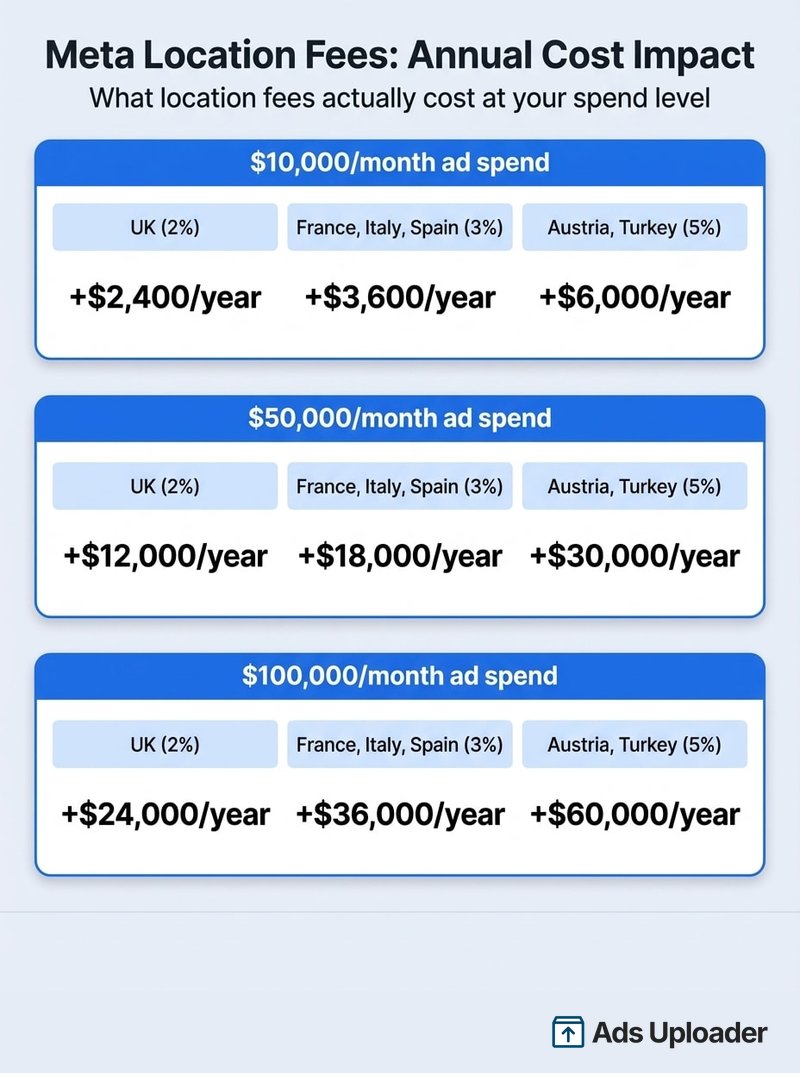
The percentages look small. The annual numbers don't.
Here's the incremental cost at common monthly spend levels, broken out by fee tier:
| Monthly Ad Spend (in-country) | UK (2%) | France / Italy / Spain (3%) | Austria / Turkey (5%) |
|---|---|---|---|
| $1,000 | $20 | $30 | $50 |
| $5,000 | $100 | $150 | $250 |
| $10,000 | $200 | $300 | $500 |
| $25,000 | $500 | $750 | $1,250 |
| $50,000 | $1,000 | $1,500 | $2,500 |
| $100,000 | $2,000 | $3,000 | $5,000 |
Now annualize those numbers. An agency managing $50,000 per month in UK-targeted spend pays $12,000 per year in location fees. A brand spending $100,000 monthly on Austrian delivery faces $60,000 in annual fees, the equivalent of hiring a junior media buyer, except it produces zero additional impressions.
These fees apply to actual delivery, not budgeted spend. If Meta's pacing overshoots your daily budget on an aggressive delivery day, the location fee applies to the full amount spent, including the overspend portion. The gap between planned cost and actual cost widens from two directions at once.
And here's the detail that matters for broad targeting: if you run a campaign with automatic placements and no geographic restrictions, Meta's algorithm decides where to deliver. If 30% of impressions land in affected countries without you intending it, you pay the fees on that 30%. The charges follow delivery, not intent.
How Location Fees Appear on Your Invoice
Location fees are a billing event, not a reporting metric. You will not see them in Ads Manager performance data. They appear in two places:
- Billing and Payments section in Meta Business Suite
- Your invoice or transaction statement, itemized by jurisdiction
On PDF invoices, each country gets its own fee line, labeled something like "Italy digital services" or "UK digital services." If your campaign delivered to three affected countries, you'll see three separate fee lines. When people ask "what does Meta charge me on top of my ads," location fees are usually the line they are looking at; they sit alongside taxes and any platform charges as part of the total Meta fees on each invoice, separate from the budget you set for delivery.
The critical implication: your Ads Manager "Amount spent" and your invoice total will no longer match. Ads Manager shows ad delivery cost. Your invoice shows ad delivery cost plus location fees plus VAT. Finance teams reconciling platform reporting against billing statements need to account for this gap starting with the first July 2026 billing cycle.
How VAT Works with Location Fees
VAT is calculated on top of the total amount, meaning ad delivery cost plus location fee. If you deliver $10,000 in ads to Italy with a 3% location fee, VAT applies to $10,300, not $10,000.
This matters for VAT recovery. Your reclaimable VAT amount will be slightly higher because the tax base now includes the location fee. Ensure your billing entity details and VAT IDs are correct in Meta's system before July. Errors in cross-border VAT handling are harder to fix retroactively.
Launch More. Click Less.
Upload hundreds of creatives at once, auto-match thumbnails to videos, and publish straight to your ad accounts through Meta's API.
Try Ads Uploader FreeNo credit card required • 7-day free trial
Coupons and Refunds
Meta's help center states that coupons apply to the total invoice amount (ad delivery cost plus location fee), with the coupon value split proportionally. For refunds, Meta says eligible refunds will include the associated location fees.
One caveat: Google Ads explicitly states it will not refund jurisdiction-specific surcharges levied on legitimate impressions served under targeting settings. Meta has not published equally detailed refund language. Treat refund handling for location fees as an open question until you confirm with your Meta rep or see how your first invoices are processed.
How Location Fees Interact with Monthly Invoicing
If you're on or migrating to monthly invoicing, location fees add a wrinkle to your credit line management.
Meta's notice states that credit line limits are set before location fees are applied. The fees are calculated after delivery and then reduce your available credit line. In practice, this means your effective spending capacity is slightly lower than your stated credit limit.
Example: if your credit line is $100,000 and you spend $98,000 on ads with 3% average location fees across affected countries, the fees add $2,940, pushing your total to $100,940. That exceeds your credit line. If you're operating close to your limit, location fees could push you over and trigger a pause in ad delivery.
For agencies managing multiple accounts under one credit line, the compound effect across accounts adds up quickly. Build the fee buffer into your credit line planning now, before July, so you're not troubleshooting paused accounts because an extra 2-3% tipped you over the edge.
How to Prepare for Meta Location Fees
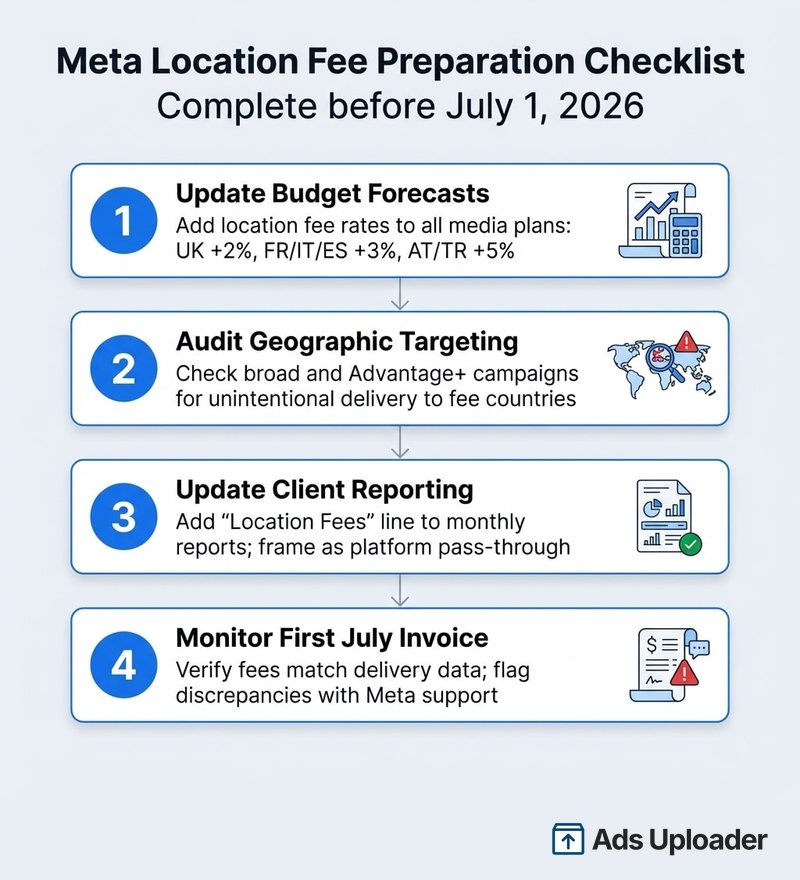
You have until July 1, 2026. Here's what to do before then.
Update Budget Forecasts
Add the applicable location fee rate to every forecast, media plan, and client proposal that includes spend in affected countries. The formula is simple:
Total cost = Ad spend x (1 + location fee rate)
For a $50,000 monthly UK budget: $50,000 x 1.02 = $51,000. Build the $1,000 into your plan from the start. Surprising a client with unexpected fees on the first July invoice is a conversation that's entirely avoidable.
For multi-country campaigns, use the blended rate formula from the section above and apply it to your projected delivery split.
Audit Your Geographic Targeting
Review every active campaign for delivery to affected countries, especially campaigns using broad targeting, Advantage+ audience, or no geographic restrictions.
Check your Ads Manager delivery breakdown by country. If campaigns are delivering 10-30% of impressions to affected countries incidentally, decide whether that delivery is valuable enough to justify the surcharge. For campaigns where European delivery isn't the objective, tightening geographic exclusions can save meaningful budget. At $20,000 monthly spend with 25% unintentional delivery to 3% fee countries, excluding them saves $150 per month, or $1,800 per year.
Update Client Reporting
Add a "Platform Fees" or "Location Fees" row to every monthly report that covers affected countries. Show it beneath the ad spend line so the core performance number stays clean for analysis, while the client sees the true total cost.
Frame the fee correctly: this is a platform pass-through of government-imposed taxes, not a performance issue and not a Meta price increase. The ad auction hasn't changed. Your CPMs haven't changed. There's just a new line item on the invoice.
Monitor Your First Post-July Invoice
New billing features can have rollout errors. When your first July billing cycle closes, verify:
- Fee rates match the published percentages for each country
- Fees are calculated on actual in-country delivery, not total campaign spend
- Country-level delivery data in Ads Manager aligns with the fee amounts on your invoice
- VAT is applied to the correct base (ad spend + location fee)
Flag discrepancies immediately. The sooner you catch an error, the easier it is to resolve with Meta support.
Frequently Asked Questions
Save Hours on Creative Testing
Stop uploading ads one by one. Bulk process unlimited creatives with automatic media matching and direct API publishing.
Try Ads Uploader FreeNo credit card required • 7-day free trial
Can I opt out of Meta location fees?
No. The fee is a platform-wide policy change applied to all advertisers. There's no setting to disable, reduce, or negotiate it. The only way to avoid paying the fee for a specific country is to ensure zero ad delivery in that jurisdiction by excluding it from your targeting.
Do location fees affect my campaign performance or delivery?
No. Location fees are an after-delivery billing add-on. Meta states that campaign budgets will not be applied to cover location fees. Ad auction and delivery mechanics remain unchanged. The impact is on your invoice total and effective CPM/CPA calculations, not on how ads are served.
What happens if I'm a UK business targeting only US audiences?
You don't pay the UK location fee. The fee follows where impressions are delivered, not where your business is registered. If none of your ads are delivered to UK users, the UK fee doesn't apply. This goes both ways. A US business targeting UK audiences pays the 2% fee on that UK-delivered spend.
Will Meta add more countries to the location fee list?
Likely. Meta's notice says jurisdictions and rates "may change over time." Several countries not currently listed have active Digital Service Taxes, including Canada, India, and Kenya. Turkey's rate is also scheduled to drop from 5% to 2.5% in January 2027. Treat your fee forecasting as a quarterly review, not a one-time setup.
How do location fees work with payment thresholds?
The notice confirms applicability across all payment methods but doesn't detail threshold-specific mechanics. Google Ads handles its equivalent surcharges by adding them at month-end, which can create an open balance in prepaid setups. Expect Meta to follow a similar pattern, but confirm against your own billing once fees go live.
Are Meta location fees tax-deductible?
This depends on your jurisdiction and entity structure. Most businesses will book location fees as part of the cost of advertising services. Spain's policy debate around DSTs included treating such taxes as deductible business expenses. Confirm the specific treatment with your accountant, especially for VAT recovery, since VAT is calculated on the combined total of ad spend plus location fee.
Do other platforms charge similar fees?
Google Ads already charges jurisdiction-specific surcharges (called Regulatory Operating Costs) on ads served in DST countries. Amazon passes DST costs through seller fees for marketplace transactions. TikTok Ads has not implemented an equivalent surcharge as of March 2026. Meta is catching up to what Google has been doing, not introducing something unprecedented.
What This Means for Your 2026 Planning
Meta location fees are real, unavoidable, and starting July 1. The amounts are manageable if you plan for them. The danger is being surprised: by an invoice that exceeds your budget, a credit line that runs out early, or a client who sees unexplained charges.
Here's the short version of what to do:
- Update forecasts with the applicable rate for every affected country
- Audit geographic targeting to catch unintentional delivery to fee jurisdictions
- Add a location fee line to all client reports and internal dashboards
- Verify your first July invoice against Ads Manager delivery data
This is one of several billing changes hitting Meta advertisers in 2026. The monthly invoicing mandate is already reshaping how agencies handle payments, and attribution changes are shifting how conversions are counted. Location fees add another layer to manage, but like the other changes, the advertisers who prepare early will handle it without disruption. We log each of these shifts as they land in our monthly Meta Ads updates, so it is worth checking back as the 2026 rollout continues.
The fee rates are small. The planning effort is smaller. Do it now, and July is just another billing cycle.