Split testing landing pages for Meta Ads means running two or more versions of a page against each other to see which one converts best. The recommended approach for wholesale page tests is testing at the ad set level inside Meta: separate ad sets, identical creative and audience, different landing page URLs. Meta optimizes delivery at the ad set level, so this preserves the algorithmic signal. Redirect-based splits are best avoided because they hide the URL difference from Meta. A test typically needs seven to fourteen days and around 50 conversions per ad set.
Landing page testing on Meta isn't quite like A/B testing on a standard CRO platform. Meta's delivery system optimizes at the ad set level. It uses information from the destination URL to decide who to show your ads to. So the way you structure your test directly affects whether the algorithm can give you a clean read, and whether the data you collect is comparable across pages.
Most teams either set up tests in ways that contaminate the data (mid-test edits, mixed variables, comparing a fresh ad set against a seasoned one) or pick a method that doesn't fit how Meta actually delivers traffic. The result is a winner you can't trust.
This guide covers wholesale page tests: testing entirely different landing pages against each other. We'll walk through the recommended ad-set-level approach, the alternatives that work in specific situations, why redirects aren't the answer, and the practical thresholds for calling a winner. For smaller above-the-fold tweaks (headlines, hero images, first paragraph), the playbook is different and we cover that briefly later.
What Is a Landing Page Split Test on Meta?
A landing page split test on Meta is a post-click experiment. You hold the ad setup as constant as you can (same audience, same creative, same budget, same optimization event) and vary only the destination. Judge the winner on downstream business outcomes: purchase rate, CPA, ROAS, lead quality. CTR alone won't tell you which page converts better.
This is structurally different from creative tests or audience tests. A creative test asks which ad converts best. An audience test asks who responds best. A landing page test asks which page converts customers toward your goal.
Three things make landing page tests on Meta uniquely tricky:
- The learning phase. Significant edits (including changes to creative, audience, or click destination) can retrigger learning, which makes mid-test data hard to read.
- Algorithmic signal. Meta's delivery system uses the destination URL to help decide who to show ads to. If you route users to a page that doesn't match what Meta thinks they're going to, the audience signal degrades.
- Attribution. Meta's click attribution model changed in 2026 to count only link clicks, which affects how you read short-window results.
"Split test" and "A/B test" mean the same thing in this article. Meta and most CRO research use the terms interchangeably.
How to Split Test Landing Pages on Meta: The Hierarchy
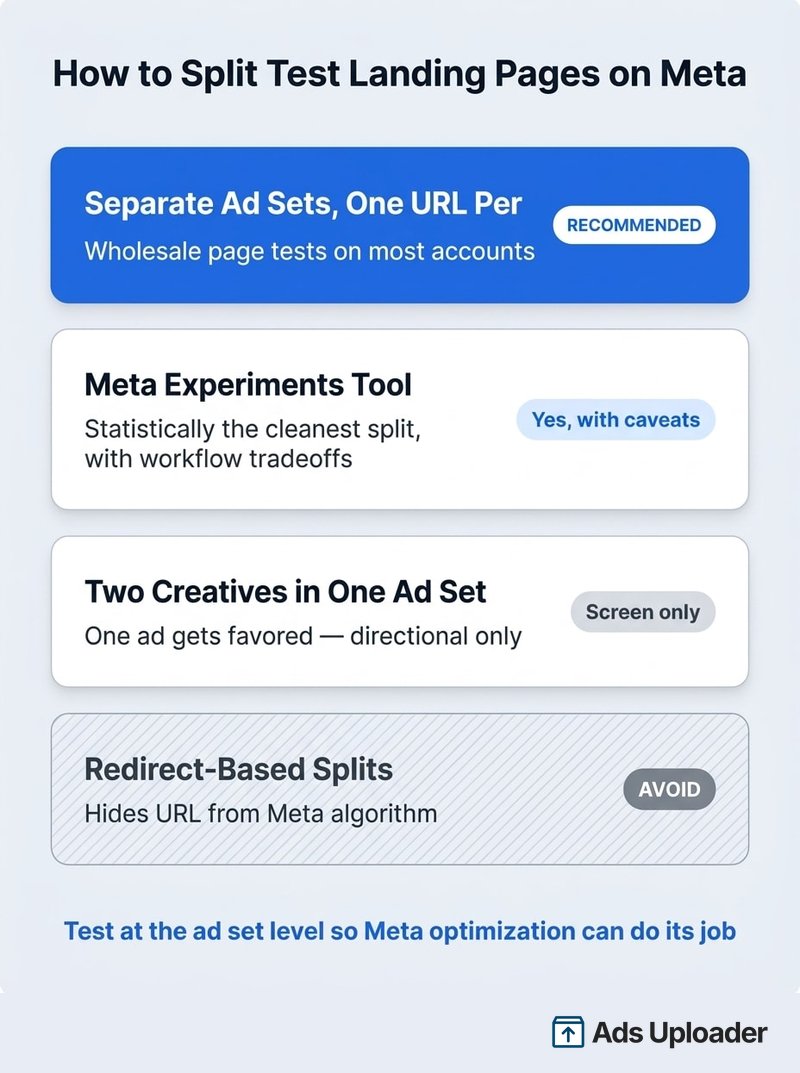
Here are the four ways most teams attempt landing page tests on Meta, ranked by what actually works for wholesale page swaps:
| Method | Recommended? | Best for |
|---|---|---|
| Separate ad sets, one URL per ad set | Yes (primary) | Wholesale page tests on most accounts |
| Meta Experiments tool | Yes, with workflow caveats | Statistically clean read on a fresh campaign |
| Two creatives in one ad set | Directional only | Fast screen when one page is likely much better |
| Redirect-based splits | No | (Avoid, see why below) |
The next sections walk through each one.
Method 1: Separate Ad Sets (The Recommended Approach)
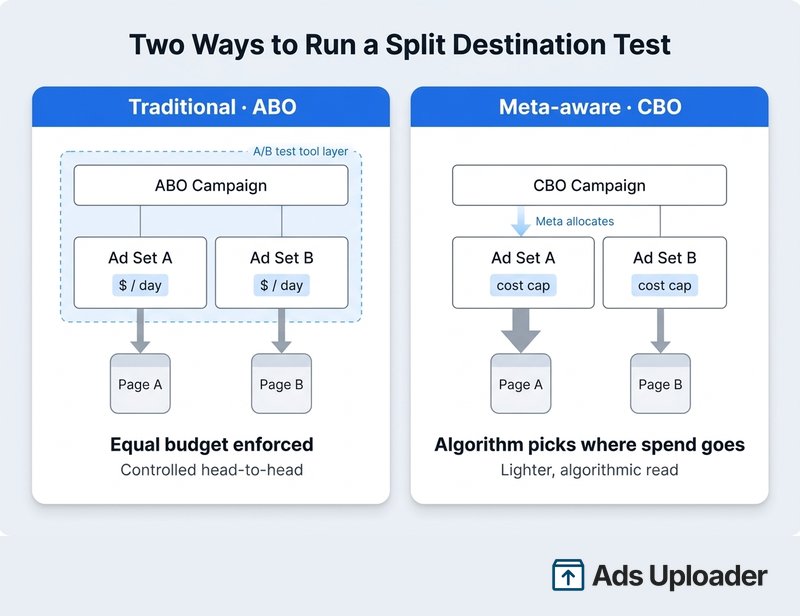
This is the cleanest, most algorithmically honest way to test landing pages on Meta for wholesale page swaps. Launch two ad sets together. They don't have to be in a new campaign, just keep them out of your live winner's structure. Both ad sets use the same audience, the same budget, the same creative, the same optimization event. The only thing that differs is the landing page URL on each ad.
Meta optimizes delivery at the ad set level. By giving each landing page its own ad set with its own URL, you let Meta's algorithm collect clean signals on which page works for which slice of the audience. The data Meta gathers is real, attributable, and useful for scaling the winner afterward.
How to set it up properly:
- Set up Ad Set A with the audience, budget, optimization event, and creative you want to test. ABO is the right call for explicit budget control at the ad set level. Use a fresh campaign or an existing test campaign. Just don't add the test ad sets into your live winner's campaign.
- Set audience exclusions on the test ad sets: past customers, website visitors, and ad engagers from your other campaigns. The people who see these test ads should only see these test ads. That's how you stop cross-campaign overlap from polluting the data.
- Duplicate Ad Set A into Ad Set B. Change only the landing page URL on the ad.
- Launch them simultaneously so both enter learning at the same moment under identical conditions.
- (Recommended) Select both ad sets and push them through Meta's A/B test tool. That enforces a non-overlapping audience split between the two arms: the same person can't see both landing pages, which is what you want for a clean read.
Strengths: Meta's algorithm receives clean, separated signal for each landing page. Both ad sets begin learning together, so the comparison is fair. You keep full control over budget and bid strategy, and you can scale a winner directly from the test campaign.
Weaknesses: spend roughly doubles versus running one campaign, which is the cost of running parallel ad sets at all. The setup steps above are what make it a controlled experiment rather than two ad sets running in parallel.
Structure pattern: group similar ad assets under one ad set, then organize ad sets into a chronological funnel. Congruent with how Meta delivers.
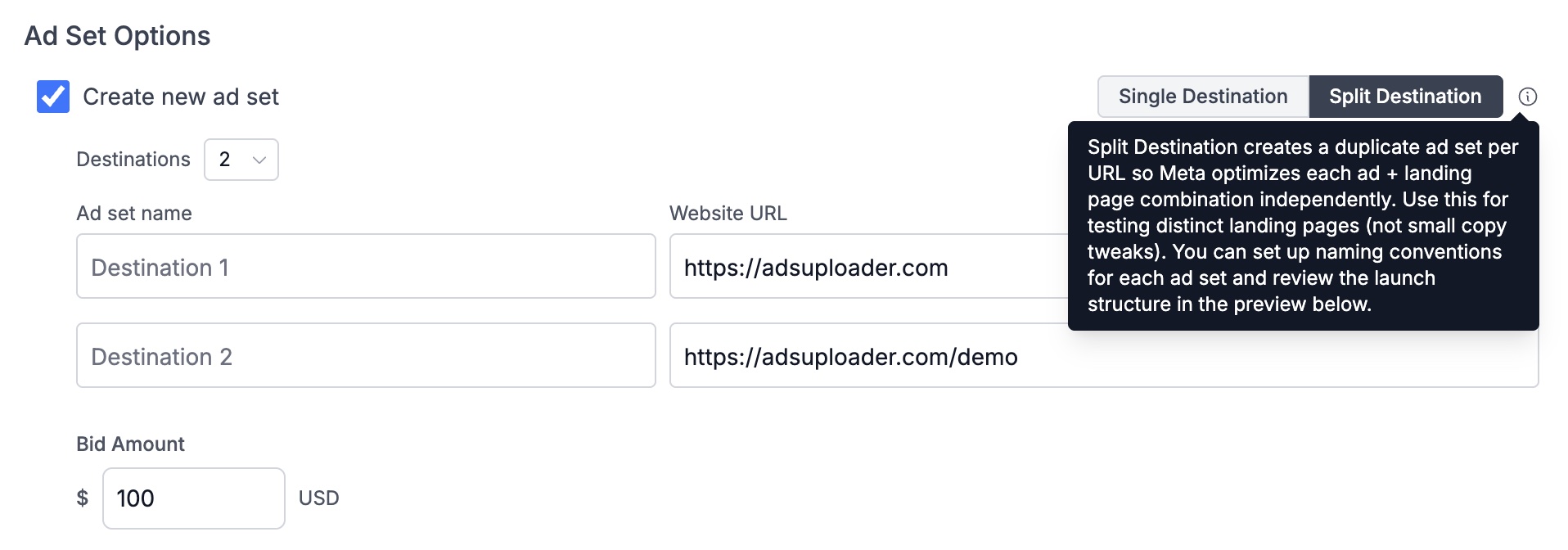
This is exactly what Ads Uploader's Split Destination feature is built for. You build whatever ad structure you want: a single ad set, different assets across multiple ad sets, five or ten assets per ad set, however your funnel is shaped. Choose between two and five destinations and Split Destination automatically creates the parallel ad set flows, ready to plug into Meta's A/B test tool. No manual cloning, no setup errors. And if you script your launches or run them through an AI agent, the same parallel-ad-set setup is available through the Ads Uploader CLI and Ads Uploader MCP.
Method 2: Meta's Experiments Tool
Meta's native A/B testing flow lives inside the Experiments workspace and the A/B test toolbar in Ads Manager. Statistically it's the cleanest way to split traffic on the platform: Meta randomizes traffic into non-overlapping audience groups so the same person can't see both variants and contaminate the result. A lot of media buyers use it.
You can run it two ways: standalone (launch from a campaign or ad set as the template, Meta builds the test structure), or as a layer on top of Method 1 (build the ad sets manually per the steps above, then push both through the A/B test tool). The second is the cleanest version: you keep manual control over structure and exclusions while the A/B tool enforces the audience split.
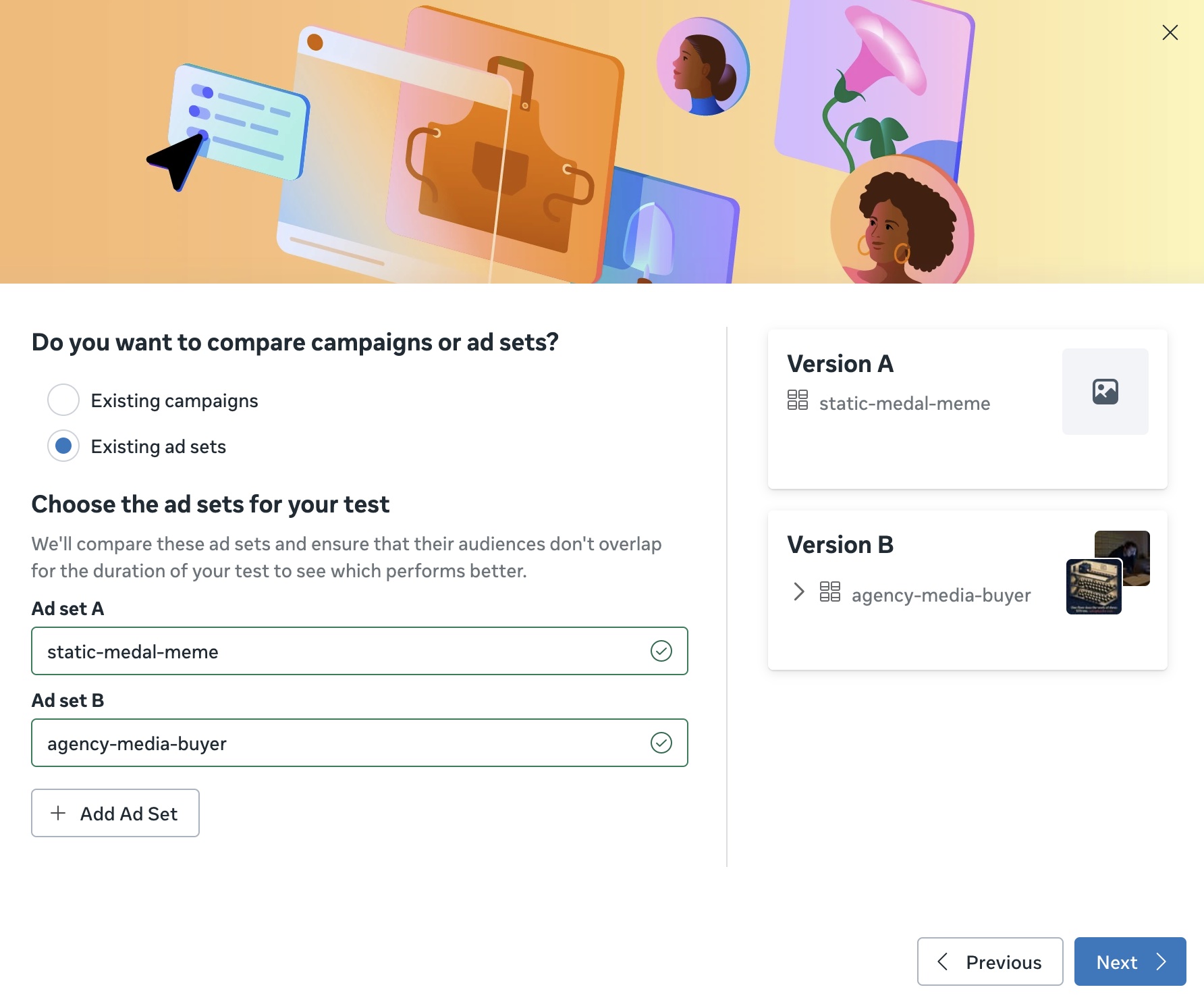
Once your ad sets are built, the Experiments tool is where you pick the two to test against each other. Choose Existing ad sets, then select Ad set A and Ad set B; Meta confirms it will hold their audiences non-overlapping for the duration of the test so the read stays clean.
The honest tradeoffs are workflow, not statistics:
- It involves a lot of clicking in and out. The Experiments view is separate from your normal campaign reporting, so you bounce between dashboards to set up, monitor, and read results.
- Data interpretation can be awkward. The ad the test was initiated from isn't always pulled into the test view, which throws people off the first time. Extracting clean numbers for a client report or a follow-up analysis takes more work than reading a regular campaign.
- Confidence threshold caveat. We've seen Meta's UI flag a winner at 65 percent confidence, softer than the 95 percent standard most CRO teams use. The celebratory language in the test view can suggest you've got a winner sooner than the data really supports.
Method 3: Two Creatives in the Same Ad Set
Same audience, same optimization event, one ad set, with two ads inside it that differ only in the landing page URL. The lightest version of an ad-set-level test, and there's a reason it sits below Methods 1 and 2.
In practice, one ad gets favored. Meta's auction leans spend toward whichever performs slightly better early, and you can't easily push budget toward the underperformer to keep the comparison even. By halfway through you might be looking at a 70/30 spend split. That's not a controlled experiment. It's directional data at best.
When it works: as a fast screen when you suspect one page is meaningfully better and want a quick read. If one wins decisively, that signal is real.
When it doesn't: when results are close. Spend allocation isn't enforced, so you can't tell whether the winner is genuinely better or just got more budget. Promote it to Method 1 for the clean read.
Method 4: Redirect-Based Splits (Why They're Not the Answer)
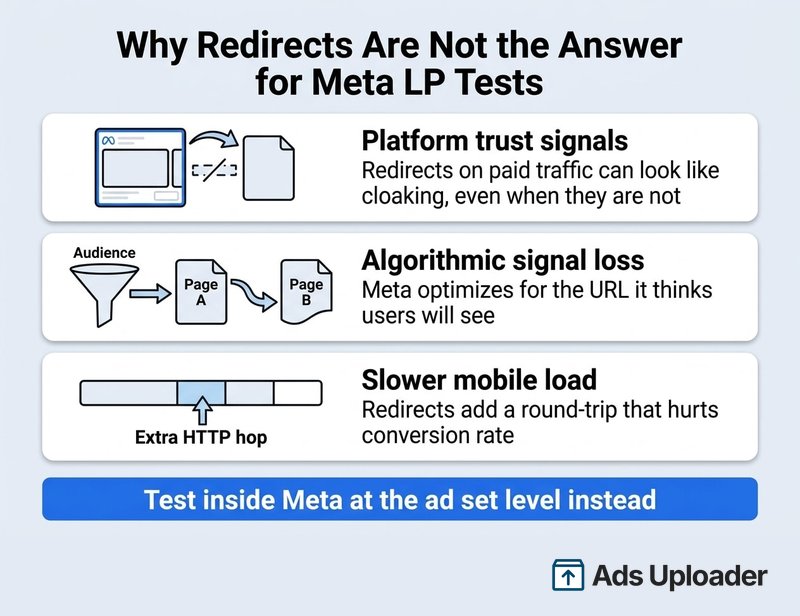
A redirect-based split keeps the ad URL unchanged and routes traffic at the server or page level so half the visitors land on Page A and half on Page B. Sounds attractive: the ad URL never changes. In practice, three reasons to avoid it on Meta:
1. Platform trust signals. Redirects on a paid traffic platform can look like cloaking or bait-and-switch, even when they aren't. Meta's review and integrity systems treat redirects with suspicion because they're a common pattern in policy-violating ads. You don't want your test setup to look like something it isn't.
2. Algorithmic signal loss. Meta's delivery system uses the destination URL to decide who sees the ad. If a redirect sends users to a different page than Meta expects, the targeting signal degrades. You end up sending audience matched to Page A's profile to Page B, which neither page was optimized for.
3. Implementation friction. Redirects add an HTTP round-trip that slows page load. Mobile users feel it. Slower load means lower conversion rate, which can swing test results for reasons unrelated to the page.
A note on JavaScript template rotation: many on-page A/B testing tools serve different templates from the same URL, swapping layouts client-side with JavaScript. No redirect, and the user lands on the URL Meta expects. The trade-off is the brief render flash before the JS resolves which template to show. Depending on page load speed, the flicker can be very visible. Not a great first impression. JavaScript tools have a place (see below), but they're not ideal for testing genuinely different landing pages.
Launch More. Click Less.
Upload hundreds of creatives at once, auto-match thumbnails to videos, and publish straight to your ad accounts through Meta's API.
Try Ads Uploader FreeNo credit card required • 7-day free trial
A Lighter Alternative: CBO and Algorithmic Allocation
Method 1 describes a controlled test: equal budget, equal audience conditions, statistical head-to-head. That's the right call for a textbook A/B test, but it isn't the only way.
A lighter alternative drops most of the rigor and runs the parallel ad sets under CBO with cost cap or bid cap. You give Meta multiple destinations and let the algorithm decide where to allocate spend. The "winner" is whichever destination Meta naturally pushes toward.
That isn't a traditional A/B test, but it's arguably more honest about how Meta delivers in 2026: the algorithm knows things about your audience that a controlled test won't surface. Expect it to run longer because the algorithm needs runway to allocate.
Ads Uploader's Split Destination structure works for either approach: plug into the A/B test tool for the traditional split, or run under CBO and watch where Meta sends the spend.
What to Test on the Page
The split testing scope split into two clean buckets: micro-optimizations on the same page, and wholesale page swaps.
Short on test ideas? Researching competitor ads in the Meta Ads Library is a good place to mine them: see which hooks, offers, and angles competitors are running (and which they have kept live for months, a sign they convert) before you decide what to put head-to-head.
Micro-optimizations on the same page are best done with on-page testing tools that swap elements client-side. The above-the-fold elements have the highest leverage:
- Headlines
- Hero images and hero offers
- The first paragraph (the proof or promise that follows the headline)
This is where you win or lose the audience, on desktop and mobile. The flash issue with JS-based tools is more tolerable here because the layout itself isn't changing, only specific elements. If you have an existing high-traffic page and want compounding gains, this is the highest-value testing work you can do.
Wholesale page swaps are what this article is about: a totally different layout, a different angle, a different funnel structure (advertorial vs product page, listicle vs direct, quiz funnel vs landing page). Test these inside Meta at the ad set level (Method 1). Don't try to JS-swap a totally different layout: the flash will be too visible, and Meta's algorithm needs the URL difference to assign the right audience to the right experience.
A useful rule: if two pages share a layout and only differ in copy or imagery, that's a micro-optimization. If they're structurally different, run it as separate ad sets.
Sample Size, Duration, and Calling a Winner
There's no universal minimum-conversions number. Required sample size depends on your baseline conversion rate, the effect size you're trying to detect, and the statistical method you're using.
Frequentist vs Bayesian. The traditional standard is frequentist: 95 percent confidence, fixed sample size, decision at the end. The newer approach used by VWO and similar platforms is Bayesian, which calculates the probability that B beats A and updates as data comes in. Bayesian methods let you read continuously and stop when probability passes a high threshold, without the false-positive penalty frequentist tests pay for early stopping. For Meta landing page tests, Bayesian tends to reach decisions faster. Either works as long as you commit to the threshold up front.
Practical rules of thumb:
- 95 percent confidence (or 95 percent Bayesian probability of being best) is the editorial standard.
- Below roughly 250–350 conversions per variation within a segment, segment-level conclusions get unreliable.
- Set the threshold before you launch. Don't move the goalposts because Day 2 looks interesting.
- Run for full weeks: day-of-week mix is real. Cover at least one full business cycle.
- Goldilocks zone: 7–14 days for healthy-volume accounts, 14–28 days for lower-volume tests. With cost cap or bid cap structures, plan toward the upper end. Beyond four weeks, external noise overwhelms the signal.
The reality check. Full statistical significance is the goal but rarely the outcome. Spend, volume, and campaign mechanics (especially cost cap and bid cap structures) push decisions faster than the textbook prescribes. With cost controls, the call is usually made on where Meta is happiest to allocate spend, not on a 95 percent read. Strive for the higher bar, but accept that decisions get made on partial data.
Budget guidance for ABO tests:
Budget per ad set per day = (target conversions per variant × CPA) ÷ test days
A two-page ABO test targeting 50 events per variant over 14 days at a $40 CPA works out to about $143 per ad set per day. For cost cap and bid cap structures this formula doesn't quite apply: Meta controls the spend. Plan a campaign budget that gives the system enough to work with, then expect a longer runway.
Don't over-test. If you're spending a few hundred dollars a day and testing four or five pages on top of multiple creative variations, the math doesn't work. Consolidate, test the highest-leverage change first, then move on.
Don't over-engineer the analysis. You can slice results by device, demographic, time-of-day, and on and on. Segment splits can flip which page looks like the winner, but at some point the question stops being "did I run the perfect test?" and becomes "which page is making me more money?" If Meta is pushing more mobile traffic to one page, the algorithm has likely decided it converts better there. Don't let segmentation paralysis stop you from acting on a clear winner.
Avoiding the Learning Phase Trap
The biggest avoidable mistake is mid-test editing of a live ad. Edit the URL on a winning ad, performance shifts, and now you can't tell whether the page or the learning reset is responsible.
The actions that can retrigger learning, per Meta's own significant-edit guidance, are:
- Changing the optimization event, audience, or creative
- Changing the click destination (i.e., landing page URL)
- Changing bid strategy or placements
- Changing budget by a meaningful amount (no hard threshold; the older "20 percent" rule is a useful conservative ceiling)
Meta's guidance is that an ad set typically needs around 50 optimization events within seven days to exit learning. Treat that as a rough planning number, not a hard cutoff. Aim for that volume so the data is readable, but don't refuse directional signal that falls short, especially in cost cap or bid cap structures where Meta controls spend.
The non-negotiables: don't edit the live winner's URL; build a parallel test campaign instead. Don't make mid-test creative or targeting changes. Launch parallel test ad sets simultaneously so both enter learning together.
If test setup itself becomes the bottleneck, a bulk ad launcher that builds parallel test ad sets from a single spec is the right tool. Manual cloning is where mistakes creep in.
Frequently Asked Questions
How long should a landing page split test run on Meta?
Long enough to hit a precomputed sample over full weeks. For high-volume accounts that's typically 7 to 14 days; lower-volume accounts often need 14 to 28 days. Beyond that, day-of-week effects, seasonality, and creative fatigue start to overwhelm the signal. Don't stop early because Day 2 results look promising.
Save Hours on Creative Testing
Stop uploading ads one by one. Bulk process unlimited creatives with automatic media matching and direct API publishing.
Try Ads Uploader FreeNo credit card required • 7-day free trial
Should I use redirects to split test landing pages on Meta?
Generally no. Redirects on a paid traffic platform can look untoward to platform trust signals, and they hide the URL difference from Meta's optimization algorithm. The recommended approach is testing at the ad set level with one URL per ad set.
Does changing the landing page URL on a winning ad trigger Meta's learning phase?
Yes. Meta's activity-history help lists "click destination" as a significant edit, which can retrigger the learning phase. That's why you should never edit a live winning ad's URL. Instead, build a parallel test campaign with separate ad sets.
What's the minimum budget for a Meta landing page A/B test?
There's no Meta-set minimum. Use this formula: target conversions per variant × variants × CPA ÷ test days. At a $40 CPA, two variants over 14 days targeting 50 events each works out to about $286 per day across the test.
Can I test more than two landing pages at once on Meta?
Yes, but every extra variant thins the traffic each one receives and slows the test toward significance. For most accounts, two pages per test is the sweet spot.
What's the difference between Meta's A/B test feature and the Experiments tool?
Ads Manager A/B testing is the launcher flow built into the campaign toolbar. Experiments is the broader workspace that includes A/B tests plus lift-style studies. Both use the same randomization model, and statistically it's the cleanest way to split traffic on Meta. The workflow involves a lot of clicking in and out, and reading the results can be awkward, but the underlying mechanics are sound.
Should I split-test landing pages or ad creative first?
If your ad isn't yet a proven winner, fix the creative first. A weak ad can't tell you anything reliable about page performance. Once you have an ad that's hitting your CPA target stably for at least two weeks, then it's time to test pages behind it.
What This All Comes Down To
For wholesale landing page tests on Meta, run separate ad sets: one URL per ad set. Same creative, same optimization event. The default path is ABO with audience exclusions, pushed through Meta's A/B test tool to enforce a clean head-to-head. If you'd rather let the algorithm pick, the lighter alternative is CBO with cost cap or bid cap on each ad set. Either gives the system clean URL signal at the ad set level.
The Experiments tool is a perfectly good option too: statistically the cleanest way to split traffic on Meta, even if the workflow takes some clicking around. Two creatives in one ad set works as a directional screen, not a winner-caller. Redirects and JavaScript template rotation belong to a different context: micro-optimizations, not wholesale page swaps.
Don't edit the winning ad. Don't over-test. Run for full weeks. Commit to your decision threshold before the test starts.
When manual ad-set cloning becomes the bottleneck, Ads Uploader's Split Destination feature does the heavy lifting. Build your ad structure once (single ad set, multi-asset ad set, or full funnel) and Split Destination duplicates the structure into parallel arms with different URLs. Head-to-head ad set against ad set, same assets, no re-uploading. The ad launching platform built for running this kind of test inside Meta.