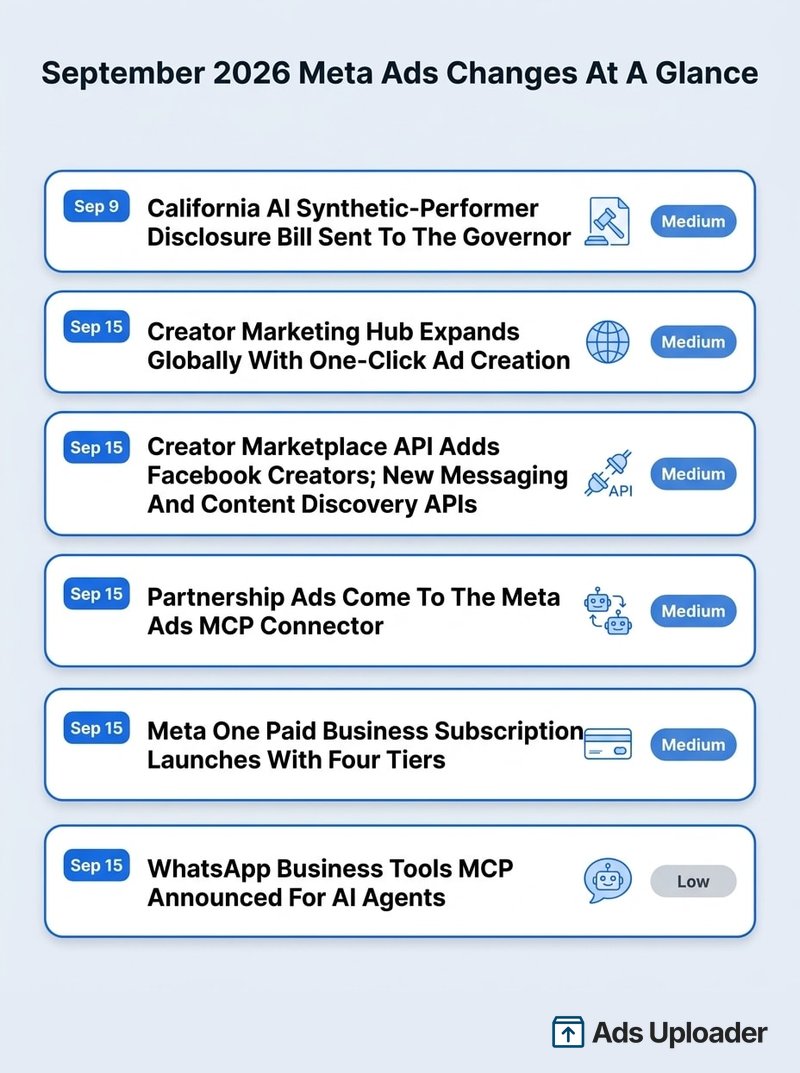
Every Meta Ads change that affects your campaigns, updated twice a month. September's headline landed at Creator Week on the 15th: the Creator Marketing Hub went global with one-click ad creation, Partnership Ads reached the AI-agent connector, and Meta put four price tiers on its new Meta One business subscription. California's AI synthetic-performer disclosure bill also reached the governor. Below: the full September rundown, August and July in full, action items, and the running deadlines table.
September 2026
September's first half was quieter than August, and most of what landed clustered on a single day. At IAB Global Creator Week on September 15, Meta pushed its creator-marketing stack out worldwide and wired Partnership Ads into the AI-agent layer, and the same day it put a name and a price on the subscription tier it had only hinted at in August: Meta One. On the regulatory side, California's AI synthetic-performer disclosure bill reached the governor's desk on September 9. Meta's status page logged no ad-platform incidents in the window.
| Date | Change | Impact | Who's affected |
|---|---|---|---|
| Sep 9 | California AI synthetic-performer disclosure bill (SB 1050) sent to the governor | Medium | Advertisers using AI-avatar creative in California |
| Sep 15 | Creator Marketing Hub expands globally with one-click ad creation | Medium | Advertisers and agencies running Partnership Ads |
| Sep 15 | Creator Marketplace API adds Facebook creators; new Messaging and Content Discovery APIs | Medium | Creator-marketing and scheduling tools |
| Sep 15 | Partnership Ads come to the Meta Ads MCP connector | Medium | Agencies and tools using AI agents |
| Sep 15 | Meta One paid business subscription launches with four tiers | Medium | Advertisers and creators using free growth and insights tools |
| Sep 15 | WhatsApp Business Tools MCP announced for AI agents | Low | WhatsApp and messaging advertisers, developers |
Creator Week: The Creator Marketing Hub Goes Global, and Partnership Ads Get Easier (September 15)
Meta's biggest September drop came at IAB Global Creator Week, in a bundle of creator-marketing updates. The Creator Marketing Hub, which merged the Creator Marketplace with the Partnership Ads Hub in June, is now rolling out globally through the end of 2026, with new discovery filters that surface creators who already feature products like yours, content-level permissions with expiration dates, smarter recommendations that suggest an ad objective, ad-readiness editing that strips copyrighted music and stickers so a post can run as an ad, and one-click ad creation from inside the Hub.
Underneath the Hub, the plumbing opened up too. The Creator Marketplace API now includes Facebook creators alongside Instagram creators through a single integration, a new Messaging API lets tools discover, message, and activate creators programmatically, and the Content Discovery API expanded with organic-content recommendations, keyword search, and ad-readiness indicators. The item that fits this year's clearest theme: Partnership Ads are coming to the Meta Ads MCP connector, so you can create Partnership Ads and manage creator permissions from an AI agent, the same way April's connectors opened campaign management. Meta also set September 29 as the general-availability date for Instagram Live video ads, which brands can amplify as Partnership Ads.
The direction is the one Meta has run all year: take a workflow that lived in a specialist tool or a manual back-and-forth, and make it one click or one agent instruction. If creator content is part of your mix, the practical wins are real, with faster sourcing, cleaner rights handling, and ad-ready posts that skip a separate edit pass. If you build tooling, the Marketplace and Messaging APIs plus the MCP path are the sanctioned way to script creator sourcing rather than scraping it. Ads Uploader runs its own MCP server too, and Partnership Ads now work through it, so you can build them straight from an AI agent with us. See the Ads Uploader MCP for how the connector layer fits together.
Get Meta Ads Updates In Your Inbox
Two emails a month rounding up what actually changed in Meta Ads. No fluff, unsubscribe anytime.
Two emails a month • Unsubscribe anytime
Meta One: The Advisory Layer Gets a Price Tag (September 15)
August's Meta AI campaign-analysis launch noted that heavier usage would sit behind a subscription. On September 15 that subscription got a name, four tiers, and prices: Meta One plans for businesses, at Essential 14.99 dollars, Advanced 49.99, Expert 149, and Max 499 per month, priced per profile and rolling out globally to eligible businesses. The paid tiers gate a set of tools that used to be free or piecemeal: Competitive Insights, Custom Audience Insights, extended insights history with CSV export, content scheduling for Facebook and Instagram, links in organic posts and Reels, a verified badge with impersonation protection, and more Meta Business Agent AI responses each month. Meta Verified is being folded into Meta One, with current subscribers to be notified about migration.
For a pure paid-media buyer, most of this is organic-growth and insights tooling rather than an ad-buying change. The line worth watching is the Business Agent metering. Taken with August's campaign-analysis rollout, it is the clearest sign yet that Meta is starting to charge for the AI advisory layer that sits on top of the auction, not just the auction itself. If Competitive Insights or Custom Audience Insights are part of how you plan, check which tier they now require before the gating reaches your account, then decide whether the subscription earns its place or whether your existing reporting already covers it.
WhatsApp Business Tools Get Their Own MCP (September 15)
Meta's Developer Blog announced a WhatsApp Business Tools MCP server that lets an AI agent set up and manage WhatsApp business messaging, from onboarding to message templates, without hand-coding against the API. It sits next to the ads MCP server from earlier in the year rather than replacing anything. If you run click-to-WhatsApp campaigns, the setup and template work that feeds those ads is now agent-addressable too, the same pattern Meta has applied to campaigns and, this month, to Partnership Ads.
California's Synthetic-Performer Disclosure Bill Reaches the Governor (September 9)
The regulatory thread from June continued. California's SB 1050, which would require a clear disclosure whenever an ad prominently features an AI-generated synthetic performer that is not a real, identifiable person, was enrolled and presented to the governor on September 9. It had cleared the legislature on August 31 and, as of mid-September, had not been signed. If signed, it would take effect no earlier than January 1, 2027, and be enforced through California's false-advertising and unfair-competition laws. It follows New York's synthetic-performer law, in effect since June, and like that one it applies based on where the ad is seen, not where your business sits.
Nothing to do this week, but the pattern is now unmistakable: state by state, AI-avatar creative is picking up disclosure obligations. If your pipeline generates human-like performers, the disclosure step you built for New York is the same one California will want, so extend it rather than waiting for a signature.
Rollout Watch
The Meta AI Developer Assistant, announced in August, reached all developers around mid-September and is now the default front door for developer support, so precise questions with error codes route faster than prose descriptions. Two older items are still pending: Muse Image has not yet appeared inside Advantage+ creative, and "Push Delivery to This Ad" still has no official Meta documentation. Both carry the caveats from earlier sections.
What to Do After the September 2026 Meta Ads Changes: Action Checklist
This week
- If you run AI-avatar creative to California audiences, extend the New York synthetic-performer disclosure step to cover it now rather than waiting for SB 1050 to be signed.
This month
- Check which Meta One tier now gates any insights tools you rely on, such as Competitive Insights or Custom Audience Insights, then decide whether to subscribe or lean on your own reporting.
- If creator content is part of your mix, try the global Creator Marketing Hub, one-click ad creation, and ad-readiness editing on a live Partnership Ad.
- Developers and agencies: scope the Creator Marketplace and Messaging APIs, and the Partnership Ads path in the Meta Ads MCP connector, if you script creator sourcing.
Before next quarter
- If you sell demonstrable products, plan a test of Instagram Live video ads once they reach general availability on September 29, and consider amplifying creator Live content as Partnership Ads.
- Fold the WhatsApp Business Tools MCP into any click-to-WhatsApp setup you maintain, so template and onboarding work stops being manual.
August 2026
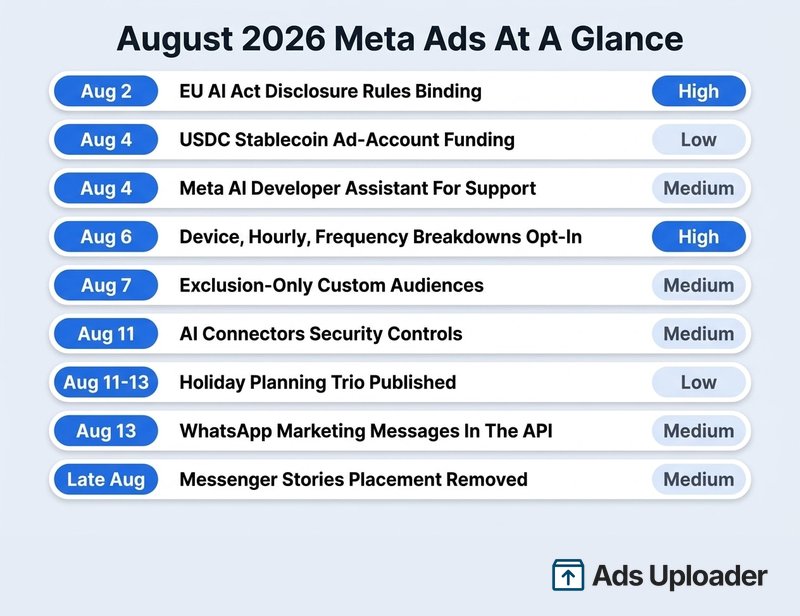
August split cleanly in two. The first half was rules and reporting plumbing: the EU's AI-disclosure obligations became binding for ads delivered in Europe, three Ads Insights breakdowns switched to opt-in with a silent failure mode, and Meta published an official page for a new exclusion-only custom audience type. The second half turned consequential: Meta AI learned to read your ad account, a test began removing placement exclusions from ad sets, the Messenger Stories placement was removed, courts imposed teen-usage limits twice, and the status page logged one Ads Delivery incident on August 21.
| Date | Change | Impact | Who's affected |
|---|---|---|---|
| Aug 2 | EU AI Act disclosure rules for AI ad content now binding | High | Advertisers using AI creative with EU delivery |
| Aug 4 | USDC stablecoin ad-account funding documented | Low | Cross-border and crypto-native advertisers |
| Aug 4 | Meta AI Developer Assistant becomes the developer support channel | Medium | Developers, ad tools |
| Aug 6 | New Mexico ruling: $567M fund plus teen usage caps (Meta appealing) | Medium | Advertisers reaching teens |
| Aug 6 | Device, hourly, and frequency breakdowns now require opt-in | High | Reporting tools, data teams |
| Aug 7 | Exclusion-only custom audiences get an official Help Center page | Medium | All advertisers |
| Aug 11 | Granular security controls for AI Connectors and the ads MCP server | Medium | Agencies and tools using AI agents |
| Aug 11-13 | Holiday planning trio published on Meta Business News | Low | Advertisers planning Q4 |
| Aug 13 | WhatsApp marketing messages available in the Marketing API | Medium | Developers, messaging advertisers |
| Aug 18 | Developer Tools MCP renamed Meta Social Technologies MCP | Low | Dev teams, API tools |
| Aug 19 | Meta AI can now analyze and optimize your ad campaigns | High | All advertisers, especially SMBs |
| Aug 19 | Placement exclusions being removed from ad sets (test, Sales and Leads) | High | Advertisers using manual placements |
| Aug 21 | Ads Delivery incident logged on Meta's status page | Medium | All advertisers |
| Aug 24 | API spec drop: AI-content flag, placement-controls param, bulk appeals | Medium | Developers, ad tools |
| Aug 25 | Reply to Keywords auto-DM test spotted on Instagram ads | Medium | Lead-gen and DM-funnel advertisers |
| Aug 26 | Creative diversity and estimated spend metrics surface in Ads Manager | Medium | All advertisers |
| Aug 26 | $18B teen-safety settlement approved; teen usage caps coming | Medium | Advertisers reaching teens |
| Aug 27 | Messenger Stories placement removed for all API versions | Medium | Developers, ad tools |
| Aug 28 | Poland: identity verification required for all financial-services advertisers | Medium | Financial-services advertisers targeting Poland |
EU AI-Disclosure Rules Now Apply to Ads Delivered in Europe (August 2)
On August 2, the transparency obligations in Article 50 of the EU AI Act became legally binding. The advertiser-facing part: anyone deploying AI-generated or AI-manipulated content that resembles real people, objects, or events has to disclose it clearly, and providers must make AI content machine-detectable. Like the location fees, it applies based on where your ads are delivered, not where your business sits, and penalties run up to 15 million euros or 3% of worldwide turnover. Meta signed the EU's Code of Practice on Transparency of AI-Generated Content on July 28, five days before the deadline. The same day, California's AI Transparency Act took effect for large generative-AI providers (detection tools and hidden watermarks), which binds the tools you use rather than you directly.
Meta's plumbing is already moving: the August 5 update to its published API spec adds an is_ai_generated flag to video and photo publishing endpoints and a much larger set of AI-provenance labels for media. New York's synthetic-performer law in June was one state; this is every EU impression. If your creative pipeline generates human likenesses or realistic scenes, whether through Meta's tools or your own stack, build the disclosure step into production now and keep a record of what was labeled, rather than retrofitting under an enforcement letter.
Three Reporting Breakdowns Went Opt-In (August 6): Empty Data, No Error
A change Meta announced quietly in a May 8 out-of-cycle changelog entry took effect on August 6: the impression_device, hourly-stats, and frequency_value breakdowns in the Ads Insights API now require per-account enablement. The device restriction applies to any breakdown combination that includes it, so a routine device-by-placement query is caught too. The failure mode is the dangerous part: requests from non-enabled accounts still return a success response with an empty data array. No error, no warning, just dashboards rendering zeroes that look like a performance collapse.
The fix is quick once you know it exists. Pull a device or hourly report covering August 6 onward; if it comes back empty on an account that had data on the 5th, an account administrator can enable the breakdowns in Ads Manager, and asynchronous report jobs then return your full history. There is also a new insights/feature-settings endpoint for enabling accounts programmatically, which agencies with long client lists will want. If you build or buy reporting, treat an empty success response as a signal to investigate, not a number to write into a table, and if you routinely export your ads data, re-check any pipeline that leans on these three breakdowns.
Exclusion-Only Custom Audiences: A Permanent Do-Not-Target List (August 7)
Meta published an official Help Center page for exclusion-only custom audiences, a new customer-list audience type that can only ever be used to exclude people. It cannot include anyone, cannot seed lookalikes or value rules, and cannot be converted to a regular custom audience later; the designation is permanent at creation. Meta's stated use cases are the compliance ones: people who opted out of your services, people you have a legal or regulatory obligation not to target, and lists you want a hard guardrail around. It works through Ads Manager and the Marketing API, supports the new audience labels, and is unavailable for Special Ad Category campaigns.
The point of the one-way design is that nobody on the team can quietly repurpose a suppression list as a retargeting source later. If you maintain opt-out lists, litigation holds, or do-not-contact files, rebuild them as exclusion-only audiences so the guardrail is structural instead of a naming convention.
Meta AI Developer Assistant Is Now the Front Door for Developer Support (August 4)
Meta made its AI Developer Assistant the primary support path on the developer site, rolling out gradually and reaching all developers by mid-September. It answers questions about API errors, webhook configuration, permissions, app review, and business verification, grounded in current documentation. If you maintain a Marketing API integration, the practical change is that support tickets now start with an AI triage layer, so precise questions with error codes will get further faster than prose descriptions.
Fund Your Ad Account With USDC (Reported August 4)
Meta now documents stablecoin funding for ad accounts: advertisers in supported countries, currently Argentina and Colombia per Meta's help page, can add prepaid funds in USDC from a compatible wallet, a third-party partner converts it to local currency, and the amount lands as regular ad credit. Meta never holds the crypto, refunds come back as ad credit rather than USDC, and funds sent to a wrong address are unrecoverable. Irrelevant for most US and EU buyers, genuinely useful if you operate from a market where card payments to Meta fail or currency controls bite.
Granular Security Controls for AI Agent Access (August 11)
First spotted by practitioners in the AI Connectors setup flow on August 11, and since confirmed by an official Help Center page on managing ads from an AI agent. You can limit an AI agent to selected Pages, Instagram accounts, and business portfolios, allow or block specific actions per ad account and per catalog, and set rules such as blocking any budget above a threshold you choose, all from the Ads MCP Server panel under Business Settings > Integrations. The page also documents newer tool areas, including A/B tests and lift studies, plus activity logs for reviewing what an agent actually did. The detail worth checking today: several sensitive write actions, including budget changes and creating campaigns, ad sets, and ads, are reportedly enabled by default per account. If you connected an AI agent to your ad account since April, open that panel and confirm the write permissions match what you actually want an agent doing unattended.
WhatsApp Marketing Messages Join the Marketing API (August 13)
An August 13 out-of-cycle changelog entry makes WhatsApp marketing messages available through the Marketing API across all versions, covering ad-account reads, ad set and creative creation, and insights. If you run click-to-WhatsApp or messaging campaigns through tooling, the channel you previously managed in the UI is now scriptable end to end. One billing footnote from Meta's own FAQ: WhatsApp marketing messages invoiced together with ads do incur the location fees in the six affected markets.
Meta AI Can Now Analyze and Optimize Your Ad Campaigns (August 19)
The biggest capability of the month. Meta's August 19 announcement lets businesses connect their Facebook and Instagram accounts, their Meta ad campaigns, and Google Workspace (Gmail, Docs, Sheets, Slides) to the Meta AI assistant. Meta's own example prompt is "Review my ad performance over the last 90 days": the assistant analyzes what is and is not working, suggests audience, creative, and budget changes, benchmarks you against comparable brands, generates decks and spreadsheets from your business data, and can run recurring scheduled reports. It is rolling out free on meta.ai, mobile, and a new Mac desktop app; heavier usage will sit behind the Meta One subscription.
Two things to hold at once. A free analyst that reads your account and drafts the Monday report is genuinely useful, especially for small teams; connect a low-stakes account and compare its read against your own before trusting it. But the recommendations come from the same company that sells the inventory, so treat "increase budget" suggestions as a starting point to verify against your MER and CRM numbers, not as neutral advice. The subscription line is the strategic tell: Meta is starting to monetize the advisory layer on top of the auction, not just the auction itself.
Meta Is Removing Placement Exclusions From Ad Sets (Test, August 19)
The most consequential control change of the month arrived as an in-product notice, not an announcement. Around August 19, advertisers began seeing: "Excluding placements, platforms, devices and operating systems will no longer be available for your ad sets." Per Jon Loomer's reporting, it is currently a test limited to the Sales and Leads objectives, excludes sensitive verticals, and comes with plans to expand; Meta has published nothing official. The direction is corroborated in Meta's own plumbing: the August 24 API spec capture adds a new placement_controls_per_objective parameter to campaign and ad set creation.
The remaining levers if the test reaches you: value rules, which let you bid up or down by placement, device, and mobile OS (bid cuts capped at 90%), and the account-wide placement controls under Advertising Settings, which apply to every campaign rather than per ad set. This is the Advantage+ playbook applied to placements: the manual option does not get worse, it gets removed. If specific placements genuinely hurt your results, get that documented with data now, then rebuild the exclusion as an account-level control or a value-rule bid-down rather than an ad set setting, so the logic survives the rollout.
Reply to Keywords: Auto-DM Tests on Instagram Ads (Reported August 25)
A limited test spotted in ad setup and reported August 25: choose up to five keywords, and when someone comments one of them on your Instagram ad, Meta automatically sends them a DM you wrote, which can carry a link, phone number, or email. Creators have run this pattern through third-party tools like ManyChat for years; this builds it into the ad itself. Not officially announced, so treat the details as provisional. If comment-to-DM is already part of your funnel, watch for the option in ad setup; it moves the automation inside Meta's walls, which usually means better delivery reliability and less API maintenance than the third-party route.
Two New Ads Manager Metrics: Creative Diversity and Estimated Spend (Late August)
Two new columns quietly appeared in Ads Manager in the last week of August. Creative diversity, live by August 26 and documented on an official Help Center page that labels it estimated and in development, rates each ad set Low, Medium, or High on how varied its ad formats, styles, and messages are; you surface it under Customize Columns. Estimated spend, reported around August 25 and not yet officially documented, projects what a campaign is likely to spend based on the first two days of delivery of similar campaigns.
The one to watch is creative diversity, because it is the first time Meta has turned its Andromeda-era preference for varied creative into a score you can see per ad set. Early practitioner reports say ad sets running a healthy mix of formats still score Low, so treat it as directional while it carries the in-development label. If Meta starts tying delivery advantages to the score, format variety inside each ad set stops being a craft preference and becomes a lever.
Courts Set Teen-Usage Limits Twice: The $18B Settlement and the New Mexico Ruling
Two separate legal outcomes in August will shape how much time under-18s spend on Meta's apps. On August 6, a New Mexico judge ordered Meta to pay $567 million into a harm-reduction fund and imposed teen restrictions including a monthly usage cap and blocked overnight notifications; Meta is appealing. Then on August 26, Meta announced a settlement with state attorneys general across the country, reported at roughly $18 billion paid out over ten years. Meta admits no wrongdoing but agreed to teen defaults: a two-hour daily usage limit, night mode blocking the apps from midnight to 6 a.m., muted school-hours notifications, hidden likes on teens' posts, an option for a non-algorithmic feed, and an independent auditor, all due in place by February 27, 2027. Portions of the payout are contingent on YouTube and TikTok adopting similar terms, which is designed to spread the standard industry-wide.
The advertiser impact is indirect but structural: capped, quieter teen sessions mean less 13-17 inventory over time, and a non-algorithmic feed option weakens ranking signal for whoever adopts it. If your account skews young, expect gradually tighter delivery and rising CPMs on the youngest segment, and plan creative and offers for the 18-plus cohorts that will carry more of the load.
Poland: Identity Verification for All Financial-Services Advertisers (August 28)
A market-specific change with template written all over it. On August 27, Poland's government asked the European Commission to fine Meta 250 million euros over scam ads. The next day, Meta announced in its Polish newsroom that every advertiser running financial-services ads targeting Poland must complete identity verification, and restated its goal of having 90% of ad revenue in the market come from verified advertisers. If you run finance offers into Poland, complete the verification prompt before it interrupts delivery. If you advertise financial products elsewhere in the EU, note the pattern: regulator pressure over scam ads is converting into hard verification requirements one market at a time.
Ads Delivery Incident on August 21
Meta's status page logged one ad-platform incident in August: Ads Delivery, resolved August 21. Practitioner threads that day quoted Meta's acknowledgment of "an issue that may be impacting ad delivery," with scattered reports of slow delivery continuing for a few days after. Annotate August 21 in reporting, and if delivery looked off that week, check the annotation before blaming creative or audiences. Worth knowing for context: August's practitioner chatter ran hot with CPM-inflation complaints dating from late July; none of it is confirmed by any official Meta change, so the standing advice applies: verify against your own MER and CRM numbers rather than reacting to in-platform swings or other people's screenshots.
Messenger Stories: Placement Removed August 27
The removal flagged in our July section landed. Per Meta's deprecation notices to advertisers and industry trackers, the Messenger Stories placement was removed on August 27 across all Marketing API versions, with spend automatically redistributing to remaining placements; the Graph API changelog still shows October 27 for some surfaces, so the placement may linger in spots until then. Either way, treat it as gone: if any placement array in your tooling or saved templates still names story under messenger_positions, strip it now, because the value is silently dropped from a successful response rather than erroring, so nothing will warn you.
The API Corner: Docs-Only Changes in the August Spec Captures
Meta's biweekly API spec capture on August 5 carried a batch of changes that appear in no blog post. The ones that touch real workflows: the four marketing_messages_website_* conversion fields were removed from Ads Insights while instagram_profile_follow was added; the old feature_preferences endpoint gave way to the insights/feature-settings machinery behind the August 6 breakdown opt-ins; five call-to-action values were removed, including SEE_MENU and GET_UPDATES; ad sets gained an anchor_event_attribution_window_days field; and brand-safety configs picked up per-platform comment-moderation filters for Facebook, Instagram, and Threads. Separately, the Marketing API v26.0 changelog now flags that country and location_spec inside lookalike_spec are deprecated, with all versions cut over on September 1; the fields are silently ignored and the lookalike's location comes from the ad set. If your tooling builds lookalikes with an explicit country, that window closed September 1.
The August 24 capture was larger and more directional. The additions that matter: an is_ai_generated boolean on ad video uploads, the disclosure plumbing behind the EU AI Act obligations above; the placement_controls_per_objective campaign and ad set parameter corroborating the placement-exclusion test; bulk ad-appeal endpoints (IntegrityAppeal) so tools can programmatically appeal batches of rejected ads instead of one-at-a-time clicks; a video_voiceover flag among the Advantage+ creative enhancements; new shop_clicks and msa_seller_budget insights metrics; an AdsSubscription object for the webhook push machinery documented in July; and an opportunity-score history endpoint (opportunity_score_history) so you can track how Meta's account score moved over time; and four staged Insights breakdowns, including placement_path and affiliate and seller breakdowns for creator commerce, with reach-and-frequency predictions now exposing a cpm field. None of these shipped with a blog post. Two smaller developer notes from the same week: the facebook-business-sdk 26.0.1 release on August 25 silently dropped 14 ad set fields, including time_start and budget_schedule_specs, so pin and test before upgrading; and an August 27 Developer Blog post opened the new Facebook Login beta, whose iOS Fast App Switch default in SDK 18.0.3 is worth watching if login quality feeds your registration events and Conversions API match rates. Housekeeping from the same window: on August 18 Meta renamed June's Developer Tools MCP to the Meta Social Technologies MCP, a rename only, distinct from the ads MCP server.
Meta's Holiday Trio: The Q4 Playbook Posts (August 11-13)
Meta Business News published three holiday-planning posts in quick succession: turn on Advantage+ placements now so October acts as a learning period before Black Friday, run three or more creative formats matched to the four phases of the season (Meta's data puts purchase intent 2.1x higher when shoppers engage with three-plus formats), and set up a Conversion Lift study before peak, when holiday volume gets results to significance in two to three weeks instead of six. Marketing content rather than product changes, but the sequencing advice is sound: whatever Q4 structure you plan to run should be live and learning before CPMs ramp.
Rollout Watch
Two July announcements still have not landed as of September 1. Muse Image remains outside Advantage+ creative; Meta's July 7 post still says "in the coming weeks" and no official confirmation of the rollout surfaced in August, so keep treating Muse-powered image variants as upcoming. And "Push Delivery to This Ad" still has no official Meta documentation; the July section's caveats stand unchanged.
What to Do After the August 2026 Meta Ads Changes: Action Checklist
This week
- Pull a device, hourly, or frequency report covering August 6 onward; if it comes back empty, opt in via Ads Manager and backfill with an async report job.
- Strip
storyfrom anymessenger_positionsplacement arrays; the placement is gone and the API drops it silently. - If your tooling creates lookalikes with an explicit
countryorlocation_spec, that deprecation reached all versions September 1, so move geo to ad set targeting now. - Annotate August 21 in reporting dashboards as a platform delivery incident.
This month
- Document with data which placements genuinely hurt your results, then rebuild those exclusions as account-level placement controls or value-rule bid-downs before the ad set option disappears.
- Connect a low-stakes account to Meta AI's campaign analysis and compare its read against your own reporting before trusting it anywhere important.
- Add the creative diversity column in Ads Manager and note your scores; treat them as directional while the metric is in development.
- If you run financial-services ads targeting Poland, complete the new identity verification before it interrupts delivery.
- Review the Ads MCP Server panel under Business Settings > Integrations and confirm which write actions your connected AI agents hold.
- Rebuild opt-out and legal suppression lists as exclusion-only custom audiences.
- If AI-generated likenesses appear in creative delivered to the EU, stand up the disclosure step and start populating the new
is_ai_generatedflag where your tooling uploads video.
Before next quarter
- Get your Q4 structure live early enough to exit learning before Black Friday, and set up a Conversion Lift study before peak volume.
- If your account skews 13-17, model delivery with the teen usage caps in place and build out 18-plus segments.
- Messaging stacks: scope the WhatsApp marketing-messages API surface alongside the October 15 Embedded Signup migration.
July 2026
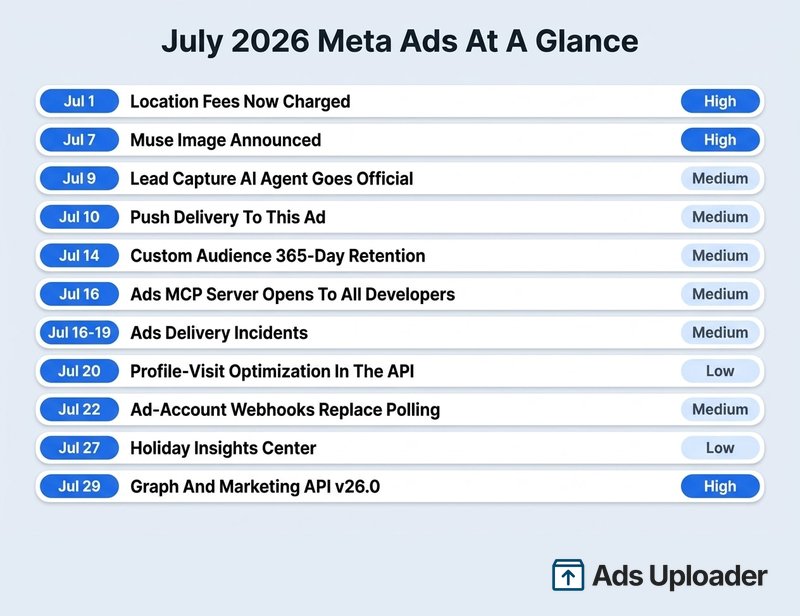
July was a developer-heavy month that still reached the account. The Graph and Marketing API v26.0 release on July 29 retired several ad placements and paths, Meta opened its ads MCP server to any developer and documented ad-account webhooks that replace API polling, the location fees started landing on invoices, an official Lead Capture AI agent arrived for Instant Forms, and the status page logged two Ads Delivery incidents.
| Date | Change | Impact | Who's affected |
|---|---|---|---|
| Jul 1 | Location fees now charged (UK 2%, FR/IT/ES 3%, AT/TR 5%) | High | Advertisers delivering in six markets |
| Jul 7 | Muse Image announced; Advantage+ creative rollout "in the coming weeks" | High | All advertisers using AI creative |
| Jul 9 | Lead Capture AI agent for Instant Forms goes official | Medium | Lead-gen advertisers |
| Jul 10 | "Push Delivery to This Ad" surfaced (no official page yet) | Medium | Advertisers running multiple ads per ad set |
| Jul 14 | Website custom audience retention: 365-day max appears in developer-doc FAQ | Medium | Retargeting and exclusion audiences |
| Jul 16 | Ads MCP server opened to all developers | Medium | Developers, ad tools |
| Jul 16 & 19 | Ads Delivery incidents logged on Meta's status page | Medium | All advertisers |
| Jul 20 | Profile-visit optimization goals added to the Marketing API (docs-only) | Low | Developers, ad tools |
| Jul 22 | Ad-account webhooks documented as the replacement for API polling on ads changes | Medium | Developers, ad tools |
| Jul 27 | Meta Holiday Insights Center launched | Low | Small-business advertisers planning Q4 |
| Jul 29 | Graph and Marketing API v26.0 released with ad-API deprecations | High | Developers, ad tools, some advertisers |
Get Meta Ads Updates In Your Inbox
Two emails a month rounding up what actually changed in Meta Ads. No fluff, unsubscribe anytime.
Two emails a month • Unsubscribe anytime
Graph and Marketing API v26.0 (July 29): The Deprecations That Could Break Your Setup
On July 29, Meta shipped Graph API v26.0 and Marketing API v26.0, and the version changelog carries the most ad-facing batch of deprecations of the year. Several land on advertisers, not just developers: the Instagram Explore Feed is removed as an ad placement, so any campaign that hardcoded it now redistributes to other placements; the Advantage+ Audience flag must be set explicitly or calls fail; Shop Ads creatives default to a website-and-shop destination unless you opt out; poll ad creation and the Messenger Stories placement are deprecated; and web-only destinations are banned for Web-plus-App campaigns. Two more matter for tooling: the delivery-estimate fields (daily_outcomes_curve, budget_guardrail, estimate_dau) are gone, and the Commerce Order Management API is sunset with no replacement (47 endpoints, blocked in v26.0 now and across all versions on October 27). On the additive side, ads in WhatsApp Status expanded, with carousels up to 10 cards and offsite-conversion optimization for Sales, Leads, and Engagement.
The practical work is an audit, not a panic. Check which API version every integration is pinned to, since apps left on an unsupported version get force-upgraded into these changes without warning. Review any placement logic that named Explore or Messenger Stories, set advantage_audience explicitly wherever you build targeting, and put the October 27 Commerce Order Management cutoff on the calendar if you touch Shops order data.
Muse Image: Meta's New Image Model Is Heading Into Advantage+ Creative
On July 7, Meta introduced Muse Image, the first image generation model from Meta Superintelligence Labs, and the business post is explicit about where it lands: Advantage+ creative image generation, rolling out to advertisers and agencies "in the coming weeks". Meta says the model brings agentic reasoning and iterative refinement - it parses a creative brief, adjusts individual elements, swaps styles, and produces on-brand variations with fewer round trips. Meta cites more than 8 million advertisers already using its AI creative tools. As of the end of July, no official post confirms the Advantage+ integration has shipped, so treat it as announced-not-live and watch Advantage+ creative for the rollout.
Today, we’re introducing Muse Image: our first image generation model from Meta’s Superintelligence Labs. It uses advanced reasoning to understand prompts and lets you turn your ideas into high-quality, relevant visuals that you can share directly to your chat, story, or feed.…
— Meta Newsroom (@MetaNewsroom) July 7, 2026
This is the model layer underneath June's brand-memory announcement getting a serious upgrade, and it sharpens the same trade-off. Image variations get better and cheaper, which raises the output floor for everyone, while the delivery system keeps grouping structurally similar creative into one entity and one audience pool. When Muse variants hit your account, treat them as variation fuel inside a concept, not as new concepts. And if your creative uses AI-generated people, remember the New York disclosure law from the June section applies to Muse output too.
Meta Location Fees Are Now on Your Invoice (July 1)
The fees announced in March are now being charged: United Kingdom 2%, France, Italy and Spain 3%, Austria and Turkiye 5%, applied to impressions delivered in those countries regardless of where your business is based, billed as a separate line item outside your campaign budget per Meta's location fees help page. Your first invoices containing them arrive this month: reconcile the line item against delivery by country and reforecast Q3 CPMs for affected markets. Full breakdown in our Meta location fees guide.
Meta's Ads MCP Server Is Now Open to Every Developer (July 16)
On July 16, Meta announced that its ads MCP server is now available to any developer with their own Meta app. April's AI Connectors put a no-code MCP server in front of end users; this opens the build-your-own layer, so any AI application can let its users create and optimize campaigns, manage product catalogs, and pull performance data through natural language. Business portfolio administrators also get controls to scope how much access an AI agent gets.
The direction is consistent: Meta is making the ad account addressable by agents at every layer, from the end user who just wants to talk to their campaigns to the developer building the tool that does it. If you build software on top of Meta Ads, this is the sanctioned path to an AI interface without waiting on partner status. For the practitioner-facing version of the same shift, our Meta Ads MCP guide covers what the connectors do and where they fit.
Profile-Visit Optimization Arrives in the Marketing API (July 20)
A docs-only addition we picked up from the out-of-cycle changelog after the July close: since July 20, ad sets created through the Marketing API can optimize for Instagram profile and Facebook Page visits, with optimization_goal set to PROFILE_VISIT or PROFILE_AND_PAGE_ENGAGEMENT and matching destination and call-to-action types, including a dual Instagram-plus-Facebook destination. Creator-adjacent and local-business tooling that could only build these ads in the UI can now script them.
Ad-Account Webhooks Now Replace Polling for Ads Changes (July 22)
Around July 22, Meta documented webhooks for ad accounts as the sanctioned way to get real-time notifications when ads change, instead of polling the API on a timer. The ad_account object now exposes standalone webhook fields: ad_recommendations (marked improved), creative_fatigue, in_process_ad_objects, with_issues_ad_objects, and product_set_issue. A new effective_status field, reported to fire on delivery blocks, policy rejections, and sync delays, appears in coverage of the launch but is not yet listed on Meta's field-reference page, so treat it as reported until the reference catches up. The same coverage puts the full ads subscription at more than 88 ad-object and insights notifications and says push delivery does not spend your rate-limit allowance on the receiving side; both of those figures come from the announcement rather than the reference doc, so hold them with that caveat. You turn a field on by subscribing your app, then authorizing the specific ad account.
The practical point for anyone running tooling on Meta Ads is that this is the way off polling loops. If your stack wakes every few minutes to diff ad statuses, recommendations, or fatigue, you can move that to push and stop spending rate limit on checks that usually return nothing. It fits the same month's agent-addressable direction and the v26.0 removal of the delivery-estimate fields: fewer scheduled reads, more event-driven reactions. Audit where you poll today and convert the noisiest loops first.
Custom Audience Retention: 365 Days Now Appears in Meta's Developer Docs
Still partially confirmed, reported here with that caveat. Meta's website custom audiences developer documentation, updated July 14, now states in its FAQ that "the longest duration can be set for 365 days" before audience members drop off unless they match the rule again. The catch is internal: the same page's retention_days API parameter still reads "between 1 and 180 days", and the Business Help Center gives no maximum number at all. So the 365-day figure is now in official documentation, but the API field and the Help Center have not caught up. The 730-day number circulating in practitioner posts appears nowhere official. If a full-year window holds, retargeting and exclusion audiences can reach a year of purchasers; until the field and Help Center align, build as if 180 is the enforced ceiling and revisit next update.
"Push Delivery to This Ad": Steer More Delivery Toward One Ad You Choose
Around July 10 a new "Push Delivery to This Ad" option began appearing, and it looks fully rolled out. It lets you push more of an ad set's or campaign's delivery toward one specific ad you select, rather than leaving the split entirely to Meta's delivery system. We are noting it from what advertisers are seeing in the interface. Meta has not published a help page for it yet, so treat the exact mechanics as provisional and watch for official documentation to confirm the details.
The trade-off is a familiar one. Meta's delivery system optimizes the ad split on signal you cannot see, so overriding it toward a favorite can help when you have a clear winner the system is under-serving, and hurt when your read is worse than the algorithm's. If you try it, change one variable, give it enough spend to judge fairly, and compare against an ad set where you left delivery alone.
Lead Capture AI Agent for Instant Forms: Meta Turns the Form Into a Conversation
The conversational lead flow that practitioners started spotting in early July is now official. Meta's Lead Capture AI agent for instant form ads Help Center page documents it: instead of always showing a static form, Meta decides per person whether an AI chat or the standard form is more likely to convert, and the agent asks and follows up in a back-and-forth to collect the lead. Meta says conversations are not stored, only the final submitted lead is shared. You turn it on with an ad-level "Enable lead capture AI agent" toggle. At launch it is English-only, does not support conversion-leads optimization, conditional logic, or appointment requests, and is gated for regulated verticals like financial services, health, and employment/housing/credit.
This is the natural next step after June's embedded appointment booking: Meta is turning the Instant Form from a form into a conversation. A chat-style capture can lift completion when a static form feels like work, but it also hands your qualifying questions to an AI, so if you test it, read the transcripts and check lead quality, not just lead volume, before you scale it. The regulated-vertical exclusions are the tell about where Meta is least confident, so keep that flow static if you sell in one of them.
Ads Delivery Incidents on July 16 and 19, 2026: When to Suspect the Platform
Meta's status page logged Ads Delivery incidents on July 16 and July 19, both since resolved. The July 19 event lined up with a wider Facebook and Instagram disruption that users reported in the early hours, US time. No Ads Manager, Ads Reporting, or Marketing API incidents were logged in the window beyond these two.
If delivery or pacing looked off on either day, that is the first place to check before you touch a campaign. Annotate both dates in your reporting so a delivery dip does not get mistaken for creative fatigue or an audience problem, and as a standing habit on odd days, read the status page's Ads section first, then trust your own MER and CRM numbers over in-platform reporting on incident days.
Meta's 2026 Holiday Insights Center: Plan Q4 Before the CPM Ramp
On July 27, Meta launched a 2026 Holiday Insights Center, a free hub of consumer research and platform benchmarks aimed at small businesses getting ready for the holiday season. It is a marketing resource, not an ad-mechanics change, but the timing is the useful part: it is the cue to lock your Q4 plan before auction prices climb into the back-to-school and holiday windows. Build your creative and budget calendar now, while CPMs are still at their summer floor.
Meta Reported Q2 2026 Earnings (July 29): Price per Ad Up 12% Again
Meta's Q2 2026 results, reported July 29, put average price per ad up 12% year over year, the second consecutive quarter at that rate, on 14% more ad impressions delivered. Ad revenue reached $59.36 billion, up 27%. For advertisers the regional split matters more than the blend: price rose 20% in US & Canada against 1% in Asia-Pacific. The full quarter-by-quarter read, and what it means for your CPMs, is in our Meta earnings for advertisers tracker.
What to Do After the July 2026 Meta Ads Changes: Action Checklist
This week
- Confirm which Graph and Marketing API version every integration is pinned to before an unsupported version force-upgrades you into the v26.0 changes.
- Annotate July 16 and 19 in reporting dashboards as platform delivery incidents.
- Check any campaign that named the Instagram Explore Feed or Messenger Stories placement; both are gone in v26.0.
This month
- Set the Advantage+ Audience flag explicitly anywhere your tooling builds targeting.
- Lead-gen: test the official Lead Capture AI agent against your current static form, and read the transcripts for quality, not just volume.
- Reconcile the location-fee line items on your July invoices against delivery by country.
- Developers: move status, recommendation, and fatigue polling to
ad_accountwebhooks, and stop spending rate limit on checks that return nothing.
Before next quarter
- Calendar the October 27 Commerce Order Management API cutoff if you touch Shops order data.
- Lock your Q4 creative and budget plan before holiday CPMs climb.
- Watch for the Muse Image rollout into Advantage+ creative and plan variations as concept fuel, not new concepts.
Upcoming Meta Ads Deadlines
| Date | Deadline | Who needs to act |
|---|---|---|
| Sep 24, 2026 | Graph API v20.0 removed | Developers, API tools |
| Sep 29, 2026 | Instagram Live video ads reach general availability | Advertisers running creator and Live content |
| Oct 6, 2026 | Marketing API v24.0 sunset | Developers, API tools |
| Oct 15, 2026 | Embedded Signup v2/v3 deprecation (v4 migration) | Messaging and CTWA stacks |
| Oct 27, 2026 | Commerce Order Management API sunset and remaining v26.0 removals extend to all versions | Shops and commerce developers, API integrations |
| Dec 31, 2026 | Creator Marketing Hub global rollout completes | Creator and partnership teams |
| Feb 3, 2027 | Developer policy 10.6.a: spend-and-fee transparency on advertiser request | Agencies, resellers, ad-buying platforms |
| Feb 27, 2027 | Teen-account defaults (daily cap, night mode) due under the AG settlement | Advertisers reaching US teens |
Keep Up Without the Noise
The pattern across these months is consistent. Meta is automating setup, opening the ad account and the developer platform to AI agents, pushing commerce closer to the ad, tightening transparency for resellers, and putting hard dates on legacy API paths. The advertisers who win are the ones who treat the "small" help-center notes and API deadlines as the real roadmap, not trivia.
When you are testing more creative concepts, across more placements and markets, at this pace, the bottleneck stops being strategy and starts being launch consistency. That is the problem bulk launching with Ads Uploader is built to remove, so your time goes to the decisions that move performance.
Frequently Asked Questions
What changed in Meta Ads in September 2026?
Most of September's first half landed on the 15th, at IAB Global Creator Week. Meta rolled the Creator Marketing Hub out globally with one-click ad creation, added Facebook creators to the Creator Marketplace API, and brought Partnership Ads to the Meta Ads MCP connector so you can build them from an AI agent. The same day it launched Meta One, a paid business subscription with four tiers that gates tools like Competitive Insights and Custom Audience Insights, and announced a WhatsApp Business Tools MCP. On the regulatory side, California's AI synthetic-performer disclosure bill (SB 1050) was sent to the governor on September 9.
What is Meta One and does it affect advertisers?
Meta One is a paid business subscription Meta launched on September 15, 2026, with four tiers: Essential at 14.99 dollars, Advanced at 49.99, Expert at 149, and Max at 499 per month, priced per profile. It gates tools that were previously free or piecemeal, including Competitive Insights, Custom Audience Insights, extended insights history with CSV export, content scheduling, links in organic posts and Reels, a verified badge, and more Meta Business Agent AI responses each month. Meta Verified is being folded into it. For a pure paid-media buyer most of this is organic-growth and insights tooling, but the Business Agent metering signals that Meta is starting to charge for the AI advisory layer on top of the auction.
What changed in Meta Ads in August 2026?
The first half was rules and plumbing: EU AI Act disclosure obligations became binding on August 2, three Ads Insights reporting breakdowns went opt-in on August 6 with silently empty results, and exclusion-only custom audiences got an official page. The second half turned consequential: Meta AI gained the ability to analyze and optimize ad campaigns, a test began removing placement exclusions from ad sets on Sales and Leads objectives, the Messenger Stories placement was removed, Meta agreed to an $18 billion teen-safety settlement with usage caps for under-18s, and the status page logged an Ads Delivery incident on August 21.
Is Meta removing the ability to exclude placements?
For some accounts, yes. Around August 19, 2026, advertisers began seeing an in-product notice that excluding placements, platforms, devices, and operating systems will no longer be available for their ad sets. It is currently a test limited to Sales and Leads objectives, with sensitive verticals excluded, and Meta has not published an official announcement. The remaining levers are value rules, which let you bid up or down by placement, device, and mobile OS, and the account-level placement controls under Advertising Settings.
What is the Meta teen-safety settlement and does it affect advertisers?
On August 26, 2026, Meta announced a settlement with state attorneys general across the country, reported at roughly $18 billion paid out over ten years. Meta admits no wrongdoing but agreed to teen defaults including a two-hour daily usage limit, a midnight-to-6am night mode, muted school-hours notifications, hidden likes on teens' posts, and a non-algorithmic feed option. For advertisers the effect is indirect: less teen time on the apps means less under-18 inventory, so campaigns skewing 13-17 should expect tighter delivery.
Why are my device, hourly, or frequency breakdowns suddenly empty?
Since August 6, 2026, the impression_device, hourly-stats, and frequency_value breakdowns in the Ads Insights API only return data for ad accounts that have opted in, and the device restriction applies to any breakdown combination that includes it. Requests from non-enabled accounts still return a success response with an empty data array, so dashboards show zeroes instead of raising an error. An account administrator can enable the breakdowns in Ads Manager, and asynchronous report jobs then return your full history.
Are the Meta location fees in effect now?
Yes. The fees announced in March took effect July 1, 2026: United Kingdom 2%, France, Italy and Spain 3%, Austria and Türkiye 5%. They are charged on impressions delivered in those countries, not where your business is based, and appear as a separate line item on top of your ad spend, outside your campaign budget. A $100 delivery to Italy bills as $103.
What is the Activity from other businesses change?
From July 2026, starting in the US and other countries, Meta is retiring the old "Your activity off Meta technologies" control. Data that businesses share through tools like the Pixel and Conversions API now personalizes Feed recommendations and Meta AI responses as well as ads, all governed by a single "Activity from other businesses" setting. Meta says no new data is being collected; existing signals are being used on more surfaces.
What are Meta Ads AI Connectors?
They are a secure, Meta-authenticated bridge between your ad account and an AI agent, made up of an ads MCP server and an ads CLI. The MCP server needs no developer credentials, API setup, or coding, so you can create, edit, report on, and troubleshoot campaigns from AI tools you already use. The Meta Ads CLI is built for developers and automated pipelines, with resources created paused by default. In June, Meta extended the same idea to its developer platform with a Developer Tools MCP.
Do I need to do anything about the AI-enriched Meta Pixel?
Yes. Existing Pixel users get a notification with a 30-day window before the AI enrichment feature turns on. Use that window to review which page and product data categories will be shared, confirm none of it is sensitive, and decide whether to keep it on. You can adjust or disable it any time in Events Manager.
What is the new Meta ad-buying transparency rule?
Under updated developer policy section 10.6.a, effective February 3, 2027, ad-buying solutions must disclose to an end advertiser, on request, the amount spent on Meta advertising separate from fees, the fee structure, and the campaign configuration, settings, and reporting in Meta terminology. It is a reactive model: disclosure is required when the end advertiser asks.
How often is this page updated?
Twice a month. This is a living page, not a series of separate posts. Early each month we finalize the previous month's section, and mid-month we fold in newly confirmed changes as they land. The newest month sits at the top, up to three months stay in full, and older months move to the yearly archive so you have one URL to bookmark.
Archive
Months roll off this page when more than three are live, and move to the archive in full so every link and detail survives:
- June 2026: Cannes commerce and AI creative suite, off-Meta activity control replaced, Marketing API v23 sunset, lead ads appointment booking, Meta Business Agent, Developer Tools MCP, the June 12 Ads Manager incident
- May 2026: Marketing API access tiers overhauled, Embedded Signup v4, Threads brand-safety block lists, legacy Advantage+ API deprecation landed, Graph API v19 expired
- April 2026: AI Connectors open beta, AI-enriched Pixel and one-click CAPI, ad-buying transparency policy, Instagram API updates, the Andromeda creative-volume reality
- March 2026: click attribution redefined, location fees announced, Nielsen to Comscore migration, webhooks mTLS change