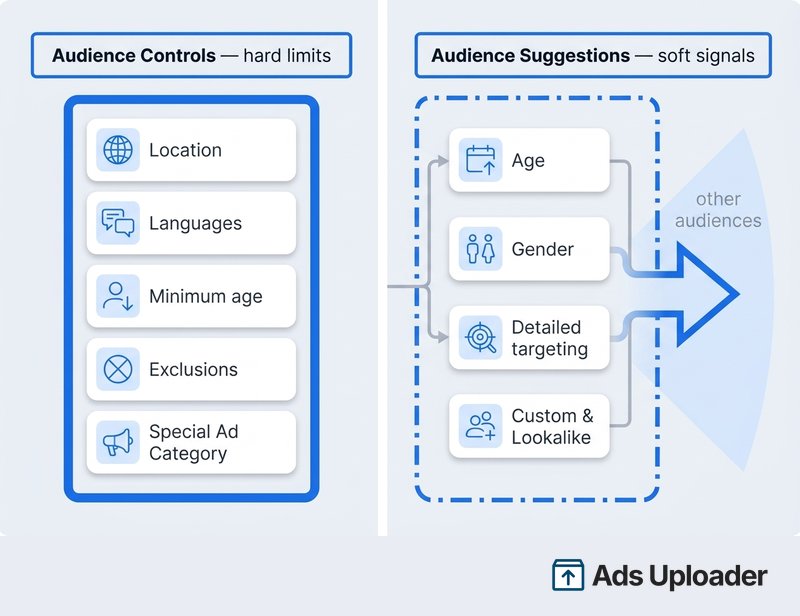
Meta audience targeting is the set of inputs that tell Meta who should see an ad. In 2026 those inputs split into two categories: hard controls (location, languages, minimum age, exclusions, Special Ad Category) and audience suggestions (age, gender, detailed targeting, custom and lookalike audiences). Suggestions steer Meta's AI but do not bind it, so ads can reach people outside your defined audience when the system predicts better performance. Four audience types still exist: core/detailed, custom, lookalike, and Advantage+. Recommended audience size remains 2 to 10 million people.
You have probably read a "every Meta targeting option explained" article in the last month. It was technically accurate and practically misleading, because almost all of them describe targeting as if it were still 2021: pick interests, stack behaviors, narrow until the audience meter turns yellow, launch.
That mental model is broken. Not because the options disappeared, but because Meta changed what they do. In most current campaign flows, the interest stack you carefully assemble is labeled an "audience suggestion." Meta's own Help Center says it will show ads "to people matching your suggestion, and other audiences when it's likely to improve performance." Your audience is now a hint, not a filter.
This guide covers what each option still does, why the behavior changed, a decision framework for what to actually run in 2026, and how to test audiences when Meta's own reporting can't always tell you which one worked.
What Meta Audience Targeting Means Now
The old definition: audience targeting is how you tell Meta exactly who to show your ad to.
The 2026 definition: audience targeting is how you tell Meta's AI who you'd prefer to reach, after which the system decides how literally to take you.
The single most important distinction in modern Meta Ads is controls versus suggestions. Meta now splits your ad-set inputs into two buckets:
- Audience controls are hard guardrails. Location, languages, minimum age, exclusions, and Special Ad Category restrictions are respected. Meta states plainly that "audience suggestions won't be shown outside your audience controls."
- Audience suggestions are soft inputs. Age, gender, detailed targeting, and custom or lookalike audiences "share information with our AI about the audience you want to reach. Ads will also be shown to other audiences when it's likely to improve performance."
Even age and gender are suggestions by default in current flows, only minimum age remains a control. That is a genuine break from how most advertisers still think about the platform.
Keep this constraint-versus-command idea in mind for the rest of this guide. Every targeting decision in 2026 is really a decision about how much you trust Meta's delivery system and how strong your other signals, pixel data, creative, offer, actually are.
The Four Meta Audience Targeting Options (and What Each Still Does)
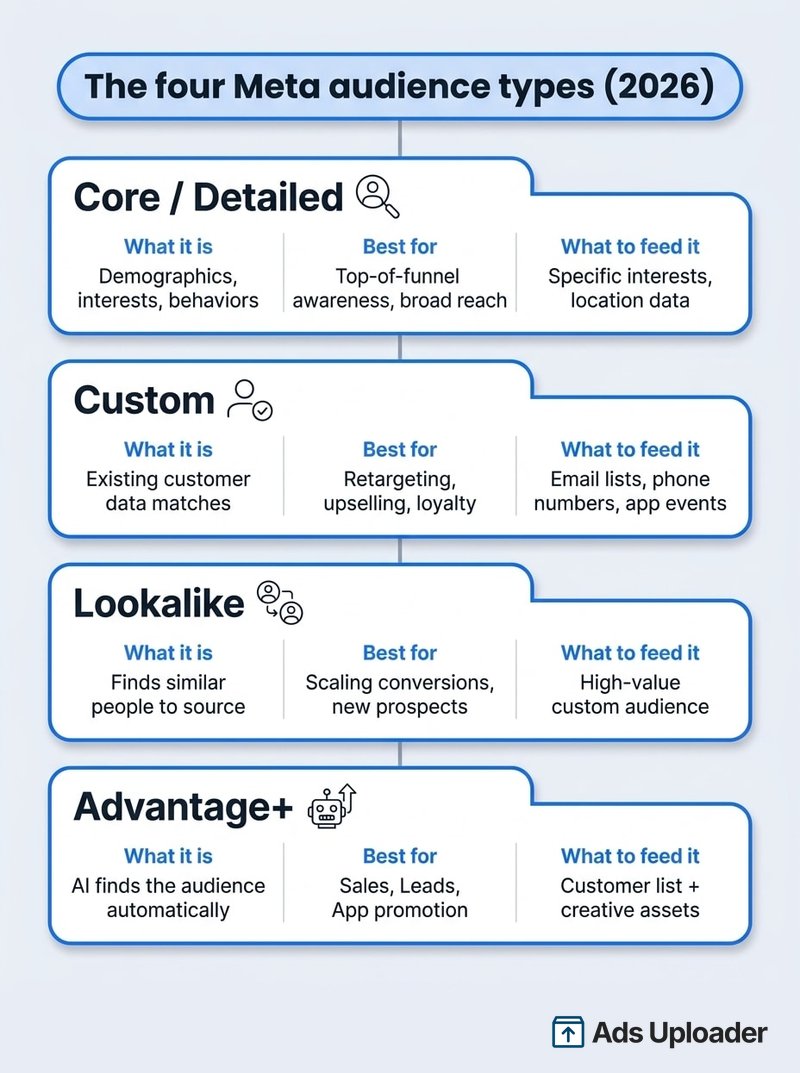
The canonical spine hasn't changed. What each rung does has.
Core and Detailed Targeting
This is location, age, gender, languages, plus the detailed targeting menu of interests, behaviors, and demographics. Meta builds these segments from a mix of what users tell it (profile data) and what it infers (engagement, on-platform behavior).
Detailed targeting still exists, but Meta now describes the options you add as "audience suggestions by default, which means we'll show ads to people matching your suggestion, and other audiences when it's likely to improve performance." The menu has also shrunk. Meta began removing sensitive interest categories, health conditions, race and ethnicity, political affiliation, religion, sexual orientation, trade union membership, in January 2022. It then removed detailed-targeting exclusions entirely from active campaigns on March 31, 2025. You can no longer exclude an interest or behavior; that lever is gone.
In current UI, the more manual setup is often tucked behind labels like "Switch to setup with more controls" or "Further limit the reach of your ads." It's still there. It's just no longer the default path.
Custom Audiences
Custom audiences are built from your own data or Meta engagement data. The current source types include website visitors (via pixel), customer lists, app activity, offline activity, and engagement audiences across Facebook Pages, Instagram accounts, video, lead forms, events, Instant Experiences, shopping, and catalog interaction. For every source type, the setup steps, and the rules that decide match quality, see the full guide to how to build a Facebook custom audience.Retention windows vary by type. Website custom audiences hold up to 180 days (up to two years for purchase events). Facebook Page, Instagram, and event engagement go up to 365 days. Shopping engagement holds up to 180 days. Lead-form engagement is commonly cited at 90 days. These are your warmest signals, best used for retargeting and as lookalike seeds. One caveat for 2026: from September 2, 2025 Meta began more proactively restricting custom audiences that could suggest sensitive information, so don't assume every list you could build a few years ago is still permissible.
Launch More. Click Less.
Upload hundreds of creatives at once, auto-match thumbnails to videos, and publish straight to your ad accounts through Meta's API.
Try Ads Uploader FreeNo credit card required • 7-day free trial
Lookalike Audiences
You give Meta a source, ideally your best customers, and it finds people who resemble them. Meta requires at least 100 seed members from one country and generally recommends a source of 1,000 to 5,000 people. Source quality matters more than size: a tight list of high-LTV buyers beats a sprawling list of newsletter signups.
The 1% to 10% framework still applies, where 1% is the closest match to your source and larger percentages trade similarity for reach. In 2026, Meta has folded the old "lookalike expansion" into a feature now called Advantage+ lookalike, explicitly described as "previously known as lookalike expansion." Lookalikes didn't die; they got absorbed into the suggestion-based delivery logic. The seed-audience rules, percentage tiers, and current setup flow are covered in the dedicated lookalike audiences guide.Here's the practical upgrade nobody states plainly enough: in 2026 you usually shouldn't build a lookalike at all. The stronger move is to feed your customer list and engaged-customer lists directly into Meta as a custom audience, then hand that to Advantage+ as a suggestion and let the system find more people like them. This has effectively replaced the old "build a 1% lookalike and let the machine run" workflow, because Advantage+ already does the look-alike modeling internally, and it does it on richer signal than a static seed list. The rule of thumb for any business: wherever you have first-party data (purchasers, subscribers, high-LTV segments, recent engagers), give it to Meta as the starting point. It is the single highest-quality suggestion you can provide, and the practitioner consensus through 2025 and 2026 is that first-party data quality now beats interest stacks and manually built lookalikes alike.
Advantage+ Audience
This is the default audience mode for Sales, App promotion, and Leads objectives, Meta confirms "the Audience section shows Advantage+ on. This is the same as Advantage+ audience." Meta describes it as using "Meta's advanced AI to find their Meta ad campaign audience."
Three terms get conflated constantly, so be precise:
- Advantage+ Audience is the full ad-set audience mode. The AI finds the audience using your controls as limits and your suggestions as priors.
- Advantage+ detailed targeting is a narrower expansion layer that lets Meta "reach a broader group of people than you defined in your detailed targeting selections."
- Original audiences is the manual path, where, in Meta's words, "Advantage+ audience typically gets better results compared with the original audience options. This is because our AI is not limited to delivering ads to people that match your selections."
That last quote is the whole story in one sentence: the AI is not limited to your selections.
Why Targeting Behaves Differently in 2026
Two forces collided: privacy law removed signal, and machine learning replaced what was left.
The privacy timeline is well-known, Apple's tracking changes, regulatory pressure, and Meta's own category removals stripped out a lot of the deterministic data that made narrow interest targeting precise. But the more interesting half is the delivery system that filled the gap.
In late 2024 Meta introduced Andromeda, described by its engineering team as "reimagining personalized ads retrieval at Meta scale," with "10,000x more model capacity" than the previous neural retrieval system and a "100x improvement in feature extraction model latency and throughput." Around the same time, Meta said sequence learning is now "at the core of our ads recommendation system," modeling "the order and timing of user interactions" rather than static interest labels.
It kept going. Meta's Adaptive Ranking Model, launched on Instagram in Q4 2025, delivered a reported +3% ad conversions and +5% click-through rate for targeted users while scaling toward roughly a trillion parameters. Meta's January 2026 newsroom post said it "doubled the GPUs used to train GEM" and credited a 3.5% lift in Facebook ad clicks and a >1% gain in Instagram conversions in Q4 2025.
The practical consequence for you: when a system processes that many behavioral signals per impression, a hand-built list of five interests is a rounding error. Narrow no longer means precise. Broad plus a strong conversion signal usually beats narrow plus weak signal, and the "signal" that matters most is your pixel/CAPI data and your creative, not your interest stack. (Worth pairing this with how you measure outcomes; our guide to Meta's detailed-targeting changes and our own incremental attribution explainer cover why reported numbers can mislead here.)
How to Choose: The 2026 Audience Decision Framework
Stop asking "which interests should I pick?" Start asking "what's my goal, how much data do I have, and how big is my budget?" Those three inputs determine the answer.
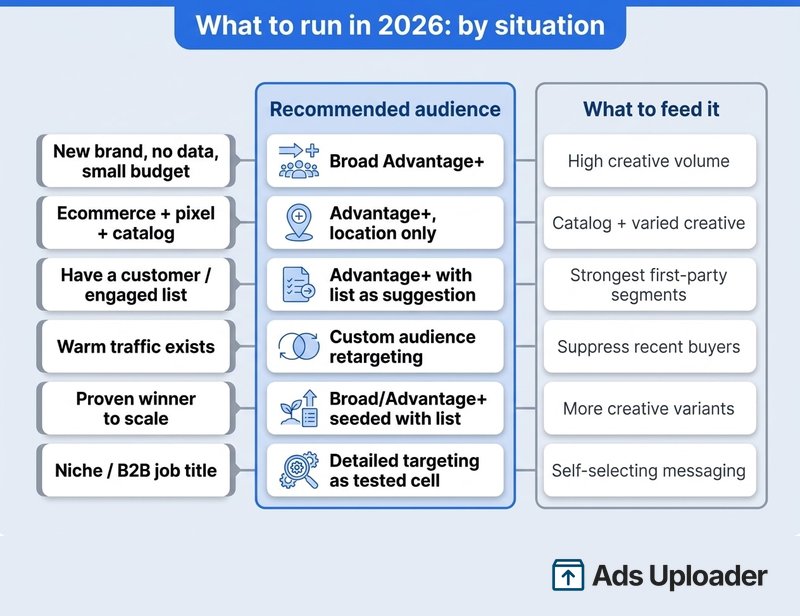
| Situation | Recommended audience | What to feed it |
|---|---|---|
| New brand, no pixel data, small budget | Broad Advantage+ Audience | High creative volume; strong offer; conversions API set up |
| Ecommerce with pixel + catalog | Advantage+ (Shopping-style) with location control only | Catalog, product feed, varied creative |
| You have a customer list or engaged-customer data | Advantage+ with the list fed in as a custom-audience suggestion | Your strongest first-party segments; suppress existing buyers |
| You have warm traffic (site, video, engagers) | Custom audience for retargeting + broad prospecting alongside | Suppression of recent buyers; sequential creative |
| A proven winner you want to scale | Broad / Advantage+ seeded with your customer list | More creative variants before more audiences |
| Genuinely niche or B2B by job title | Detailed targeting as a tested cell vs. broad | Tight messaging that self-selects the audience |
The point of the table is consolidation. In almost every row, the answer is "go broader and let creative do the qualifying," with detailed targeting demoted to a thing you test against broad rather than your default. That single shift replaces most of the contradictory advice floating around.
The Learning Phase and Audience Size, Demystified
Two numbers get repeated as folklore. Here's what they actually mean.
2 to 10 million. Meta's current guidance recommends "a size between 2,000,000-10,000,000 people" for most audiences. This isn't arbitrary. Smaller audiences give the auction fewer opportunities to find the cheapest qualified impression, so Meta warns directly that "low audience size can cause your cost per result to be at least twice as much" and that "smaller target audiences tend to cost more to reach." Narrow feels safer and is usually more expensive, and a small pool also fatigues faster because the same people see your ads more often.
~50 conversions per week. Meta says "ads exit the learning phase as soon as the system has gathered enough information, typically around 50 optimization events within 7 days." Until then, delivery is unstable and costs are inflated. An ad set becomes learning limited when it's "limited by small audience size, low budget, low bid or cost control, too many ads, or high auction overlap." Notice how many of those are self-inflicted by over-segmentation.
One under-discussed detail: the estimated audience size meter is a setup diagnostic, not a delivery promise. Meta says it "will not reflect the total number" of reachable accounts when Advantage+ expansion is active, and that it is "not a proxy" for monthly or daily active users. Treat the meter as a sanity check, not a forecast.
Save Hours on Creative Testing
Stop uploading ads one by one. Bulk process unlimited creatives with automatic media matching and direct API publishing.
Try Ads Uploader FreeNo credit card required • 7-day free trial
How to Actually Test Meta Audiences
Here's the operator problem nobody's article addresses honestly: Meta's built-in reporting often can't tell you which audience worked. You cannot reliably break results out by interest or by custom-audience type after the fact. If you stuff two interests into one ad set, you'll never cleanly know which one carried it.
So testing has to be designed in, not extracted later:
- One variable per ad set. If you're testing Audience A vs. Audience B, the ad sets must be identical except for the audience, same creative, same budget, same optimization, same placements.
- Use exclusions to prevent overlap. Audience overlap means, in Meta's words, "multiple ads from your Page may enter the same ad auction," which can "lead to poor delivery." Mutually exclude test cells.
- Hold the cell long enough to exit learning. A test that never reaches ~50 events per week is measuring noise, not audiences.
- Don't over-segment the budget. Five tiny ad sets that each stay learning-limited tell you nothing. Two well-funded cells tell you something.
The friction here is operational: building five or ten identical-except-the-audience ad sets by hand, correctly, every time you want a clean read, is exactly the repetitive work that introduces errors. This is the workflow Ads Uploader was built for, spinning up consistent audience-test ad sets from a reviewable spec so the only thing that varies is the variable you're testing. If you're running these at volume, our breakdown of the best bulk ad launch approach for Meta walks through the structure.
And remember the post-click half. In-platform numbers are increasingly directional, not gospel. Pair every audience test with analytics beyond the platform, UTMs and a real read on what happened after the click. Our guide to Meta click attribution covers why the platform's own view drifts from reality.
Creative Is Now Part of Targeting
When the audience is broad and your inputs are suggestions, the creative is the targeting. The ad itself selects the audience: a video that opens "Nurses, this one's for you" will out-target any interest segment, because Meta's system reads who responds and finds more of them.
The data backs this hard. Motion's 2026 creative benchmark analyzed over 550,000 ads from 6,000+ advertisers across roughly $1.3 billion in spend, and found only 5–8% of ads become real winners while around 50% get little or no spend. Andrew Foxwell summarized the era bluntly: "In 2026, the main limitation for Meta ads is not targeting, but creative volume and interpretation."
Practically: you feed the AI by giving it volume and variety to learn from, not by hand-narrowing who it can reach. Studying which angles competitors are actually getting delivery on in the Meta Ads Library is the cheapest source of that variety. Then you make sure the post-click experience matches the promise, testing landing pages is part of the same loop, which we cover in split testing landing pages for Meta ads.Common Meta Audience Targeting Mistakes
- Relying solely on stacked interests. Detailed targeting is a suggestion now. Treat it as a test cell, not a strategy.
- Over-narrowing the audience. Smaller is not more precise; Meta's own docs say it costs more and risks learning-limited delivery.
- Trusting exclusions to be perfect. Custom-audience exclusions work for clear suppression, recent purchasers, active customers. Detailed-targeting exclusions no longer exist at all (removed March 31, 2025). There's no public, universal match-rate benchmark, so treat exclusions as strong-but-imperfect.
- Ignoring audience overlap. Overlapping ad sets compete in the same auction and degrade delivery. Consolidate or mutually exclude.
- Optimizing to inflated in-platform numbers. If your only scoreboard is Ads Manager's reported conversions, you're optimizing a number the delivery system is increasingly authoring. Validate against incrementality and post-click data.
Frequently Asked Questions
What are the different targeting options available in Meta Ads in 2026? A hybrid of audience controls (location, languages, minimum age, exclusions, Special Ad Category) and audience suggestions (age, gender, detailed targeting, custom and lookalike audiences). Manual "original audience" setups still exist but are hidden behind "more controls" language.
Does detailed or interest targeting still work in 2026? Yes, but Meta labels your selections an "audience suggestion by default" in most flows, so ads can deliver to people beyond your selections. Sensitive categories were removed starting January 2022 and detailed-targeting exclusions were removed March 31, 2025.
What's the difference between Advantage+ Audience, audience expansion, and original audiences? Advantage+ Audience is the full AI-driven ad-set audience mode. Advantage+ detailed targeting and Advantage+ lookalike are narrower expansion layers on a manual starting point. Original audiences is the more constrained manual path.
How big should a Meta audience be? Meta recommends 2 to 10 million for most audiences and warns that smaller, more specific audiences raise costs and cause learning-limited delivery.
How large should a lookalike source audience be? At least 100 from one country; 1,000 to 5,000 recommended. The 1% to 10% similarity range still applies.
What's the best targeting strategy on a limited budget? Consolidate. Fewer ad sets, broad prospecting, only essential exclusions. Don't atomize the account into narrow cells unless running a deliberate A/B test.
Do exclusion audiences still work? Custom-audience exclusions do, for clear suppression like recent purchasers. Detailed-targeting (interest/behavior) exclusions were removed in 2025.
Should I use broad or detailed targeting? Lean broad when conversion signal is healthy and creative does the qualifying. Use detailed targeting as a tested cell for niche or low-data accounts, not as a default.
What It Comes Down To
Meta audience targeting in 2026 looks the same on the surface and behaves completely differently underneath. The four audience types still exist, but your inputs are now suggestions the AI can override, the manual path is hidden behind "more controls," and the system processes more behavioral signal per impression than any interest stack could ever encode.
So the playbook inverts. Choose your audience by goal, data maturity, and budget, not by hunting interests. Go broader than instinct says and let creative do the qualifying. Test by isolating one variable per ad set, because Meta's reporting won't reconstruct it for you. And measure against incrementality and post-click reality, not just Ads Manager's increasingly self-authored numbers.
The direction of travel is more automation, not less. The advertisers winning in 2026 aren't the ones with the cleverest interest stacks, they're the ones who built a fast, repeatable process for feeding the system strong signals and clean tests. If your workflow starts with a folder of creatives and ends with real budget on the line, that process is the edge. Ads Uploader exists to make the launch-and-test half of it fast enough to actually do.