Facebook lead ads for real estate are Meta's Leads-objective ads that let agents collect buyer and seller contact details inside Facebook or Instagram through an instant form, with no website needed. A prospect taps the ad, a pre-filled form opens, and they submit name, phone, and any qualifying answers in a few taps. Real estate ads run under Meta's Housing Special Ad Category, which limits targeting, so lead quality comes from form design and fast follow-up. Low friction means cheap, high-volume leads that demand qualification.
Real estate lead ads are the cheapest way to fill a pipeline on Meta, and the fastest way to end up with a CRM full of people who barely remember tapping your ad. That tension is the whole story. The instant form that makes leads so cheap is the same thing that floods you with tire-kickers. If you have run real estate ads before and walked away thinking "Facebook leads are garbage," the leads were not the problem. The setup was.
This guide is the real-estate-specific version. If you want the mechanics of the format itself, start with our full breakdown of how Facebook lead ads work, then come back here for the agent playbook: the exact form fields and qualifying questions for buyers, sellers, and investors, the lead-quality levers, the follow-up math, and the Housing compliance rules you cannot skip. After years of running Meta lead gen across accounts and verticals, I can tell you the agents who win are not the ones with a secret audience. They are the ones whose form and follow-up do the qualifying that Meta's targeting no longer can.
Why Facebook Lead Ads Work So Well for Real Estate
Real estate is a local, visual, relationship-driven business, which happens to be exactly what Meta is good at. You can put a scroll-stopping listing photo or a "what's your home worth?" hook in front of people in your service area, and capture their interest before they ever leave the app.
The in-platform instant form is the unlock. Sending a mobile user from an ad to a slow IDX site and asking them to type their details is where most leads evaporate. The instant form pre-fills name, email, and phone from their Meta profile, so completion rates stay high. For a buyer scrolling on their couch, the difference between "tap, tap, done" and "load a website, find the form, type everything" is the difference between a lead and a bounce.
The economics are the other draw. Across many US markets, agents report Facebook and Instagram lead costs in the rough range of $10 to $30 per lead, with wide variance by market and ad quality. Portal leads from sites like Zillow or Realtor.com commonly run several times that, and are often shared across multiple agents. The numbers move constantly, so treat them as a starting estimate and read our deeper take on real estate cost per lead before you budget. The point stands either way: lead ads are a volume-and-value channel.
And there is the catch that sets up the rest of this guide. Cheap plus frictionless equals a lot of low-intent leads. The volume is real, but so is the cleanup. Quality is not something you buy with a bigger budget. You build it into the form and the follow-up.
The Housing Special Ad Category: Read This Before You Launch
If your ad is about buying, selling, renting, or financing property in the US, you are required to declare the Housing special ad category in Ads Manager. This is not optional, and Meta actively blocks or disapproves housing-related ads that try to run without it. The rule traces back to a 2019 fair-housing settlement.
Declaring Housing changes what you can target. Meta removes the levers that could be used to discriminate:
- No age or gender targeting. Your ad serves to adults of all ages.
- No ZIP code targeting. You target by city, region, or a geographic radius, and Meta enforces a minimum radius of 15 miles. No micro-targeting a single neighborhood.
- No income, demographic, or detailed financial-interest filters.
- No standard Lookalike Audiences. They are replaced by a Special Ad Audience, which models behavior without the protected attributes.
You can read the current specifics in the Meta Business Help Center entry on special ad categories, since the details shift over time.
The copy rules matter just as much. Under the Fair Housing Act, your ad text cannot imply a preference for or against a protected group. Agents are routinely surprised by how broad this is. Phrases like "perfect for newlyweds," "great for empty nesters," "ideal for a young family," "within walking distance," or "safe neighborhood" can all get an ad disapproved, because they signal family status, age, or mobility. Write in neutral terms about the property and the offer, not the person you imagine buying it.
Here is the productive way to read all of this. Meta took away your targeting scalpel, so your creative, your offer, and your form now do the qualifying. That is not a workaround. It is the entire premise of the sections below.
Real Estate Lead Form Fields and Qualifying Questions
This is where most agents leave money on the table, and where you can pull ahead. The default lead form asks for name, email, and phone, and that is exactly the form that fills your CRM with junk. Every qualifying question you add trades a little volume for a lot of intent.
Two quick settings first. Choose a Higher Intent form over More Volume for most real estate campaigns. Higher Intent adds a review-and-confirm step before submission, which trims the accidental taps. And prioritize the phone field over email. Agents close on the phone, not over a newsletter.
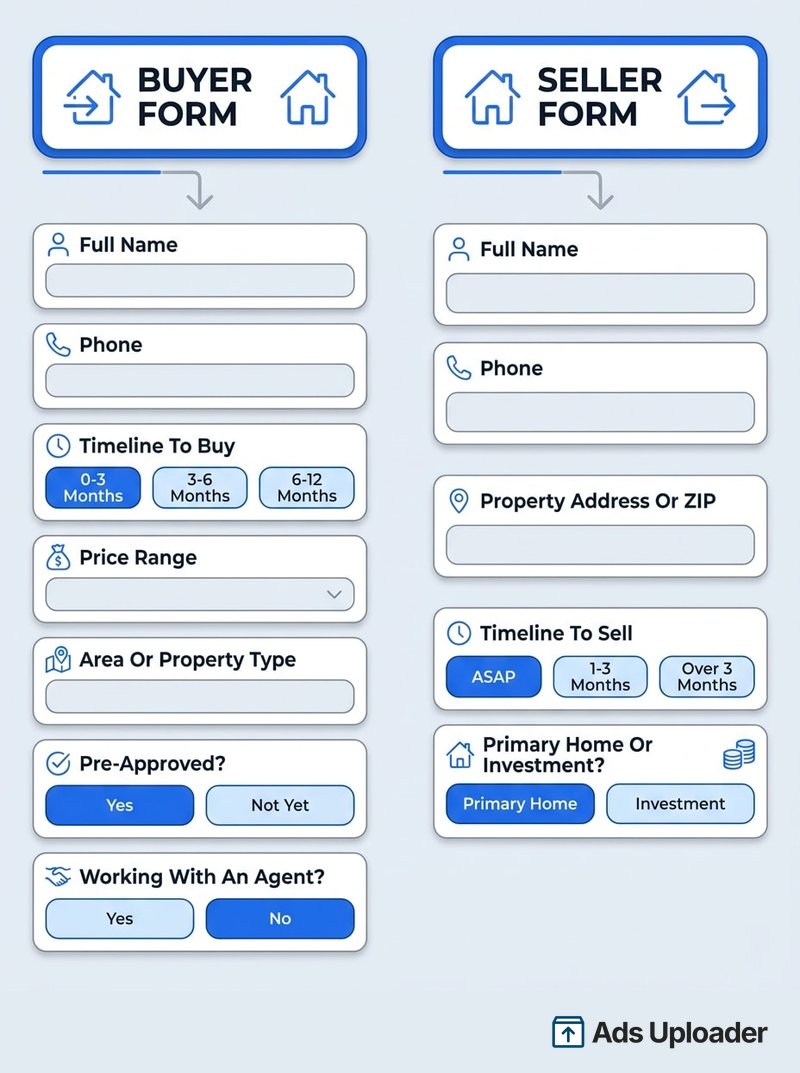
Then add one to three qualifying questions, matched to who you are after. Meta supports up to 15 custom questions and simple conditional logic, but resist the urge to use them all. Three to five total fields is the sweet spot. Here is a starting set by intent.
Buyers
- When are you planning to buy? (0 to 3 months / 3 to 6 / 6 to 12 / just browsing)
- What is your price range? (ranges as multiple choice)
- Which area or property type are you after?
- Are you pre-approved for a mortgage? (yes / not yet)
- Are you already working with an agent? (yes / no)
Sellers
- What is the property address or ZIP? (the input for a valuation offer)
- When are you looking to sell? (now / 3 to 6 months / just curious)
- Is this your primary home or an investment property?
Investors
- What is your budget or buying power?
- Cash or financed?
- Are you looking to rent or flip?
- Which markets or property types?
Use multiple-choice ranges instead of open text wherever you can. "Select your budget" gets answered; "Type your budget" gets abandoned. The "already working with an agent?" question alone filters out a surprising share of dead-end buyer leads, and the timeline question tells your follow-up team who to call first.
One compliance note that ties back to the last section: a qualifying question about timeline, budget, or financing is fine. A question that sorts people by a protected characteristic is not. Keep the qualifiers about the transaction, never the person.
Launch More. Click Less.
Upload hundreds of creatives at once, auto-match thumbnails to videos, and export directly to Meta Ads Manager.
Try Ads Uploader FreeNo credit card required • 7-day free trial
Lead Magnets That Actually Convert for Agents
A form only gets filled if the offer is worth the tap. The lead magnet is the offer, and the strongest ones map cleanly to intent:
- Home valuation ("What's your home worth in today's market?") pulls sellers and is the workhorse of real estate lead gen.
- Curated home lists ("See every home under $400K in [area] with a pool") pull active buyers.
- New-construction or incentive lists work because builders offer perks a resale cannot match.
- Coming-soon and off-market access creates urgency and exclusivity.
- Just-sold and market reports position you as the local expert and quietly attract sellers wondering about their own value.
- First-time buyer guides capture early-stage buyers you can nurture.
The one rule that beats all the others: your promise has to equal your deliverable. If the ad says "instant valuation," the prospect should not wait two days for a generic email. The gap between what you promised and what you deliver is where good leads go cold, which brings us to the two things that actually decide whether these leads turn into deals.
The Lead Quality Problem, and How to Fix It
Let me be blunt about the failure mode, because pretending it does not exist helps no one. A poorly built real estate lead campaign can return junk rates of 50% to 80%: wrong numbers, "just looking" browsers, people who forgot they tapped. That is not Meta being broken. It is the predictable result of a one-tap form with no qualification.
The fix is a stack of levers, not a single switch:
- Form-level qualification. Higher Intent form plus the one to three questions from the section above. This is your first and cheapest filter.
- Phone verification. Meta's form builder can require a one-time code to verify the phone number, which knocks out the obviously fake submissions. Turn it on for high-value campaigns.
- Conversion Leads optimization. This is the lever most agents never pull. Instead of optimizing for raw form fills, you send CRM outcomes back to Meta through the Conversions API: contacted, appointment set, listing consult booked, qualified, closed. Delivery then learns to find people who look like your good leads, not just your easy leads. It takes setup, but it is the difference between Meta optimizing for quantity and optimizing for revenue.
- Disqualify in the copy. A headline like "For homeowners serious about selling in the next 6 months" pre-filters before anyone taps.
And reframe the metric you are chasing. A higher cost per lead with better leads usually beats a rock-bottom cost per lead of people who never answer the phone. Cheapest is not the goal. Cheapest-that-closes is.
Speed to Lead: The Follow-Up System That Closes
You can do everything above right and still lose, because in real estate the lead is won or lost in the first few minutes. The often-cited lead-response research from MIT found that contacting a web lead within five minutes, rather than thirty, makes you far more likely to reach and qualify it, and the odds fall off a cliff with each passing minute. Industry lore in real estate is even blunter: the first agent to respond usually gets the client.
Lead ads make this harder in one specific way. The lead never leaves Facebook, so without automation it sits quietly in your Leads Center while the prospect moves on or fills out three competitors' forms. Speed is not a nice-to-have here. It is the mechanism.
So build the system:
- Instant sync. Connect the lead form to your CRM with the Conversions API, a webhook, or a native integration, so a new lead triggers an alert in seconds, not on tomorrow's CSV export.
- First touch in five minutes. A call if you can, a text if you cannot. "Hi, saw you asked about homes under $400K in [area], are you hoping to move this year?" beats a polished email an hour late, every time.
- A real cadence. Expect that only a slice of leads answer on the first attempt. Make five or more touches across calls, texts, and email over the following days, and log every one in the CRM.
Fast and human wins. Slow and perfect loses.
Save Hours on Creative Testing
Stop uploading ads one by one. Bulk process unlimited creatives with automatic media matching and direct API publishing.
Try Ads Uploader FreeNo credit card required • 7-day free trial
Lead Ads vs Conversion Ads for Real Estate
Lead ads are not always the right call. The decision comes down to your offer and your follow-up.
Reach for lead ads when the offer is simple and the follow-up is fast: valuations, "homes under $X" lists, buyer and seller opt-ins, open-house RSVPs. They are mobile-first, cheap, and quick to launch with no landing page.
Reach for conversion ads that send people to your own site or IDX when you need a richer experience, higher purchase intent, or stronger first-party tracking: a full property search, a branded luxury presentation, or a retargeting funnel where the pixel and Conversions API signal matter more.
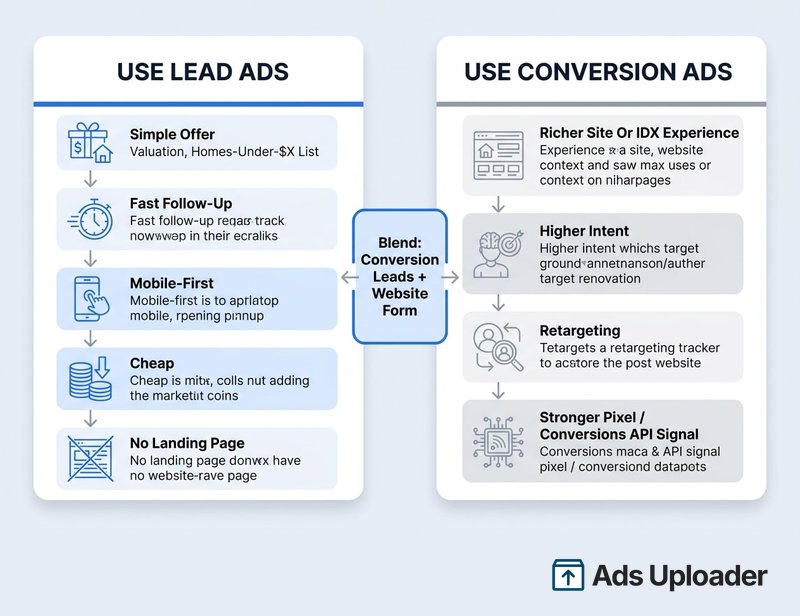
If you cannot decide, the blended move is a Conversion Leads campaign pointed at a website form, which keeps some of the lead-ad speed while giving you a page you control. For most agents starting out, in-platform lead ads are the faster path to a full pipeline, and you graduate to conversion campaigns as your site and tracking mature.
Scaling Real Estate Lead Ads With Volume and Testing
Here is the trap almost every agent falls into: they build one "list of homes" ad, it works for a while, and they run it into the ground. That is not a campaign. It is a single bet.
Because lead ads are cheap, the real constraint is not budget, it is how many combinations you test. Buyer angle versus seller angle. Valuation offer versus listings offer versus market report. Higher Intent form versus More Volume. Video walkthrough versus single image versus carousel. Each is a small experiment, and the winners are rarely the ones you would have guessed.
So build a small matrix instead of a single ad. Pick two or three offers, two or three creatives, and a couple of form variants, launch them together, kill the losers in a week, and pour budget into what closes. The agents who treat lead gen as a testing program, not a one-time launch, are the ones with a pipeline that does not dry up when a single ad fatigues. New construction has incentives a resale lacks. A market-update angle lands with investors that a listing photo never would. You only find those edges by running them side by side.
Wrapping Up
Facebook lead ads give real estate agents the cheapest in-platform leads on the internet, and that is exactly why they require discipline. The Housing special ad category strips out your targeting, so the work shifts to the parts you control: a Higher Intent form with the right buyer, seller, or investor questions; a lead magnet whose promise matches its deliverable; a Conversions API loop that teaches Meta what a good lead looks like; and a follow-up system that calls within five minutes. Get those right and the junk-lead complaint disappears.
Pick lead ads when the offer is simple and your speed-to-lead is genuinely fast, lean on conversion ads when you need a richer page and stronger tracking, and treat the whole thing as a testing program rather than a single ad you set and forget. The agents filling their calendars with real estate Facebook lead ads in 2026 are not lucky. They built a form and a follow-up that do the qualifying, and then they tested enough to find what converts.