Facebook lead ads cost per lead (CPL) equals total ad spend divided by completed instant-form submissions. In 2025 the cross-industry average sat around $27.66, up roughly 21% year over year, with verticals ranging from about $3 for restaurants to $77 for dentists. On-platform lead forms produce the cheapest leads but often the lowest intent, so the number that actually matters is cost per qualified lead. A profitable CPL is one that clears your break-even, not simply a low one.
Picture two advertisers reporting the same $40 cost per lead. One closes a steady stream of customers and reinvests happily. The other is drowning in spreadsheets full of fake phone numbers and people who do not remember filling anything out. Same CPL, opposite outcomes. That gap is the whole point of this article, because the headline number you obsess over tells you almost nothing about whether the campaign is working.
If you are still deciding whether the format fits your business, or you need a refresher on how the instant form actually works, start with our complete Facebook lead ads guide. This piece picks up where benchmarks usually stop. We will reconcile the wildly different CPL figures floating around the web, give you a straight answer on whether lead ads are effective, and then walk through the one lever that matters most: cutting junk leads so your cost per qualified lead drops even when your raw CPL ticks up.
After years of running Meta Ads across local services, ecommerce, and B2B accounts, I have learned that a cheap lead is not the goal. A lead your sales team is glad to call is the goal. Those are not the same thing, and chasing the first one blindly is how good budgets quietly leak.
How Facebook Calculates Cost per Lead
The formula is simple. Cost per lead is total amount spent divided by the number of leads recorded. Meta's own help docs define it that way, and on the Lead Generation objective the platform logs a "lead" only when someone successfully submits your instant form.
One wrinkle trips people up constantly. The label you see in Ads Manager depends on the campaign objective. Run the lead generation objective with an on-platform form, and your results show up as "leads" with a clean cost per lead. Run a conversion campaign that sends traffic to a landing page with its own form, and those submissions appear as "results" or conversions, optimized for whatever event you chose. Both are lead generation in spirit. Only one reports a metric literally called cost per lead, which is why two people comparing CPLs are sometimes comparing different things.
There is also a measurement caveat worth knowing. Because of iOS privacy limits and SKAdNetwork, Meta now models some conversions rather than counting each one directly. So your reported CPL can include estimated leads for privacy-limited users. It is close enough to act on, but it is not a perfect tally.
Average Facebook Lead Ads Cost per Lead in 2026 (By Industry)
Here is where the confusion starts. WordStream and LocaliQ benchmark data, reported in September 2025, put the average Facebook cost per lead at $27.66 across industries, a 21% jump from the year before. Facebook still beats Google, which often runs near $70 per lead. Live dashboard tools and agency cohorts, meanwhile, frequently report averages closer to $40 to $50. None of them are lying. They are measuring different accounts, objectives, geographies, and timeframes.
The bigger truth is that averages hide enormous spread. CPLs vary widely from industry to industry. Here is a representative cross-industry view based on the 2025 benchmark data.
| Industry | Average CPL |
|---|---|
| Restaurants & Food | $3.16 |
| Real Estate | $16.61 |
| Career & Employment | $17.64 |
| Arts & Entertainment | $18.17 |
| Attorneys & Legal Services | $18.17 |
| Sports & Recreation | $19.30 |
| Education & Instruction | $28.22 |
| Personal Services | $30.57 |
| Industrial & Commercial | $37.34 |
| Furniture | $40.04 |
| Home & Home Improvement | $41.26 |
| Physicians & Surgeons | $47.47 |
| Beauty & Personal Care | $51.42 |
| Health & Fitness | $52.98 |
| Dentists & Dental Services | $76.71 |
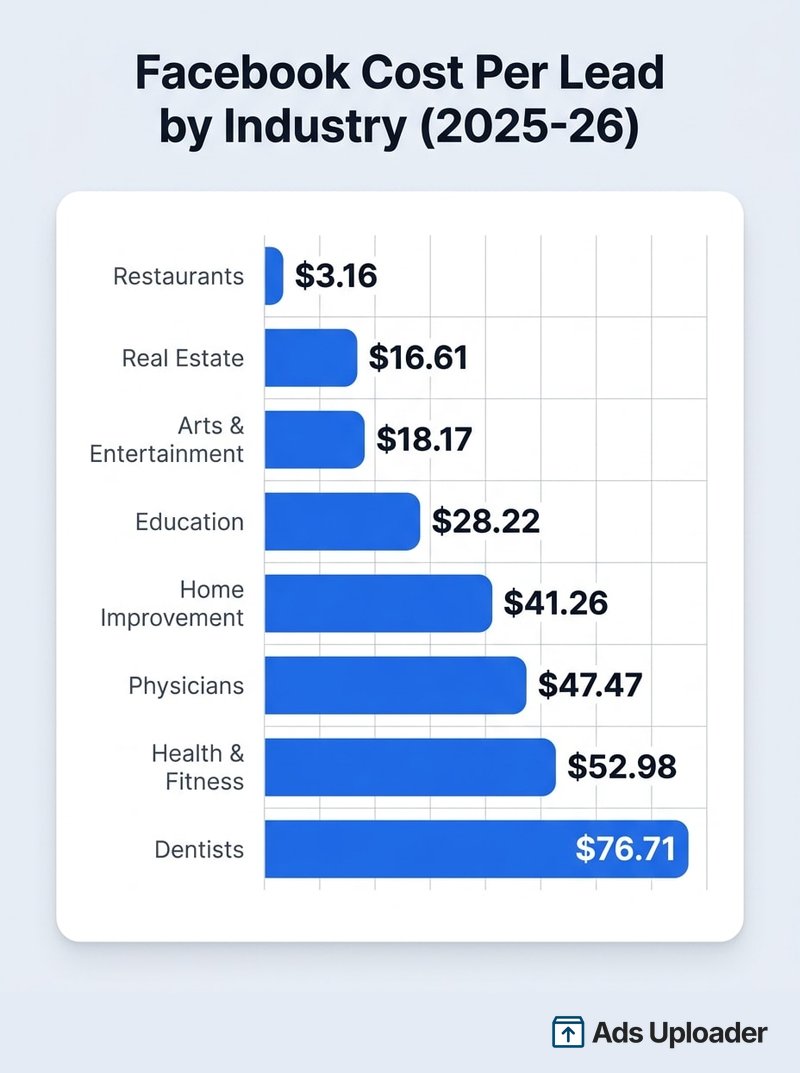
The pattern is clean once you see it. Low-ticket, broad-appeal verticals like restaurants and retail post very low CPLs because almost anyone is a plausible customer and each sale is small. High-value, regulated, or specialist verticals like dental, finance, and B2B run high because the audience is narrow and a single customer is worth a lot.
Launch More. Click Less.
Upload hundreds of creatives at once, auto-match thumbnails to videos, and export directly to Meta Ads Manager.
Try Ads Uploader FreeNo credit card required • 7-day free trial
CPL by Ad Format and Funnel Stage
Format moves the number too. One analysis of 138 Facebook campaigns found the on-platform instant form delivered the lowest cost per lead, with the other formats stacking up predictably above it.
| Ad format | Average CPL |
|---|---|
| Lead form (Instant Form) | $34.10 |
| Single image | $38.60 |
| Carousel | $41.50 |
| Video | $45.80 |
| Instant Experience | $49.70 |
Funnel stage follows the same logic. In that same dataset, bottom-of-funnel campaigns averaged $33.15, mid-funnel $42.25, and top-of-funnel $51.40. Warmer audiences who already know you convert cheaper, which is exactly why retargeting is such a reliable CPL lever.
A quick reality check from the field keeps these tables honest. In community threads, advertisers report everything from a niche pond-digging business at $16 per lead to home-services accounts in the $5 to $7 range during good months. Your account is the only benchmark that ultimately counts.
What Is a "Good" Cost per Lead on Facebook?
Every benchmark page eventually shrugs and says "it depends," then leaves you there. Let us actually finish the thought.
A good CPL is one that clears your break-even. The math is straightforward:
Break-even CPL = average customer value × lead-to-customer rate
Say 5% of your leads become customers, and the average customer is worth $1,000. Your break-even CPL is $50. At that close rate and value, a $30 cost per lead is highly profitable even though it looks high next to a restaurant's $3. Flip the numbers, and a $30 lead feeding $50 sales is a slow-motion disaster.
This is why the smartest operators stop optimizing for CPL and start optimizing for cost per qualified lead (CPQL) or cost per customer. As one benchmark author bluntly summarized it, high CPL does not always mean a bad campaign, because the metric that matters is cost per customer, not cost per lead. A dentist paying $77 per lead is thrilled when a single new patient is worth several thousand dollars over time. Raw CPL is a compass, not a verdict.
Are Facebook Lead Ads Effective? An Honest Verdict
Short answer: yes, when you match them to the right job, and no when you ask them to do work a landing page should be doing. Here is the breakdown.
Lead ads shine for top-of-funnel volume. Because users never leave Facebook, signup rates are high and the cost to capture an email or phone number is low. Event registrations, newsletter growth, content offers, and simple local-service inquiries all tend to perform well. If your sales process can nurture a larger pool of leads over time, the scale is hard to beat.
Landing pages often win on quality. When someone clicks through to your site, fills out a longer form, and reads your pitch on the way, they self-select for higher intent. Agency reports routinely show landing-page leads converting to customers at meaningfully higher rates than instant-form leads, despite a higher CPL. For high-ticket B2B or complex products that demand qualification, that tradeoff is usually worth it.
Speed to lead can decide everything. A genuine advantage of lead ads is instant CRM sync and automated follow-up. Research on lead generation consistently finds that the time between form fill and first contact matters more than the cost of the lead itself. A cheap lead called within five minutes beats an expensive lead called the next day. If your team ignores leads for hours, even great leads go cold and the format looks worse than it is.
If real estate is your world, the dynamics get specific fast, from form questions to follow-up cadence. We cover them in depth in our guide to Facebook lead ads for real estate.
The verdict: lead ads are effective at generating interest cheaply, but they trade away built-in qualification. Their success rides on your follow-up and on how you design the form, which is the part almost nobody optimizes.
Save Hours on Creative Testing
Stop uploading ads one by one. Bulk process unlimited creatives with automatic media matching and direct API publishing.
Try Ads Uploader FreeNo credit card required • 7-day free trial
Why Cheap Leads Can Cost You the Most
By design, the instant form removes friction. That is its superpower and its weakness. The same frictionless flow that lifts your volume also invites accidental taps, prefilled and mistyped email addresses, bots, and people who say "sure" to anything because it took two seconds.
As CPLs rose through 2025, several analyses flagged the same conclusion: lead ads now demand a sharper focus on quality over quantity to avoid wasted spend. When the form asks nothing of the user and pre-populates every field from their profile, you are optimizing for the path of least resistance, and the path of least resistance is full of people who will never buy.
This is the trap behind a suspiciously low CPL. A $4 lead is only a bargain if a reasonable share of those leads are real and reachable. Cut your cost per lead in half by stripping out every question, and you can easily double the share of junk, which means your cost per qualified lead actually went up while the dashboard looked like a win.
How to Cut Junk Leads and Lower Cost per Qualified Lead
The good news is that lead quality is a design problem, and design problems have levers. Here are the ones that move the needle, roughly in order of impact.
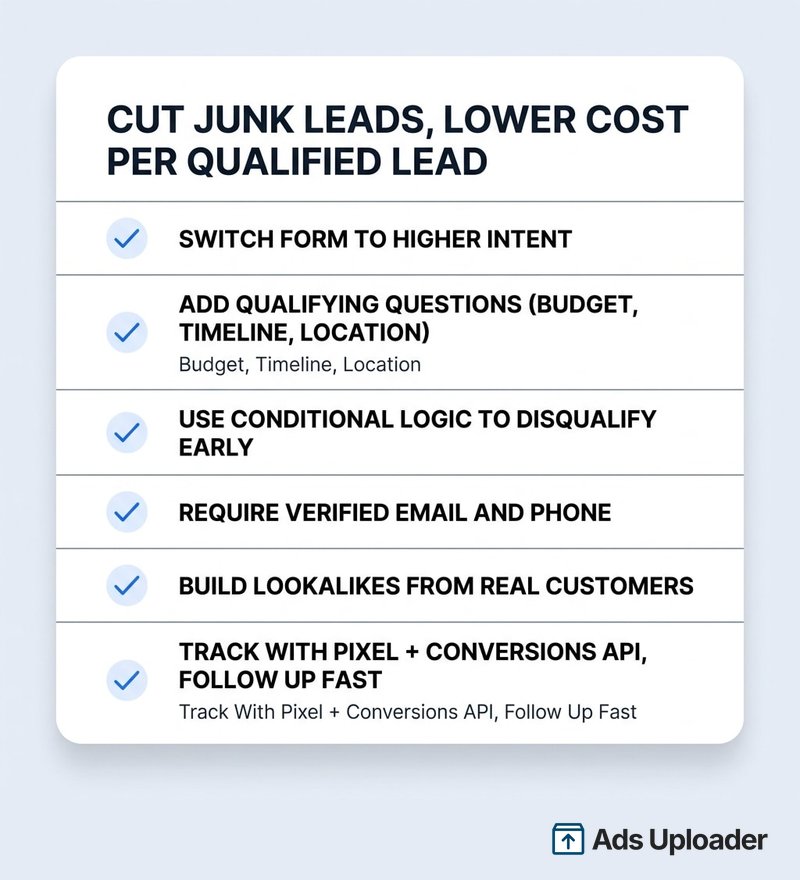
Switch the form to Higher Intent. Meta gives you two form types: More Volume (the default) and Higher Intent. Higher Intent adds a review step where the user sees their answers and confirms before submitting. It typically trims total leads, often by 20% to 30%, but it filters out fat-finger submissions and forces a moment of deliberate intent. For most lead-quality complaints, this is the first switch to flip. The mechanics of both modes are covered in our Facebook instant form guide.
Add qualifying questions. Use the form builder to insert screening fields that bad-fit prospects will not bother answering. Ask about budget ("Is your project budget above $5,000?"), timeline ("Are you looking to start within 30 days?"), or location ("Do you live within our service area?"). Multiple-choice and dropdown questions complete at higher rates and return cleaner data than open text, so use them for your key filters. Each required question is a small hurdle, and hurdles are exactly what you want when the goal is fewer, better leads.
Use conditional logic. Branching questions let you disqualify early. If someone selects "just browsing" or picks a budget below your floor, you can route them to a different ending or simply accept that they will drop. Letting the wrong people opt out before they submit is cheaper than paying your sales team to call them.
Require verified contact fields, and reconsider prefill. Keep email and phone as required fields rather than leaning on a casual nickname. Where fraud or junk is high, asking users to type their contact details instead of accepting the prefilled version adds a sliver of friction that meaningfully cuts bots and stale data.
Build audiences from converters, not raw leads. When you create lookalikes, seed them from people who actually became customers rather than from everyone who ever filled a form. You will teach Meta to find more real buyers instead of more form-fillers. Layer in retargeting of warm site visitors and past engagers, who almost always cost less per qualified lead. Counterintuitively, broadening a too-narrow audience and letting Advantage+ optimize frequently lowers CPL, because the auction has more cheap impressions to choose from.
Test creative at volume. Stale creative attracts careless clicks and rising costs. Running five to ten variations per campaign, then cutting losers quickly, keeps both your CPM and your lead quality healthier. Volume testing is the most durable CPL lever there is, precisely because it never stops paying off.
Track properly and follow up instantly. Make sure form submissions fire a real "lead" event through the Pixel and Conversions API so Meta can optimize toward people who convert, not just people who submit. Then sync to your CRM and contact new leads within minutes. Better tracking lowers your true CPL by feeding the delivery system cleaner signals, and fast follow-up rescues leads that would otherwise rot.
Notice what every one of these has in common. They often raise your raw cost per lead on paper, because you are deliberately collecting fewer, more committed leads. That is the entire trade. You are buying down the number that actually hits your bank account, which is cost per qualified lead, even as the vanity metric rises.
The Bottom Line
Facebook lead ads remain one of the cheapest ways to generate interest at scale, and in 2026 a typical cost per lead lands anywhere from a few dollars to north of $75 depending on your industry, format, and funnel stage. The cross-industry average sits in the high $20s and has been climbing, so expect to pay a bit more than you did a year ago.
But the benchmark is a starting point, not a scorecard. Three things turn a number into a result. First, judge performance by cost per qualified lead against your break-even, not by raw CPL. Second, decide honestly whether an on-platform form or a landing page fits your sales motion, and use both where it makes sense. Third, treat the form itself as a quality filter by switching to Higher Intent, adding qualifying questions, and seeding audiences from real customers.
Do that, and you stop being the advertiser drowning in fake phone numbers and become the one quietly reinvesting in a channel that works. The cheapest lead was never the goal. The lead worth calling always was.