Instagram ads cost is set by auction rather than a fixed rate card, so advertisers pay a different price for every impression and click. Meta ranks each ad on bid, estimated action rate, and ad quality, then charges the winner. Recent worldwide median benchmarks from Emplifi put Instagram Feed at $5.00 CPM and $0.70 CPC, with Stories and Reels slightly cheaper per impression. Placement, country, objective, and creative move the number far more than bidding tactics do. Budget from your target cost per result, not from a published average.
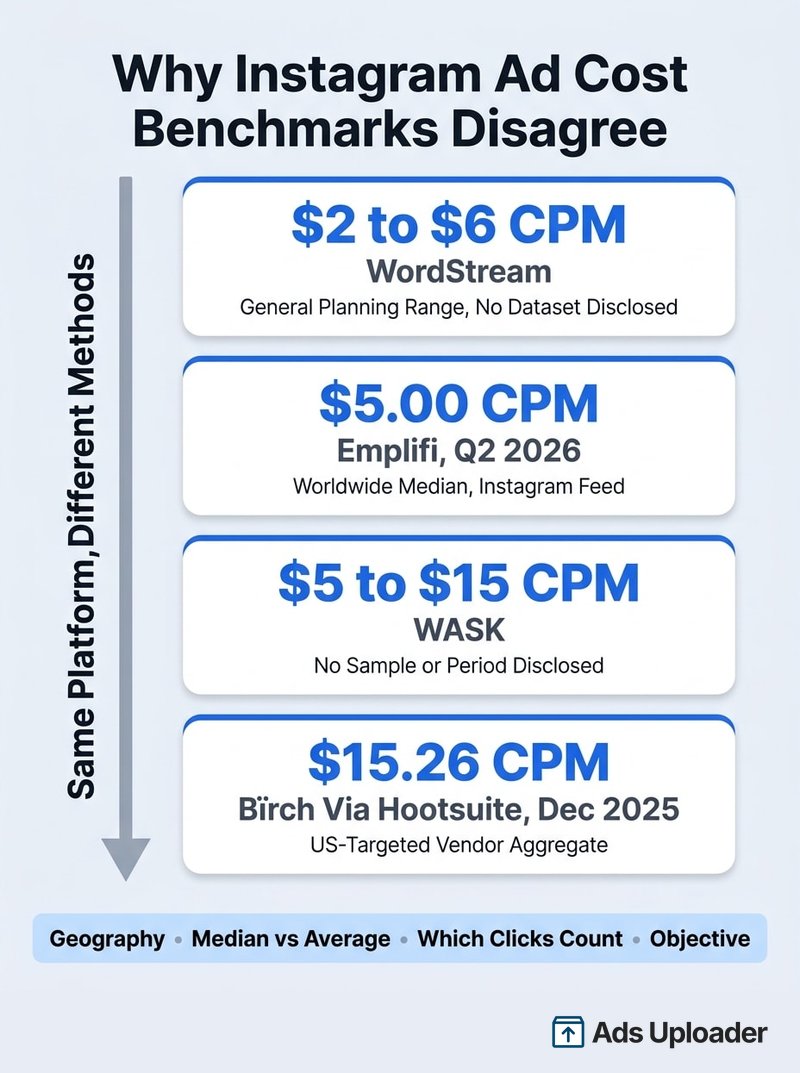
Search for what Instagram ads cost and you will find figures ranging from $2 CPM to more than $15, and click prices from a few cents to well over $3. Most of those sources are not wrong. They are measuring different countries, different placements, different click definitions, and different kinds of advertiser accounts, then publishing the result under the same three-word headline.
That is a problem when you need one number to put in a budget this week.
This guide does three things. It lays out the current benchmarks alongside who published them and what they actually measure, so you can pick the one that matches your situation. It breaks cost down by placement, since Feed, Stories, and Reels do not price identically. And it covers two cost factors that rarely appear in these articles at all: how Meta's own ad prices are trending, and a 30% payment fee that applies to one specific way of buying Instagram ads.
How Much Do Instagram Ads Cost in 2026?
There is no defensible single average. The most useful thing to know is which benchmark applies to you.
| Benchmark | Publisher and period | What it measures |
|---|---|---|
| Feed $5.00 CPM, $0.70 CPC | Emplifi, Q2 2026 | Worldwide median, all industries, by placement |
| $15.26 CPM, $1.31 CPC, $11.31 CPL | Hootsuite citing Bïrch, December 2025 | US-targeted campaigns, vendor aggregate |
| $2 to $6 CPM, $0.40 to $2.00 CPC | WordStream, current page | General planning ranges, no dataset disclosed |
| $5 to $15 CPM | WASK, current page | General estimate, no sample or period disclosed |
Those numbers look irreconcilable until you notice what separates them.
Geography. Emplifi's medians are worldwide and include lower-cost markets. The Bïrch data behind the Hootsuite figures is US-targeted. That difference alone can triple a CPM.
Median versus average. A worldwide median suppresses expensive outliers. An arithmetic average across US direct-response accounts gets pulled upward by high-value conversion campaigns.
Which clicks count. This one causes more confusion than any other. A general CPC can include link clicks, image expansions, profile taps, and reactions. A destination or link-click CPC counts only clicks heading toward your site. Bïrch flags this explicitly: its default Meta CPC includes all clicks, while its link-click metric is narrower. Two honest publishers can print CPC figures that differ by half simply because one counted every click and the other counted visits.
Objective and audience. Reach and engagement campaigns clear the auction cheaply. Purchase, lead, and narrow retargeting campaigns do not.
The practical takeaway: a benchmark is only useful when it matches your country, objective, placement, and click definition. Use the worldwide medians for directional planning, use US-targeted aggregates if you sell in the US, and treat any figure with no disclosed sample or collection period as a rough planning range rather than measured data.
One number worth ignoring entirely: a purchase cost per acquisition benchmark. No current public dataset provides a defensible cross-industry Instagram purchase CPA with a disclosed sample and attribution method, and for good reason. Your CPA depends on product price, margin, prospecting versus retargeting mix, attribution window, conversion tracking coverage, and site conversion rate. Work backward from what you can afford to pay instead.
Instagram Ad Costs by Placement
Placement is where Instagram ads cost questions actually get answered, and the current picture has more nuance than a single average captures.
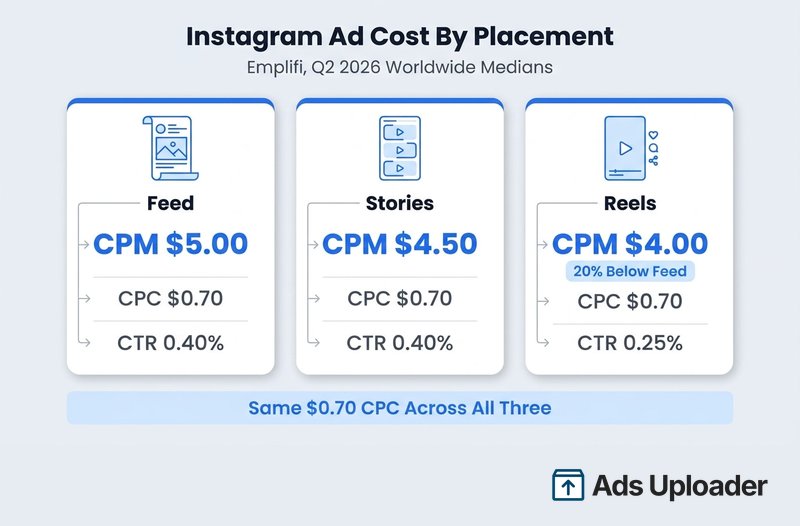
Emplifi's Q2 2026 worldwide medians, covering April through June 2026 across all industries. Worth knowing before you lean on them: Emplifi does not disclose the size of its paid-ad sample, and these are worldwide medians rather than US averages, so treat them as directional.
| Placement | CPC | CPM | CTR |
|---|---|---|---|
| Instagram Feed | $0.70 | $5.00 | 0.40% |
| Instagram Stories | $0.70 | $4.50 | 0.40% |
| Instagram Reels | $0.70 | $4.00 | 0.25% |
One detail in that table is easy to miss.
Reels bought impressions 20% cheaper than Feed. But Reels also recorded the lowest click-through rate of the three, and the result is that all three Instagram placements landed on the same $0.70 CPC. Cheaper reach did not translate into cheaper clicks.
Stories came out 10% below Feed on CPM, with identical CPC and CTR. If you have seen the claim that Stories cost 20% to 30% less than Feed, or the specific pairing of $3.35 Feed CPC against $1.83 Stories CPC, those figures come from a 2022 benchmark roundup that compiled other publishers' numbers. They circulate widely in articles dated 2026, but they are not current placement data.
The cheaper-Reels-CPM finding does hold up across sources, even though the size of the gap moves around. Tinuiti measured Reels CPM 46% below Feed among its managed US clients back in Q1 2024. Meta's own Q1 2026 SEC filing acknowledges that newer surfaces including Reels do not yet monetize at the same rate as Feed and Stories, which is platform-level confirmation of the same effect.
Reels is also taking a growing share of delivery. Across Tinuiti's managed US client portfolio, Instagram Reels went from 21% of impressions in Q2 2025 to 35% in Q2 2026. That is one agency's client base rather than Instagram's worldwide mix, but the direction is clear enough to plan around.
What This Means for Your Creative
A low CPM on a placement your creative was not built for is a false economy. If a Feed asset gets automatically reframed into a 9:16 Reels slot, you may buy impressions cheaply and lose the click anyway, which is one plausible reading of that 0.25% Reels CTR.
Producing placement-native assets is the fix. Reels and Stories want full-screen vertical video with the hook in the first second, and Feed rewards a different composition entirely. Our guide to Meta ads aspect ratios covers the right ratio for each surface, and the safe zones guide explains where Instagram's interface will cover your text if you place it badly. If you are producing at volume, the Meta ads size reference lists the specs for every placement in one table.
Launch More. Click Less.
Upload hundreds of creatives at once, auto-match thumbnails to videos, and export directly to Meta Ads Manager.
Try Ads Uploader FreeNo credit card required • 7-day free trial
Instagram vs Facebook Ad Costs
Both platforms run through the same Ads Manager and the same auction, but they do not price the same way. Comparing them only works when the numbers come from one source using one method, so these are Emplifi's matched Q2 2026 worldwide medians:
| Metric | ||
|---|---|---|
| Feed CPC | $0.70 | $0.20 |
| Feed CPM | $5.00 | $3.50 |
| Feed CTR | 0.40% | 1.53% |
| Reels CPC | $0.70 | $0.30 |
| Reels CPM | $4.00 | $3.50 |
| Reels CTR | 0.25% | 0.87% |
Instagram Feed cost 3.5 times as much per click as Facebook Feed in this data, but only 43% more per thousand impressions. That gap between the two ratios is arithmetic. Cost per click is roughly your CPM divided by a thousand times your click-through rate. Instagram's CPM was moderately higher and its CTR was substantially lower, and those two effects compound.
So if you are buying raw click volume, Facebook was the cheaper starting point in this dataset. That is not the same as saying Facebook produces a lower cost per purchase for your business. Audiences differ in purchase intent, demographics, and how they respond to creative, and none of that shows up in a CPC. Instagram clicks cost more, and whether they are worth more depends on what happens after the click in your own account.
One thing worth resisting: splitting your budget manually between the two platforms to chase the cheaper one. Meta's guidance is that giving the delivery system access to more inventory creates more opportunities to find a low-cost result, and there is no reliable public study showing that a manual platform split beats letting the system allocate.
Boosting a Post vs Running Ads in Ads Manager
Boosting and Ads Manager are not two price tiers. Both put ads into the same auction, and Meta does not document a separate rate for boosted posts. What differs is how much control you get over the things that actually move cost.
| Instagram boost | Meta Ads Manager | |
|---|---|---|
| Objectives | Simplified goal selection | Full objective and optimization structure |
| Audience | Suggested or basic custom audience | Custom, lookalike, retargeting, exclusions |
| Placements | Limited | Advantage+ or manual placement control |
| Creative | Constrained to the existing post | Multiple formats, copy, and variants |
| Testing | Limited | A/B tests and structured experiments |
| Tracking | Simplified | Pixel, Conversions API, attribution windows |
Boosted posts often do report worse cost per result, but the cause is usually the setup rather than a penalty. A boost typically runs a simpler optimization goal, using creative that was made as an organic post rather than as an ad, with fewer placement and bidding controls. Ads Manager gives you more levers, it does not hand you a discount.
Boosting still has a legitimate use: putting money behind organic content that is already performing, quickly, without building a campaign.
The Apple Service Fee on iOS Boosts
There is one cost difference that is not about efficiency at all, and it is the largest single controllable line item in this article.
Meta's help documentation states that in most regions, an Apple service fee of 30% of your total ad payment, before any taxes and local fees, may apply when you add funds to your ad account inside the Instagram iOS app. Apple retains that fee. Meta does not. Meta's own guidance on avoiding Apple service fees when boosting on Instagram is to buy through the web instead.
Note the base it applies to. Meta describes it as 30% of the total ad payment, not 30% added on top of your media spend. On a $1,000 payment, that is $300 going to Apple before a single impression is served, leaving roughly $700 for the auction.
The flows that are affected:
| How you buy | Apple fee |
|---|---|
| Boost inside the Instagram iOS app | 30% may apply |
| Boost via instagram.com | Avoided |
| Campaign in Meta Ads Manager | Not applicable |
| Campaign in Meta Business Suite | Not applicable |
| Boost on Android | No equivalent fee documented by Meta |
Apple's App Review Guidelines draw a line between an app used purely to manage advertising and a social app selling a boost that appears in that same app, and the second case falls under in-app purchase rules. Apple did relax some external-payment restrictions in the US in May 2025 and in the EU in June 2025, but Meta's help page still carried the warning as of August 2026. If you boost from your phone, funding the account through a browser is a genuinely free saving.
What Meta's Own Numbers Say About Ad Prices
Meta's investor disclosures show the actual direction of ad prices.
Meta's average price per ad rose 12% year over year in both Q1 and Q2 2026, according to Meta's Q2 2026 results. The regional spread in Q2 is the more useful part:
| Region | Q1 2026 | Q2 2026 |
|---|---|---|
| Worldwide | +12% | +12% |
| US and Canada | +14% | +20% |
| Europe | +19% | +10% |
| Asia-Pacific | +5% | +1% |
| Rest of World | +18% | +21% |
On the Q2 2026 earnings call, Meta attributed the increase to improvements in ad performance, a better macroeconomic environment than Q2 2025, and foreign exchange tailwinds, partly offset by strong impression growth on lower-monetizing surfaces and regions.
One caveat matters. Meta defines average price per ad as total advertising revenue divided by the number of ads delivered. That blends Facebook, Instagram, Messenger, and WhatsApp inventory, every country, every surface, and both impression-priced and action-priced campaigns. It is not a CPM, and Meta publishes no Instagram-only breakout. A 12% rise in that metric does not mean your Instagram CPM rose 12%.
What it does tell you is directional, and the regional table makes the point better than any global benchmark can: US and Canada prices rose 20% while Asia-Pacific rose 1%. For a US budget, the regional line is the one to plan against, not the worldwide median. We track this pricing trend each quarter for advertisers in our Meta earnings for advertisers report.
Save Hours on Creative Testing
Stop uploading ads one by one. Bulk process unlimited creatives with automatic media matching and direct API publishing.
Try Ads Uploader FreeNo credit card required • 7-day free trial
How Much Should You Budget for Instagram Ads?
Work backward from the result you need. Setting an Instagram ads cost target before you know what a result is worth to you is how budgets end up too small to produce readable data.
Awareness: target impressions divided by 1,000, multiplied by expected CPM. At Emplifi's Q2 2026 medians, $500 buys roughly 100,000 Feed impressions at a $5.00 CPM, or about 125,000 Reels impressions at $4.00.
Traffic: target destination clicks multiplied by expected link-click CPC. Use a link-click figure here, not an all-click one, or you will underestimate by a wide margin.
Leads: target qualified leads multiplied by the CPL you can actually afford, which comes from your lead-to-sale rate and customer value, not from a benchmark.
Sales: start from allowable cost per acquisition, roughly gross profit on a first order plus whatever future contribution you are willing to spend against, minus your required profit. Then make sure the budget can buy enough purchases at that CPA to be worth running.
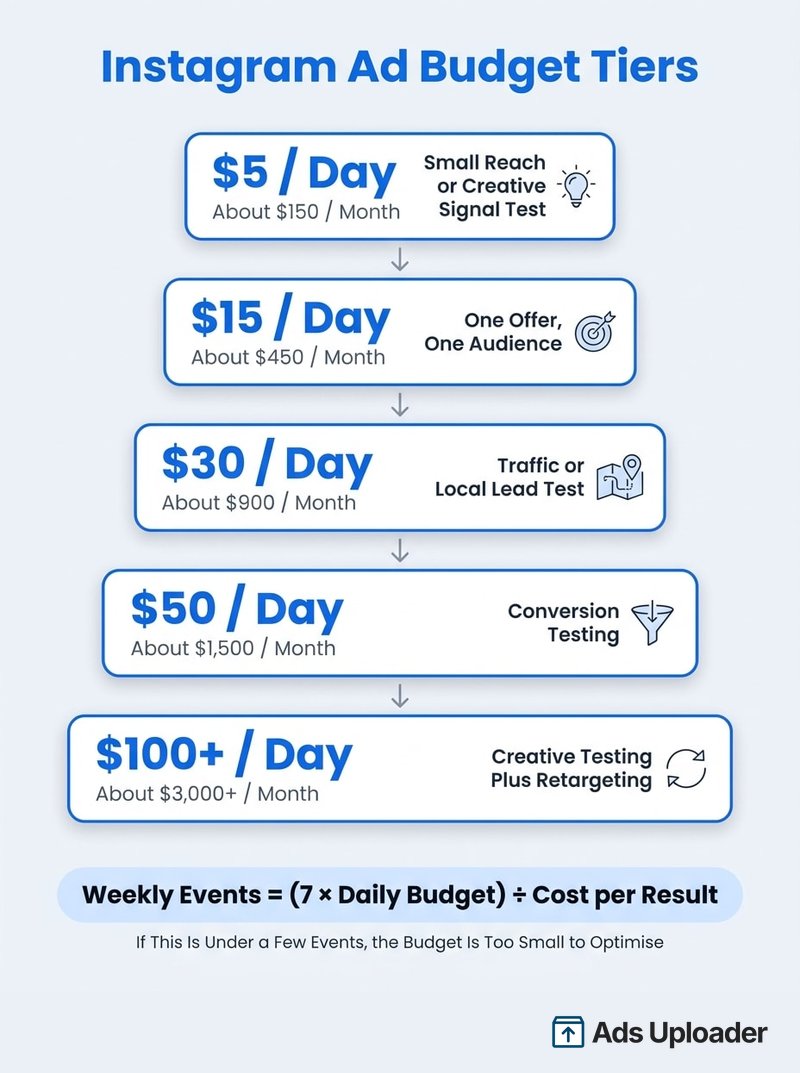
| Daily budget | Roughly 30 days | What it realistically supports |
|---|---|---|
| $5 | $150 | A small reach or creative signal test |
| $15 | $450 | One offer, one audience, a few creative variants |
| $30 | $900 | A workable traffic or local lead test |
| $50 | $1,500 | Conversion testing where CPA allows several weekly events |
| $100+ | $3,000+ | Structured creative testing and prospecting split from retargeting |
Two pieces of official guidance are frequently misstated.
Meta's ad pricing and budget guidance recommends starting with at least $5 total and running longer than six days, and giving the system at least seven days to learn. The claim you will see elsewhere, that Meta requires $5 per day per ad set for six days to exit the learning phase, is not what Meta currently says. Meta's learning phase documentation does not publish a universal number of optimization events required to exit at all.
Also useful: a daily budget is an average, not a ceiling. Meta may spend up to 75% above it on a given day, but weekly spend will not exceed seven times the daily figure. A $5 daily budget can deliver $8.75 on a busy day while staying capped at $35 for the week.
The real test of whether a budget is big enough is how many optimization events it can buy. Multiply your daily budget by seven and divide by expected cost per result. At $5 per day against a $20 cost per lead, that is under two leads a week, which is not enough for the system to optimize against.
How to Lower Your Instagram Ad Costs
Most of what reduces Instagram ads cost happens before the auction, in how the campaign is built rather than how it is bid. These are the levers worth pulling, roughly in order of impact.
Open up placements before restricting them. Meta recommends Advantage+ placements, and suggests using at least six placements if you go manual. More inventory access gives delivery more chances to find a cheap result. Restrict a placement only when you have evidence of poor lead quality, creative incompatibility, or brand risk.
Match creative to the surface. This is the biggest lever most accounts have. Build 9:16 video with an immediate hook for Reels and Stories, keep text out of the interface safe zones, and produce Feed-specific variants rather than letting one asset get cropped into every slot. Meta's Advantage+ creative enhancements can adapt assets automatically, which helps, though it works better with source material built for the placement.
Optimize for the event that matters. Optimizing for link clicks reliably produces cheap clicks and can just as reliably produce disappointing sales. Use the deepest event that still generates enough weekly volume for delivery to learn from.
Consolidate fragmented ad sets. Splitting a modest budget across many ad sets starves each one of the events it needs. Fewer, better-funded ad sets usually beat a sprawl of small ones.
Batch your edits. Significant changes can send an ad set back into learning, where performance is less stable and costs are typically worse. Plan changes and make them together rather than tinkering daily.
Improve the estimated action rate. The auction rewards ads it expects to produce your chosen outcome. Landing page speed, mobile usability, checkout friction, and the quality of your conversion tracking all feed into that prediction.
Read the relevance diagnostics properly. Quality ranking, engagement rate ranking, and conversion rate ranking tell you where a cost problem originates. They are a diagnostic, not a KPI, and raising your bid is rarely the right response to a low one.
Watch frequency. A climbing CPM often means you are paying repeatedly to reach a small audience. Check audience size, frequency trend, and creative-level CPM before concluding the auction got more expensive.
Fund the account outside the iOS app. Worth repeating, because it is the only item on this list that saves money without any tradeoff at all.
On seasonality, be careful with rules of thumb. The claim that Q4 CPMs run 26% above Q1 is not reliable across accounts. Emplifi's worldwide all-platform chart implied roughly 39% between November 2025 and January 2026, Tinuiti measured Instagram CPM up 8% year over year in Q4 2025, and PMG reported Meta CPCs across its client portfolio down 21% year over year during Cyber Five 2025, including 24% lower on Black Friday. Your own prior-year account data is a better seasonal planning input than any published average.
Frequently Asked Questions
How much do Instagram ads cost per day? You choose. Meta recommends starting with at least $5 total and running longer than six days, giving the system at least seven days to learn. A daily budget is an average: Meta may spend up to 75% above it on a given day, capped at seven times the daily figure across a week.
Is $5 a day enough for Instagram ads? Enough to enter the auction and test creative. At the $4.00 to $5.00 CPM Emplifi reported for Instagram placements in Q2 2026, $5 buys roughly 1,000 to 1,250 impressions a day before frequency. It is usually too little for stable lead or purchase optimization, since the deciding factor is expected cost per result.
How much does it cost to boost a post on Instagram? There is no fixed price. You set a budget subject to your interface minimum. If you pay inside the Instagram iOS app, Meta documents that an Apple service fee of 30% of the total ad payment, before taxes and local fees, may apply in most regions. Paying via the web avoids it.
Are Instagram Stories cheaper than Feed ads? Slightly on CPM, not by the 20% to 30% often claimed. Emplifi's Q2 2026 medians put Stories at $4.50 CPM against Feed at $5.00, with both at $0.70 CPC and 0.40% CTR.
Is it cheaper to advertise on Facebook or Instagram? On Emplifi's matched Q2 2026 data, Facebook Feed ran $0.20 CPC and $3.50 CPM against Instagram Feed at $0.70 and $5.00. The click gap is wider than the impression gap because Facebook Feed recorded a 1.53% CTR against Instagram's 0.40%. Cheaper clicks do not guarantee a cheaper purchase.
Why is my Instagram CPM so high? Common causes: a high-cost country, narrow or overlapping audiences, a competitive vertical or season, conversion optimization rather than reach, restricted placements, or creative fatigue with rising frequency. Compare against your own prior periods before comparing against a global benchmark.
How much do Instagram ads cost per month? No minimum exists. $5 daily is about $150 a month, $30 daily about $900, $100 daily about $3,000. Derive the figure from your goal rather than picking a round number.
The Short Version
Instagram advertising cost is the output of an auction and a delivery strategy, not a price list. A few things are worth carrying into your next budget:
- Benchmarks are only useful when they match you. Country, objective, placement, and click definition explain almost all of the apparent disagreement between published figures.
- Placement gaps are real but modest. Emplifi's Q2 2026 medians show Reels CPM 20% below Feed and Stories 10% below, with all three Instagram placements landing at the same $0.70 CPC.
- Instagram clicks cost more than Facebook clicks. Roughly 3.5 times more on Feed in matched data, mostly because of the click-through rate gap rather than the impression price.
- Boosting is a simpler tool, not a cheaper rate. And if you boost from an iPhone, funding through a browser instead saves 30% of your payment outright.
- Budget from the result backward. Target outcomes multiplied by the cost per result you can afford beats any published average, and it tells you immediately whether your budget is large enough to optimize at all.
The advertisers who get Instagram cheap are rarely the ones bidding cleverly. They are the ones giving delivery enough inventory to work with, producing creative built for the placement it runs in, and measuring against their own account history rather than someone else's benchmark.