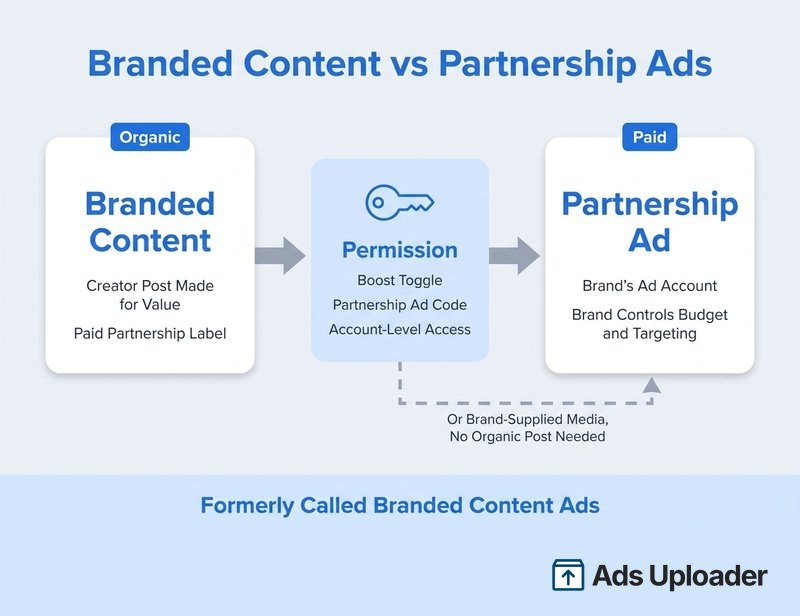
Branded content ads are now called partnership ads. Meta renamed the format in May 2023. A branded content ad was a paid ad that ran with a creator's or publisher's identity while the brand funded and managed it from its own ad account. Partnership ads work the same way: the partner grants permission, for one post or for the whole account, and you control budget, targeting and placements. What changed is the vocabulary in Ads Manager and the range of options around it.
If you last ran these ads a few years ago, you'll go looking for the Branded content checkbox in Ads Manager or the Paid partnerships tab in Business Suite and find neither. Both settings were renamed or moved, not removed.
Below, each old label is mapped to where it lives now. For the current setup step by step, use the partnership ads guide.
What Branded Content Ads Were
In a 2022 Meta for Business walkthrough, Meta defined branded content as creator content that features, or is influenced by, a business partner in exchange for value. Branded content ads were the paid version: the brand ran that creator content as an ad, labeled as both a paid partnership and sponsored.
The typical workflow looked like this:
- The creator published a post with the Paid partnership label, tagging the brand.
- The creator allowed the business partner to promote it.
- In Ads Manager, the brand chose Use Existing Post, picked the post from the Branded content tab, and the branded content checkbox in the identity section switched on.
Brands could also build branded content ads without an existing post, uploading media that ran under the creator's handle and never appeared on the creator's feed. That needed account-level permission, requested from the Paid partnerships settings in Meta Business Suite.
One distinction from that era still holds. Branded content is the organic post, and Meta's definition covers gifted products as well as payment. Branded content ads were the paid layer on top.
Branded Content Ads Are Now Partnership Ads
Meta's Instagram for Business blog announced "Branded Content Ads Are Now Partnership Ads" in May 2023, and its current partnership ads help uses the new name throughout. Partnership ads became the umbrella for any ad that runs with a creator's, publisher's or other business's identity, with their permission.
Here's how the old labels map:
| Older label | Current equivalent |
|---|---|
| Branded content ad | Partnership ad |
| Branded content checkbox in Ads Manager | Partnership ad toggle, set at the ad level |
| Primary identity / Partner identity | First identity / Second identity |
| Branded Content tab when selecting a post | Partner content, or entering a partnership ad code |
| Allow business partner to promote | Allow brand partner to boost |
| Request ad creation access / Paid partnerships settings | Account-level partnership ad permission, managed in Ad Partnerships, Partnership Ads Hub or Creator Marketing Hub |
| Brand Collabs Manager | Creator Marketplace, now merging into Creator Marketing Hub |
Your account may show a different label for the permissions area. Meta announced Creator Marketing Hub in June 2026 to combine Creator Marketplace and the Partnership Ads Hub, and it's rolling out gradually, so the older names will linger for a while.
What Changed and What Didn't
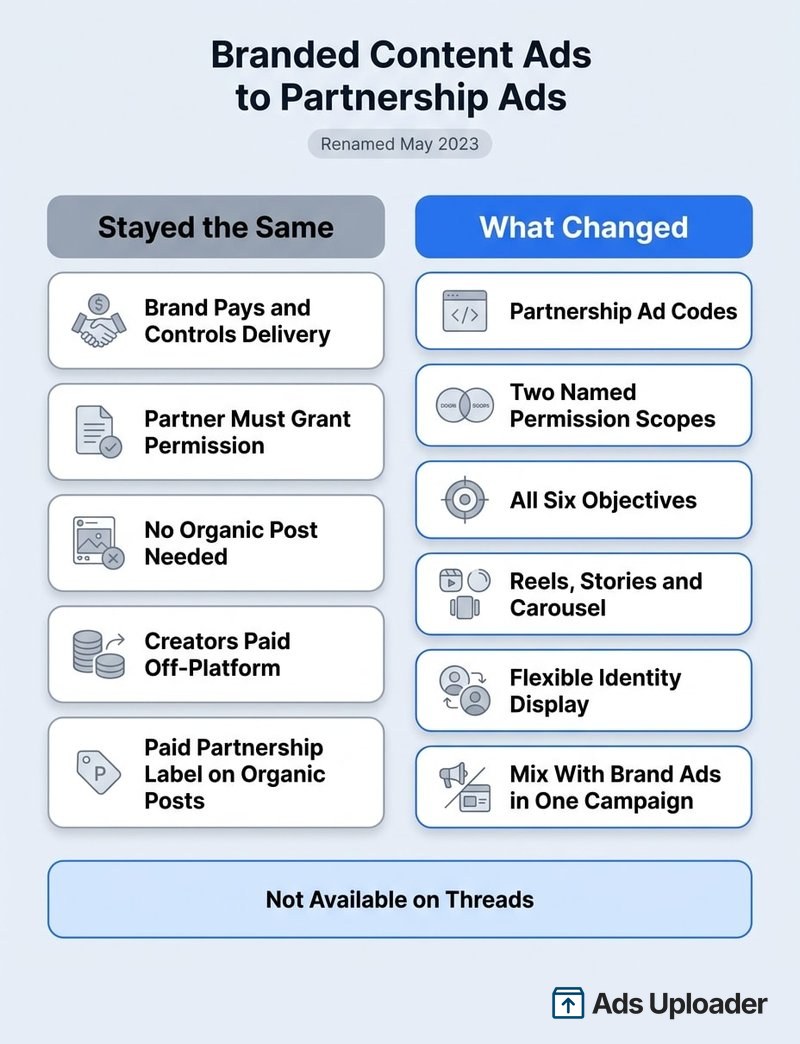
What Stayed the Same
- The brand pays and controls delivery. You build the campaign in your own ad account, with your objective, audience, budget and placements.
- The partner has to grant permission. Typing a creator's username into Ads Manager isn't enough.
- Ads don't need an organic post. With account-level permission you could build from your own media in 2022, and you still can.
- Creators are paid off the platform. Meta doesn't handle the fee, so rates, duration and usage rights still belong in your contract.
- Organic disclosure still applies. If a creator was compensated, their organic post needs the Paid partnership label, whether or not you later advertise it.
What Changed
- Partnership ad codes. A creator can generate a code for one post and send it to you, and pasting it in Ads Manager pulls in the post and the partner identity. Codes were part of Meta's May 2023 partnership ads setup materials.
- Two named permission scopes. Meta now separates content-level permission (one post, through a code or the boost toggle) from account-level permission (ongoing use of the partner's identity). Meta's partnership ad permissions guide covers both.
- More objectives, formats and placements. Branded content ads launched with narrower objective and format support. Meta's current setup guide supports all six Ads Manager objectives and image, video, carousel, Stories and Reels formats, and partnership ads also work with Advantage+ catalog ads.
- Flexible identity display. The first and second identity fields come with header options that show both accounts or let Meta vary which one leads.
- Mixed campaigns. Partnership ads can sit in the same ad set or campaign as your regular brand ads, so creator content competes with your usual creative instead of running in a separate silo.
- Broader Facebook support. Meta expanded access in June 2023 so more creators could let brands advertise from their Facebook Pages.
One thing didn't come along: Threads. Creators can disclose organic branded content there, but partnership ads and boosting aren't available on Threads.
Launch More. Click Less.
Upload hundreds of creatives at once, auto-match thumbnails to videos, and publish straight to your ad accounts through Meta's API.
Try Ads Uploader FreeNo credit card required • 7-day free trial
The Branded Content Tool on Facebook
Meta still uses the branded content name for the organic side. It's how creators disclose a paid relationship and how brands control who can tag them as a partner.
Creators use it to add the Paid partnership label, tag the business partner, allow that partner to boost a post, generate a partnership ad code, and grant or revoke account-level ad permission.
Brands use it to approve branded content tag requests, manage approved partners, find eligible partner content, and see organic performance on posts they're tagged in. Meta's branded content overview covers the disclosure rules and eligibility requirements.
Disclosure and permission are separate. A Paid partnership tag tells viewers about the relationship, but it doesn't let you advertise the post. You still need the boost toggle, a partnership ad code or account-level permission.
Policy carries over too. Branded content that promotes products restricted under Meta's Branded Content Policies needs audience restrictions and, where Meta requires it, written pre-authorization.
Branded Content Examples
Three documented patterns. The numbers come from the sources named, not from our own campaigns.
Boosting a Creator's Best Organic Post
This is the original branded content ad pattern: watch which partner posts perform organically, then put paid reach behind the winners. Influencer marketplace TRIBE describes Dr Teal's picking its top-performing creator posts and amplifying them as partnership ads. You keep the creator's voice and the post's social context while you control targeting and budget.
Many Creators in One Campaign
Clinique Australia ran content from 10 creators over two weeks. Instagram's business case study, with figures also cited by creator platform Aspire, reported 54% lower cost per purchase and an 8.7x ROAS. Meta's documentation allows up to 20 eligible existing posts from multiple creators in certain dynamic creative setups, which makes a multi-creator test like this practical inside one campaign.
Creator Ads Alongside Brand Ads
Viator ran a one-month A/B test of brand ads against brand ads plus creator branded content ads, with matched budgets and targeting. The Meta Marketing Partners case study, run with Social Native, reported 59.7% lower CPA, 36.9% lower CPM and 38.6% more link clicks. If your team calls this creator whitelisting, it's the same permission running from the creator's handle.
Running Partnership Ads One at a Time or at Scale
For a single creator post, Ads Manager is fine: switch on Partnership ad at the ad level, pick the identities or enter the code, and build the ad as usual.
Dozens of creators across several ad sets is where it slows down. Ads Uploader, a browser app with a CLI and MCP server, handles both partnership routes in bulk. For creators' existing Instagram posts, turn on Partnership Ads Mode in Import by Link and paste partnership ad codes or Instagram post URLs, one per row, to build a batch of creator posts in one pass. A post URL only works if you already have partnership advertising permission for that post, imported posts keep their original caption, and Facebook post imports aren't supported.
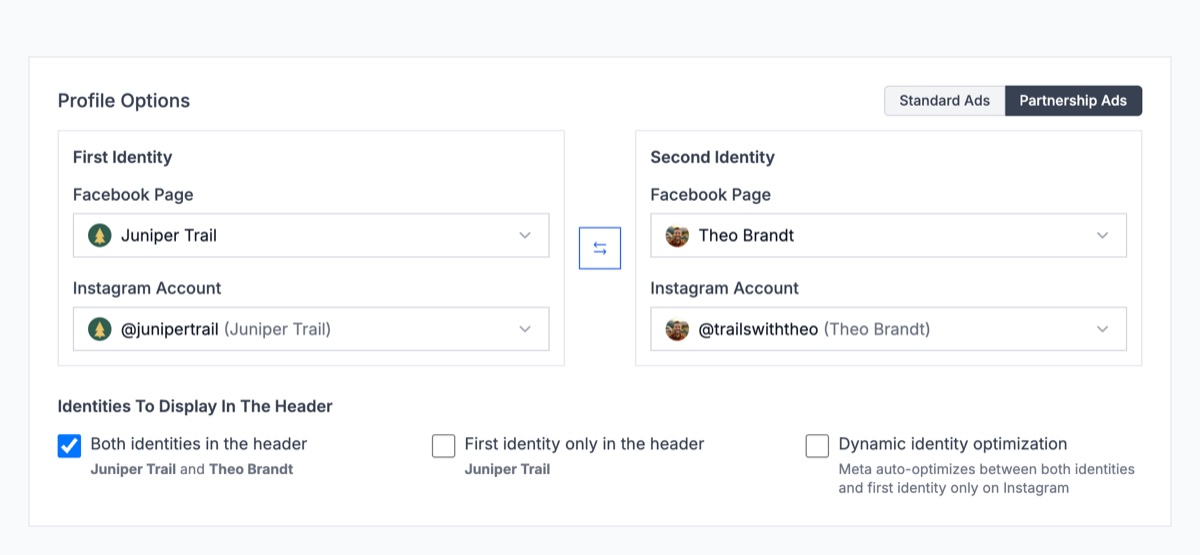
For dark posts from your own media, switch Profile Options from Standard Ads to Partnership Ads, choose the First Identity (your brand) and the Second Identity (the approved partner), and pick the header display. The ads run with the creator's identity without the creator publishing anything. You can set a different partner per ad or per ad set, or mark a row No Partner to keep it a standard ad.
Save Hours on Creative Testing
Stop uploading ads one by one. Bulk process unlimited creatives with automatic media matching and direct API publishing.
Try Ads Uploader FreeNo credit card required • 7-day free trial
Frequently Asked Questions
Are Branded Content Ads Still a Thing?
Not under that name. Meta calls them partnership ads now, and "branded content" refers only to organic, disclosed creator posts.
What Are Branded Content Ads on Facebook?
Paid ads that ran with a creator's or publisher's Facebook identity, funded from the brand's own ad account. The same format on Facebook is now called partnership ads.
What Replaced Branded Content Ads?
Partnership ads. They keep the old mechanics and add partnership ad codes, named permission scopes, more objectives and formats, and mixed campaigns with your brand ads.
Is Branded Content the Same as a Partnership Ad?
No. Branded content is an organic, disclosed creator post. A partnership ad is paid distribution run with the partner's permission, and it doesn't have to start as an organic post.
Key Takeaways
- Branded content ads are now partnership ads, and branded content means organic, disclosed creator posts.
- The mechanics carried over: partner permission, brand-controlled delivery, and ads built from media the creator never posted.
- If an old tutorial sends you to a Branded content checkbox or a Paid partnerships tab, look for the Partnership ad toggle and your account's Ad Partnerships, Partnership Ads Hub or Creator Marketing Hub settings instead.