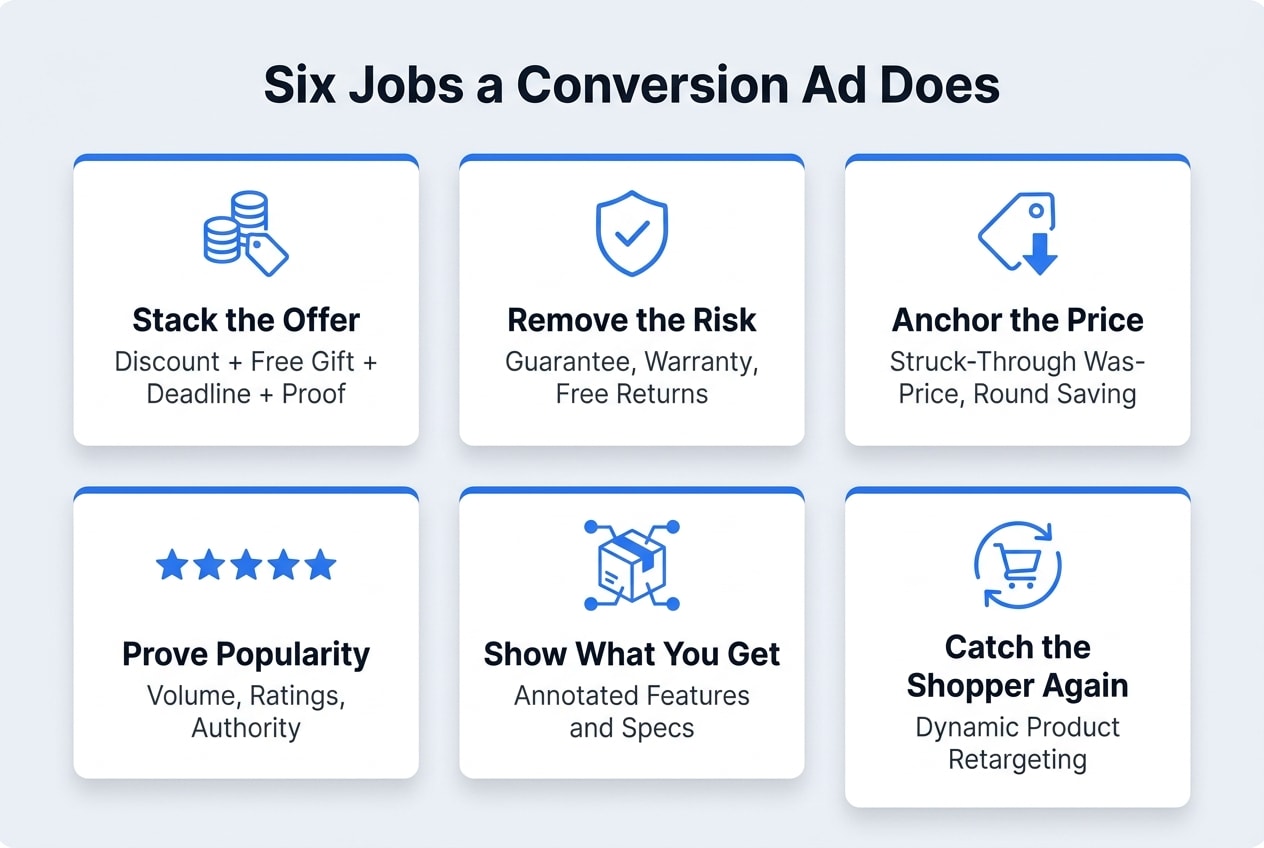
Conversion ads are Meta campaigns run on the Sales objective and optimized for a conversion event such as a purchase, using the pixel and Conversions API to tell delivery which clicks became customers. The creative earns the click; the offer, the landing page and the returned signal earn the conversion. Live Ad Library examples show the same jobs: stacking an offer, removing risk, anchoring price, proving popularity, showing what you get, and retargeting shoppers. The library shows how an ad is built, not how it performs.
Every "high-converting Facebook ads" roundup has the same quiet problem: nobody outside the advertiser can prove any of the ads converted. The Meta Ad Library exposes creative, copy, platforms and dates. It does not expose spend, conversion rate, CPA or ROAS. So a post that lines up a dozen famous brand ads and calls them "high-converting" is showing you construction and guessing at performance.
This one does the guessing out loud. All fourteen ads below were pulled live from the Meta Ad Library on 8 September 2026, each is the advertiser's genuine creative with its archive ID linked so you can open it yourself, and each teardown is about how the ad is built to earn a sale, never a performance claim I cannot back up.
They are grouped by the job the ad does, because "conversion ad" is not a creative style. It is an objective and a signal, and the six jobs below are the ones real purchase-objective ads keep doing.
What a Conversion Ad Actually Is
Each ad below is one entry from our wider library of Facebook ad examples.
A conversion ad is not a format. It is an ad delivered toward a business outcome. In Meta's current structure an ecommerce purchase sits under the Sales objective, and underneath that you choose four things: the objective, a conversion location such as your website, a performance goal and optimization event such as Purchase, and a data source that reports the result. Meta's objective pages keep Sales, Traffic and Engagement separate for exactly this reason: Traffic can still produce a purchase, but the system is being rewarded for visits, not buyers.
The signal is the part people skip. The pixel sends browser events and the Conversions API sends them from a server or commerce platform, usually alongside the pixel with duplicate events removed. Purchase is the conversion event; the pixel and CAPI are just how it travels back to Meta. Optimize for a clean purchase signal and delivery learns to find buyers; optimize for link clicks and it learns to find clickers.
So a static discount ad, a testimonial video, a carousel and a catalog ad can all be conversion ads. What follows is fourteen live ones, each doing one of six jobs, and the creative is only ever half the story.
How These Conversion Ad Examples Were Pulled
Everything here came from the Meta Ad Library, filtered to the United States and to active ads, retrieved on 8 September 2026. Each card below shows the advertiser's real creative and verbatim copy, and each footer links straight to that ad's Library entry so you can confirm it is still running. These are all recognizable direct-to-consumer advertisers, from Dr. Squatch and HexClad to True Classic, Manscaped and The Ridge, running "Shop now" and "Get offer" creative, so they are conversion ads by construction.
One limit matters more than any other. For ordinary commercial ads the library shows creative, copy, advertiser, platforms and start date, and nothing about money. It does not show conversion rate, purchases, CPA, ROAS, spend, the campaign objective or the targeting. So when a post tells you an ad has "a 4.2 ROAS", it is inventing a number the library never contained. Longevity is a weak tell at best: a long-running ad might be a winner, or it might be low-spend, a testing shell, or simply forgotten. What you can read is the offer and the build, which is what the teardowns cover.
Stacking the Offer
The default job for a low-ticket product: pile several conversion levers into one ad. Dr. Squatch runs the same offer as a stream of creator videos, a discount, a free gift, a deadline, review proof and an audience gate, and simply varies the person delivering it. The two below carry identical primary text ("FREE TRAVEL BAG + 50% OFF | Final Days", "Tens of thousands of 5 star reviews", "New customers only") over completely different creator hooks, one counting the boxes you get, the other a "read the reviews before you buy" story. That is the real lesson: the offer is the constant, and the creative is the variable you produce in volume.


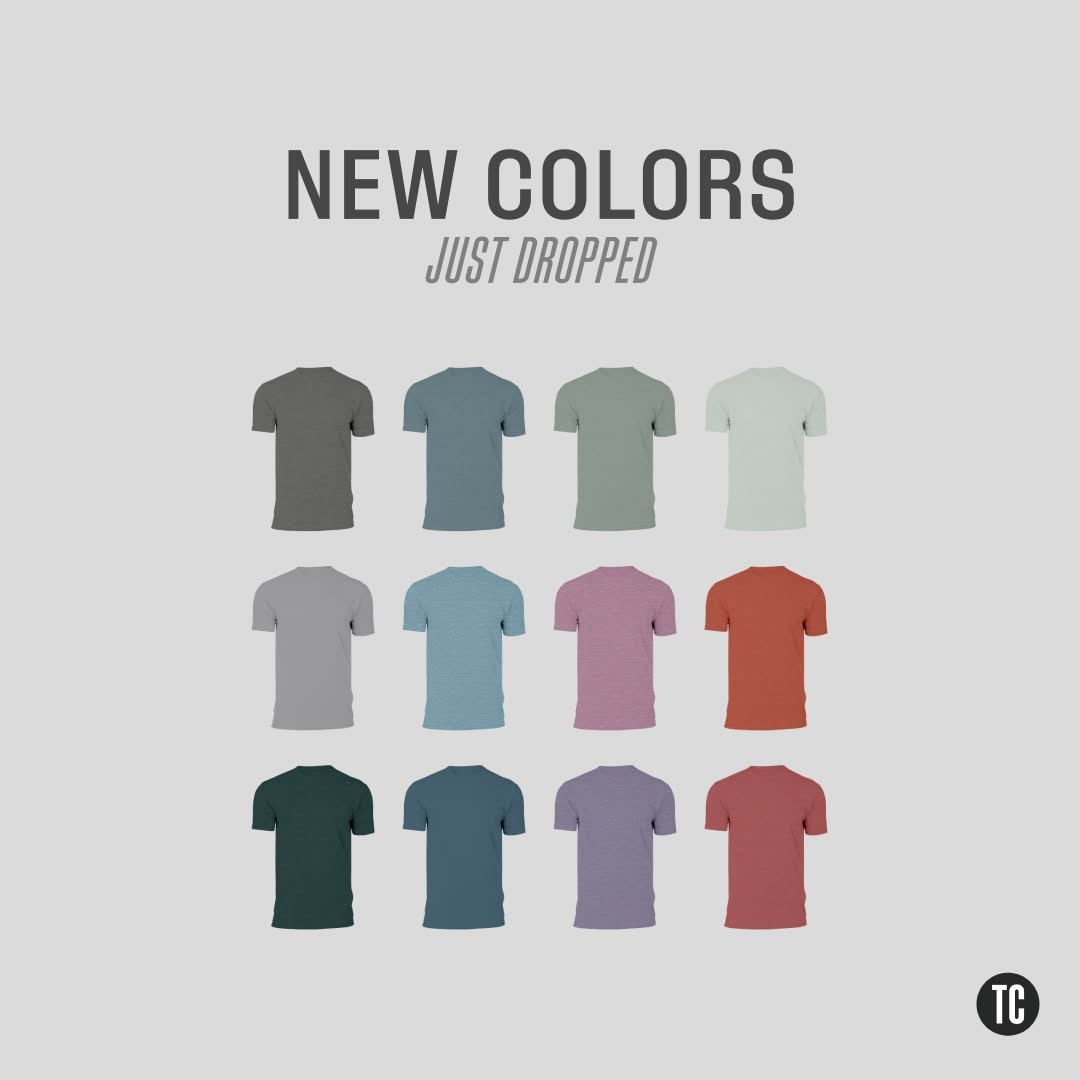
True Classic runs the plainer version of the same job: a straight percentage off in the headline over a seasonal product static, the copy doing nothing more than "Crisp. Comfortable. Popular." The offer sits in the link headline, so the creative stays a clean product shot.

What to copy, and the risk. The gate is a real decision: "New customers only" spends the aggressive discount to buy first orders rather than reward repeat buyers. The lever to handle carefully is the deadline. The FTC treats a countdown or "Final Days" as a dark pattern when the offer never actually ends, so a "sale ends soon" that runs every week is a genuine risk, not just a tired trope. The evidence that offers move behaviour is solid but modest: a 2026 Journal of Consumer Research field study across 127,443 viewers found the way a promotion is framed changed click-through by roughly ten percent, a meaningful edge and nowhere near a guarantee.
Removing the Risk
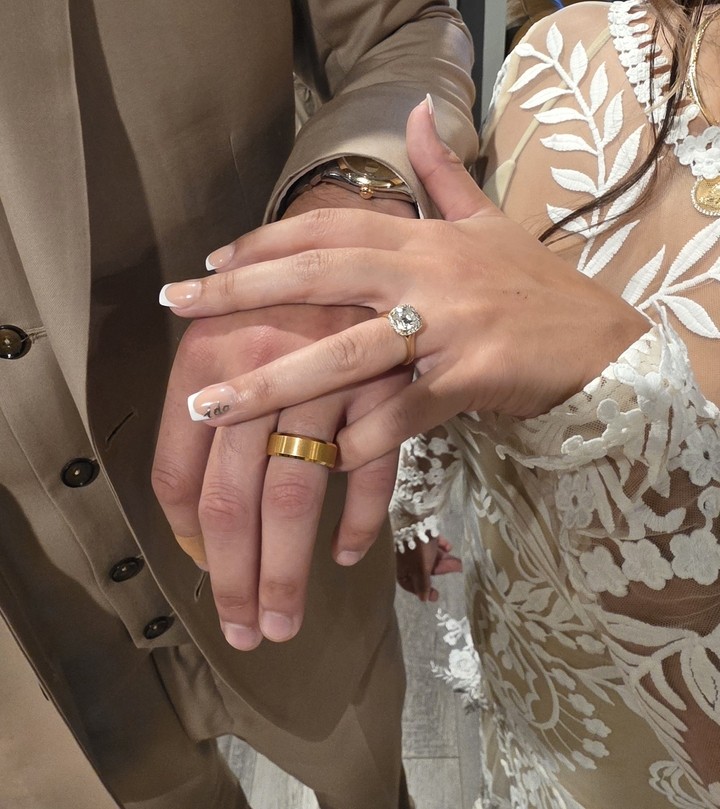
For a product you buy once and keep, the objection is rarely price, it is "will this last and will I regret it". The Ridge answers that in the headline, spending its space on "Built to Last. Backed for Life." instead of a discount, and the creative supplies context rather than a studio pack shot: the ring is already on a hand at a wedding.

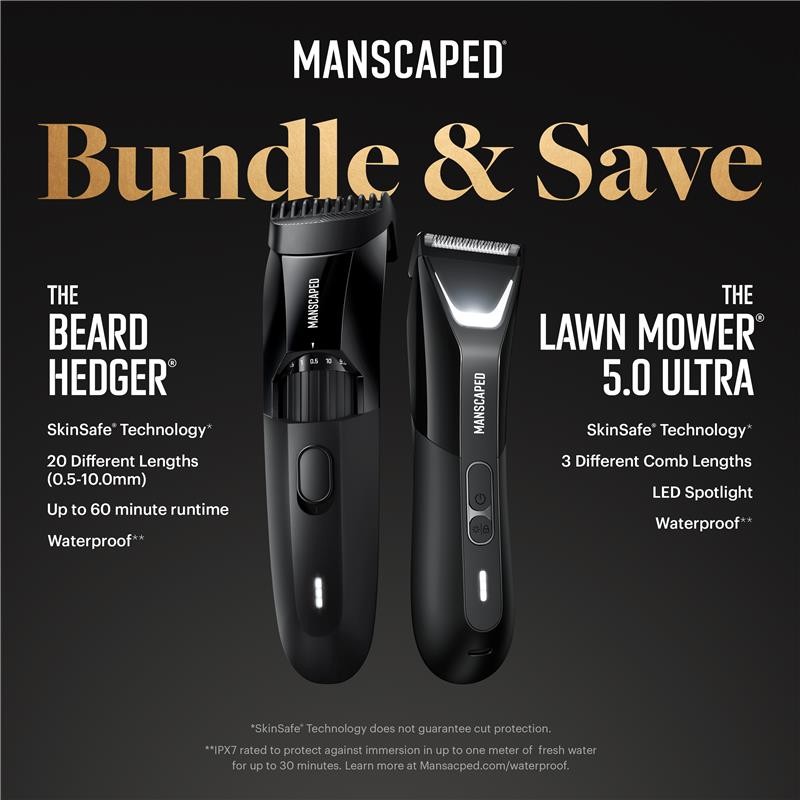
Manscaped does the same job with a stated warranty and a bundle, wrapping the risk-reversal in "2-Year Warranty" and social proof ("Join over 12 million men worldwide"). Note the offer is a bundle, not a discount, which raises order value instead of cutting margin.

What to copy. When the product is durable or considered, removing the risk beats shaving the price, and it does not train buyers to wait for the next sale. A lifetime or multi-year guarantee is a claim, so it has to be real and honoured; a warranty you would not actually pay out is a compliance problem, not a hook.
Anchoring the Price
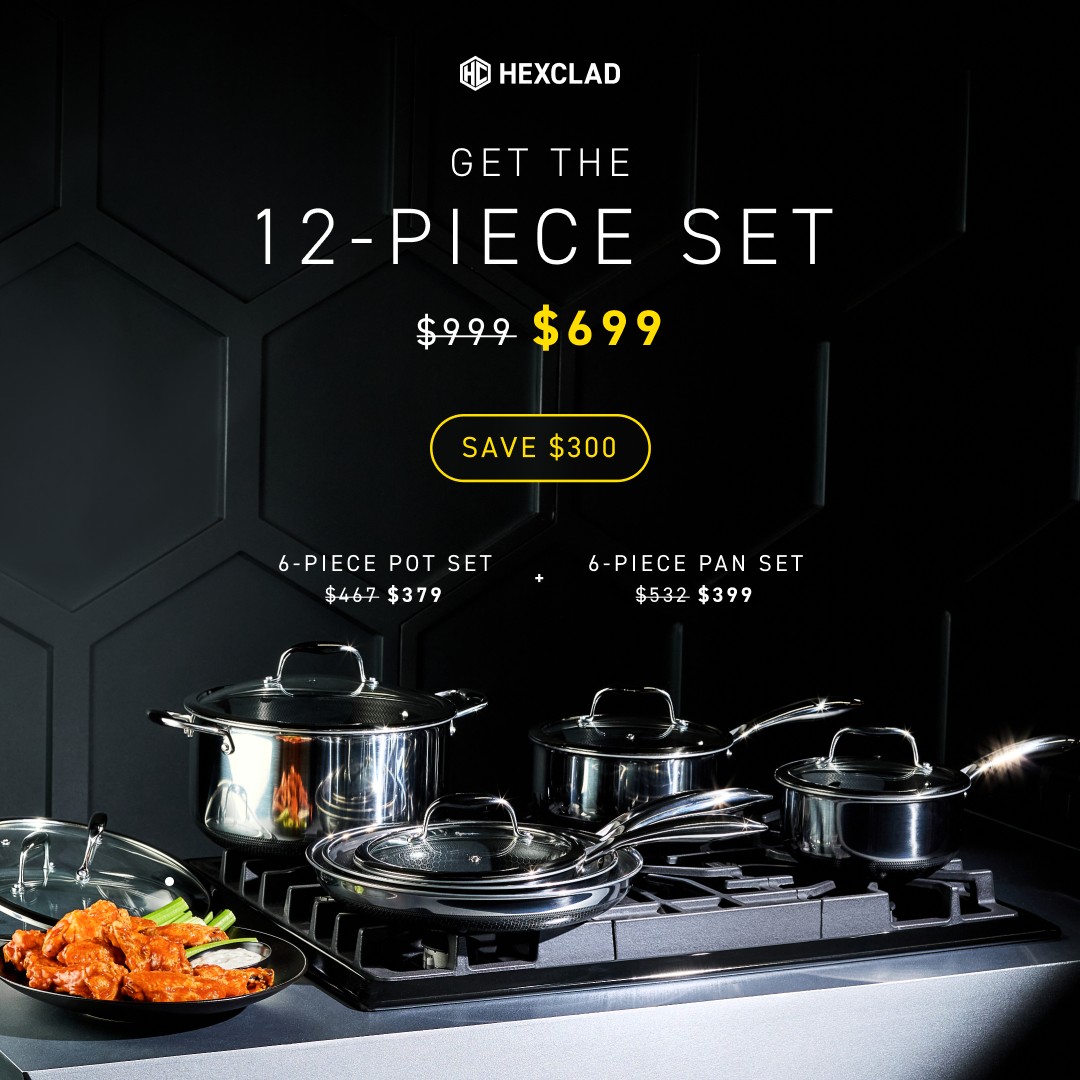
On a high-ticket product, the move is to never show the price alone. HexClad's static shows "$999" struck through beside "$699" with a "SAVE $300" badge, then breaks the bundle into a pot set and a pan set with their own crossed-out prices, and lets a long feature list plus "Lifetime Warranty, FREE shipping & 30-day returns" carry the value.

The same offer runs as a video, a phone-shot clip in a marble kitchen captioned "I'm glad I waited to get Gordon Ramsay's 12pc set", with the offer stated as "save $300 + get a FREE gift" during a named "End of Summer Sale". A real calendar event does the work the fake countdown was faking.

What to copy, and the risk. Price anchoring is a real presentation lever with a legal floor: the FTC's Guides Against Deceptive Pricing say a struck-through "was" price has to be a genuine, recent, good-faith selling price, not a number inflated to manufacture the saving, and a perpetual "sale" makes the former price deceptive. Anchor against a price you really charged.
Proving Popularity
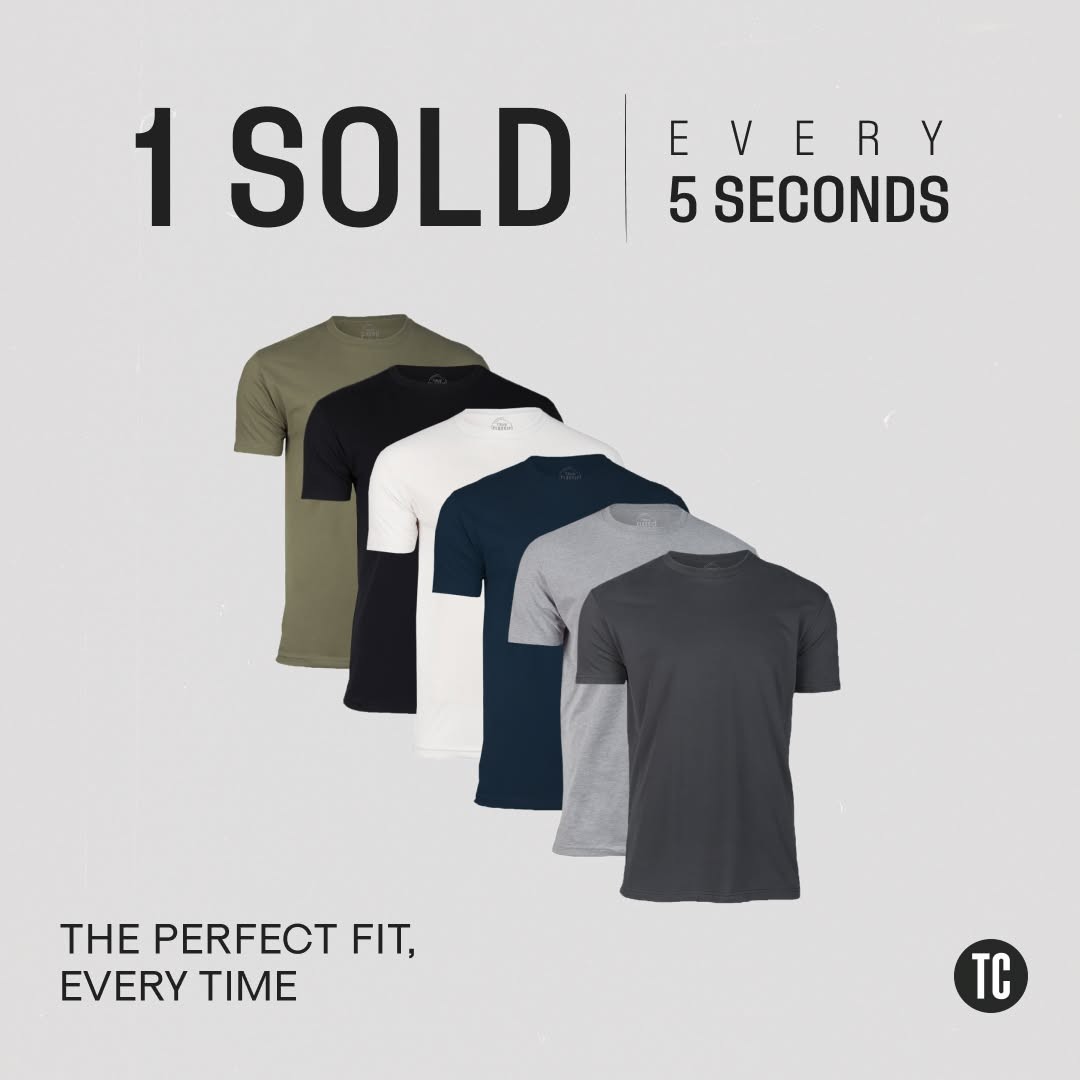
When the offer is not the story, the proof is. True Classic makes a sales-velocity claim the hero, "1 SOLD EVERY 5 SECONDS" over the colourway range, with a scroll gag in the body ("wear again and again and again…"). A volume claim like this describes the business, not the individual customer, which keeps it low-risk.

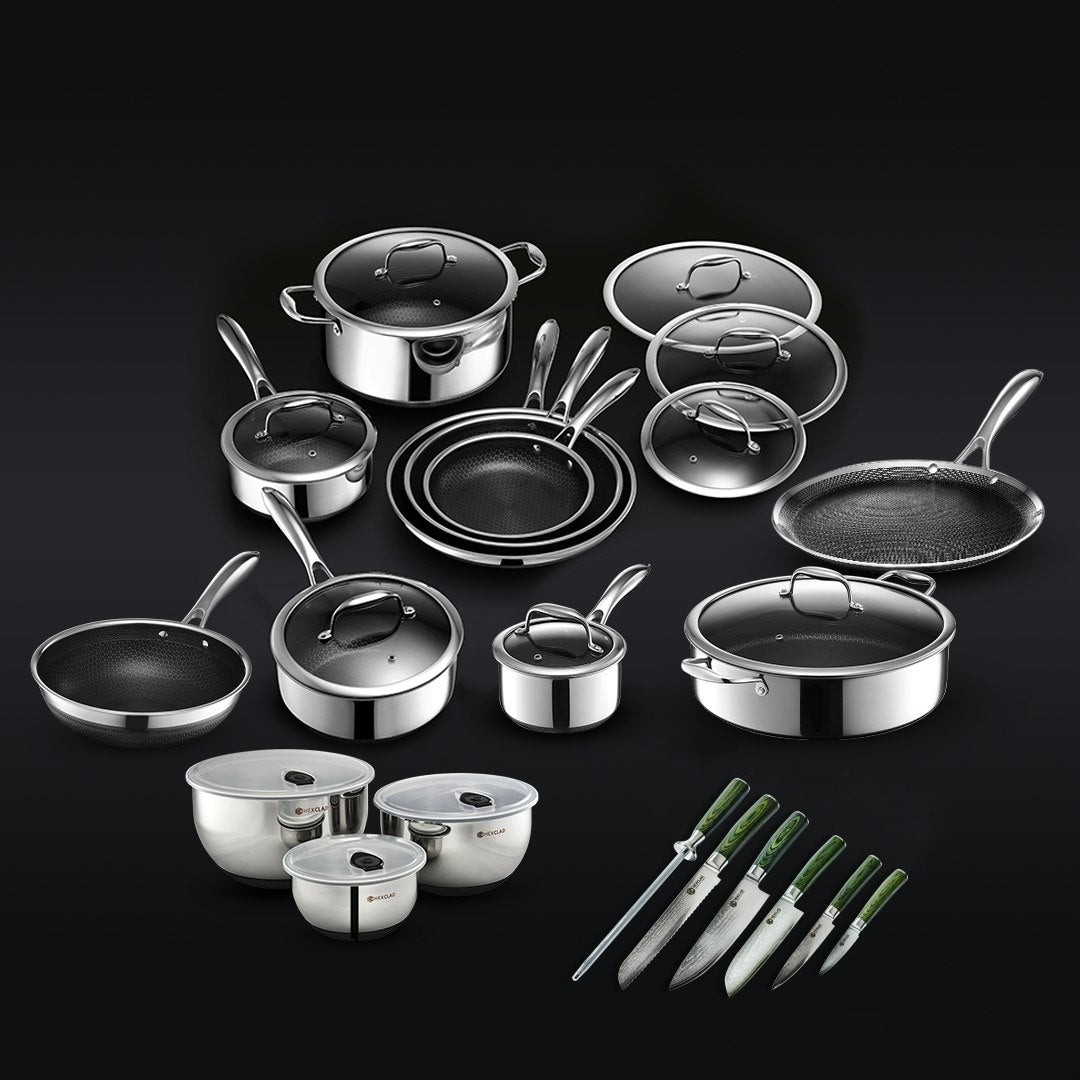
HexClad stacks two other kinds of proof: authority and volume together. The static bundle ad leans on "over 1 MILLION other home cooks" and "Gordon Ramsay's favorite cookware" against a full-set flat-lay, selling the size of the crowd and the name at once.

Then the third form, a person you trust. This ad runs from a chef creator's page rather than the brand's, a Partnership Ad answering "Is HexClad really worth it?" with a searing-pan demo. Meta's own testing found Partnership Ads using a creator's identity outperformed business-as-usual creative in a set of split tests, which is why the authority proof is worth building as a real collaboration, not a stock endorsement.

What to copy, and the risk. Proof comes in three flavours, volume, ratings and authority, and the strongest advertisers use more than one. Ratings are where the rules bite: since the FTC's Consumer Reviews and Testimonials Rule took effect on 21 October 2024, a review or star count copied into an ad functions as a testimonial, so fake or AI-written reviews, undisclosed insider reviews and implying a curated set represents all reviews are all prohibited. Keep the offer and any fine print inside Meta's current character limits.
Showing Exactly What You Get
Some conversion ads just answer "what do I actually receive". Manscaped's static does it on the creative itself, an annotated trimmer with labelled callouts, and hangs a first-order incentive in the headline, "15% Off First Order When You Sign Up With Email", quietly turning a purchase ad into a lead-capture ad.


The video version of the same job runs the features as a fast product tour and adds a scarcity angle, a "special edition white hot" colourway with "limited run. You're not finding this anywhere else." Sizing matters here: build the static and the vertical video at the right ratios for feed and Reels.

True Classic answers "what do I get" a different way, with a creator try-on. The video is a phone-shot clip of a guy in a backwards cap admitting "I got the dad bod going on" and pulling on the tee to show the fit. Same job, demonstrated on a body instead of labelled with callouts.

What to copy. An explainer ad, labelled static or demo video, is the one that reduces uncertainty before the click. Two habits worth stealing: put the offer in the link headline so the creative stays a clean explainer, and asterisk any claim you make, the way Manscaped footnotes that its SkinSafe technology "does not guarantee cut protection", which is the same substantiation habit the FTC expects behind "up to" and outcome claims.
Build Your Own Swipe File
Stop scrolling the Ad Library by hand. Search, filter, and save proven ads with a free Chrome extension built for media buyers.
Get Ad Library Helper FreeFree Chrome extension • Built by Ads Uploader
Catching the Shopper Again
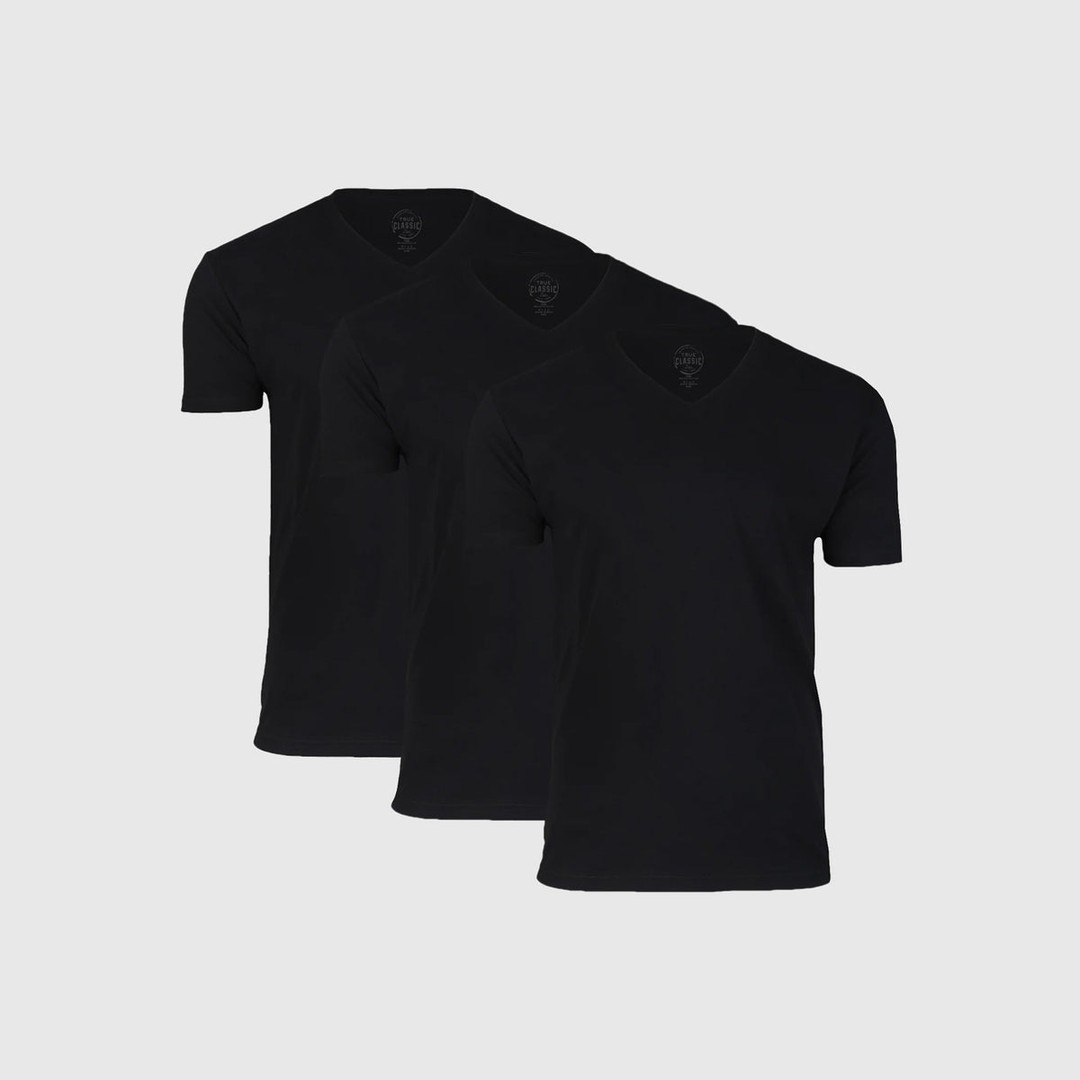
The ad that actually closes a sale is often not the cold-audience creative, it is the catalog ad shown to someone who already viewed the product. This True Classic dynamic product ad is a plain catalog tile, the product image, name and price pulled straight from the feed, wrapped in copy written for a warm shopper: "STOP THE SEARCH! You found the perfect fit."

What to copy, and the risk. Meta's Advantage+ catalog ads select products dynamically and personalize them by a person's interests and actions, running for prospecting or retargeting depending on setup. Be sceptical of the folklore that travels with them, though. The widely repeated claim that dynamic ads deliver "70% CPA savings and 146% more conversions" has no verifiable primary Meta source, and "retargeted users are 70% more likely to convert" traces back to a murky 2014 figure. Cart abandonment really does sit around 70% by Baymard's aggregate of 50 studies, but that is not proof retargeting recovers those carts. The honest way to value retargeting is a randomized holdout, because a high attributed ROAS quietly includes people who would have come back anyway.
What the Rest of the Pull Shows
Fourteen ads from five brands, one of them also running through a creator partnership, and a few patterns repeat:
- The offer is the constant, the creative is the variable. Dr. Squatch ran one offer, "free travel bag + 50% off", as a stream of different creator videos. The advertiser is not testing the deal, it is testing who delivers it.
- Discounts get stacked, not stated. The strongest offer ads combine several levers: discount, free gift, deadline, review count and "new customers only" in a single ad.
- Price anchoring follows the ticket. HexClad never shows the sale price alone; on a $20 soap, Dr. Squatch leans on the free gift instead.
- Bundles raise order value where discounts cut margin. Manscaped's "Beard & Balls Bundle" and HexClad's "Complete Kitchen Bundle" sell more per order rather than less per unit.
- Social proof takes three forms. Volume, ratings and authority, from "1 sold every 5 seconds" to "50k+ reviews" to a chef's Partnership Ad.
- Video and catalog dominate. Six of these fourteen are video, several are creator-shot, and the ad that closes the loop is a plain dynamic catalog tile, not a designed static.
- The careful advertisers asterisk their claims. Manscaped footnotes its cut-protection claim; HexClad footnotes its savings and warranty. That habit is cheap insurance.
What Actually Makes a Conversion Ad Convert
Strip away the creative and the same short list decides whether these ads make money, and most of it is not visual.
The offer does more work than the design. Measured field experiments show promotions move behaviour, but often by prompting extra visits rather than lifting conversion on the spot, and the framing matters as much as the depth. The proof reduces uncertainty, and the strongest evidence is for genuine reviews, not decoration. The signal decides what delivery optimizes toward: return clean purchase events through the pixel and CAPI and the system finds buyers, and Meta reports advertisers using CAPI alongside the pixel saw around a 13% improvement in cost per action, a Meta figure worth treating as directional. The objective and event have to match the real outcome, or you scale the wrong action. And the ad needs enough of that event to learn: Meta's guidance is roughly 50 optimization events per ad set in seven days, which is why fragmenting a small budget across many ad sets quietly starves every one of them.
Creative is a major lever because it decides which promise, product and proof enter Meta's matching system, and in the Andromeda era of automated retrieval that matters more than it used to. But it is not a universal single lever. A brilliant ad cannot rescue an uncompetitive offer, a broken pixel, a slow landing page, a deceptive claim or a checkout that leaks.
Building and Testing Conversion Creative at Volume
The structural tell across this pull is variance. Dr. Squatch does not run one perfect ad; it runs one offer as many creator videos, which is exactly why the same primary text appears under different archive IDs. That is deliberate, because creative diversity is what a modern delivery system feeds on, and it is also an operational problem: shipping thirty variants of an offer by hand, each correctly named so you can read which angle won three weeks later, is where testing quietly dies.
So the job is to make variants cheap to launch and easy to read. A concept crossed with a few offers, a couple of formats and the placements you actually use becomes twenty or thirty ads fast, and you want to ship them without hand-building each one and analyze them without decoding "Ad 4 copy 2". The same discipline applies whether the examples you are modelling are these purchase ads or lead-gen creative.
Frequently Asked Questions
What Is a Conversion Ad on Facebook?
A conversion ad is one delivered toward a measurable downstream action, not a creative style. An ecommerce purchase sits under the Sales objective, where you choose a conversion location, a performance goal and an event such as Purchase, and feed the result back through the pixel or Conversions API. A testimonial, product photo, video, carousel or discount static can all be conversion ads. The objective and the event make it one, not the look.
What Makes a Facebook Ad Convert?
A system, not a single hook: the right objective and event, a reliable signal to Meta, relevant audience matching, a credible offer, effective creative, truthful proof, a fast low-friction landing page and checkout, and viable unit economics. Creative decides which promise and proof enter Meta's matching system, but it cannot compensate for a weak offer, poor tracking, a slow page or a broken checkout.
Save Hours on Creative Testing
Stop uploading ads one by one. Bulk process unlimited creatives with automatic media matching and direct API publishing.
Try Ads Uploader FreeNo credit card required • 7-day free trial
What Is a Good Conversion Rate for Facebook Ads in 2026?
There is no universal number. For ecommerce, Triple Whale's 2026 benchmark across more than 40,000 brands put the median click-to-customer rate at 1.53%, with industries ranging from about 1.09% to 1.89%. WordStream's 7.72% is a lead-campaign rate, mostly form fills, not purchases. The 9.21% figure everyone quotes is from 2016 to 2017 data that mixed sales with forms and calls, so it is not a current purchase benchmark.
Which Objective Should I Use for Conversions?
Use Sales when the outcome is a measurable purchase, Leads when it is a lead or instant form, and Traffic only when visits are genuinely the goal or a deeper result cannot yet be measured. Do not pick Traffic because its clicks look cheaper when you need purchases, because delivery is then rewarded for visits rather than buyers.
Do Conversion Ads Need the Pixel or Conversions API?
Website purchase optimization needs a website event source. The pixel supplies browser events; the Conversions API sends them from a server or commerce platform and usually runs alongside the pixel, with duplicate events deduplicated. On-Meta conversions such as instant forms do not need a website pixel, because Meta observes the action directly. The pixel and CAPI are how the event is sent, not the event itself.
Is Static or Video Better for Conversion Ads?
Neither universally. Meta found native Reels video produced a 34.5% lower cost per result than still images across 15 split tests, and a separate group of tests found native Reels creative lifted conversion rate 11%, but those are placement-specific results, not proof video wins everywhere. Test static and video against the same offer, message and audience.
How Many Conversions Are Needed to Exit the Learning Phase?
Roughly 50 occurrences of the selected optimization event per ad set within seven days, not 50 clicks or pooled account purchases. It is a delivery guideline that gives the system enough feedback to stabilize, not a promise of profitability at event 50. Significant edits to targeting, creative, the event or budget can restart learning.
How Do I Find High-Converting Facebook Ad Examples?
Use the Meta Ad Library, filter by country, active status, platform and media type, and study each ad's offer, proof, CTA and how long it has run. Call them currently live examples, not verified high-converting ads, because the library never shows conversion rate, CPA, ROAS, spend, objective or targeting. Only the advertiser's reporting and a controlled test can prove an ad converts.
The Short Version
"High-converting" is a claim nobody outside the advertiser can verify, so judge these ads on how they are built, not on a performance number a roundup invented. Fourteen live ads, six jobs: stack the offer, remove the risk, anchor the price, prove popularity, show exactly what you get, and catch the shopper again with a catalog ad.
Underneath all six, the same truth. A conversion ad is an objective plus a conversion event plus the signal you send back, not a creative trick. The creative earns the click, and it matters more than ever in an automated auction, but the offer, the proof, the signal and the checkout are what turn the click into a customer. Model the construction, keep the claims inside FTC and Meta rules, and test concepts and offers rather than cosmetic tweaks. That is the part of a "high-converting ad" you can actually copy.