Solar Facebook ads are lead-generation ads run by installers, dealers and lead brokers to reach homeowners considering rooftop solar. Most open with a bill-reduction or roof-qualification hook, attach a $0 down or instant-quote offer, and capture the lead through a Meta instant form or a landing page. Live examples in the Meta Ad Library show the same four offer types repeating across national brands and one-person shops, usually duplicated heavily across states, counties and utilities. Copy choice drives both lead volume and whether those leads survive contact.
Every ad below was pulled live from the Meta Ad Library in August 2026, and each one carries its advertiser name and archive ID so you can open it and check it yourself. None of them is a fresh launch: each has either been running for a month or more, or sits inside a set of dozens of live variants, because an ad that went up this morning tells you nothing. That filter matters more than usual here, since solar copy goes stale fast and a lot of what is still running was written under rules that no longer apply.
They are grouped by the offer they make rather than by creative format, because the offer is the thing that actually varies in this vertical and the thing you have to choose. After the teardowns there are two sections worth more than the examples: why solar leads go bad, and which claims in these very ads are now a problem. For ads from other verticals, our roundup of Facebook ad examples covers the wider field.
How These Solar Facebook Ads Examples Were Pulled
Everything here came from the Meta Ad Library, filtered to the United States and to active ads, retrieved on 19 August 2026.
Then I applied a rule, because "currently running" is a very low bar. An ad that launched this morning proves nothing. To be featured below, an ad had to have been live for at least a month, or sit inside a set of at least 40 live variants from the same advertiser. Longevity and variant investment are the only performance signals the Ad Library exposes, and they are indirect ones: nobody keeps renewing an ad, or funds 200 variations of it, that is losing money. Six ads cleared that bar. The ones that did not are discussed too, because what got excluded turned out to be as informative as what got in.
One limitation matters more than any other, and it is the reason the usual format of these posts is misleading. For ordinary commercial ads, the Ad Library shows creative, copy, start date and platforms. It does not show spend, impressions, cost per lead, or conversion rate. So nobody can honestly attach a CPL figure to a specific competitor ad, and this article does not. What follows is a teardown of creative and offer construction. Presence in the library proves an ad was live when I checked, nothing more. It is not evidence that the ad performed well, or that Meta reviewed its claims as lawful.
Where an ad ran instant forms, the library also exposes the form questions, which turns out to be where the most useful material is.
Each ad below is shown in a consistent card. The creative, the profile picture, the primary text, the headline and the call-to-action button are the advertiser's own, taken from the Ad Library entry linked in each block. Only the card around them is ours. Where an advertiser runs many variants, I picked the one that best represents the concept and said so.
The Four Offers Solar Ads Actually Make
Across the pull, nearly every solar ad resolves to one of four offers. The creative varies wildly. The proposition does not.
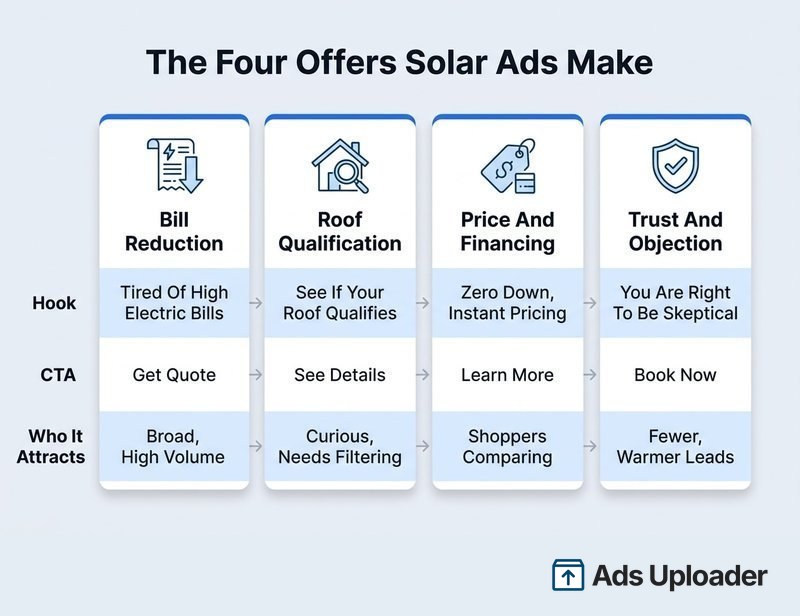
| Offer | Typical hook | Typical CTA | What it attracts |
|---|---|---|---|
| Bill reduction | Tired of high electric bills | Get quote | Broad, high volume, weakly qualified |
| Roof qualification | See if your roof qualifies | See details | Curious clickers who need filtering |
| Price and financing | $0 down, instant online pricing | Learn more | Shoppers actively comparing |
| Trust and objection | You are right to be skeptical | Book now | Fewer leads, warmer, slower to scale |
The useful thing about this frame is that it tells you what cleanup each offer creates downstream. A bill-reduction ad and a trust ad can post identical costs per lead and produce completely different sit rates.
Bill-Reduction Offers
The default solar offer, and the one every guide in this space recommends. It works because bill savings is the dominant stated motivation: Aurora Solar's 2025 survey of 1,039 US homeowners found 93% cited utility-bill savings, against 51% for environmental benefits. It also happens to be the offer with the most claims exposure.
Trinity Solar: Tired of High Electric Bills

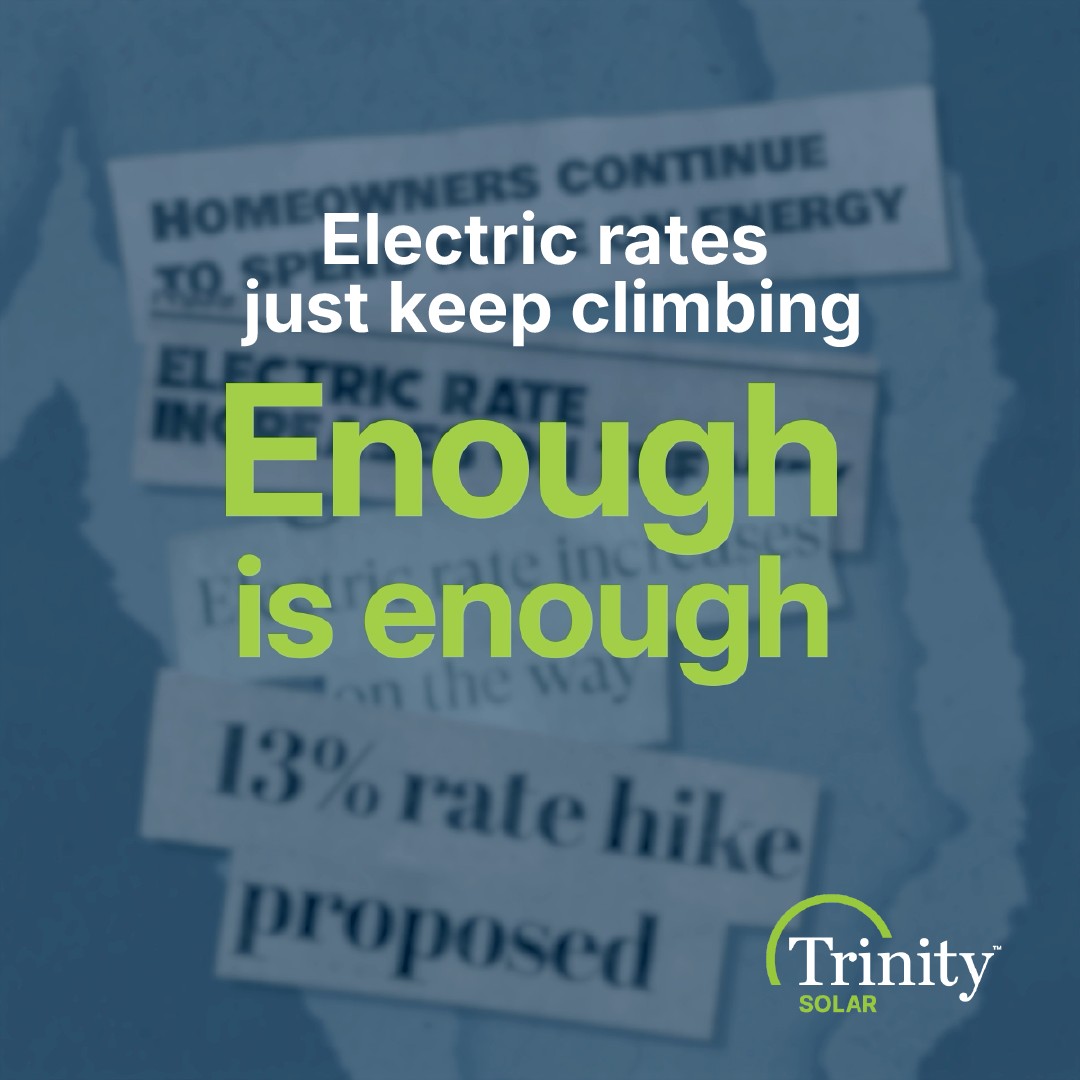
- Advertiser Trinity Solar
- Ad Library 1585567849631347
- Format Single image, dynamic creative with three variants
- Destination New Jersey installation landing page
What to take from it. There is not a single number in this ad. No percentage, no dollar figure, no deadline. That is a deliberate trade: it gives up stopping power and gains a claim set needing almost no substantiation.
The more interesting decision is structural. The same concept runs with near-identical copies against at least five state landing pages, including New Jersey, Connecticut, Pennsylvania and Massachusetts. One idea, a matrix of geographies.
Solar Energy World: Flip the Script on Your Bills

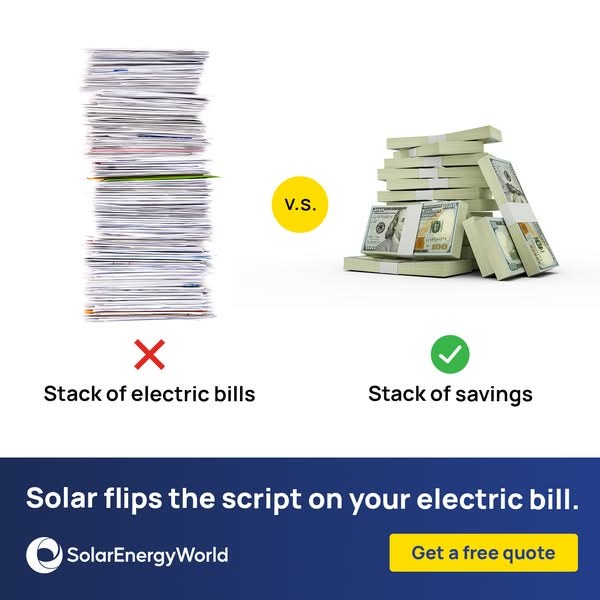
- Advertiser Solar Energy World
- Ad Library 1001858132242914
- Format Single image, one of 42 live variants
- Destination Dedicated go-solar landing page
What to take from it. This is the restrained end of bill-reduction advertising and it is instructive precisely because it claims so little. No percentage, no dollar figure, no program, no deadline. Just control and long-term payoff.
An established installer running 42 concurrent variants on that footing is making a different bet from the small advertisers in this vertical: fewer, better-qualified clicks, and nothing in the copy a regulator could take issue with.
Roof-Qualification Offers, and Why None Made the Cut
"See if your roof qualifies" is the highest-volume offer in solar and the one you will see most often in the Ad Library. Not one example of it survived the selection rule above, and that is the most useful thing this pull turned up.
Every qualification-style ad I found was running from a page created days earlier, with single-digit or double-digit likes, and had gone live within the previous 24 hours. Search the same terms next week and you will find a different set of pages running near-identical creative. The offer works well enough for somebody, but not for the advertiser whose name is on it, because that advertiser keeps changing.
Two structural habits are worth taking from the cluster even without featuring a single ad:
They are built as geographic matrices, not as creative. One ad names a utility and a county, then the same concept runs again with the county swapped, and again with a different utility in another state. Naming the reader's own utility is genuinely the sharpest personalization available in this vertical and it costs nothing to write. But the work is not creative work, it is launch work: one concept multiplied across dozens of geographies. That is a bulk launch problem, and it is the single most common structural feature of solar accounts.
The offer is deliberately empty. "See if you qualify" commits the reader to nothing and commits the advertiser to nothing, which is why it is frictionless to click and why the leads behind it are the hardest to work. It is also the phrasing that lets an ad imply a program, a deadline and a saving without stating any of them, which is exactly where the claims exposure sits.
If you run this offer, the lesson from the ads that do persist is to attach something concrete to it: a named utility, a named product, a named price, or a real qualifying question in the form.
Price and Financing Offers
Where solar advertising has visibly moved, because opacity got expensive. Both examples here are Sunrun, running the two halves of the same objection: show me the price, and there is no price to fear.
Sunrun: Enter Your Zip for Instant Online Pricing

- Advertiser Sunrun
- Ad Library 1032293239720863
- Format Video
- Destination Self-serve pricing configurator
What to take from it. The opening line attacks the category rather than the competition, then the destination does something almost no solar advertiser does: it is a configurator, not a lead form.
This removes the objection that actually kills solar form fills, which is not price but the expectation of a two-hour kitchen-table pitch. The angle is only credible from a brand with the scale to back the guarantees, and it trades volume for shoppers further along.
Build Your Own Swipe File
Stop scrolling the Ad Library by hand. Search, filter, and save proven ads with a free Chrome extension built for media buyers.
Get Ad Library Helper FreeFree Chrome extension • Built by Ads Uploader
Sunrun: A Powerwall for $44.99 a Month

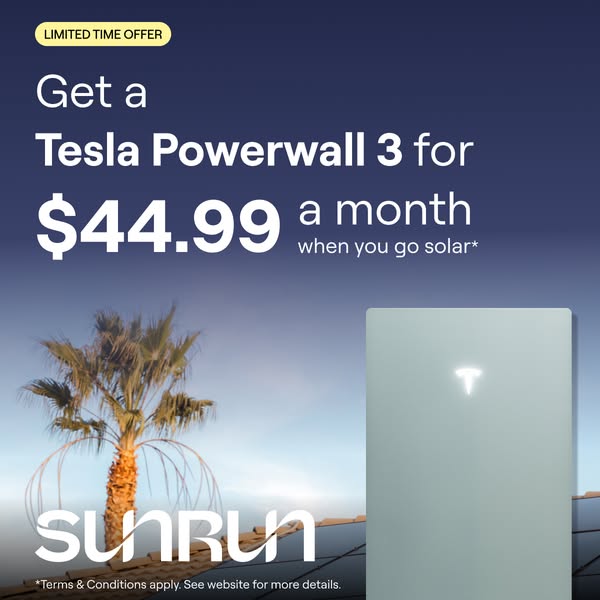
- Advertiser Sunrun
- Ad Library 2742056299493375
- Running since 10 May 2026, with near-identical variants alongside it
- Format Single image
- Destination Battery storage landing page
What to take from it. A named product at a named monthly price, state-scoped in the headline, with the terms asterisked. That is the most concrete offer in this entire set, and it has been running for over three months.
The reason it can be that specific is the financing structure behind it. Most solar advertisers cannot name a monthly number because their price depends on a site survey, so they retreat to "up to 80%" and "see if you qualify". Sunrun sells a subscription, so it can name the number and let the ad do the qualifying.
Note also that an ad built on monthly payments and approval is exactly the kind that belongs in Meta's financial products special category.
Trust and Objection Offers
The newest cluster in the pull, and a direct read on the state of the vertical.
Volt Seed Solar: Solar Isn't Free, but It Will Save You Money

- Advertiser Volt Seed Solar
- Ad Library 912181904216895
- Format Video, dynamic creative with four headline variants
- Destination Instant form, then a virtual consultation
What to take from it. This has been running since October 2024, which in a vertical this volatile is the most interesting fact about it. The copy opens by refusing the category's favourite promise: solar is not free, it is just cheaper than the utility bill.
The creative matches the claim. It is a phone-shot vertical video of the owner standing in snow beside a real ground-mount array in Dudley, Massachusetts, with burned-in captions. No studio, no brand overlay.
The instant form is the best-written one in the whole pull. It opens by admitting the company is picky about who it can help, calls that a bad thing to say when you are trying to win customers, then explains the questions exist so nobody wastes anybody's time. That is qualification framed as respect, doing the same job as a Higher Intent setting.
One line has aged badly. The government pitching in 30% was accurate when the ad launched and is not accurate for a homeowner buying today.
Freedom Power: Stop Renting Power from the Grid

- Advertiser Freedom Power
- Ad Library 4184371165195327
- Format Video, dynamic creative
- Destination Clean energy ecosystem quote flow
What to take from it. Four sentences, no numbers, no offer. It reframes the utility bill as rent, which turns an ongoing cost into an ownership decision, then bolts on outages as a second reason that has nothing to do with savings.
The reason to study this one is the volume behind it. The same concept is running across more than 200 live variants with different lengths, aspect ratios and call-to-action buttons. Nobody builds that much variation around a concept that is not returning, and it is a working example of the ad-set structure discussed further down.
Pairing solar with battery backup also sidesteps the payback maths entirely. Resilience is not a number you can be held to.
What the Rest of the Pull Shows
The six above are not the whole picture. A few patterns from the ads that did not get their own section:
- Battery and outage offers are now a separate campaign line. Sunrun runs a Powerwall 3 offer at "$44.99/mo" and a battery-only Texas ad that needs no solar at all. The demand is real: about 70% of California customers entering the Net Billing Tariff had paired storage by the end of 2024, and EnergySage recorded a 38% battery attach rate nationally in the second half of 2025.
- Rate rises are the hook of the moment, and they check out. EIA data puts the average US residential price at 17.30 cents per kWh in 2025 against 16.48 in 2024, with the January to May 2026 preliminary average at 18.11 cents, up about 7.9% on the same months of 2025.
- Small installers often run no offer at all. Evergreen Solar and Sun Solar Off-Grid both run what are effectively boosted brand statements with a Learn more button.
- Local proof does the work of a discount. Ecotech Solar leans on "124 five star reviews and counting" across Northwest Washington. Volt Seed runs hyperlocal production ads: "22 Solar Panels in Auburn MA", "Dudley MA. Ground Mount $6,657 estimated Production per year."
- The tell. Two advertisers, Solar Exit Support and Cancel Solar Payments, run identical creative aimed at unhappy solar customers: "They Told Me Solar Would Save Me Money. Instead, I'm Stuck Paying For a System That Barely Works." Cancellation and litigation services are buying the same audience you are. I found no data measuring how common these are nationally, so treat it as a live example rather than a trend, but it explains why the trust angle above exists.
Why Solar Facebook Leads Go Bad
Solar's junk-lead reputation is mostly a selection problem, and it starts in the ad.
Instant forms prefill name, email and phone, so a distracted tap becomes a lead. Pair that with a campaign optimizing for the cheapest submission and a hook as broad as "see if you qualify", and you are buying volume from renters, non-decision-makers, shaded roofs and out-of-territory prospects. Exaggerated savings hooks make it worse, because they attract people interested in a benefit that does not exist.
Then there is what happens after submission. The SEIA consumer protection primer warns that aggregators bundle leads from multiple generators, that leads get transferred and resold, and that a bad first interaction creates misinformation the eventual installer has to unwind. No reliable public study quantifies how much of the US solar lead pool is duplicated, aged or bot-completed, so treat any specific percentage you see with suspicion, including in this vertical's own marketing.
What the pull shows is that the operators who take this seriously fix it in three places:
- Qualify in the creative. Say the state, the utility and the ownership requirement in the ad, so unsuitable readers self-select out before they cost you anything.
- Qualify in the form. Every strong example above puts homeownership, bill band, roof condition or credit band ahead of the contact fields. Meta's Higher Intent review step does similar work.
- Feed outcomes back. Returning qualified-lead, appointment, sit and install events through the Conversions API lets delivery optimize toward customers instead of submissions. Meta reports advertisers using the conversion-leads goal with CRM data saw 15% lower cost per quality lead and a 44% increase in lead-to-quality conversion, though that is cross-industry and Meta-selected rather than solar-specific.
Claims Rules Solar Advertisers Keep Breaking
Two facts do most of the work here.
The 30% federal homeowner credit is gone. Public Law 119-21, enacted 4 July 2025, amended Section 25D so that no credit is allowed for expenditures made after 31 December 2025. The IRS states the credit is not available for property placed in service after that date, and prepaying in 2025 did not preserve it if installation finished in 2026. So "they'll pitch in 30%" and "30% through 2032" are stale in any ad aimed at a homeowner buying now. A lease or PPA provider may still claim the commercial Section 48E credit on equipment it owns, but that is a credit for the provider, not a payment to the customer, and describing it as the latter is the exact misrepresentation regulators have been pursuing.
"Up to" does not soften a claim. FTC consumer research found many people read an "up to" claim as what they are likely to get, and the resulting FTC guidance says advertisers should be able to substantiate that consumers are likely to reach the maximum under normal circumstances. "Save up to 80%" therefore needs evidence about your actual market, tariffs and customer population, not one favourable install. "Results may vary" does not fix it.
The FTC has been unusually direct on the free-solar framing, stating in an August 2024 consumer alert that "the federal government does not install solar systems in homes for free". Enforcement has followed the same themes: Ohio sued G3 Solar in January 2026 over claims about bill elimination, net metering and tax credits, and Texas sued CAM Solar in May 2026 after more than 100 complaints about savings and transaction terms.
On the platform side, two rules catch solar advertisers regularly. Meta's Financial Products and Services special ad category became mandatory for US advertisers on 21 January 2025 and covers credit and long-term financing, so a solar loan ad belongs in it while a cash-purchase ad does not. And Meta's personal attributes rule means "Are you struggling to pay your power bill?" is a risky line, where "Compare solar and battery options in California" is not.
None of this makes solar unadvertisable. It makes the specific, local, named-program version of the offer the safer one, which is also the version that converts.
Building a Solar Ad Set You Can Actually Read
The structural lesson from this pull is duplication. Trinity ships one concept against at least five state landing pages. Phoenix Rising, another advertiser in the pull, ships one concept against two counties and two utilities. Once you commit to naming the utility or the town, and you should, a single creative concept becomes twenty or thirty ads.
That has two consequences. First, you need a launch process that can produce those variants without hand-building each one, or you will quietly stop testing new hooks because shipping them is too much work. Second, you need naming you can read three weeks later, because "Ad 4 copy 2" tells you nothing about whether the PGE angle beat the SDG&E angle. A consistent naming convention that encodes offer type, geography and hook is what makes the geo matrix analyzable instead of just large.
Plan on three to five hooks per offer type, each geo-swapped, and rotate on qualified outcomes rather than click-through rate.
Save Hours on Creative Testing
Stop uploading ads one by one. Bulk process unlimited creatives with automatic media matching and direct API publishing.
Try Ads Uploader FreeNo credit card required • 7-day free trial
Wrapping Up
Six live ads, four offers, and a fairly consistent picture:
- Lead with the bill, then get specific. Savings is the dominant motivation, but the defensible version of the claim is a property-specific estimate, not a percentage.
- Name something. The utility, the county, the number of installs in that town. It is the cheapest lift available and the small operators do it better than the national brands.
- Qualify before the contact fields. Ownership, bill band, roof shading, credit band. The best forms in this pull all do it, and it costs less than cleaning up afterwards.
- Check the claim before you scale it. The federal homeowner credit ended for 2026 installations, and "up to" numbers need evidence about your market.
- Build for duplication. The geo matrix is the real workload in solar, so set up naming and launch before you have forty ads you cannot read.
The advertisers doing well here are not the ones with a secret audience. They are the ones whose ad says something specific enough to be checked.
Frequently Asked Questions
Do Facebook Ads Work for Solar Companies?
They reliably produce inquiries, but raw lead volume is a poor measure of success. No credible public dataset shows a representative national return on ad spend for solar on Meta in 2026. Profitability depends on contact rate, qualification, sits, financing approval and cancellations, so judge campaigns on cost per qualified sit and per completed install.
What Should a Solar Facebook Ad Say?
State who you are and whether you are the installer, dealer, lender or lead generator. Name the transaction: cash, loan, lease, PPA or a specific state program. Give the territory and eligibility conditions. If you say $0 down, be clear that it is not the same as free. Then offer a property-specific estimate as the next step.
How Much Do Solar Facebook Ads Cost per Lead in 2026?
There is no authoritative national figure. The most relevant published estimate is a small agency sample from EBCD covering 12 accounts and roughly $1.4 million of Meta spend across Q4 2025 and Q1 2026, reporting raw form-fill costs near $40 low, $55 median and $75 high. Treat it as a reference point, not a benchmark, and compare it against the cost ranges in our Facebook ads by industry guide before reading much into it.
Do Solar Ads Need a Special Ad Category?
It depends on the offer, not the product. A cash-purchase solar ad does not need one. A solar loan does, under Meta's Financial Products and Services category, mandatory for US advertisers since 21 January 2025. Ads promoting $0 down financing, APR, monthly payments or prequalification fall inside it. Meta has published no definitive ruling on leases and PPAs.
Is the 30% Solar Tax Credit Still Available in 2026?
Not for a homeowner buying a system now. Public Law 119-21, enacted 4 July 2025, ended the Section 25D residential credit for expenditures made after 31 December 2025, and prepaying in 2025 did not preserve it if installation completed in 2026. A lease or PPA provider may still claim the commercial Section 48E credit on equipment it owns, but the homeowner does not receive that credit.
How Do I Find My Competitors' Solar Facebook Ads?
Use the Meta Ad Library, set the country, choose All ads, and search company names, solar terms, utility names, state program names and battery terms. Open each advertiser's page to see active variants, then record the Library ID, start date, copy, creative, CTA and destination.