Facebook ads for chiropractors are Meta campaigns that promote a new-patient offer, typically a $37 to $97 consultation and exam, to people inside a clinic's service area. Clinics run them through Instant Forms or a booking page, then call and text to convert leads into appointments. Meta's personal attributes policy bars copy implying a viewer has back pain, and HIPAA limits what a clinic can send back to Meta. Cost per lead rarely decides profitability; the appointment show rate does.
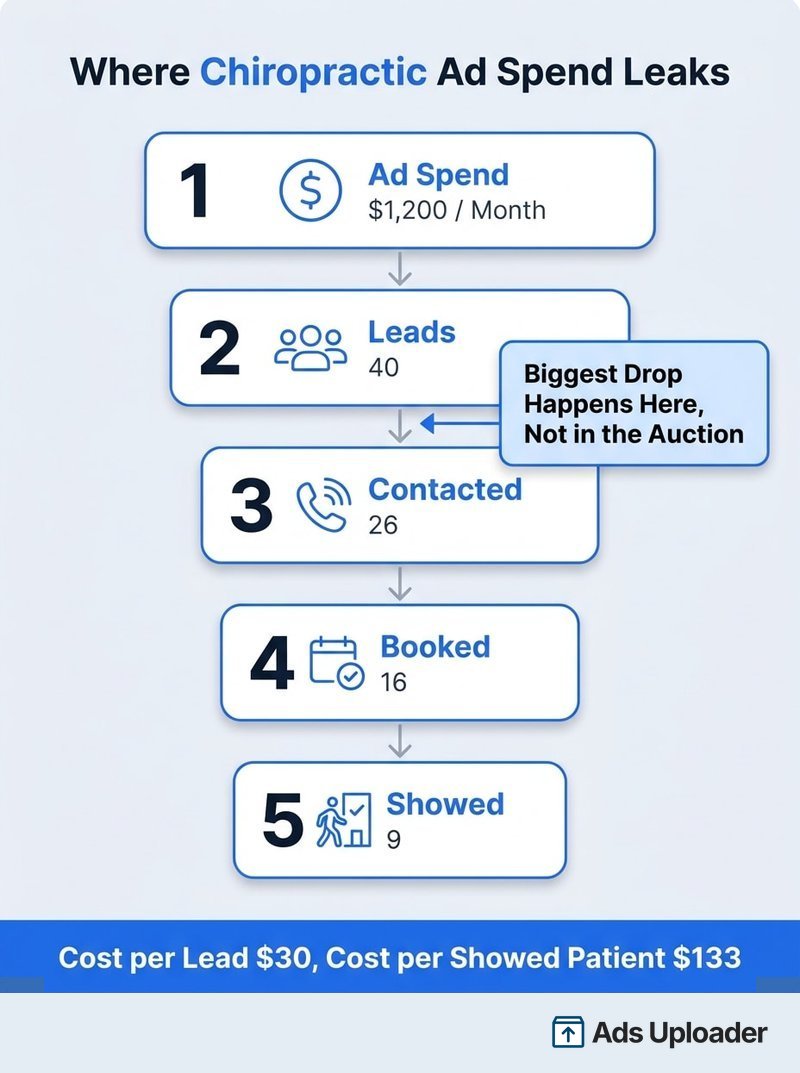
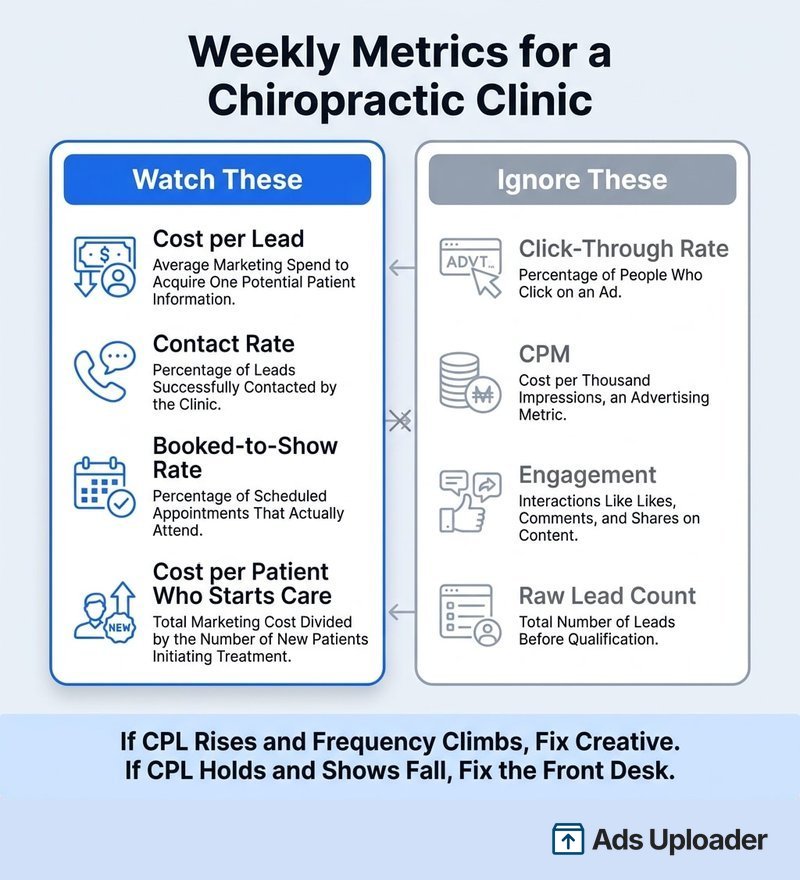
Most chiropractic ad accounts that "do not work" have a perfectly respectable cost per lead. That is what makes the failure so frustrating. You paid for 40 leads at $30, the spreadsheet looks fine, and nine people walked through the door. The money did not leak in the auction. It leaked between the form submission and the front desk.
A second failure happens earlier and hurts more: the ad never runs at all. The opener every chiropractic template reaches for, some version of "Do you suffer from back pain?", collides with a Meta policy that has nothing to do with chiropractic and everything to do with what an ad may imply about the person reading it.
This guide covers both, plus the parts between them: the offer and what it does to your economics, the copy patterns that get approved, the tracking setup that keeps a clinic out of trouble, and the follow-up system that decides whether any of it was worth doing. Where the evidence is thin, and in this vertical it often is, I will say so rather than dress up an agency case study as a benchmark.
Do Facebook Ads Actually Work for Chiropractors?
Yes, with a qualification that matters more than the answer.
Facebook ads for chiropractors work as a demand-creation channel, not a demand-capture one. Nobody on Instagram is searching for a chiropractor. They are scrolling, and your ad interrupts them with an offer they were not planning to take. That reaches the large group of people whose back has been bothering them for months who have not gotten around to doing anything about it. Google Search does the opposite job: it captures people who have already decided.
The two are complements. For context on relative cost, WordStream's April 2025 to March 2026 search dataset reported $40.04 per lead for Physicians and Surgeons, while its 2025 Meta dataset reported $47.47 for the same category, a figure we place alongside other verticals in our Facebook ads by industry benchmarks. The datasets are not directly comparable and neither is chiropractic-specific, so do not read a winner into them. On a modest budget, starting nearer 60% search and 40% Meta is reasonable where local search demand exists, then reallocating once you can measure cost per patient who actually shows.
Meta is good here at local reach, video that builds familiarity with a specific doctor, offer distribution, and retargeting a small warm pool. It struggles because there is no search intent to ride, discount offers skew toward price shoppers, and health advertising carries policy friction most verticals never encounter.
Published chiropractic results exist, but they are agency self-reports rather than audited data. One 2026 case reported 103 leads, 55 bookings and 42 shows on a lower-back campaign; another reported 138 leads, 77 bookings and 42 shows. Both came from the same agency. There is no independent controlled study of chiropractic Meta performance, so anyone quoting you a national benchmark is quoting a marketing page.
The New-Patient Offer and What It Does to Your Economics
Live chiropractic offers cluster in a narrow band: $37, $47, and $97. The bundle is consistent too, usually consultation, examination, clinically necessary X-rays, and a report of findings. Whether the first adjustment is included varies by clinic.
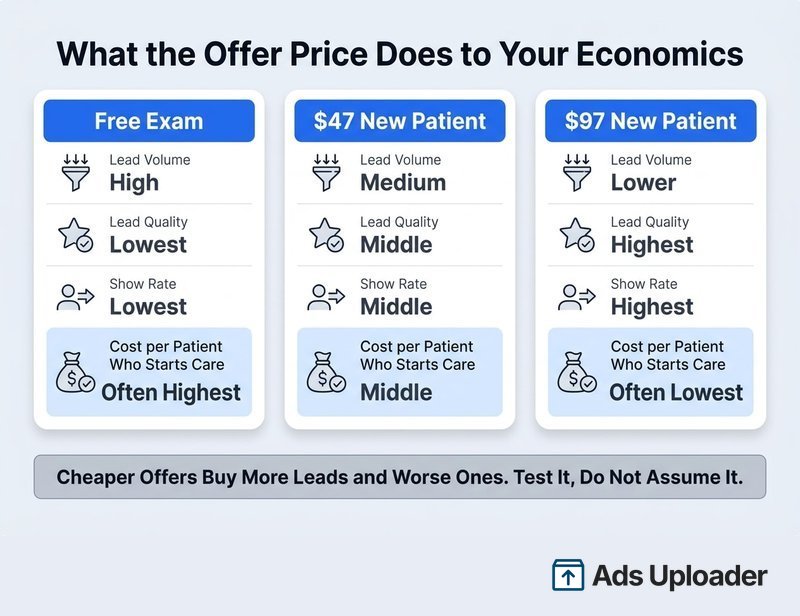
The price is a dial, not a right answer. Turn it down and you buy more leads and worse ones. Turn it up and you buy fewer, better-qualified people. The instinct is to assume a paid offer filters out tire-kickers better than a free one, and plenty of practitioners will tell you exactly that. Worth saying plainly: no controlled study in healthcare or local services supports it. A 2023 behavioral-economics review found little rigorous evidence for financial approaches generally, and a Danish randomized trial of 6,746 appointments found no meaningful effect from announcing a no-show fine. Treat "paid offers show up better" as a hypothesis to test, not a settled fact.
What is not a hypothesis is the arithmetic, and this is where cost per lead stops being useful. Take a $40 lead and reasonable conversion rates:
| Stage | Rate | Cumulative cost |
|---|---|---|
| Lead | $40 | |
| Booked appointment | 60% | $66.67 |
| Showed | 75% | $88.89 |
| Began care | 70% | $126.98 |
That $40 lead is a $127 acquisition cost before a single hour of front-desk labor. Run it again at a 40% show rate and it becomes $166. The offer that generates the cheapest leads frequently produces the most expensive patients.
On the other side of the equation, the 2025 Chiropractic Economics Salary and Expense Survey reported a typical respondent seeing 138 patient visits per week, taking on seven new patients per week, with a patient visit average of 34, annual collections of $450,425, and $13,540 in annual marketing spend. That visit average includes maintenance care, so do not read it as care-plan length. No reliable national figure for average case value exists in current independent data; agency claims range from $900 to $3,600 and neither is a benchmark.
So calculate your own. Take collections from a cohort of new patients over 90 or 180 days, divide by the number of patients in that cohort, and segment by cash versus insurance and by offer. That number tells you what you can afford to pay.
Meta's Ad Policies for Chiropractic Copy
This is the section to read twice, because it is the difference between a running account and a disabled one.
The policy that catches chiropractors is Privacy Violations and Personal Attributes. Meta renamed and expanded it in June 2024, and it now lives in the Transparency Center rather than the old Business Facebook path most articles still link to. The operative line is short:
"Ads must not contain content that asserts or implies personal attributes."
The enumerated list includes physical or mental health, including medical conditions. Meta's own example pair marks the boundary: "Depression counseling" is allowed, "Depression getting you down?" is not.
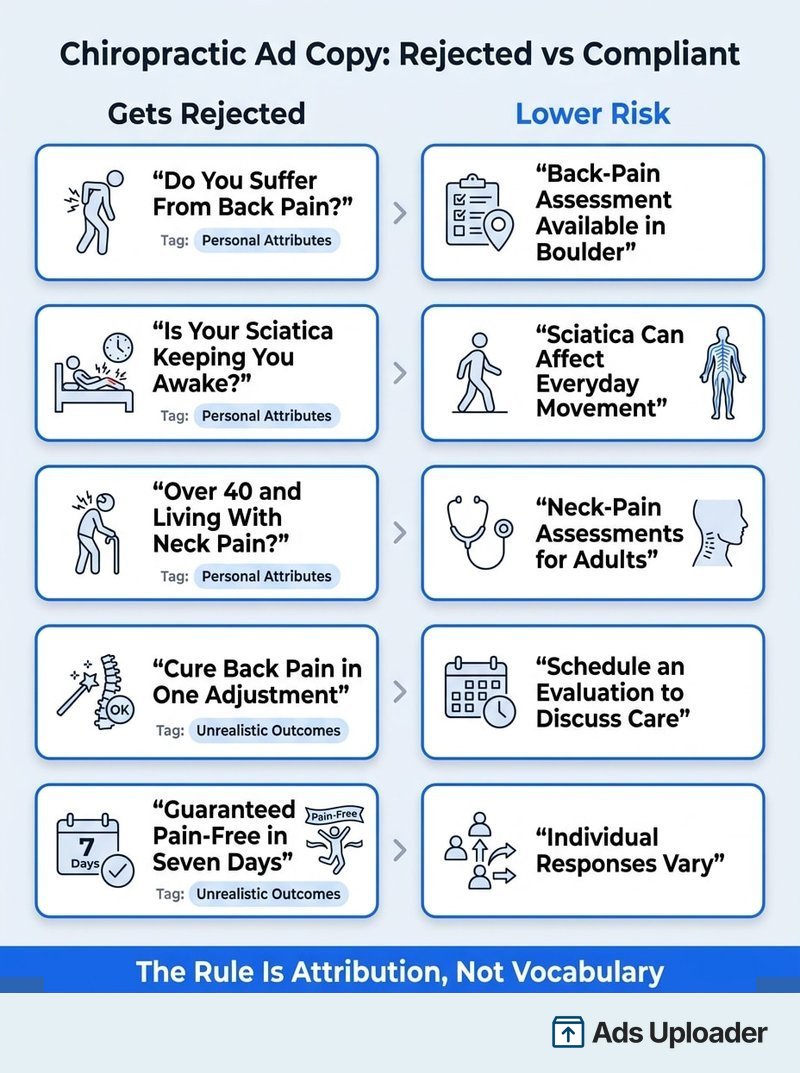
Notice what the rule is about. It is not the word "you," and it is not the question mark; plenty of compliant ads say "Book your appointment online." The violation is the semantic link between the reader and an enumerated attribute. "Do you have back pain?" implies the viewer has the condition. "Back pain is common in adults" discusses a health topic without assigning it to anyone.
The Rewrite Table
The practical version. Left column is the phrasing that gets chiropractic ads rejected, right column is a lower-risk rewrite, and the middle names the policy doing the work.
| Risky original | Governing policy | Lower-risk rewrite |
|---|---|---|
| "Do you suffer from back pain?" | Personal Attributes | "Back-pain assessment and chiropractic care are available in Boulder." |
| "Is your sciatica keeping you awake?" | Personal Attributes | "Sciatica can affect everyday comfort and movement. Learn about our evaluation process." |
| "Over 40 and living with neck pain?" | Personal Attributes (age plus health) | "Neck-pain assessments for adults in Boulder." |
| "We know your back hurts after CrossFit." | Personal Attributes | "Recovery-focused chiropractic evaluations for active adults." |
| "Join other back-pain sufferers near you." | Personal Attributes | "Learn about local options for back-pain care." |
| "Cure back pain in one adjustment." | Unrealistic Outcomes | "Schedule an evaluation to discuss whether chiropractic care may be appropriate." |
| "Guaranteed pain-free in seven days." | Unrealistic Outcomes | "Individual responses vary. Learn what an individualized care plan may include." |
| Form question: "Which condition do you have?" | Lead Ad Terms | Name, contact method, preferred appointment window only. |
The second policy in play is Unrealistic Outcomes: ads must not contain promises or suggestions of unrealistic outcomes for health. Cure language, guarantees, and implausibly fast results all land here. Meta's approval is not a legal shield either, since the FTC requires objective health claims to be substantiated by competent and reliable scientific evidence held before the claim is made.
Two pieces of stale advice are worth retiring. The 20% text-in-image rule was removed in September 2020, so any guide saying an image gets throttled for exceeding it is years out of date (less text still helps readability, just not because of a policy threshold). And the widely repeated claim that Meta categorically bans images with a red-highlighted painful area does not appear in any current published policy. Such imagery can still fail if it is sensational or paired with copy that diagnoses the viewer, but the blanket rule people cite is not a rule.
Before and after imagery is genuinely in flux. Meta revised its Health and Wellness policy on July 23, 2026, moving to a claims-based structure and removing the separate weight-loss and cosmetic category. Reporting suggests side-by-side imagery is no longer automatically rejected there, though no first-party changelog confirms the implementation. For a clinic the practical read is unchanged: "before: in pain / after one visit: pain-free" is still an outcome claim and still high risk.
If an ad is rejected, read the reason in Business Support Home, fix the ad and the landing page together, and appeal once if you believe the decision is wrong. Do not duplicate and resubmit the same rejected claim, and never try spelling tricks or a fresh account to get around review. Meta escalates on repeated violations and evasion attempts, and an account-integrity problem is far harder to unwind than a copy problem.
The current policy text lives in Meta's Privacy Violations and Personal Attributes standard.
Do Chiropractic Ads Need a Special Ad Category?
No, and this trips up a lot of clinics who have heard real estate agents talk about Housing.
As of August 2026 the Special Ad Categories are housing, employment, financial products and services, and social issues, elections or politics. Healthcare is not among them. Do not declare a category simply because you are a medical practice. Your constraints come from the Personal Attributes and Health and Wellness policies, Unrealistic Outcomes, the Lead Ad Terms, Meta's Business Tools data restrictions, and your own professional advertising rules, not from the Special Ad Category system.
HIPAA, Patient Data, and the Meta Pixel
No page currently ranking for this keyword mentions this, and it is the exposure most likely to cause a clinic real trouble.
HHS lists chiropractors among providers that can be HIPAA covered entities, specifically when they transmit information electronically in connection with a standard transaction such as insurance claims or eligibility checks. A genuinely cash-only clinic conducting no covered electronic transactions may fall outside HIPAA, though state consumer-health privacy law and the FTC Act can still apply.
Meta's side is unambiguous. Its Business Tools Terms prohibit sending data that "includes or is based on, directly or otherwise, health information, financial information, consumer report information, or other categories of sensitive information." That covers the Pixel, the Conversions API, offline conversions, and the SDK alike.
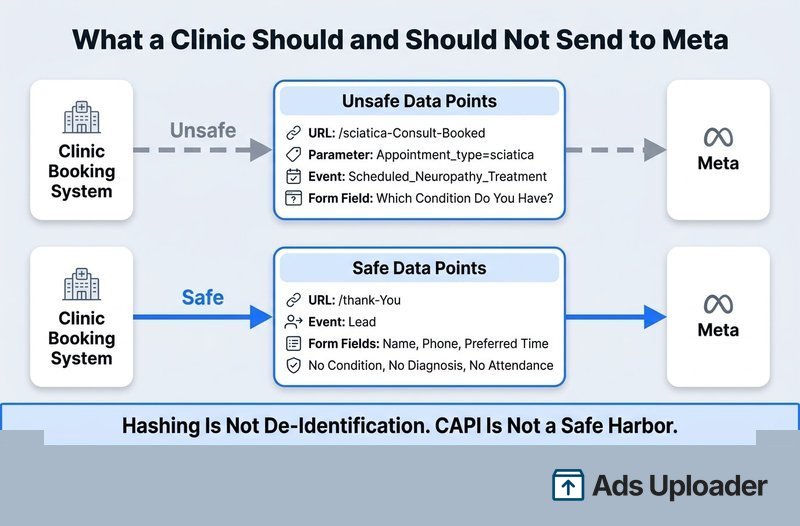
Two beliefs need killing. Hashing is not de-identification: HIPAA requires Safe Harbor removal of specified identifiers or an expert determination, and hashing an email satisfies neither. And the Conversions API is not a safe harbor, because server-side events face exactly the same restrictions as browser events.
Where does patient data actually leak? Almost always one of these:
- A confirmation URL like
/sciatica-consult-booked, or a query string carrying? condition=disc-injury - A CAPI parameter such as
appointment_type=sciatica - A custom event named something like
Scheduled_Neuropathy_Treatment, where the event name itself is the disclosure - An Instant Form asking about symptoms, diagnosis, medication, or injury details
- A CRM sync pushing "booked sciatica consult," diagnosis, or treatment acceptance back to Meta
- Pixel code sitting on a patient portal, intake form, or appointment-detail page
Meta has built defenses against some of this. Since January 2025 it applies extra restrictions to health and wellness data sources, and by its own account its Core Setup blocks custom parameters, truncates URLs after the domain, and puts healthcare custom-event names through human review. Useful, but a platform filter is not a legal shield. The obligation stays with the clinic.
A safer setup: keep Meta tracking off portals, intake, and condition-coded booking or confirmation pages entirely. Strip condition names out of URLs, parameters, and event names. Never send diagnosis, appointment type, attendance, or case value back to Meta. Use a vendor that will sign a Business Associate Agreement if PHI must be processed, noting that Meta does not offer one for the Pixel or CAPI. And the privacy policy Meta requires on lead forms must accurately describe what you collect and who processes it, though a privacy policy is not a HIPAA authorization.
The one-line test: your Meta ad account should never be able to tell you a lead's diagnosis. For the underlying rules, see HHS guidance on online tracking technologies.
Build Your Own Swipe File
Stop scrolling the Ad Library by hand. Search, filter, and save proven ads with a free Chrome extension built for media buyers.
Get Ad Library Helper FreeFree Chrome extension • Built by Ads Uploader
Building the Campaign: Structure, Targeting, and Creative
Budget and Structure
A widely copied budget rule sets monthly spend by the population within a 10-mile radius: $300 for a small market, $500 for medium, $1,000 to $5,000 for large. It is not evidence-based. Population does not determine auction cost, offer appeal, or whether anyone answers your phone.
Work from lead math instead. Using 2025 healthcare Meta lead costs of roughly $47 to $53:
| Monthly spend | Raw leads before booking and show loss |
|---|---|
| $500 | 9 to 11 |
| $1,000 | 19 to 21 |
| $1,500 | 28 to 32 |
| $3,000 | 57 to 64 |
Apply a 60% booking rate and a 70% show rate to that $1,000 row and roughly eight or nine people come through the door. That is the honest picture. Treat $500 a month as a proof of concept, $750 to $1,500 as a real validation budget, and $1,500 to $3,000 as the range where you can test creative properly.
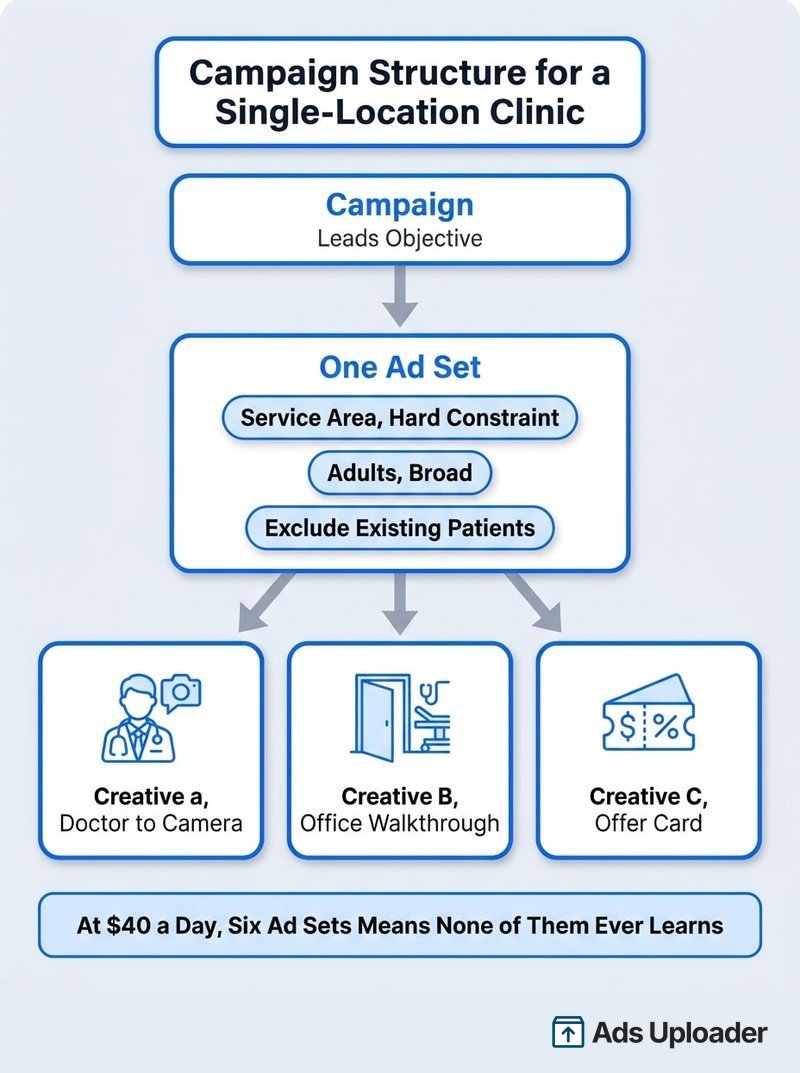
Structure follows from the same constraint. Meta said in December 2025 that performance typically stabilizes after roughly 50 optimization events within seven days. At $30 a day you have $210 a week, which would need $4.20 leads to clear that bar. You will not get there. So consolidate: one campaign, one ad set, several creatives. A clinic spending $40 a day across six ad sets has guaranteed none of them learns anything.
Targeting After Andromeda
Every article ranking for this keyword still tells you to stack interests: yoga, CrossFit, wellness, runners, golfers. That describes a version of Meta that no longer exists.
Advantage+ audience now treats age, interests, custom audiences and lookalikes as suggestions that help delivery start searching, not as hard constraints. Location, minimum age, language, and custom-audience exclusions remain real controls. Behind that sits Andromeda, the retrieval engine Meta launched in late 2024 with roughly 10,000 times the model capacity of its predecessor. Meta also removed detailed-targeting exclusions from new ad sets on March 31, 2025.
So the 2026 starting structure is one consolidated adult audience, your true service area as a hard location constraint, broad demographics, and several genuinely different creative angles. Use your real patient draw area rather than the smallest radius available, because a five-mile circle is enormous in a dense city and useless in a rural one. Audiences still earn their place for excluding existing patients and retargeting video viewers and page engagers.
One hard rule: never build audiences around medical diagnoses or treatment histories.
Creative That Passes Review and Still Converts
Video does the heavy lifting here, and the reason is trust rather than format preference. People are choosing someone who will put hands on their spine. A doctor talking to camera, an office walkthrough, or a patient story framed without outcome claims all do work a stock photo cannot.
Safer imagery means a clinician and patient in a neutral consultation, the treatment environment, educational anatomy without pain explosions, or someone doing an ordinary activity without being labeled as your expected result. Since audience slicing no longer carries the load, creative volume is the lever. Three or four distinct angles in one ad set will teach you more than a dozen ad sets running the same ad.
Lead Capture: Instant Forms vs Landing Pages
Instant Forms give you the cheapest leads and the weakest intent. The form pre-fills from the user's Meta profile, so someone can submit in two taps while half paying attention. Choose the Higher Intent variant where available, put phone above email, and keep the field count low.
A landing page with a real booking calendar flips the trade: fewer leads, much better show rates, because someone who picks a time slot has made a decision the form-filler never made. Meta positions website forms for exactly this.
Most clinics should run both. Instant Forms for volume at the top, direct-to-scheduler for retargeting and warm traffic, compared on cost per patient who shows rather than cost per lead.
On what you may ask: appointment window, preferred contact method, and general availability are fine. Symptoms, diagnosis, medication, pregnancy status, imaging results, and accident details are not. Meta's Lead Ad Terms state that you "will not collect any data that is sensitive or prohibited by Meta's Advertising Standards," and those answers are personal attributes besides. Collect clinical history later, in a system built to hold it.
The Show-Rate System, Where Chiropractic Campaigns Are Won
Here is the part the rest of the internet skips.
Published chiropractic cases put booked-to-show rates between roughly 55% and 88%, a range so wide it tells you the average is not the story. The variable is not the vertical, it is the clinic's process. For a floor reference, broad medical research puts outpatient no-show rates anywhere from 5% to 31% depending on specialty and population.
Save Hours on Creative Testing
Stop uploading ads one by one. Bulk process unlimited creatives with automatic media matching and direct API publishing.
Try Ads Uploader FreeNo credit card required • 7-day free trial
Speed to Lead
You have seen the statistic: respond in five minutes rather than 30 and you are 100 times more likely to make contact. It comes from the Lead Response Management study, which analyzed about 15,000 web leads using 2007 data across six companies, none of them healthcare. The 2011 Harvard Business Review follow-up audited 2,241 companies and found average response time was 42 hours, with 23% never responding.
Nobody has replicated those numbers for chiropractic paid-social leads, so do not quote "100 times" at your front desk as though it were physics. The defensible version is just as actionable: response delay destroys intent, so contact people while they still remember filling in the form. Then measure your own contact, booking and show rates by response-time band (under 5 minutes, 5 to 15, 15 to 60, 1 to 4 hours, same day, next day) and let your data set the target.
The Confirmation Stack
Reminders are the one intervention with solid current evidence behind them. A March 2026 systematic review of 10 randomized trials found reminders increased hospital outpatient attendance by 11% relatively (pooled RR 1.11, 95% CI 1.05 to 1.19). More striking, a 2026 Penn Medicine trial randomizing 59,994 high-risk patients found that adding an interactive automated call on top of existing SMS reminders cut no-shows from 11.3% to 9.6% and lifted completed appointments from 75.9% to 77.8%.
The detail worth stealing: the call let patients confirm, cancel, or reschedule. Active response beats passive notification. A cadence to test:
- Immediate confirmation with address, parking, and a reschedule link
- Human contact or interactive message shortly after the lead comes in
- A confirmation request 48 to 72 hours before the appointment
- A reminder 24 hours before
- A short logistics message on the day
- A fast rebooking message after any no-show
Book the appointment during the first conversation rather than promising to call back, and keep the gap between booking and appointment short. Every day of lead time is another day for intent to decay.
Deposits and card-on-file are worth testing, but the evidence is not there yet. Check state law, insurance contracts, and access implications first.
Feeding Outcomes Back to Meta
Normally this is where I would tell you to send "booked" and "showed" events back so delivery optimizes toward patients instead of form-fills. For a clinic, that advice runs straight into the previous section: attendance and treatment events are health information under Meta's Business Tools Terms.
The workable middle ground is to optimize to the highest privacy-safe event that happens often enough, keep the full lead-to-patient analysis inside a HIPAA-capable system, and accept that Meta will know less about your funnel than it would for an ecommerce advertiser. That is a constraint of the vertical, not a problem to engineer around.
What to Measure, and What to Ignore
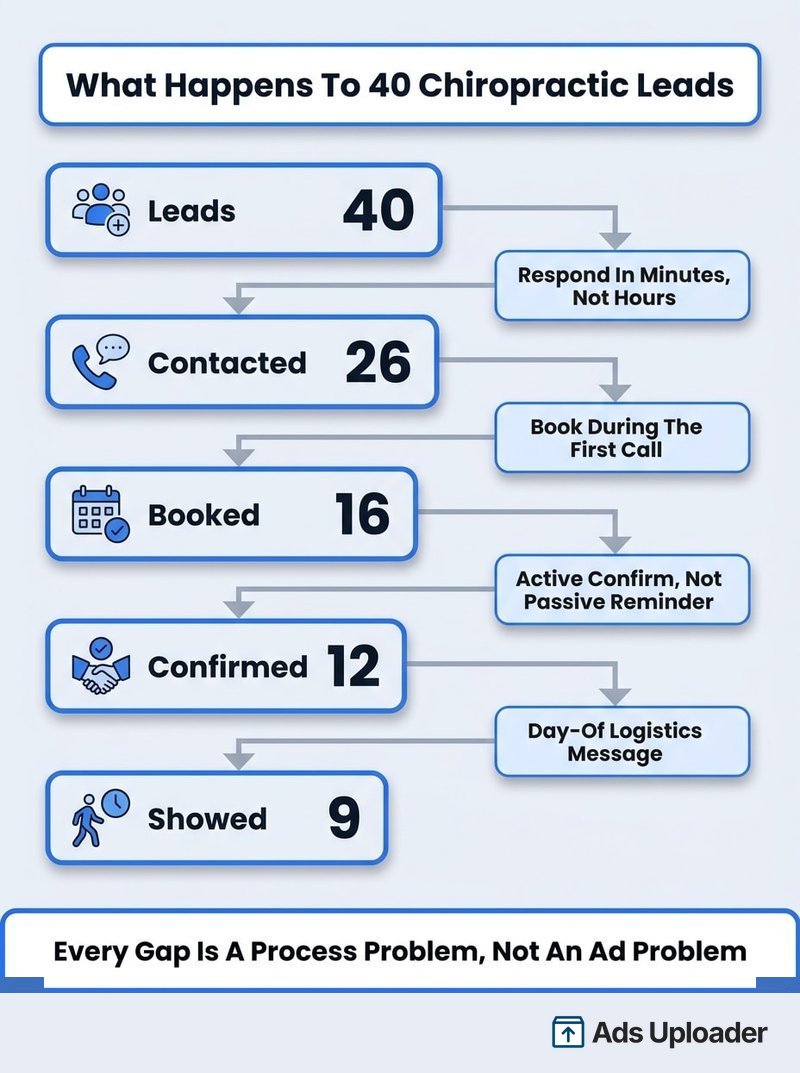
Four numbers decide whether Facebook ads for chiropractors are working: cost per lead, contact rate, booked-to-show rate, and cost per patient who begins care. Everything else is texture.
The metrics that mislead here are the ones Ads Manager shows first. Click-through rate, CPM, engagement, and raw lead count all move independently of whether anyone got adjusted. Fifty leads a month at a great CPM, with the front desk converting 15% of them, is not a good campaign.
A weekly review takes 20 minutes: spend and lead count, median first-response time, bookings and shows from last week's leads, then creative. If cost per lead is climbing while frequency rises and click-through falls, that is creative fatigue and new angles fix it. If cost per lead is stable but shows are falling, the ad account is fine and the problem is downstream. Telling those two apart is most of the skill.
Kill a campaign when cost per showed patient exceeds what a patient is worth, and only after you have fixed the follow-up.
Real Chiropractic Facebook Ads Running in 2026
The Meta Ad Library shows every ad a Facebook Page is currently running, which makes it the best free way to see what real clinics are putting in front of patients. The six ads below were all active for at least a month when they were captured in September 2026, and together they cover the formats and offers this guide discusses: low-priced new-patient exams, spinal decompression offers, pain-point creative, and patient testimonials. The copy is quoted exactly as it ran. Study what each ad does, not what it spends, because the Ad Library shows creative and copy but never budget.
This is the archetypal new-patient offer. A $21 package (exam, X-rays, first adjustment and 30 minutes of stretch therapy) is framed as a $300-plus value and capped at "the first 30 people" to add urgency. The square video opens on a spine model and a blunt pain-point hook (back, neck, sciatica, disc pain), which is what earns the cheap click. Copy the structure: the offer lists concrete deliverables instead of a vague discount, and it describes the service rather than promising a cure, which keeps it clear of Meta's Unrealistic Outcomes rule.

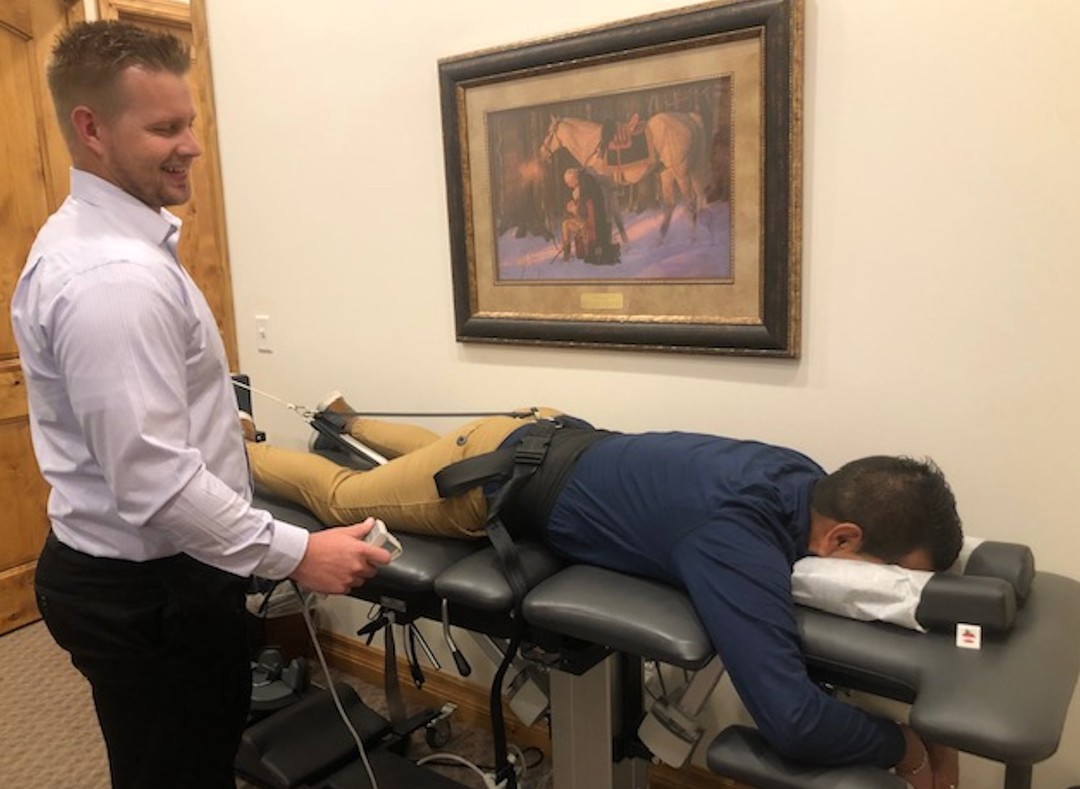
This ad leads with a named patient testimonial, then sells a "Chronic Back Pain Evaluation Special" built around laser and spinal decompression, positioned as drug-free. The offer itself is a free consultation limited to the first 30 people this month, and the creative is a genuine treatment photo rather than stock. The worth-copying move is pairing one specific testimonial with one clear offer. On compliance, a testimonial describing a clinical result raises the bar, and phrasing like "FDA-Cleared and Highly Effective" is exactly the efficacy claim the FTC expects you to be able to substantiate before it runs.

A $47 new-patient package sold against a "$195 Total Value", with 30 packages available "for THE NEXT WEEK" and a three-photo collage of the doctor actually adjusting patients. The lesson is in the itemized stack: consultation, functional spinal assessment, nervous-system scan, report of findings and first adjustment are each named, so the reader can see where the value comes from instead of taking a percentage on faith.

A patient-filmed testimonial video paired with a $25 consultation, exam and two X-rays, limited to 23 vouchers. The clip is deliberately homemade, which is a common and effective format for local service ads. Two things are worth copying: the exact voucher count makes the scarcity feel real, and the copy spells out that any extra X-rays are credited toward services, which heads off a bait-and-switch reading. The ad even carries a 72-hour refund-rights disclaimer, the kind of line some states require on discounted health offers.

A $39 "Women's Special" (normally $350) aimed only at women, whose stacked offer quietly includes a decompression treatment and positions the clinic as one of few locally with a decompression table. Segmenting one offer to one audience makes the message feel personal. The creative is the red-highlighted pain-zone collage that many guides claim Meta bans outright; the fact that it is running shows that blanket "red painful area" rule is not an actual published policy. Keep copy like this describing your service rather than diagnosing the viewer, which is where the personal-attributes line actually sits.


Not every clinic ad is a coupon. This one skips the discount entirely, shows the practice website on a phone under an "Award Winning Spinal Care" banner, and drives straight to online booking across multiple North Texas locations. A clean "Book now" path like this suits an established brand with name recognition and several sites, where a deep new-patient discount would train the market to wait for one.


Wrapping Up
Facebook ads for chiropractors reward the boring parts. The offer sets your economics, and a cheaper offer is not automatically better once you follow the math through to cost per patient. Meta's Personal Attributes policy decides whether you get to run at all, and the fix is almost always to rewrite the reader out of the sentence and put the service in. Tracking has to stay clean, because a clinic sending condition data to Meta has a problem no amount of ROAS makes acceptable. And the show rate, not the cost per lead, decides whether the campaign made money.
If you take one action from this, make it an audit rather than a campaign change. Time how long your front desk takes to call a new lead, then count what happened to last month's leads at each stage: contacted, booked, confirmed, showed, started care. Most clinics find the biggest drop sitting between "lead" and "contacted," which no amount of creative testing will solve. Fix that first, get the copy compliant, then spend more.