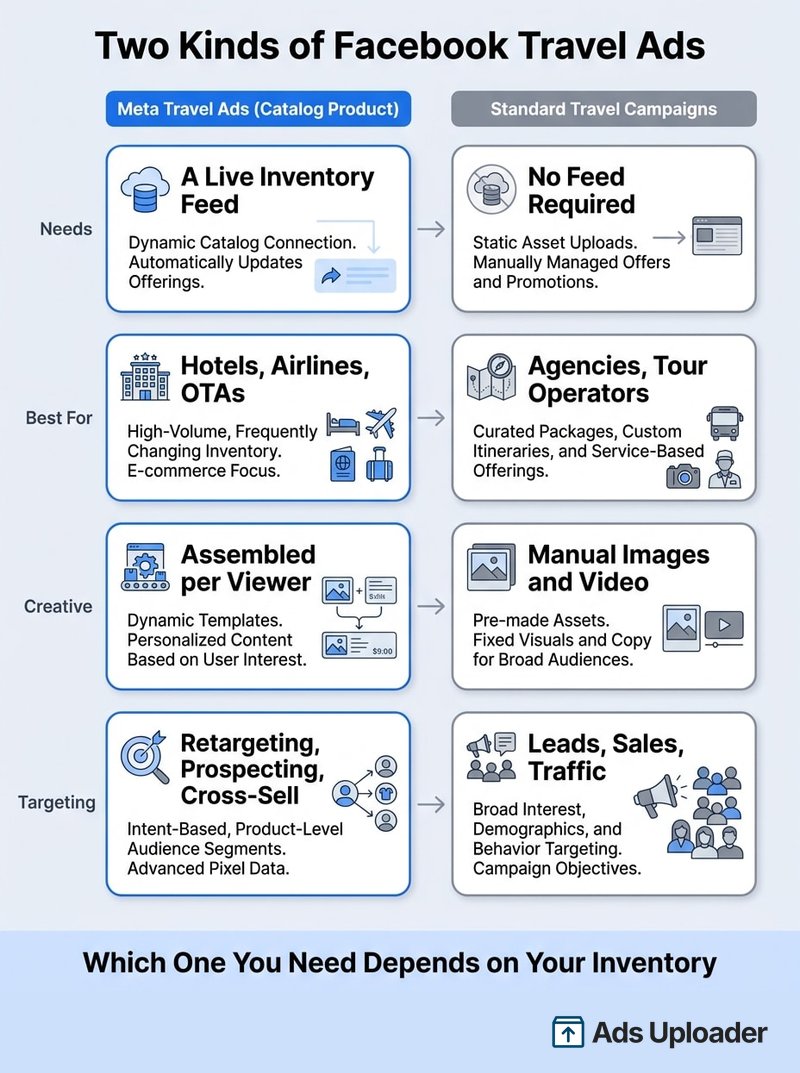
Facebook travel ads describe two things. Meta Travel Ads are a specific catalog-driven format that pulls live prices and availability from a hotel, flight or destination feed and matches inventory to a traveller's intent. More loosely, the phrase means any campaign a travel business runs on Facebook and Instagram. The catalog product needs a feed and suits hotels, airlines and online travel agencies; smaller operators without one should run standard Leads or Sales campaigns. Results depend on the offer, follow-up and booking window, not the format.
The same search sends two very different advertisers to the same page. One is an online travel agency with a 50,000-property hotel feed that changes price by the hour. The other is a solo agency owner with a thousand-dollar budget and no inventory feed at all. Meta's own documentation assumes you have a catalog. The agency blog posts assume you do not and skip the catalog product entirely. Almost nobody tells you which description fits you.
This guide fixes that. It covers what Meta Travel Ads actually are, the full playbook for advertising travel on Meta, and a plain decision rule for which setup your business needs. If you are weighing travel against other verticals first, our overview of Facebook ads by industry sets the wider context.
Two Things Called "Facebook Travel Ads"
When people type "facebook travel ads" they mean one of two things.
The first is Meta Travel Ads, a named product. It is the travel-specific implementation of Meta's dynamic catalog advertising, historically called Dynamic Ads for Travel and now part of the Advantage+ catalog family. It automatically promotes items from a hotel, flight or destination catalog, personalising the image, dates, link and price for each viewer based on travel signals. It needs a structured inventory feed and event tracking.
The second is the travel vertical in general: any Facebook or Instagram advertising a travel business runs, whether that is a brand video for a tour company, a lead form for a honeymoon specialist, or a seasonal offer from a boutique hotel. No catalog required.
Both are legitimate. The mistake is assuming the catalog product is the "proper" way to advertise travel and the rest is amateur hour. For most travel advertisers, the opposite is true: the catalog product is heavy infrastructure that only pays off at a certain scale of inventory.
What Meta Travel Ads (the Product) Actually Are
Meta Travel Ads are still a documented product in 2026. Meta's Travel Ads developer documentation was last updated in November 2025 and continues to use the name, while the wider catalog family is branded Advantage+ catalog ads. There is no retirement notice for the travel verticals. The most accurate way to describe them: Meta Travel Ads are the hotel, flight and destination implementations of Advantage+ catalog advertising.
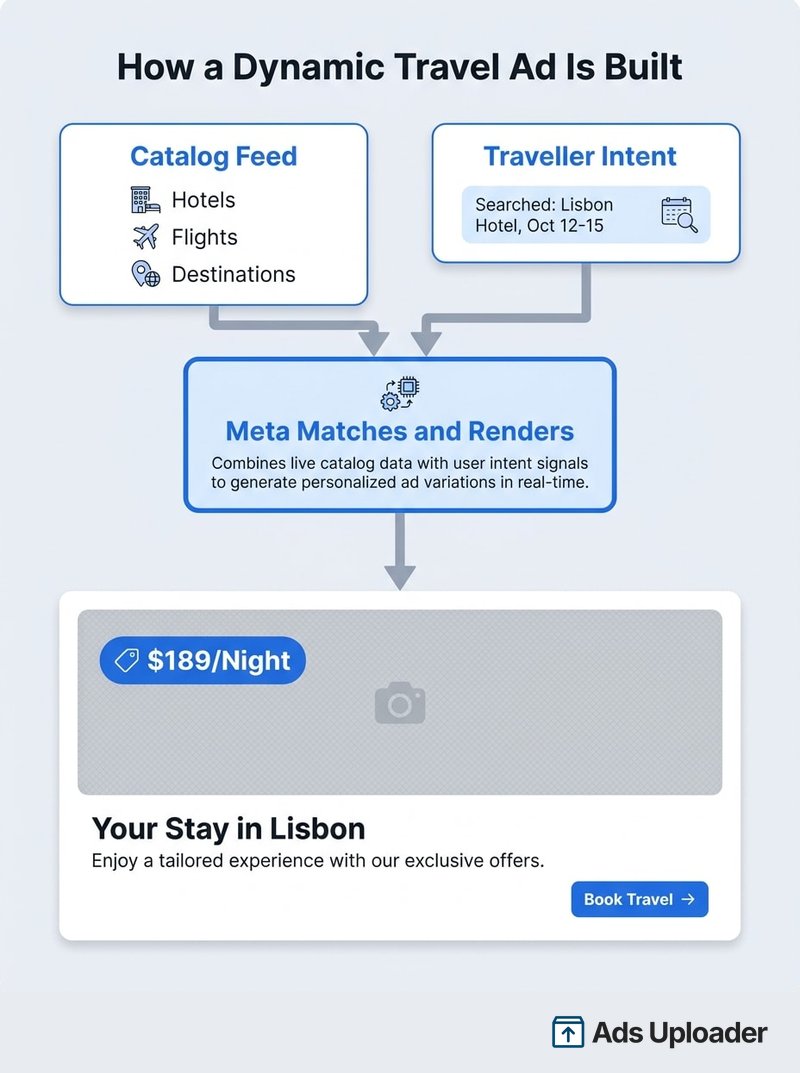
They are dynamic and effectively always-on. Once the campaign is built, Meta assembles each ad on the fly, pulling the right item and its current price from your feed and showing it to the right traveller across mobile, desktop, tablet and the Audience Network. You do not build a separate ad per hotel or route.
The Three Catalog Types
Everything starts with a catalog, and there are three.
| Catalog | Designed for | What the feed must carry |
|---|---|---|
| Hotel | Individual properties and dynamically priced stays | Stable hotel ID, name, description, landing-page URL, image and location. Can include base and sale prices, ratings and brand. Supports date and room-specific pricing up to a 180-day horizon and 14-night stays. |
| Flight | Routes and itineraries | Origin and destination airport codes, image, description and booking URL. Items can come from a feed, from flight-event data, or both. Cities and price data are optional. |
| Destination | Cities, regions or package pages | A destination ID that matches your event content IDs, plus name, type, location, image and URL. Price fields are optional. |
A hotel advertiser using dynamic room and date pricing needs far more than a list of names and photos. Its availability and pricing system has to reliably produce the date, stay-length and price combinations Meta expects. That is a materially heavier build than running ordinary image or video ads, and it is the single biggest reason not every travel business should attempt it.
Objective, Creative and Overlays
In the current Ads Manager interface you start from the simplified Sales objective. Under the hood, Meta's Travel Ads API still uses the PRODUCT_CATALOG_SALES objective, names your catalog at the campaign level and your eligible inventory at the ad-set level, and optimises for offsite conversions against events like Purchase or InitiateCheckout. The travel-specific BOOK_TRAVEL call to action is available.
Creative is templated. You insert catalog and trip data into the text, description and URL using template tags such as the hotel city, price, trip dates or number of travellers. You can run single-item or carousel ads, mix static and dynamic cards, and send travellers to a landing page pre-filled with their trip details. Meta renders these dynamic frames much like a standard Meta carousel, except the cards are chosen per viewer.
Price overlays are where the verticals differ, and it catches people out:
| Overlay | Hotel | Flight | Destination |
|---|---|---|---|
| Current price | Yes | Yes | Yes |
| Strikethrough / original price | Yes | No | No |
| Percentage discount | Yes | No | No |
Strikethrough and percentage-off overlays are hotel-only, and they depend on valid price and sale-price fields in the feed. An overlay is not an independent claim; it reflects the feed. If the feed goes stale or the landing page changes before the catalog refreshes, the ad can quietly become misleading, which matters for the compliance rules later in this guide.
The Tracking Underneath
Travel Ads run on four standard events, sent through the Meta Pixel for web, the SDK for apps, or the Conversions API for server events: Search, ViewContent, InitiateCheckout and Purchase. Each carries travel-specific parameters, such as check-in and check-out dates for hotels, origin and destination airports for flights, and travel start and end dates for destinations.
The operational catch is consistency. The browser, app and server versions of an event have to agree on IDs, dates, currency and value, and events sent for the same conversion need matching event IDs so Meta can deduplicate them. The Conversions API makes events more resilient; it does not fix mismatched catalog IDs or wrong booking values.
Build Your Own Swipe File
Stop scrolling the Ad Library by hand. Search, filter, and save proven ads with a free Chrome extension built for media buyers.
Get Ad Library Helper FreeFree Chrome extension • Built by Ads Uploader
The Three Ways Travel Ads Target
Travel Ads support three operating modes, and choosing the right one is most of the strategy.
Retargeting reaches people who fired travel events, such as searching a route or viewing a property, usually within a defined window. It re-shows the exact hotel, flight or destination they investigated, with current availability and price. Dynamic travel audiences support retention windows as short as four hours and rules based on booking windows, dates, length of stay and traveller counts.
Prospecting expands beyond your own visitors. It uses a broad demographic and geographic audience plus Meta's predictive signals, paired with a broad product set. Meta specifically recommends more than 100 hotels for hotel prospecting so delivery has room to match a person to an item. You let the system pick both the traveller and the inventory.
Cross-sell and upsell targets existing visitors or purchasers with a different product set: hotels shown to people who bought a flight, or premium fares and ancillaries offered after a booking. Meta's guidance suggests you can include retargeting-eligible people in prospecting while excluding recent purchasers, using an example exclusion of buyers from the previous ten days.
Report these three separately from day one. Blending them hides which part of the funnel is actually paying, and the same logic that governs audience targeting on Meta more broadly applies here.
Do You Even Need Travel Ads? A Decision Rule
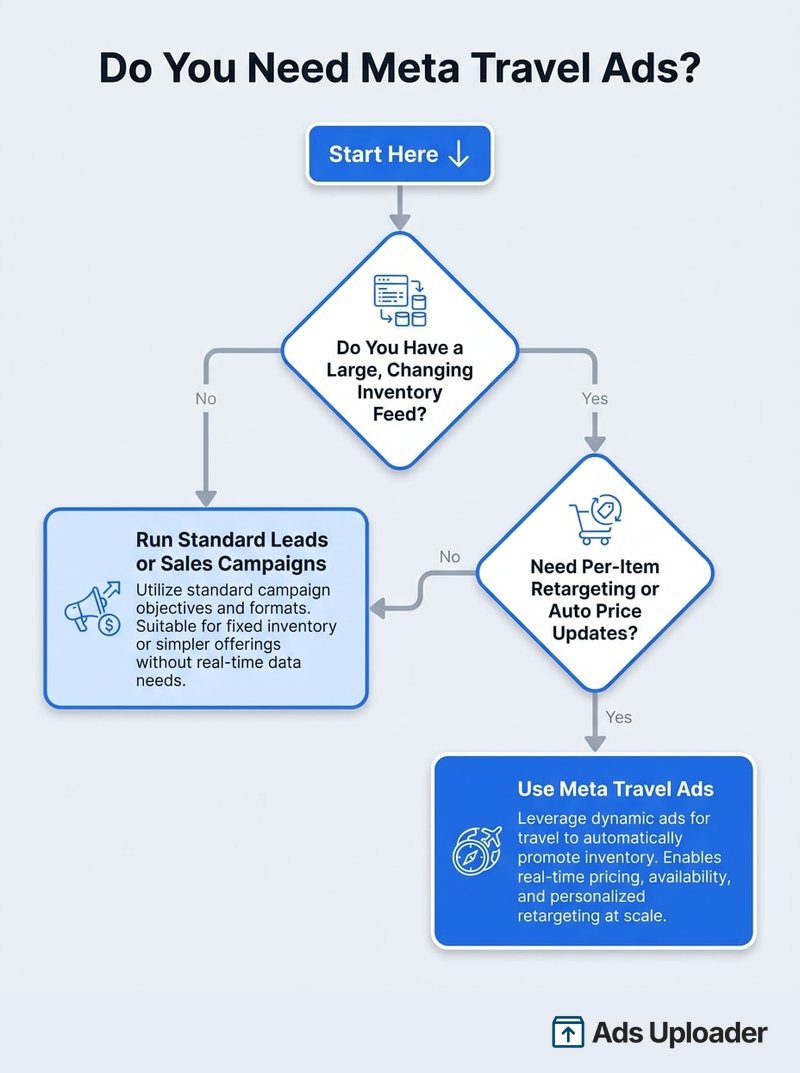
Here is the part the search results tend to skip. A catalog is required to run the Meta Travel Ads product. It is not required to advertise travel on Facebook. For many advertisers, building a feed is effort spent solving a problem they do not have.
| Your situation | Recommended setup |
|---|---|
| Small agency or tour operator selling a limited number of trips via consultations or quotes | Standard Leads campaign with first-party tracking. No catalog. |
| Travel business taking online bookings but with no structured inventory feed | Standard Sales campaign optimised for a reliable booking or checkout event. No catalog. |
| Hotel group, airline, OTA or tour marketplace with substantial, changing inventory | Meta Travel Ads using a hotel, flight or destination catalog. |
| Advertiser needing personalised inventory retargeting, automatic price updates or flight-to-hotel cross-sell | Meta Travel Ads. |
| Advertiser who only needs destination inspiration, brand video or a single seasonal offer | Standard Meta ads. A catalog is unnecessary. |
The tell is inventory. If you sell a handful of curated trips, or the same few packages season after season, a catalog adds cost without adding much personalisation. If you have thousands of price-changing items and want to re-show the exact one a traveller viewed, the catalog earns its keep.
Small operators are usually better served by lead ads and consultation booking than by catalog infrastructure. One advertiser in a small travel company's own testing found a Sales campaign outperformed an Engagement campaign with the same budget and creative, which is the more useful lesson than any catalog feature: pick the objective that maps to the commercial outcome.
The Vertical Playbook: Advertising Travel on Meta
If the decision rule pointed you toward standard campaigns, or you run both alongside a catalog, this is the playbook.
Objective and Funnel Structure
Match the objective to the outcome. Leads fits businesses where the sale starts with an inquiry or custom itinerary. Sales fits online bookings with a reliable Purchase event. Traffic optimises for clicks, not bookings, so use it only when a landing-page visit is genuinely the goal.
Structure a simple funnel: awareness with inspiring video and Reels, consideration retargeting engagers and video viewers, and conversion for high-intent visitors. Resist splitting a modest budget across a dozen tiny ad sets, because none will gather enough events to exit the learning phase. Consolidate instead. The tradeoff between one big budget and many small ones is the same one behind ad set versus campaign budget optimisation.
Targeting Travellers in 2026
Travel targeting has changed, and evergreen advice about specific interest names is a trap. Meta spent 2025 consolidating detailed targeting, and third-party tracking reports that many legacy behaviour options stopped delivering in January 2026. That includes the old "Planning to travel" behaviour that older guides still tell you to select. Do not build a strategy around a named audience that may not exist in your account.
What remains dependable are the hard controls that survive Advantage+ audience expansion: location, minimum age, language and custom-audience exclusions. Everything else, including detailed interests and lookalikes, is treated as a suggestion Meta can expand past. So a sound travel setup constrains only the markets you can serve, feeds Meta strong first-party signals from purchasers and qualified leads, lets the audience run broad, and puts the destination, price and departure point clearly in the creative. If you want a life-event angle such as newly engaged travellers for honeymoons, search and validate it live rather than assuming it is available.
Creative That Sells the Trip
Travel is a visual purchase, so lead with motion and put the destination name on screen in the first two seconds. Add captions, because most feed video plays silent. Show the actual experience, rooms, food and views, and back it with real social proof rather than stock gloss. Keep one message per ad and one clear call to action.
Rotate concepts often. Travel visuals fatigue faster than most verticals because the audience is inspiration-driven and sees the same beaches everywhere, so watch for the signals of creative fatigue and refresh with genuinely different angles, not headline tweaks. Keep the offer and destination inside the first line of primary text, before it truncates.
Save Hours on Creative Testing
Stop uploading ads one by one. Bulk process unlimited creatives with automatic media matching and direct API publishing.
Try Ads Uploader FreeNo credit card required • 7-day free trial
Facebook or Instagram?
Neither platform wins outright for travel; they reach different travellers. Meta and Tourism Economics found social-media travel planning at 71% for ages 18 to 24 and 68% for 25 to 34, falling to 21% for 55 and over, with Instagram use among younger adults more than double that of the oldest cohort. Pew's November 2025 data shows Facebook still reaches most older US adults while Instagram skews young. So Instagram Reels and Stories carry younger inspiration, and Facebook feed and groups reach older, often higher-spending travellers.
The practical move is to run Advantage+ placements at first, supply vertical video that works everywhere, then read the placement breakdown and judge it on bookings or qualified leads rather than cheap engagement.
What Travel Ads Cost and What to Budget
Travel-specific benchmarks are thin, and honest planning means saying so. The strongest recent public figures come from different samples and should not be stitched into one "average campaign":
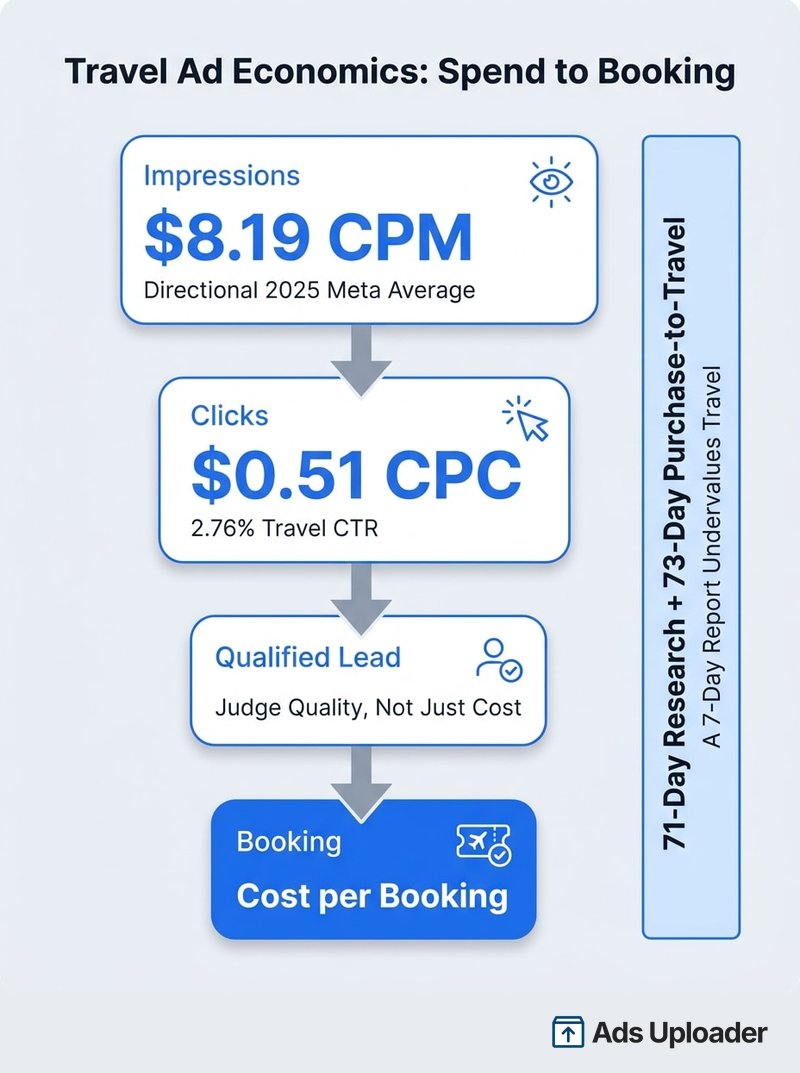
- WordStream and LocaliQ's 2025 Facebook advertising benchmarks show travel traffic campaigns at a 2.76% click-through rate and $0.51 cost per click, though no travel row appears in their lead cost table.
- Gupta Media's 2025 report put the broad Meta CPM average at $8.19.
- Varos data from July 2024 reported travel services at roughly $86 cost per acquisition and a 5.49 platform ROAS, and hotels at $209 and 7.04.
Treat all of these as directional. Platform-reported ROAS is not incremental ROAS, and none of these samples is a clean travel-only benchmark. The often-quoted "$750 to $2,000 a month" starting budget is an agency rule of thumb, not a validated figure. A better formula is your desired qualified results multiplied by an acceptable cost per result. Thirty qualified leads at a $75 target implies about $2,250; twenty hotel bookings at a $209 directional cost implies about $4,180. A small agency can validate one offer in one market on a modest budget, but a multi-market catalog campaign usually needs far more before any ad set stabilises. Travel also has a measurement lag most verticals do not. Expedia's Path to Purchase research found an average 71-day path from inspiration to purchase, then another 73 days from purchase to travel. A seven-day platform report can badly undervalue a campaign that started a two-month decision. Connect leads and eventual booking revenue back through your CRM and cohort reporting, and judge campaigns on cost per booking rather than first-click cost per lead.
Seasonality and Booking Windows
There is no single booking window for travel; it moves with geography, fare type and scarcity. Align your creative and retention windows to how far ahead your travellers actually book.
| Trip type | What the data shows |
|---|---|
| US domestic flights | Google Flights found the lowest prices around 39 days before departure, in a 23 to 51 day range. |
| US international flights | Lowest fares tended to appear 49 or more days out, so start earlier and hold audiences longer. |
| UK flights | Expedia UK found domestic savings at 31 to 45 days and international at 15 to 30 days, so do not export US assumptions. |
| Cruises | Cruise line trade data shows growing 9 to 12 and 12 to 18 month windows; build inspiration a year or more ahead. |
| Honeymoons | Planning guidance recommends booking core components at least six months ahead, earlier for peak dates. |
| Package and general leisure | Expedia's 71-day research path means longer nurture and measurement windows than an impulse buy. |
The evergreen move is to analyse your own distribution of days between first click, lead, booking and departure, and let that decide audience retention and promotion timing. Shift creative from inspiration to urgency as the low-fare or deadline window approaches.
Tracking, Compliance and Lead Handling
Whichever setup you run, get tracking right first. Pair the Pixel with the Conversions API for resilient event delivery, keep IDs and values consistent across sources, and optimise to the deepest event you can measure reliably. Then move fast on the human side: travel leads go cold quickly, so route them to your CRM and follow up within minutes, not hours. On compliance, the good news is that travel is not a Special Ad Category, so you keep full targeting. An ad only enters a category when the underlying offer is regulated, such as a travel job (Employment) or travel financing (Financial Products and Services).
Pricing claims are where travel advertisers get into trouble, and the rules tightened recently:
- In the US, the FTC's Rule on Unfair or Deceptive Fees took effect on 12 May 2025. For short-term lodging, the displayed price must show the total of known mandatory charges upfront, with the total more prominent than partial prices. Airfare is separately covered by federal rules requiring the entire price, including any round-trip condition.
- In the UK, CAP guidance says at least 10% of promoted products should be available at a "from" price, non-optional charges generally belong in the headline price, and availability limits must be disclosed.
None of this bans a good offer. It just means the advertised fare or room rate has to be genuinely bookable, mandatory charges handled honestly, and your lead and booking flows matched to what the ad promised. With a catalog, that also means keeping feed prices and landing pages in sync, because a stale overlay is a compliance risk, not just a bad experience.
Real Travel Facebook Ads Running in 2026
Every ad below is live in Meta's Ad Library as of September 2026 and has been running for at least a month. Together they cover the formats this guide walks through: the dynamic catalog product, standard deal and bundle creatives, top-funnel destination video, and the no-catalog campaign a small operator actually runs. The copy in each card is verbatim from the advertiser. The Ad Library shows creative and copy, never spend, so read these for structure and angle, not performance.
Expedia runs this as a dynamic catalog ad: the creative is a single property photo pulled straight from its hotel feed, and the copy pushes the app rather than a web landing page. This is the Meta Travel Ads product in its purest form, one template that swaps in a different hotel and price for each viewer. Note the app-install angle, which lets Expedia optimize for installs and mobile-exclusive rates instead of a single booking page.


Airbnb feeds its listings into the same kind of catalog, but the inventory is homes, not hotels. The creative is the host's own interior photo, and the description leans on scale, eight million rentals and two million Guest Favorites, to make a broad prospecting set feel curated. If you sell stays rather than rooms, copy the restraint here: let the property photo carry the ad and keep the primary text to a single line.


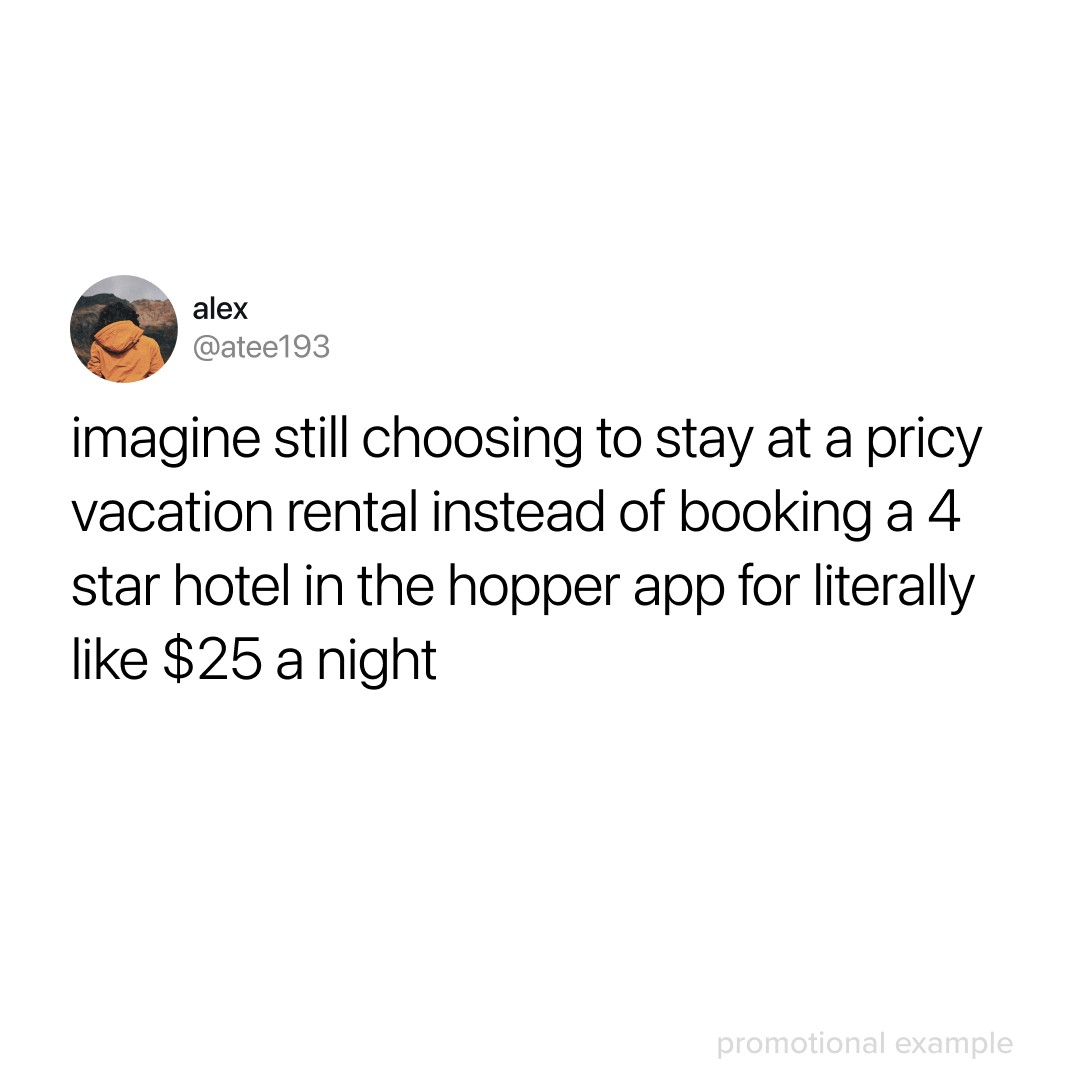
Hopper skips the polished hero shot and formats the ad as a screenshotted tweet, a native-feeling meme that anchors on one hard number, a four-star hotel for about 25 dollars a night. The thing to copy is that single concrete price doing all the persuading. The compliance note matters too: Hopper labels the creative a promotional example in the corner, which is the honest way to run a price claim you cannot guarantee for every user.

This Expedia video sells the bundle, flight plus hotel plus car, against a dreamlike Tokyo backdrop, then drops a mock search bar on screen so the next step is obvious. It is built as dynamic creative, so Meta can test the hook and framing automatically. Copy the structure: lead with a specific trip occasion, name the saving mechanism, and end on the search action.

Aruba's tourism board runs pure top-funnel inspiration: a slow underwater shot, a tagline about the island loving you back, and no price anywhere. There is nothing to book in the creative, and that is the point, it plants the destination before anyone is shopping. If you market a place rather than a product, this vertical, mood-first video is the template, paired with a soft Learn More rather than Book Now.

Booking.com leans on creator-style footage: a handheld clip of someone teaching their 102-year-old grandpa and 89-year-old grandma to book a trip, with burned-in captions so it plays with the sound off. The lesson is that a relatable, low-production story can outrun a glossy brand film in feed. The captions are load-bearing here, since most people watch muted, so build them in rather than trusting auto-captions.

Visit My Smokies shows what the playbook looks like with no catalog at all: one strong cabin photo, a clear location in Pigeon Forge, Tennessee, and a deals-led headline pointing to an ordinary landing page. A regional operator does not need a feed to compete, it needs a good creative and a tight geographic offer. This is the standard Sales or Traffic campaign most small travel businesses should run long before they consider the catalog product.


The Short Version
"Facebook travel ads" is two products wearing one name. Meta Travel Ads are the catalog-driven format built for advertisers with large, price-changing inventory: hotels, flights and destinations, personalised per traveller and served always-on. The wider term is any campaign a travel business runs on Meta, and for most small agencies and operators that means standard Leads or Sales campaigns with no catalog at all.
So start with the decision rule. If you do not have a real inventory feed, do not chase the catalog product; run lead-gen or booking campaigns and put your energy into the offer, the creative and the speed of follow-up. If you do have the inventory, build the feed properly, keep retargeting, prospecting and cross-sell reporting separate, and hold your prices in sync.
Either way, measure to the end of the trip. Travel's decision cycle runs two to three months, so a seven-day report tells you almost nothing. Judge campaigns on cost per booking, respect the booking window your travellers actually use, and answer the lead before it goes cold.