Facebook ads for coaches are Meta campaigns that place an offer, usually a free training or application, in front of a coach's audience on Facebook and Instagram, then route the lead into a booking and sales funnel. Broad or lookalike targeting feeds a nurture step such as a webinar, DM or video sales letter, ending in a booked call. Coaching carries no local audience ceiling but faces Meta's personal-attributes and income-claim rules. Profitability is decided by the offer and funnel, measured as cost per client, not cost per lead.
Coaching is one of the few Meta verticals with no inventory, no storefront and no service radius, which sounds like an advantage until you meet the two things that actually decide whether the ads work. The first is the funnel math, because a lead is not a client and the gap between them is where most budgets disappear. The second is Meta's review system, which treats "help you fix your life" offers with more suspicion than almost anything else on the platform.
Most coaching ad advice skips both. It stops at "run a $50-a-day campaign and test your creative," which is the easy part. What follows is the harder and more useful version: what the channel costs by niche and how that compares with Facebook ads in other industries, how the offer and funnel change those costs, the rules that get coaching ads rejected before they ever spend, and how to build and measure a campaign in 2026.
Do Facebook Ads Work for Coaches?
Yes, when the offer is differentiated, the proof is credible, the margin is real and a sales process already exists. Cheap leads are not evidence that any of that is true.
Here is the structural difference from most businesses. Nobody scrolling Instagram is searching for a coach. On Google, someone announces intent by typing "career coach near me." On Meta, you create the moment, which means an offer-led ad carries the campaign and brand awareness rarely books anyone on its own. The ad opens the loop; the funnel closes it.
That is also why the economics only work at certain price points. A $5,000 group program can absorb a $200 cost per booked call and still be wildly profitable. A $47 ebook or a $200-a-month membership cannot. The higher the ticket and the better the follow-up, the more the channel forgives. Coaching campaigns fail most often for three reasons that have nothing to do with targeting: the offer was never validated organically, there is no system to follow up on leads within minutes, and the coach judges the whole thing on cost per lead.
What Facebook Ads for Coaches Actually Cost
There is no audited, coaching-specific benchmark for cost per client, so the honest approach is to start from the closest verified lead-form data and then model the funnel yourself.
The best current reference is WordStream and LocaliQ's 2025 Facebook advertising benchmarks, covering 726 US lead campaigns from April 2024 through June 2025. These are lead-form medians, not cost per coaching client, and coaching spans several of their categories.
| Closest vertical (2025 lead campaigns) | Cost per lead | Conversion rate | CPC |
|---|---|---|---|
| Career and Employment | $17.64 | 5.77% | $0.86 |
| Education and Instruction | $28.22 | 10.08% | $1.65 |
| Personal Services | $30.57 | 6.51% | $2.08 |
| Health and Fitness | $52.98 | 5.63% | $2.64 |
| All industries | $27.66 | not stated | $1.92 |
Read those as proxies: business and mindset coaching sit near Education and Personal Services, weight-loss and fitness coaching near Health and Fitness, career coaching near Career and Employment. The all-industry median rose about 21% year over year, which the publisher attributes to auction competition, privacy signal loss and inflation.
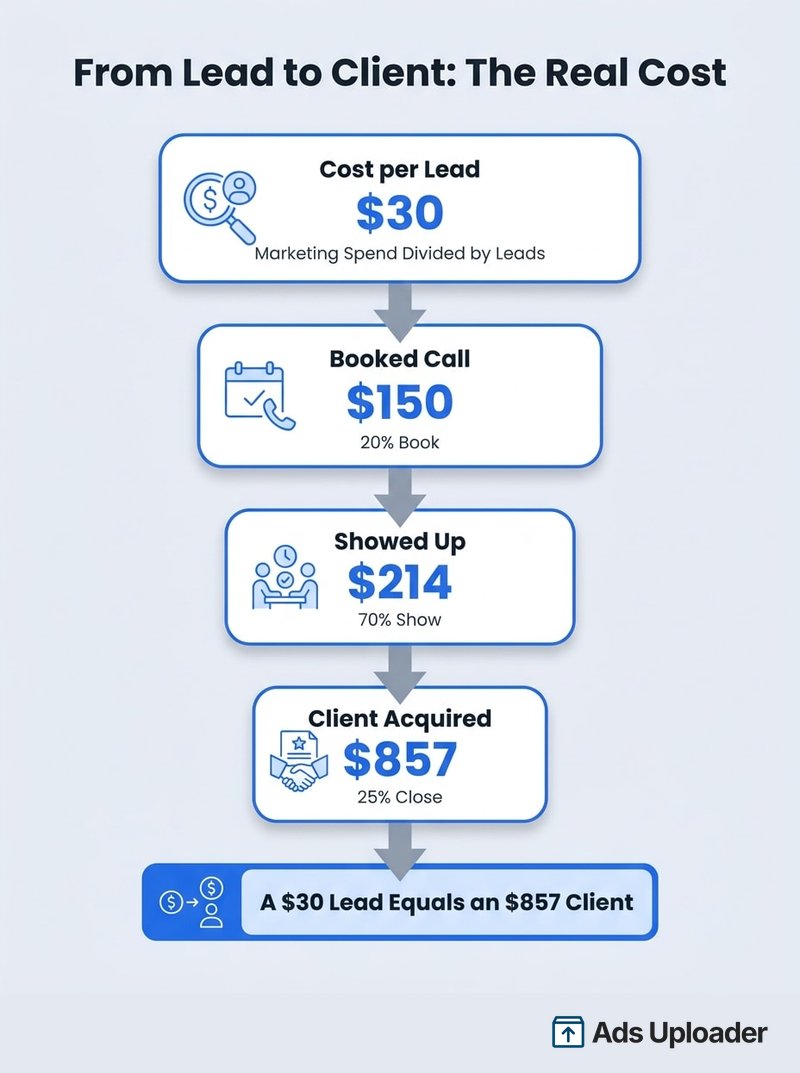
The trap is stopping there. A "lead" on a form is a long way from a client, and the multiplication is unforgiving. Take a realistic chain: a $30 cost per lead, 20% of leads booking a call, 70% of those showing up, and 25% of shows closing.
- Cost per booked call: $30 / 20% = $150
- Cost per show: $150 / 70% = $214
- Cost per client: $214 / 25% = $857
A $30 lead became an $857 client acquisition cost. That is not a failure; it is the actual number, and it is why cost per lead tells you almost nothing on its own.
The number that matters is your allowable acquisition cost, and it comes from collected contribution margin, not the price on the sales page. Suppose a $5,000 program collects $4,200 on average after payment-plan defaults, costs $1,500 to deliver and sell, and carries a $300 refund allowance. If you want $1,000 of contribution left after marketing, your maximum allowable acquisition cost is $1,400. Work that back through a 70% show rate and a 20% close on attended calls, and your allowable cost per booked call is about $196. Now the $150 booked call from the example is profitable, and a $250 one is not. Set that ceiling before you launch, because it decides which offers can even use paid traffic.
The Meta Rules That Get Coaching Ads Rejected
Coaching lives in the part of the policy that gets the most enforcement, because the classic direct-response hook is built on naming the reader's pain. Meta reads that as claiming to know the viewer's private situation. Below are the four rules that catch coaches specifically.
Personal Attributes
Meta's rule is one sentence: ads must not contain content that asserts or implies personal attributes. The protected list includes physical and mental health, disability, and vulnerable financial status, which is exactly the territory coaching sells into.
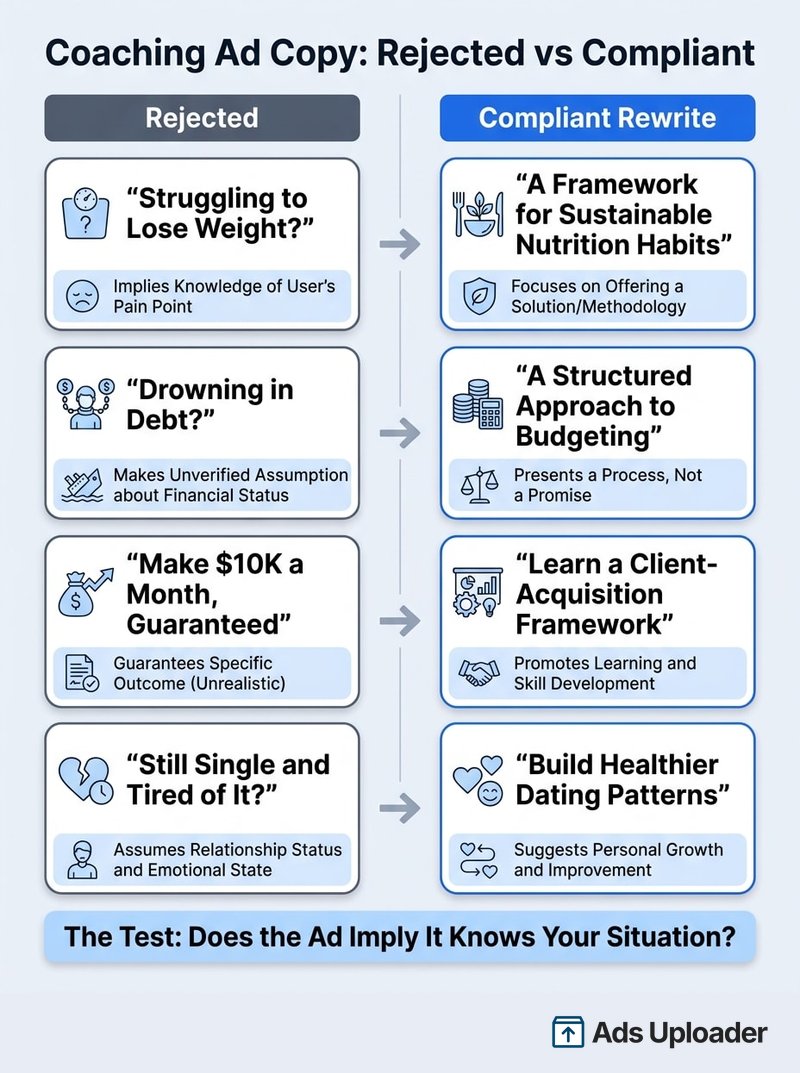
It is widely misread as a ban on "you" and "your." It is not. "Build a business that gives you more flexibility" is fine. The violation is combining "you" with an assertion about a sensitive condition or status. The test: does the ad sound as though you already know the viewer has the problem?
| Copy that gets rejected | Why it fails | Compliant rewrite |
|---|---|---|
| "Struggling to lose weight?" | Implies a physical condition | "A practical coaching framework for sustainable nutrition habits." |
| "Still single and tired of it?" | Implies relationship status | "A program for building healthier dating patterns." |
| "Drowning in debt?" | Implies vulnerable financial status | "Learn a structured approach to budgeting and debt planning." |
| "Are you addicted to alcohol?" | Implies a health condition | "Recovery coaching and accountability resources." |
The compliant column follows one pattern: describe the service and let readers who need it recognize themselves. Performance rarely drops from the change. Meta reviews the headline, the text inside the image or video, your form questions and the landing page, so moving the offending line into the creative or the destination does not cure it, and live ads get re-reviewed weeks in.
Negative Self-Perception and Body Image
Weight-loss and fitness coaches face a second rule. Meta prohibits imagery and copy that generate negative self-perception: pinching fat, circling "problem areas," before-and-after body shots framed to shame, or "lose 20 pounds in 21 days" countdown claims. A genuine client result can still be rejected if it implies the viewer should expect the same outcome. Sell the process and the routine, not the insecurity.
Income and Get-Rich-Quick Claims
Business and money coaches trip the deceptive-claims rules. "Make $10,000 a month with this exact system," "guaranteed to sign five clients in 30 days," "quit your job in 90 days" and "passive income on autopilot" all read as unrealistic outcome guarantees, and a disclaimer at the bottom does not license a deceptive headline. Advertise the education instead: "Learn a client-acquisition framework for service businesses" says what the program teaches without promising an economic result.
Special Ad Categories
Most coaching is not a Special Ad Category. The four categories are Housing, Employment, Financial Products and Services, and Social Issues, Elections or Politics, and ordinary life, health, business or mindset coaching sits outside all of them. Two edges catch coaches. A money coach whose funnel moves into investing, credit repair or debt relief can fall under Financial Products and Services. A career coach promoting job placement or recruiting closers into their own company can fall under Employment. Both categories strip your targeting: no narrow age or gender, no ZIP targeting, a minimum radius, and no lookalikes. The category follows what the ad actually promotes, so the safe move is to keep the advertised offer educational.
There is also a data layer beneath the copy. Since January 2025, Meta restricts how sources in sensitive categories, including health and wellness, share events through its Business Tools. For a weight-loss or health coach that means keeping the pixel and Conversions API event generic, such as a plain Lead, and never sending diagnoses, weight, BMI or condition-revealing URL slugs and form answers back to Meta. The Conversions API is not a loophole here; the same terms govern server-side data. And in September 2025 Meta began blocking Custom and Lookalike Audiences that suggest health conditions or financial status, so a list named "Diabetic weight-loss clients" is a problem by its composition even when the identifiers are hashed.
Build Your Own Swipe File
Stop scrolling the Ad Library by hand. Search, filter, and save proven ads with a free Chrome extension built for media buyers.
Get Ad Library Helper FreeFree Chrome extension • Built by Ads Uploader
Choosing the Offer and the Funnel
Two decisions set your cost before you touch targeting: what you offer, and where the click goes.
On the offer, the split is free training versus direct application. A free training or lead magnet produces cheap, lower-intent leads; a direct "apply to work with me" ad produces fewer, more expensive, higher-intent leads. Neither is better in the abstract, which is why testing both is the standard move.
On the funnel, there are three routes, and budget plus price point decides which to test first.
| Situation | Funnel to test first |
|---|---|
| Under $50/day, no proven funnel | Instant form or DM |
| $2,000+ offer with strong proof | Landing page, VSL or application |
| Strong personal brand, active inbox | Messenger or Instagram DM |
| Broad workshop or challenge | Instant form |
| Weak sales-call process | Fix the process before scaling any funnel |
Instant forms remove friction and usually win on raw volume and cost, at the price of accidental and low-intent submissions, so fast follow-up is essential. A landing page with a webinar or video sales letter gives you room for proof, positioning and qualification, which suits $2,000-plus programs and produces fewer but better leads. A DM funnel starts a real conversation and fits creator-led coaches, but a conversation start is not a booked call and it is labor-intensive to run at volume. Pick the one that matches your price and your capacity to follow up, not the one with the lowest cost per lead.
Building the Campaign in 2026
Objective and Structure
For client acquisition, run Leads for forms and calls, or Engagement optimized for messages if you are running a DM funnel. Keep it consolidated: one campaign, one broad ad set, three to six genuinely different creatives. The reason is volume. Meta's longstanding guidance is that an ad set needs roughly 50 optimization events in seven days to exit the learning phase reliably, and almost no coach generates 50 booked calls a week. Splitting a $100 daily budget across five interest audiences guarantees none of them ever gets there. Optimize for an upstream event you can actually feed, often an application or a qualified lead rather than a booked call, and improve quality through the offer and follow-up.
Targeting
The 2026 reality is that manual targeting does less than it used to. Advantage+ audience is now the default on Leads and Sales campaigns, and Meta reports about 10% lower cost per qualified lead with it on, though that is a platform claim rather than an independent test. Detailed-targeting exclusions were removed from active campaigns on March 31, 2025, and Meta's cited internal test found a 22.6% lower median cost per conversion without them. Under the Andromeda delivery system, stacking interests is now a testable suggestion, not the main source of precision, and the creative itself does much of the targeting: "how consultants move from referrals to a repeatable system" filters an audience more sharply than any interest checkbox.
Lookalikes still have a place, but seed quality is everything. A 1% lookalike built from 100 random leads can underperform broad delivery, while one built from paid clients or attended calls carries real intent. The seed hierarchy runs clients first, then qualified attended calls, then applications, then booked calls, then all leads. Meta's technical minimum is 100 matched people, but treat that as a floor, not a target, and remember the September 2025 restrictions on health- and finance-suggesting audiences.
Creative
Creative is where coaching campaigns are won, because it carries both the message and much of the targeting. The concepts that work are unglamorous: the coach's first-person story, a client case study framed without outcome guarantees, a framework or common-mistake explainer, an objection-handling video, a direct invitation to apply. Put the offer in the first line of primary text before it truncates. A small audience burns through creative fast, so a "new ad" should be a new angle, not a new button color, and you should watch for the signs of ad fatigue that arrive sooner than most advertisers expect.
Measuring What Actually Matters
Because the decisive events happen off-platform, Ads Manager will happily show you a great cost per lead while you lose money. Track the whole chain in a CRM or a simple sheet: lead, booked, showed, closed, and cash collected, each matched to the campaign that produced it.
Then judge the campaign on cost per client against your allowable acquisition cost, not on cost per lead. Manage lead quality actively: if a cheap ad set is filling your calendar with people who never show, turn it off after about a week rather than celebrating the low cost per message. Keep sensitive qualification, especially anything health-related, inside your CRM rather than passing it back to Meta. The discipline is measuring to the end of the chain, not the start.
Real Coaching Facebook Ads Running in 2026
Here are seven coaching ads that were live in the Meta Ad Library on 8 September 2026, spanning the funnels this guide covers: a masterclass registration, an authority video sales letter, a free community, a named free framework, a long-form problem story, a DM funnel, and a direct course enrollment. The library shows the creative and the copy, never spend or results, so read these as examples of offer and funnel construction, not proof of what worked. Each card is the genuine creative with verbatim copy, and its Library ID links straight to the ad.
Shelby Sapp runs the webinar funnel at scale: a phone-shot selfie hook ("Late 20s? No savings? Watch this") driving registrations to a free high-ticket sales masterclass, with the registration count ("172,113 women have registered") carrying the social proof. Copy this: put the live proof number in the first line and send the click to a registration page, not a sales page. Compliance note: the money framing ("minimum $100,000 saved up") sits close to Meta's income-claim line, so keep the promise about the training, not the viewer's future earnings.

Dan Lok, one of the most recognizable business coaches on the platform, runs a filmed-on-stage authority clip with a curiosity hook ("How to transform dreaded sales calls into effortless closings ... an underused technique anyone can master in just days"). The move to copy is the setting: a real event or interview signals credibility a selfie video cannot, which suits a higher-ticket program. Note the "in just days" speed claim, the kind of phrasing Meta scrutinizes on business-opportunity ads.

Beyond PhD Coaching shows the free-community lead magnet done well: a clean designed image ("Doctoral Students: Stop Donating Tuition, Join the FREE Dissertation Help Community") over a long, specific story that names the mechanism, a free masterclass and a five-step process. Copy this: lead with the prospect's exact, narrow problem and give something genuinely free before asking for anything. It is also a tight lesson in niche authority, because "sat on over 300 dissertation committees" is a claim a general life coach cannot make.


Lindsey Parry (Coach Parry) packages the offer as a named framework, the "Rule of 5 Ones," in a simple talking-to-camera clip pointing at a maze diagram. The lesson is that a memorable, named method makes a free training feel like a system rather than generic advice, which tends to lift opt-ins. It also shows endurance coaching, a vertical where the transformation is performance rather than appearance, so the copy stays clear of Meta's body-image rules.

Prevent Divorce with Josh Hudson runs the long-form problem-story ad: a talking-head video paired with a wall of primary text that agitates the pain (why marriage counseling fails) before offering a free masterclass on a branded "5 Shifts" method. Worth copying is the willingness to write a genuinely long, specific story for a high-consideration, emotional purchase, where a one-liner would not earn the click. It is also a reminder that a sensitive hook has to describe the method, not assert the viewer's situation.

Smart Coach is the coach-for-coaches DM funnel: a selfie clip ("How can I get coaching clients when I have no followers?") asking viewers to DM a keyword ("BASELINE") to start the conversation, optimized for Instagram messages rather than a form. The mechanic to note is the keyword-to-inbox play, which opens a real conversation but is labor-intensive at volume. The compliance flag is loud, though: "$891k/mo," "$100k/mo," and a client guarantee are exactly the income and get-rich-quick claims Meta restricts and the FTC polices, so treat this as a model of the funnel and a warning on the copy.

Efficient Coach sells the certification itself: a designed "Life Coach Certification" image with a mock certificate, a 21-module list, "70% off today," and a "30-day money-back guarantee," running as a direct-enrollment offer since 2024. If you sell a productized program, copy the risk reversal: a discount plus a guarantee can carry a cold purchase without a call. The long runtime suggests the offer keeps earning its place, though the Ad Library cannot confirm that.


Frequently Asked Questions
Save Hours on Creative Testing
Stop uploading ads one by one. Bulk process unlimited creatives with automatic media matching and direct API publishing.
Try Ads Uploader FreeNo credit card required • 7-day free trial
Do Facebook Ads Work for Life Coaches Specifically?
Yes, though there is no life-coach-only benchmark, and life coaching is trust-heavy and often undifferentiated. Results depend on positioning, proof and sales conversion more than on targeting. The nearest cost categories are Education, Personal Services and Business Services. A coach selling a defined process for a recognizable goal advertises far more easily than one selling generic confidence coaching to everyone.
How Much Should a Coach Spend to Start?
Roughly $1,500 to $3,000 over four to six weeks for a consumer lead funnel, and more for a direct high-ticket application funnel. Fund at least 20 to 30 expected conversions so the result is readable. A $500 budget can test whether a lead form gets responses, but it rarely gives stable evidence at the cost-per-client level. Below $500 a month, organic and sales-process work usually returns more.
What Is a Good Cost per Lead for Coaching Ads?
Use the closest verified vertical from the 2025 WordStream and LocaliQ benchmarks: Education about $28, Personal Services about $31, Career about $18, Health and Fitness about $53. Those are lead-form medians, not cost per client. A higher cost per lead can be better if the leads book, show and close at higher rates, so judge on cost per booked call and cost per client.
Why Do My Coaching Ads Keep Getting Rejected?
Most often the Personal Attributes policy, which prohibits implying a viewer's health, relationship or financial situation. Hooks like "Struggling to lose weight?" or "Drowning in debt?" fail. Other common causes are negative body-image imagery, unrealistic income or weight-loss claims, before-and-after photos, deceptive scarcity, and landing pages that contradict the ad. Meta reviews image text, form questions and the destination page.
Are Coaching Ads a Special Ad Category on Meta?
Normally no. The categories are Housing, Employment, Financial Products and Services, and Social Issues, Elections or Politics. Ordinary life, health, business and mindset coaching is not among them. Coaching can become covered when the offer promotes a financial product or service such as investing or debt relief, or an employment opportunity such as job placement. The category follows what the ad promotes.
Should I Run Coaching Ads to a Webinar, a Lead Form, or DMs?
Match the funnel to your budget and price. Instant forms suit low budgets and simple qualification. A landing page with a webinar or VSL suits expensive programs that need proof before a call. DM funnels suit personal-brand coaches who respond fast. Test on cost per qualified show and cost per client, because the cheapest funnel to fill is rarely the cheapest to sell from.
Is It Better to Hire a Facebook Ads Coach, Learn It, or Use an Agency?
Learn it yourself under about $1,500 a month or before the offer is proven. Hire a coach or consultant, often a $500 to $2,000 audit, when campaigns run but strategy is the gap. Hire a freelancer around $2,000 to $10,000 monthly spend once the funnel works. Hire an agency once the offer and close process are validated. Avoid anyone guaranteeing ROAS or booked calls regardless of your offer.
The Short Version
Coaching has no local audience ceiling, which makes it feel like an easy vertical and hides the two things that actually decide it. The first is the funnel math: a $30 lead can be an $857 client, and only your collected margin says whether that is good or fatal. Set your allowable acquisition cost from contribution, then judge campaigns on cost per client, because cost per lead will lie to you.
The second is the rulebook. Coaching sells into health, money and relationships, which is exactly where Meta's Personal Attributes and deceptive-claims policies bite hardest. Describe the offer and the process, let readers recognize themselves, keep income and weight-loss claims out of the copy, and keep sensitive data out of your pixel. Do that, and Facebook ads for coaches become a predictable client channel instead of a rejected campaign and a mystery invoice.