Facebook automotive inventory ads are a catalog-based Meta format that turns a dealership's live vehicle feed into a self-updating campaign across Facebook and Instagram. They pull a vehicle catalog and Meta Pixel intent signals, then use machine learning to match in-stock vehicles to in-market shoppers for retargeting and prospecting. Setup runs in four steps: build a vehicle catalog, install the Pixel, connect them, and create an ad template. Because ads update automatically as inventory and pricing change, one campaign promotes the entire lot without a separate ad per vehicle.
Most dealerships still boost a lot photo and hope the algorithm finds a buyer. The dealer down the road is serving the exact truck a shopper viewed last night, with today's price pulled from a live feed. That is the gap automotive inventory ads close, and it is why Meta built a whole vertical product for it, one of only a handful of industries in our Facebook ads by industry guide that gets its own format.
The problem is that Meta documents this product across five or six separate help pages, and the agency guides that fill the rest of the results page are mostly sales copy. So the real setup, the vehicle feed spec, and one genuinely confusing targeting rule are hard to pin down in one place. This guide puts them together: what the format is, how to set it up, the feed that decides everything, the Special Ad Category catch, and what dealers should actually expect it to cost.
What Automotive Inventory Ads Are, and What They Are Not
Automotive inventory ads, or AIA, are a catalog-based Meta ad format built specifically for automotive businesses. Three inputs drive them: a vehicle catalog holding structured data for every unit on the lot, the Meta Pixel tracking which vehicles shoppers view on your site, and Meta's machine learning matching that inventory to people who either browsed your listings or resemble the shoppers who do. When someone views a 2024 Ford F-150 on your website and opens Instagram an hour later, they see that exact truck with your current price. That is the system working as designed.
AIA is the automotive flavor of Meta's broader catalog and dynamic ads system. Inside Ads Manager, Meta now files AIA and its sibling product under Advantage+ catalog ads, so the naming in the interface has shifted even though the mechanics are the same.
The product has been around longer than most dealers realize. Facebook launched Dynamic Ads for Automotive in November 2017, added lead generation in 2018, then rebranded it as Automotive Inventory Ads in January 2019 and rolled it out globally, expanding delivery beyond a dealer's own recent website visitors to broader in-market audiences. So retargeting was the original use, and prospecting was bolted on later. Both still run today.
Automotive Inventory Ads vs Automotive Model Ads
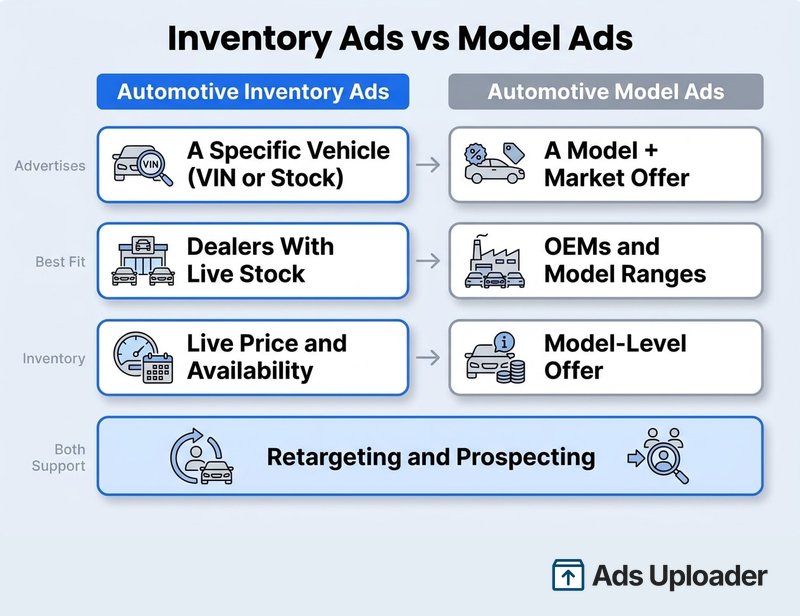
Meta maintains two automotive products, and the guides that conflate them cause real setup errors. The difference is item granularity, not funnel stage.
| Automotive Inventory Ads (AIA) | Automotive Model Ads (AMA) | |
|---|---|---|
| Advertises | A specific vehicle, usually a real VIN or stock listing | A model and its market-level cash, lease or finance offer |
| Catalog | Automotive inventory (vehicle) catalog | Automotive models-and-offers catalog |
| Best fit | Dealers promoting current new, used or CPO stock | OEMs and model-range or offer marketing |
| Inventory | Live price and availability per unit | Model and offer scoped to a market |
| Retargeting | Yes | Yes |
| Prospecting | Yes | Yes |
Both products support prospecting and retargeting in Meta's current documentation, so treat any advice that "model ads are top-of-funnel only" as outdated. The practical rule is simpler: use AIA when the ad should resolve to a specific available unit, and AMA when it should resolve to a model or a market-level offer. AIA is not new-car only either. The state_of_vehicle field explicitly supports New, Used and CPO.
Are Automotive Inventory Ads a Special Ad Category?
This is the one rule worth getting exactly right, because Meta's own documentation is inconsistent and the answer changes with how you build the campaign.
Start with the fact that matters: vehicles are not one of Meta's four canonical Special Ad Categories. Those are Financial products and services, Employment, Housing, and Social issues, elections or politics. Automotive does not appear on that list, and it does not appear in the Ad Library category enum either. The broader "Financial products and services" label replaced the older "Credit" category, required from January 2025 for US advertisers.
So why do so many dealers see a Special Ad Category applied to their vehicle ads? Because Meta applies it inside specific flows:
- The simplified US dealership Page and Meta Business Suite flow, reached through Promote, then Get more vehicle sales, states in Meta's own words that "Vehicles are considered a Special Ad Category and this will be automatically selected for you." That simplified vehicle-sales flow is US-only.
- The Ads Manager guide for building AIA with an on-Facebook destination tells vehicle advertisers to select Financial products and services.
- Any ad promoting an auto loan, monthly payment or long-term financing falls under Financial products and services regardless of format, because that is what the category covers.
For a plain website-destination inventory ad that only shows vehicles and prices, Meta's general setup does not impose a category, and its targeting guidance openly discusses ZIP codes, DMAs and cities. That is strong evidence there is no blanket "all cars are a Special Ad Category" rule, but Meta never states the exemption in so many words, so treat it as a documented interpretation rather than a promise.
Why it matters: when a Special Ad Category applies, Meta strips away the targeting controls dealers lean on. ZIP and postal-code targeting disappears and gets replaced by an expanded radius, historically a 15-mile minimum. Age and gender lock to the full range. Detailed-targeting options narrow, exclusions go away, and Lookalike Audiences become unavailable. Special Ad Audiences, the old restricted substitute for lookalikes, were discontinued back in 2022, so do not build a campaign plan around them.
The operator rule is to follow the explicit designation the campaign flow shows you. Do not declare "automotive" as a category it is not, do not fight the flag on the on-Facebook or finance flows, and confirm the live interface for your market, since Meta moves these details without changelogs.
How to Set Up Automotive Inventory Ads
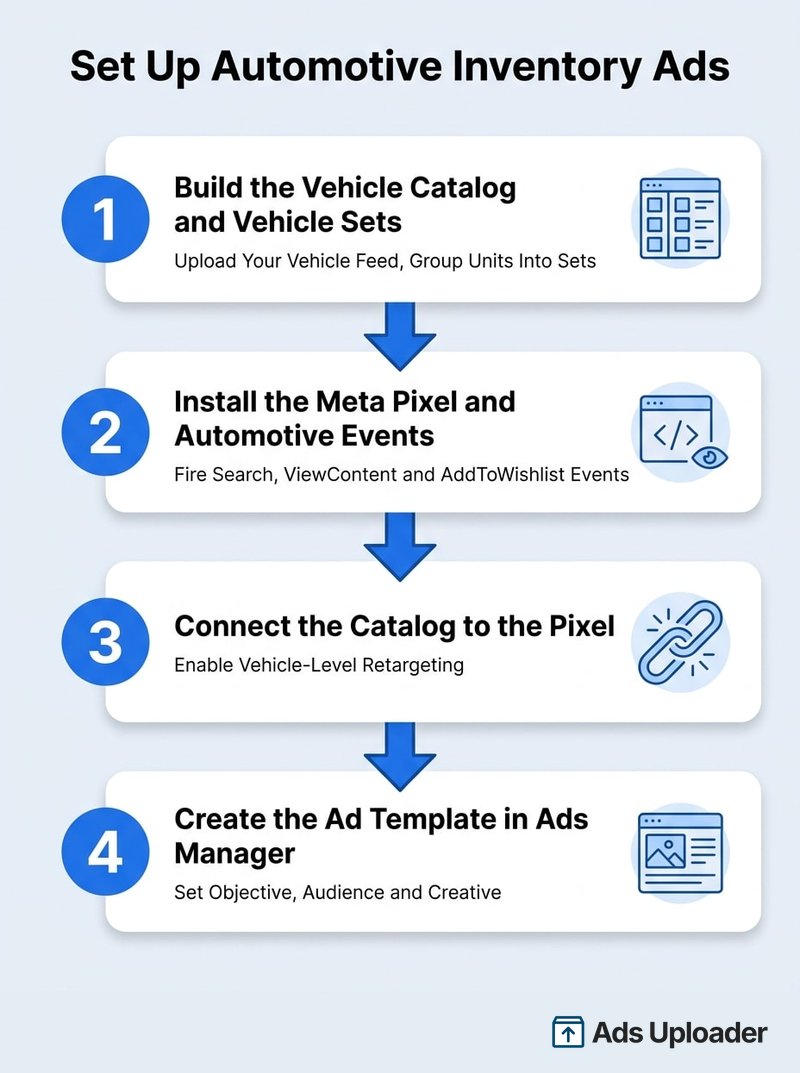
Meta spreads the setup across five pages. It collapses into four steps.
Build Your Own Swipe File
Stop scrolling the Ad Library by hand. Search, filter, and save proven ads with a free Chrome extension built for media buyers.
Get Ad Library Helper FreeFree Chrome extension • Built by Ads Uploader
Step 1: Build the Vehicle Catalog and Vehicle Sets
In Commerce Manager, create a catalog and choose the Auto catalog type, then upload your vehicle feed. Inside the catalog, build vehicle sets, the subgroups that control which units appear in a given campaign. You might run one set for trucks, one for used SUVs under a price ceiling, and one for new inventory. Custom label and custom number feed fields exist precisely so you can slice sets by lease specials, price bands or days on lot. Start with broad, commercially meaningful sets and subdivide only when inventory volume can support it, since sets that are too narrow starve delivery.
Step 2: Install the Meta Pixel and Automotive Events
If your ads send shoppers to your website, install the Pixel and fire Meta's automotive events. The AIA event trio is Search, ViewContent and AddToWishlist, and the content_ids on those events must exactly match the vehicle_id values in your catalog. That match rate is what lets Meta retarget a shopper with the specific vehicle they viewed. Meta recommends passing the VIN as the stable identifier where it fits. Standard events like Lead or Schedule are still useful for measuring the dealership funnel, but they are not part of the required automotive trio. If you use an on-Facebook destination, you can skip this step.
Step 3: Connect the Catalog to the Pixel
Link the catalog to your Pixel or dataset so Meta can tie viewed inventory to catalog items. Without this connection there is no vehicle-level retargeting, only broad prospecting.
Step 4: Create the Ad Template in Ads Manager
Build the ad in Ads Manager, where you choose the objective, audience, placements, formats and creative. This is also where you add overlays, the dynamic price badges and promotional callouts layered onto feed-driven creative. Recommended assets work in both square 1:1 and vertical 4:5, ideally at 1080x1080 and 1080x1350.
The Vehicle Feed Is the Whole Ballgame
Feed quality is the single largest determinant of AIA performance. A clean feed produces ads with correct photos, live prices and in-stock units. A sloppy one advertises sold cars at last month's price, and shoppers notice.
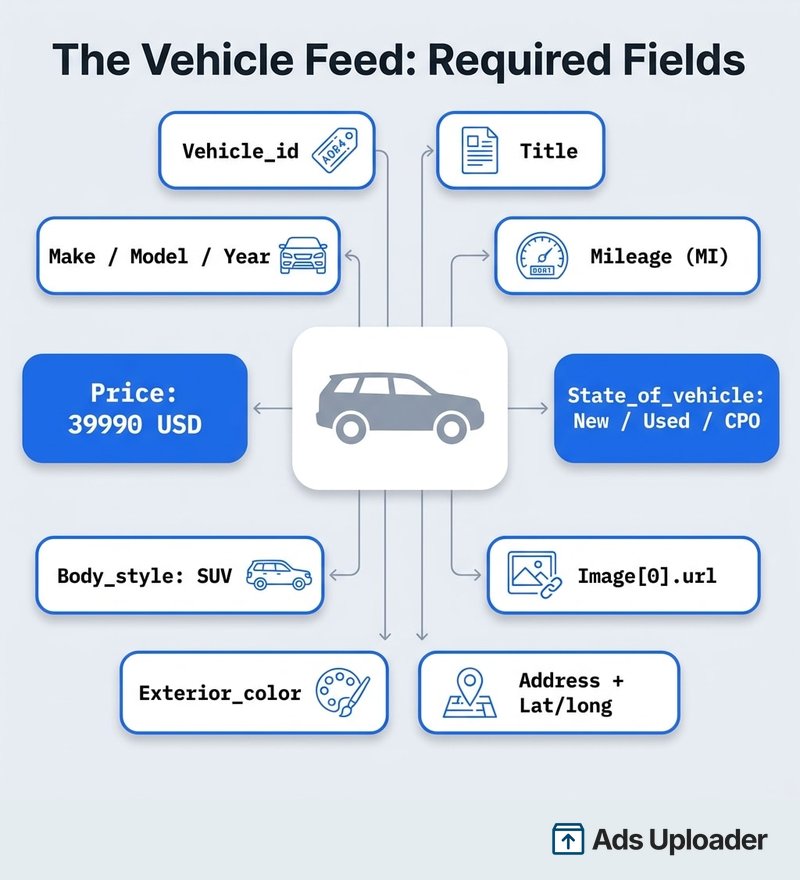
Meta's Auto Ads feed reference defines the required fields precisely. Every vehicle needs:
| Field | Requirement |
|---|---|
vehicle_id | Unique per item, up to 100 characters. Can be the VIN. |
title | Up to 500 characters. Year, make, model, trim. |
description | Up to 5,000 characters, no links or all-caps. |
url | Full URL to the vehicle detail page. |
make, model, year | Manufacturer, model, four-digit year. |
mileage | Numeric value plus unit (MI or KM). Zero for new. |
image[0].url | At least one image, up to 20, each under 4 MB. |
body_style | TRUCK, SUV, SEDAN, COUPE and similar. |
price | Amount plus ISO currency, for example 39990 USD. |
exterior_color | Required. |
state_of_vehicle | New, Used or CPO. |
address, latitude, longitude | Dealership location. |
An on-Facebook destination adds one conditional requirement, fb_page_id. Optional but valuable fields include vin, trim, transmission, drivetrain, fuel_type, sale_price, availability, days_on_lot, and the custom_label_0 through custom_label_4 fields you use to build vehicle sets.
Feeds can be CSV, TSV or XML, with Google Sheets supported through Meta's general catalog importer. Scheduled feeds pull hourly, daily or weekly. Use at least a daily replacement feed, and move to hourly or incremental updates when your turnover makes a 24-hour lag unacceptable. The failure modes are predictable. Sold units left in the feed for days. Stock photography instead of the actual vehicle. Feed prices that do not match the VDP. Missing structured fields that stop Meta categorizing a vehicle. Fix the feed before you touch anything else in the account.
Save Hours on Creative Testing
Stop uploading ads one by one. Bulk process unlimited creatives with automatic media matching and direct API publishing.
Try Ads Uploader FreeNo credit card required • 7-day free trial
On-Facebook Destination or Your Website
AIA gives you two places to send a click, and the choice has real tradeoffs.
| On-Facebook destination | Website destination | |
|---|---|---|
| Click lands on | A Meta-hosted mobile vehicle detail page | Your own VDP |
| Pixel needed | No | Yes |
| Data control | Meta controls the experience | You control page, forms, analytics |
| Best when | Weak mobile site or unreliable Pixel | Strong VDP and working tracking |
| Main tradeoff | Less first-party data and attribution | Load-time and tracking risk if the VDP is weak |
The on-Facebook page loads fast, needs no Pixel, and is a reasonable choice when your mobile site is slow or your tracking is shaky. The cost is that Meta owns the intermediate experience and the first-party engagement data. A website destination keeps everything in your hands, including forms, CRM handoff and full-funnel analytics, provided your mobile VDP is quick and your events fire cleanly. Most dealers with a solid site should send traffic to their own VDP.
Audiences: Retargeting, Prospecting and Lookalikes
AIA supports three audience approaches, and running them together tends to produce the strongest result.
Retargeting is your hottest segment: shoppers who fired Search, ViewContent or AddToWishlist events on specific vehicles. Meta's own guidance suggests splitting recency windows, for example 0 to 7 days and 8 to 30 days, and bidding more aggressively on the more recent group. Cap frequency so you do not exhaust a small local audience.
Prospecting lets Meta find in-market shoppers who have not visited your site, using broad audiences plus vehicle-intent signals and geographic targeting around your market. Start broad rather than stacking interests. Meta explicitly discourages heavy interest layering on AIA. Lookalikes modeled on your CRM buyer list, ideally the last 6 to 12 months of sales, combine behavioral modeling with real buyer signal. The catch is the Special Ad Category rule above: if your campaign is declared under Financial products and services, or runs through the on-Facebook flow that applies it, lookalikes are unavailable and you fall back to broad prospecting. For a plain website-inventory campaign they remain a strong tool.
What Automotive Inventory Ads Cost and How to Measure Them
Be skeptical of the numbers floating around this topic. Agency pages advertise figures like $0.27 cost per click against a $0.79 benchmark, or 5% click-through against 1.02%, with no campaign period, spend or sample disclosed. Treat those as unverified vendor self-reports, not expectations.
The most defensible recent independent figure comes from WordStream and LocaliQ's 2025 Facebook benchmarks: automotive traffic campaigns showed a 1.48% median click-through rate and a $0.79 median cost per click, across US campaigns running April 2024 through June 2025. That sample is not AIA-only, and the report does not publish an automotive cost per lead. No current independent, AIA-specific CPL benchmark with a disclosed automotive sample exists, so anyone quoting a precise dealership CPL for this format is guessing.
Meta case studies point the right direction without being benchmarks. Meta and Porsche Singapore reported roughly 30% lower cost per lead from an AIA test, and early beta dealers reported large lifts in vehicle detail page views. Read those as directional wins from specific advertisers, not numbers you should underwrite a budget against.
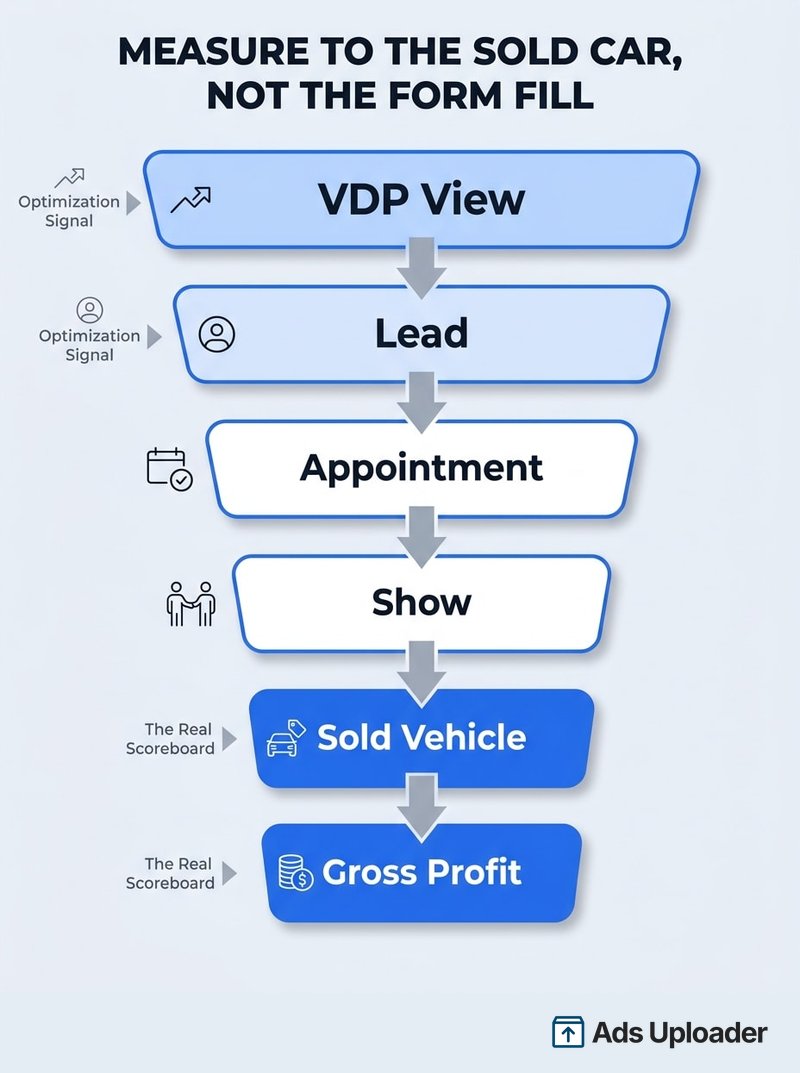
On budget, there is no current Meta-published dealership figure. Facebook's 2019 Automotive Playbook suggested $50 to $100 a day, roughly $1,500 to $3,000 a month, but that guidance predates today's auction and campaign structure. Size your budget from market, inventory volume, target cost per VDP view or lead, lead-to-sale rate, and the number of ad sets that each need enough weekly optimization events to leave the learning phase. Measurement is where dealers leave money on the table. Cost per lead and cost per VDP view are optimization signals, not the scoreboard. Track lead-to-sale from the CRM, and feed matched sale data back to Meta through the Conversions API so the algorithm learns from actual buyers rather than form fillers. Meta's optimization guidance leans on the roughly 50 optimization events per ad set per week that stabilize delivery, but 50 VDP views are not 50 sold cars. Keep your reporting running all the way through qualified lead, appointment, show, sale and gross profit.
One compliance note that sits on top of all of it. Any price or finance overlay has to match the live feed, the landing page and applicable disclosure law. Regulation Z requires advertised credit terms to be real and, once you state a payment or rate, to carry the full terms and an APR. The FTC warned 97 dealership groups in March 2026 about advertising prices that omitted mandatory fees. Treat the feed price, the overlay, the primary text and the destination VDP as one advertising claim, because regulators do.
Real Automotive Inventory Facebook Ads Running in 2026
The fastest way to understand automotive inventory ads is to watch them in the wild. Every ad below was pulled live from the Meta Ad Library, is still running, and shows the exact chrome a shopper sees on Facebook and Instagram. They span the formats this guide covers: dealer-group catalog ads that drop a single VIN with a live price, national used-car retailers, a local buy-here-pay-here financing offer, and video. The copy inside each card is verbatim.
AutoNation runs the cleanest example of a catalog-driven single-vehicle ad. The headline is the vehicle and the live price straight from the feed, the body names the exact rooftop the unit sits on, and the display domain is the syndication feed (cars.com) rather than the dealer site. One thing to copy: let the feed do the talking. The specific unit and price carry more intent than a slogan ever will.


Here is the same AutoNation ad account with a different rooftop and a very different unit, a nearly six-figure BMW X7 from Valencia BMW. Both ads share one template and one feed, yet each renders the current in-stock vehicle for that store. That is the whole point of the format: one catalog, one campaign, thousands of live listings. Note it delivers across five placements including Threads, so a single vehicle set fills every surface Meta offers.


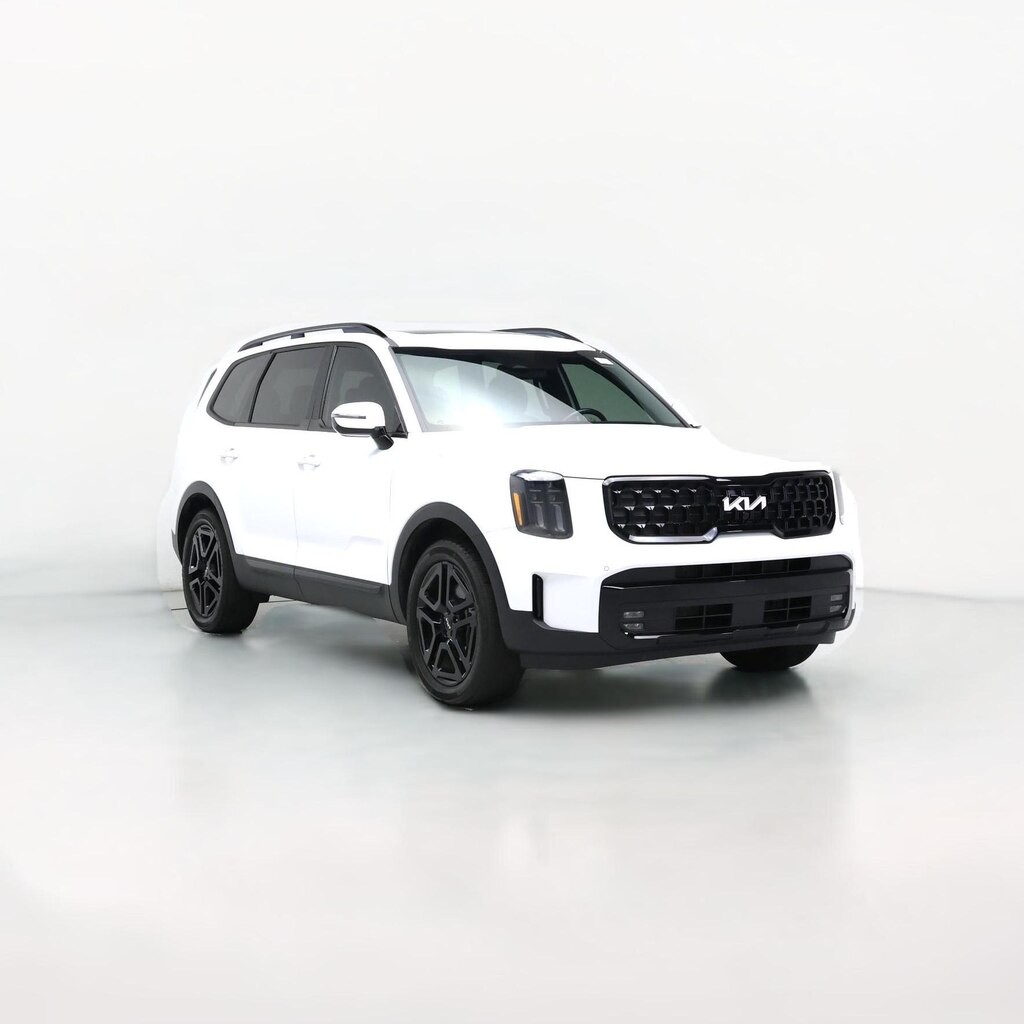
CarMax runs the retailer version of the same idea: a single reconditioned unit (a 2024 Kia Telluride) with a lifestyle line instead of a hard price, and a "Shop now" button pointing to carmax.com. The link description does the SEO-style reassurance work ("Search used cars, research vehicle models, and compare cars"). One thing to copy: the casual body line ("Looking for a set of wheels?") keeps a catalog ad from reading like a spreadsheet.

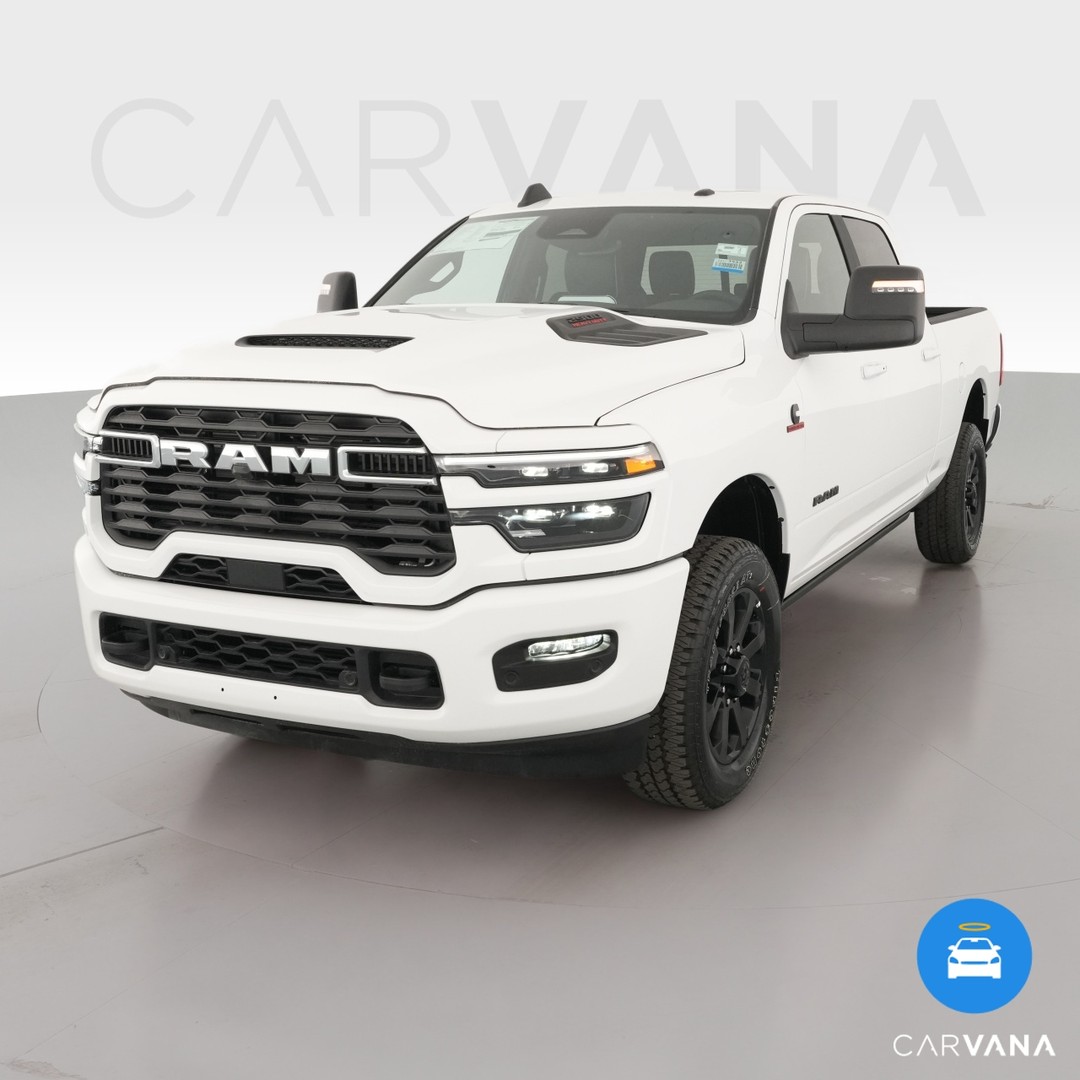
Carvana leans on the offer rather than the price. The unit is a brand-new Ram 2500, but the pitch is the buying experience: 100 percent online, no haggling, delivery, and a 7-day return window, laid out as two checkmark lines. One thing to copy: if your differentiator is the process, not the sticker, put it in the first two lines where the "See more" cutoff falls.

Catalog ads are not the only automotive format worth watching. This CarMax video is a vertical brand spot that sells trust rather than a specific unit, walking through the AutoCheck history report a shopper gets on a CarMax Certified car. It runs on Facebook and Instagram in 9:16. One thing to copy: the script answers the used-car buyer's real anxiety ("Is this car the real deal?") in the first line, which is exactly what a hook has to do before the sound is even on.

A single independent dealer can run video too, without a big-brand budget. Henry's Auto in Moncks Corner, SC pairs a vertical inventory video with a body that reads like a storefront window: address, phone, website, the languages the team speaks, and a promise to source a vehicle they do not have in stock. One thing to copy for local dealers: the multilingual and location lines qualify the click before it costs you anything. (This creative has no spoken audio, so there is no transcript.)

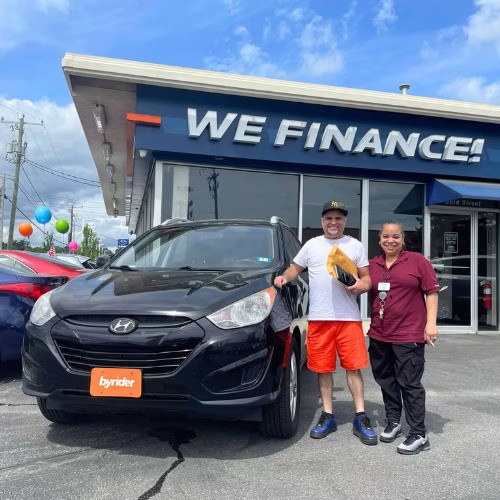
Finally, a compliance lesson. This Byrider buy-here-pay-here ad is a retargeting play ("You've been browsing our inventory") built entirely around financing: in-house approvals, low down payments, and "we approve when others say no." Any ad promoting financing, monthly payments, or credit approval falls under Meta's Financial products and services Special Ad Category, which strips out age, gender, ZIP, and detailed targeting. Note how the advertiser handles it: a full legal disclaimer sits at the bottom of the primary text ("All offers subject to change... Not all customers will qualify... with approved credit"). If your inventory ads mention credit at all, expect the same category restriction and write the disclaimer in.

The Short Version
Facebook automotive inventory ads connect a live vehicle catalog to Meta's machine learning so specific in-stock vehicles reach in-market shoppers, on repeat, without a media buyer building an ad per unit. The setup is four steps: catalog and vehicle sets, Pixel and automotive events, connect the two, and build the ad template. Everything downstream rides on the feed, so a clean, frequently refreshed feed with accurate photos and prices is not a nice-to-have, it is the product.
Two things separate the dealers who profit from AIA from the ones who conclude it "doesn't work." The first is the Special Ad Category rule: know when Meta applies Financial products and services, because it changes which targeting you get. The second is measurement. Cost per lead tells you almost nothing on its own. Cost per sold vehicle, tracked through your CRM and fed back to Meta, tells you whether to scale.