Facebook ads for SaaS are Meta campaigns that promote a software product to prospects on Facebook and Instagram, routing them to a trial, a demo, or a lead form. They use lookalike and custom audiences, plus Advantage+, to find buyers, and optimize toward a chosen conversion event. SaaS advertisers face long sales cycles and low conversion volume, so the optimization event and CRM-connected measurement usually decide results more than targeting does. Profitability is judged on pipeline and retained revenue, not on lead count inside Ads Manager.
A SaaS Meta campaign can look excellent in Ads Manager and still lose money, because the number that decides whether it worked is not in Ads Manager. It is in your CRM, sixty to a hundred and eighty days later: how many of those leads became opportunities, how many closed, and how much they are worth over their lifetime.
That gap is why so many teams run Facebook ads for their SaaS for a quarter, see a pile of cheap leads that never turn into revenue, and conclude the channel is broken. Usually it is not the channel. It is that SaaS breaks two things Meta's machine learning depends on: frequent conversions and short feedback loops. Get those two things right and Facebook becomes a serious demand and retargeting engine. Get them wrong and no amount of clever targeting saves you.
Here is what actually moves the needle: what the channel costs against real industry benchmarks for Facebook ads, how to choose an objective Meta can learn from, targeting that reaches software buyers on a consumer platform, the policy traps specific to SaaS, and how to measure pipeline instead of leads.
Why SaaS Is a Different Meta Ads Problem
On Google, someone announces their need by typing it. On Meta, nobody scrolling Reels is shopping for your software. You create the moment. That single fact means offer-led and demand-creation ads carry these campaigns, and pure brand awareness rarely books anyone on its own.
Four SaaS-specific realities shape everything downstream.
You have two motions, not one. Product-led and self-serve SaaS sells a lower-priced plan that the buyer starts inside the app. Sales-led SaaS sells a higher-priced contract through demos and calls. These fork almost every decision that follows: your objective, your offer, your optimization event, and your benchmarks. A guide that treats "SaaS" as one audience is already wrong.
Your sales cycle is long. The Norwest 2025 B2B Benchmark Report, which surveyed 177 venture and private-equity-backed companies, found 51% of respondents reporting sales cycles of three to six months and another 27% at seven to twelve months, with cycle length rising alongside contract value. Meta's feedback loop is measured in days. A lead that becomes revenue five months from now is invisible to a campaign optimizing this week.
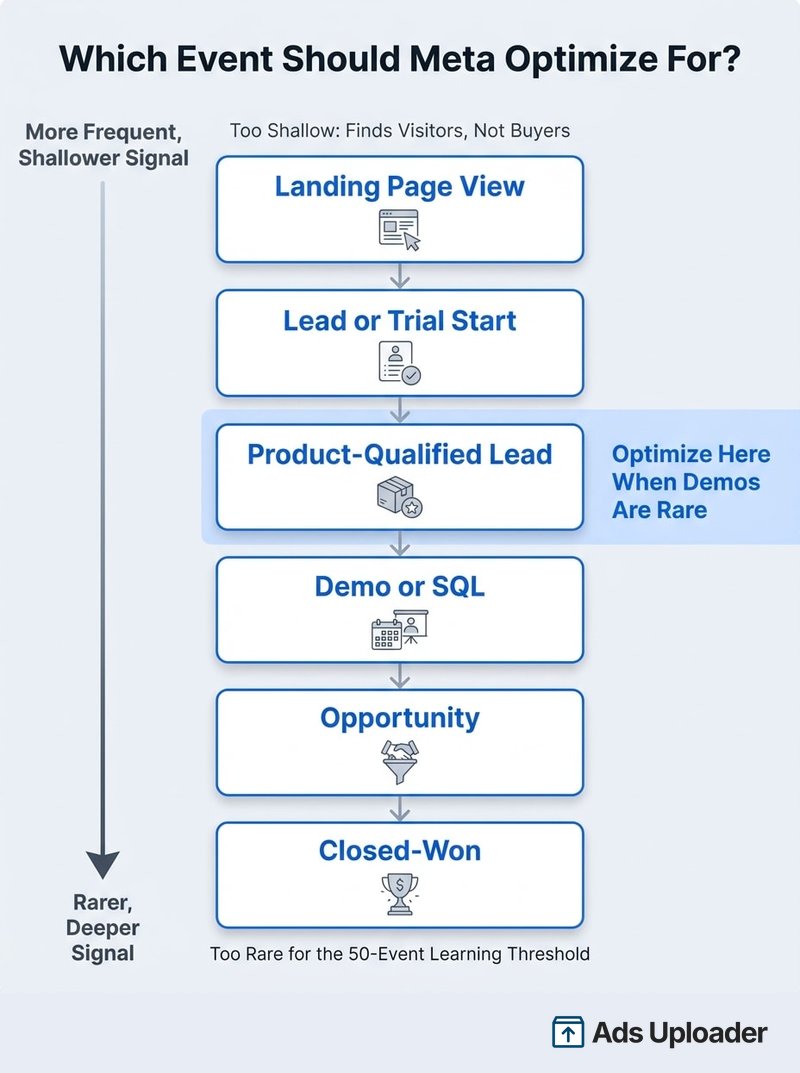
Your conversion volume is low. Meta's learning phase wants a minimum of 50 optimization events per ad set over a seven-day period. A B2B SaaS booking twenty demos a month cannot feed one ad set 50 demo events a week, let alone several ad sets. This is the constraint that quietly wrecks more SaaS campaigns than bad creative ever does.
A human still closes the deal. For sales-led SaaS, your rep and your onboarding decide the outcome after the click. For self-serve, activation does. Either way, the ad only starts the process, which is why measuring form fills tells you almost nothing about whether the money worked.
Does Facebook Work for B2B SaaS, and What Does It Cost?
Short answer: yes, as a demand and retargeting layer, and rarely as a pure last-click bottom-funnel channel for high-ticket enterprise deals.
The honest benchmark picture is messier than most articles admit, because "lead" means something different in every dataset. Here are the most defensible current reference points, each with a real source and sample.
| Dataset | Scope | CPM | CPC | CPL |
|---|---|---|---|---|
| Facebook, all industries (WordStream 2025) | 726 US lead campaigns, Apr 2024 to Jun 2025 | n/a | $1.92 | $27.66 |
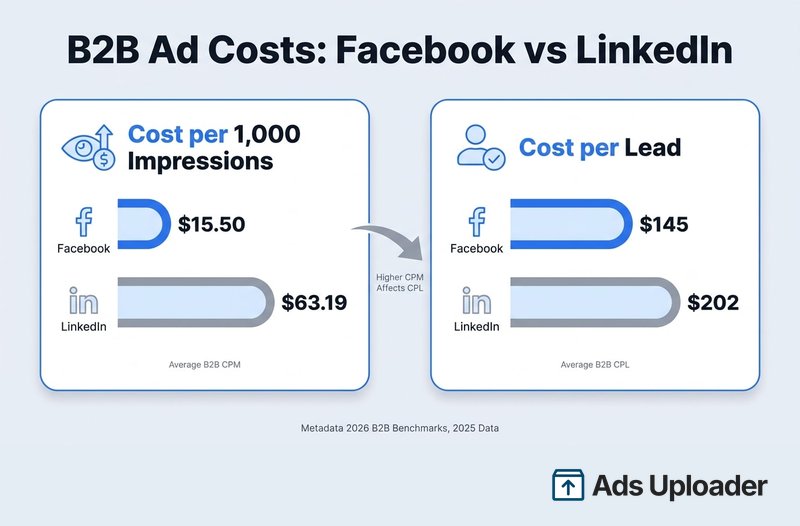
| Facebook, B2B (Metadata 2026) | 71 advertisers, 2025 | $15.50 | $1.95 | $145 |
| LinkedIn, B2B (Metadata 2026) | 138 advertisers, 2025 | $63.19 | $9.39 | $202 |
| Meta, B2B SaaS (TripleDart agency) | 84 managed accounts, 2025 | n/a | n/a | $94 |
The all-industry Facebook lead cost of $27.66 comes from WordStream and LocaliQ's 2025 Facebook Ads benchmarks, built on 726 US lead campaigns, but it mixes low-friction native leads across every industry, so it is far too optimistic as a B2B SaaS MQL cost. The more plausible B2B reference is Metadata's $145, from a disclosed dataset of 71 Facebook advertisers with published methodology. The SaaS-specific $94 figure is a single agency's managed-account result, useful directionally but not a market median.
Two takeaways matter more than any single number. First, Facebook's CPM and CPC run roughly a quarter of LinkedIn's for B2B, which is exactly why it is worth running even when LinkedIn targets better. Second, a "good" cost per lead is meaningless without a lead definition and a downstream close rate, which is why the economics of cost per lead should be tied to your actual CAC ceiling, not to a benchmark.
On the popular claim that Meta CPMs jumped roughly 20% year over year: it is not supportable as a general fact. Tinuiti's same-client tracking showed Meta CPM up 5% in Q4 2024, up 4% in Q1 2025, then flat to down through 2025 and into 2026. Your account may have risen 20%. The platform did not.
Meta makes sense when your addressable pool is large enough for the algorithm to work, when creative can make your problem understandable in three seconds, and when you want cheaper reach and retargeting than LinkedIn offers. It makes less sense when your market is a few thousand named accounts, when the buy depends on exact seniority targeting, or when you cannot return CRM outcomes to train delivery.
Choosing the Right Campaign Objective for Your SaaS
This is the section every competing guide skips, and it is where most SaaS money is won or lost.
Meta's current objectives, under its Outcome-Driven Ad Experiences structure, are Awareness, Traffic, Engagement, Leads, App promotion, and Sales. For SaaS the choice usually comes down to two, and it maps to your motion:
- Sales-led SaaS (demos, sales calls, CRM-qualified leads): start with the Leads objective, then configure a qualified-lead or deeper CRM event where eligible.
- Product-led or self-serve SaaS (trials, activations, subscriptions, purchases recorded on your site): use the Sales objective, optimized for the trial-start, subscription, or purchase event.
Do not reach for Traffic just because real conversions are scarce. Traffic optimization teaches Meta to find people who click, not people who buy, and you will get exactly what you asked for.
The Conversion-Volume Problem, and How to Escape It
Now the hard part. Meta's official launch guidance tells you to structure ad sets to reach at least 50 optimization events over seven days, and warns that missing the threshold raises cost per result. Most B2B SaaS advertisers simply cannot produce 50 demos or 50 paid signups per ad set per week.
There is no official Meta rule that says "always optimize one funnel step higher," despite how often that advice gets repeated. But there is a defensible operating sequence, and it is the single most useful thing to get right.
- Consolidate first. Collapse countries, placements, and audiences into fewer, broader ad sets so events pool into one learning signal instead of scattering across a dozen starved ad sets.
- Optimize for the deepest event that happens often enough. If completed demos are too rare, step up to the nearest upstream event that correlates with revenue: an activated trial, a product-qualified lead, a completed application, or a qualified CRM lead.
- Keep sending the deeper events anyway. Continue passing SQL, opportunity, and closed-won events to Meta through the Conversions API so the system accumulates quality and value information even while it optimizes on the proxy.
- Judge the proxy on revenue, not surface CPA. A cheap proxy event that never becomes pipeline is worse than an expensive one that does.
- Move the event deeper once volume allows. When sustained delivery gives you enough true conversions, run a controlled test to optimize on the real event.
Optimizing for landing-page views merely to hit 50 events usually just teaches Meta to find visitors. If you have a completed signup or lead event, that is almost always the better signal.
Value optimization is the advanced lever here. In 2025 Meta expanded value optimization beyond purchases to events like subscriptions, and reported an average 12% higher ROAS in its own testing for advertisers who optimized on conversion value rather than count. For SaaS, feeding subscription value, plan tier, or predicted lifetime value gives the algorithm a target that maps to money rather than to raw lead volume. Just do not invent arbitrary values to steer delivery; the technique is only as good as the values you send.
Targeting That Reaches SaaS Buyers on a Consumer Platform
Facebook targets interests and behaviors, not verified job titles. For B2B SaaS that is the core targeting problem: interest stacking gets you close to an ICP but never nails it the way LinkedIn's firmographics do. So the highest-leverage move is not clever interest targeting. It is giving Meta a great seed and letting it find the rest.
Seed lookalikes from your best customers, not from every signup. A lookalike audience is only as good as its source. Meta needs at least 100 matched people from one country to build one, and has historically recommended a source of 1,000 to 5,000. Build yours from retained, high-LTV customers or product-qualified users rather than from ten thousand trial signups who mostly churned. A cleaner seed carries a cleaner commercial signal. This is a testable strategy rather than a guaranteed percentage lift, so compare source groups directly: all signups versus activated users versus paying customers versus high-LTV customers, holding everything else constant, and judge them on pipeline and CAC.
Layer your seed lists by quality. A practical structure runs four tiers per market: existing customers, SQLs, MQLs, and lookalike downloaders from any channel. Volume grows as you move down the tiers, and quality falls with it, which is fine because you are handing Meta buckets and letting it find the people most likely to convert.
Use custom audiences from first-party data. Beyond a customer list uploaded from your CRM, build custom audiences from product-usage events (activated a feature, crossed a usage threshold, reached the aha moment) and from website and app activity. These behavioral segments are frequently the best lookalike seeds you have.
Treat Advantage+ audience as a suggestion engine, not a fence. Under Advantage+ audience, the lookalikes and interests you supply act as starting signals that Meta can expand beyond when it predicts better results. Your real controls are geography, minimum age, language, and custom-audience exclusions. For SaaS with enough conversion volume, letting the system go broad from a strong seed often beats a hand-built audience. Note that Meta removed detailed-targeting exclusions from campaigns in early 2025, so exclusion now runs mainly through custom audiences.
The Special Ad Category and Policy Traps for SaaS
Most SaaS is not a Special Ad Category, so most software advertisers keep normal targeting and lookalikes. But two traps catch SaaS teams by surprise, and both remove the exact levers this guide just told you to pull.
Meta's Special Ad Categories are Housing, Employment, Financial Products and Services, and Social Issues, Elections or Politics. Classification depends on what the ad promotes, not on whether you call yourself software.
Trap one: Financial Products and Services. Meta made this category mandatory for relevant US advertisers in January 2025. It catches ads that promote consumer-facing lending, banking, investments, insurance, payments, buy-now-pay-later, or earned-wage access, even when a SaaS platform delivers the service. If your product touches consumer finance, an ad can be forced into the category, which strips age, gender, and ZIP targeting and removes lookalikes, killing the seed-quality strategy above. The important nuance: purely business-to-business financial infrastructure is generally excluded, so a back-office payroll or treasury platform advertising to finance teams is usually fine. Fintech is not the trigger; the promoted offer is. Plan around this before launch, not after your lookalikes vanish.
Trap two: Employment. The moment you run a "we're hiring" ad for your own open roles, it falls under Employment with the same targeting restrictions. Selling HR or recruiting software does not make your acquisition ads Employment ads, but recruiting for your own team does. Keep hiring campaigns in a separate account structure so the category declaration does not bleed into your product campaigns.
Crypto products sit under a separate restricted policy that can require prior written permission, so if your SaaS touches trading, wallets, or staking, check that standard as well.
Build Your Own Swipe File
Stop scrolling the Ad Library by hand. Search, filter, and save proven ads with a free Chrome extension built for media buyers.
Get Ad Library Helper FreeFree Chrome extension • Built by Ads Uploader
Offers and Creative That Convert SaaS Prospects
Great targeting cannot rescue a weak offer, and the offer has to match where the prospect is in their journey.
Ladder the offer by awareness stage. A cold audience is not ready for a demo. Lead cold traffic with a genuinely valuable resource (a benchmark, a teardown, a calculator, something they cannot get free elsewhere), move engaged prospects to case studies and comparisons, and reserve the trial or demo for warm, bottom-funnel audiences who already understand the problem. Pitching "book a demo" to someone who has never heard of you is the most common SaaS offer mistake.
Say who it's for in the first line. People ignore ads reflexively. If your first line does not make a specific role think "this is for me," the rest never gets read. Call out the buyer explicitly, lead with the pain the product solves rather than a feature list, and make the CTA name the exact next action.
Match the format to the job. Short vertical video demos work for showing the workflow and outcome fast. Founder-led video explains the painful status quo and the insight behind the product. Customer-proof concepts build trust. Static pain-and-benefit ads test propositions cheaply. Carousels walk through steps, integrations, or before-and-after workflows, and our roundup of conversion ads examples shows how these formats look when built for a Sales objective. And when low-friction capture matters, a Facebook instant form keeps the submission inside the app. Meta's own lead-gen testing found instant forms with conversion-lead optimization delivered around 20% lower cost per quality lead than website forms, though instant forms can also admit low-intent submissions, so add qualifying questions and fast follow-up before you trust them.
On the popular creative stats: the widely cited "UGC gets 41% higher CTR" and "video cuts CPL 28%" numbers are a single agency's managed-account claims, not industry facts. Meta's own Reels split tests did show vertical video beating still images on cost per result by about a third, but those tests were ecommerce, not SaaS. Test UGC and video against your best static concepts rather than assuming they win.
Whatever you run, test many concepts, not two or three. Serious SaaS advertisers put dozens of genuinely different creative variants into rotation, because a small, well-defined audience saturates fast and creative fatigue arrives sooner than you expect. Rotate distinct concepts, not headline tweaks. This is exactly the operational load that makes launching test batches by hand in Ads Manager painful, and where building ads in bulk earns its keep.
Measuring Pipeline, Not Leads
Every guide says "measure pipeline, not leads." Almost none tell you how. Here is the mechanism.
Last-click attribution systematically undercredits Meta for B2B, because the buying journey is long, crosses devices, and involves several touches before a branded search or a direct visit gets the last click. If you judge Facebook on last-click conversions in a 30-day dashboard, you will conclude it does not work, right up until you turn it off and pipeline dries up.
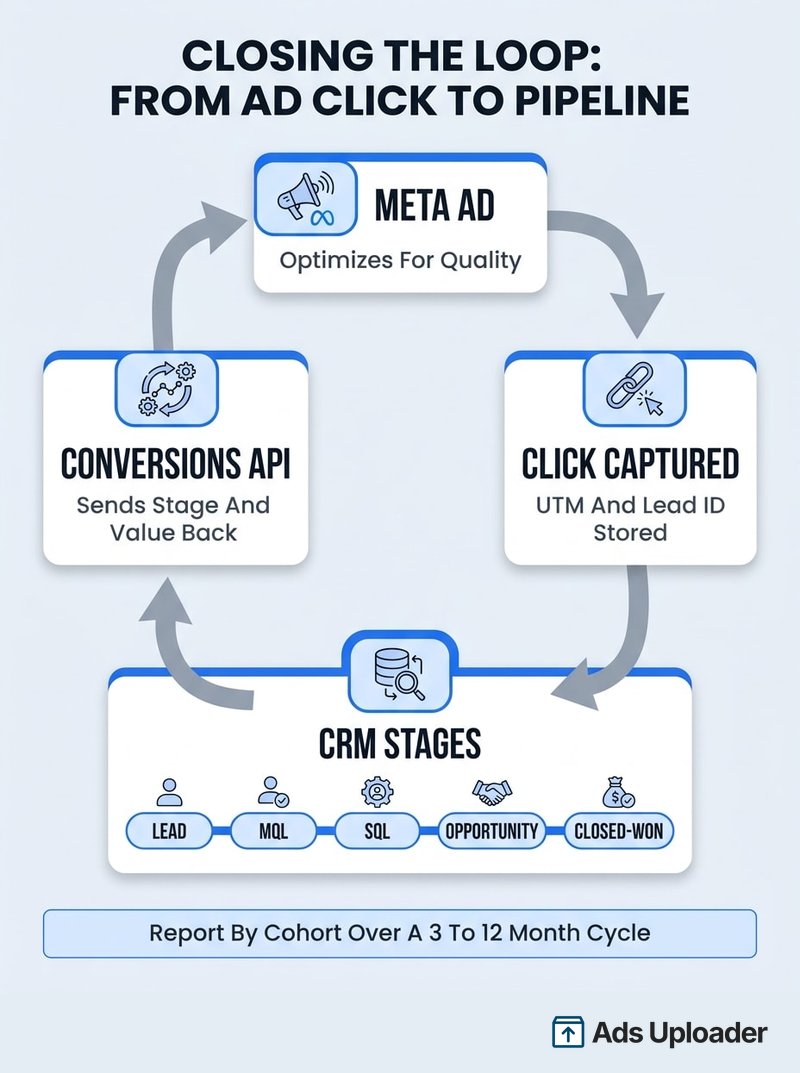
The fix is a closed loop between your CRM and Meta:
- Capture identity at the click. Put consistent UTMs on every ad, and capture Meta's click and browser identifiers on the landing page. Preserve the Meta lead ID for instant-form submissions.
- Store it against the record. Save those values against the lead, contact, account, and opportunity in your CRM so a closed deal months later still points back to the ad that started it.
- Define stages consistently. Lead, MQL, SQL, opportunity, closed-won, subscription. These have to mean the same thing every time.
- Send stage changes back to Meta. Use the Meta Conversions API to pass CRM outcomes and their values back so delivery optimizes for quality, not raw form volume. Deduplicate any web event reported by both the pixel and the server so you do not double-count.
- Report by cohort, over the real cycle. Track the March cohort through to closed revenue 90 to 180 days later. With most B2B cycles running three to twelve months, a monthly dashboard will understate a channel whose leads mature slowly.
Then validate the whole thing with incrementality. Meta's Conversion Lift, or a well-designed geo holdout when a randomized test is not available, tells you the conversions Facebook actually caused rather than the ones it merely got credited for. Note that Meta changed its attribution model in early 2026, moving non-link engagements into a renamed engage-through window and lowering the qualifying video-view threshold, so record the actual attribution setting on each ad set rather than assuming the old defaults.
Retargeting economics fit here too. In Metadata's 2025 B2B dataset, Facebook retargeting ran about 28% cheaper per lead than prospecting ($120 versus $166), a real edge but nowhere near the "45% cheaper" figure that circulates. Retargeting is where warm demand converts, but it depends entirely on the volume and quality of the upstream traffic you feed it, which loops you right back to demand creation.
Real SaaS Facebook Ads Running in 2026
To see how the two motions play out in the wild, here are eight real SaaS ads pulled live from the Meta Ad Library on 8 September 2026, each shown with its verbatim copy and a footer that links back to the ad so you can check it yourself. The Ad Library shows creative, copy and CTA, not spend or results, so read these as construction, not proof of performance. They are ordered roughly from product-led self-serve at the top to sales-led and lead-magnet offers at the end.
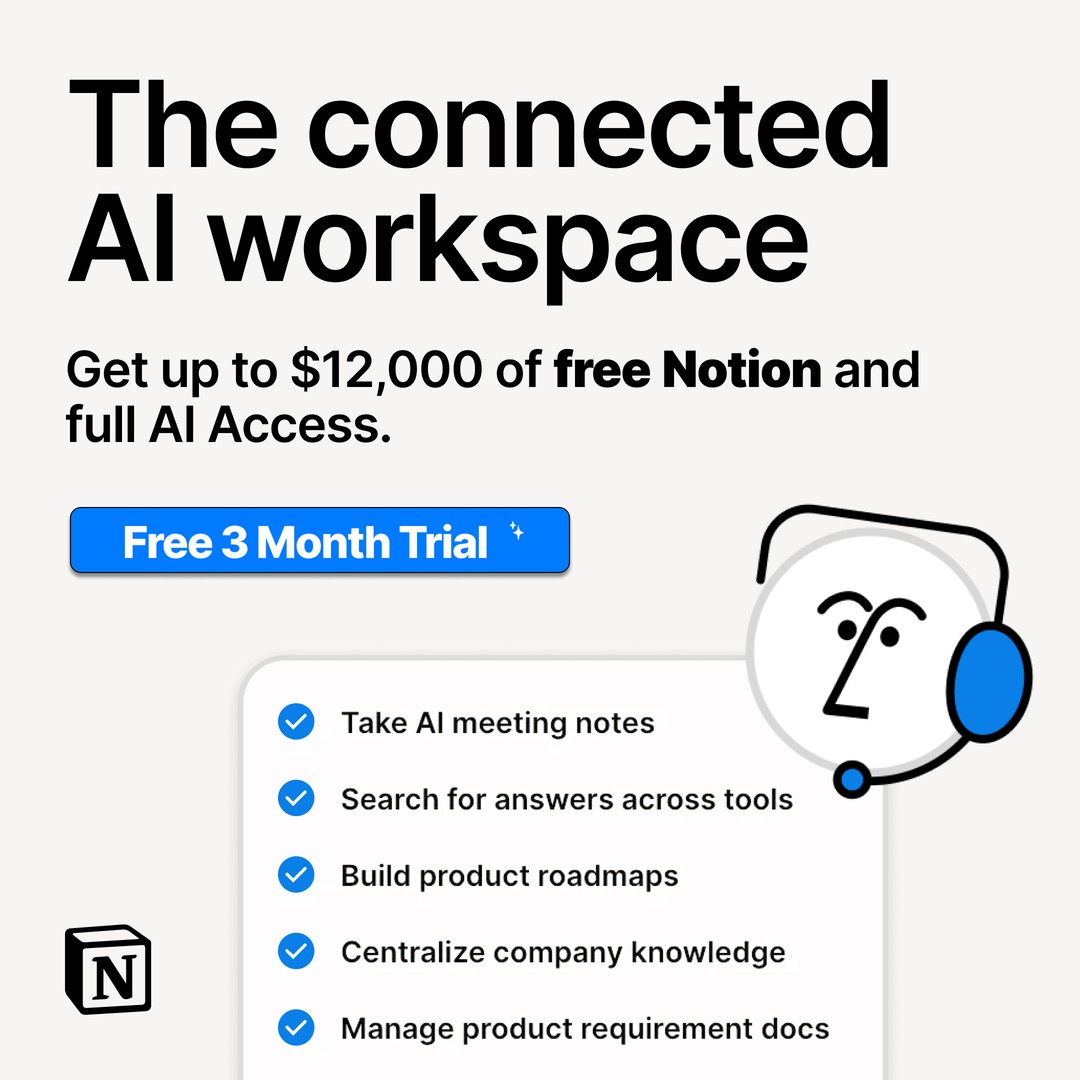
Notion runs the maximalist self-serve signup: a long feature-and-benefit list that names the exact jobs its AI agents do, aimed at a buyer who will start the product alone. Copy this when your product genuinely does many things and your ICP is broad, but keep the first line self-contained because most of that list hides behind "See more."

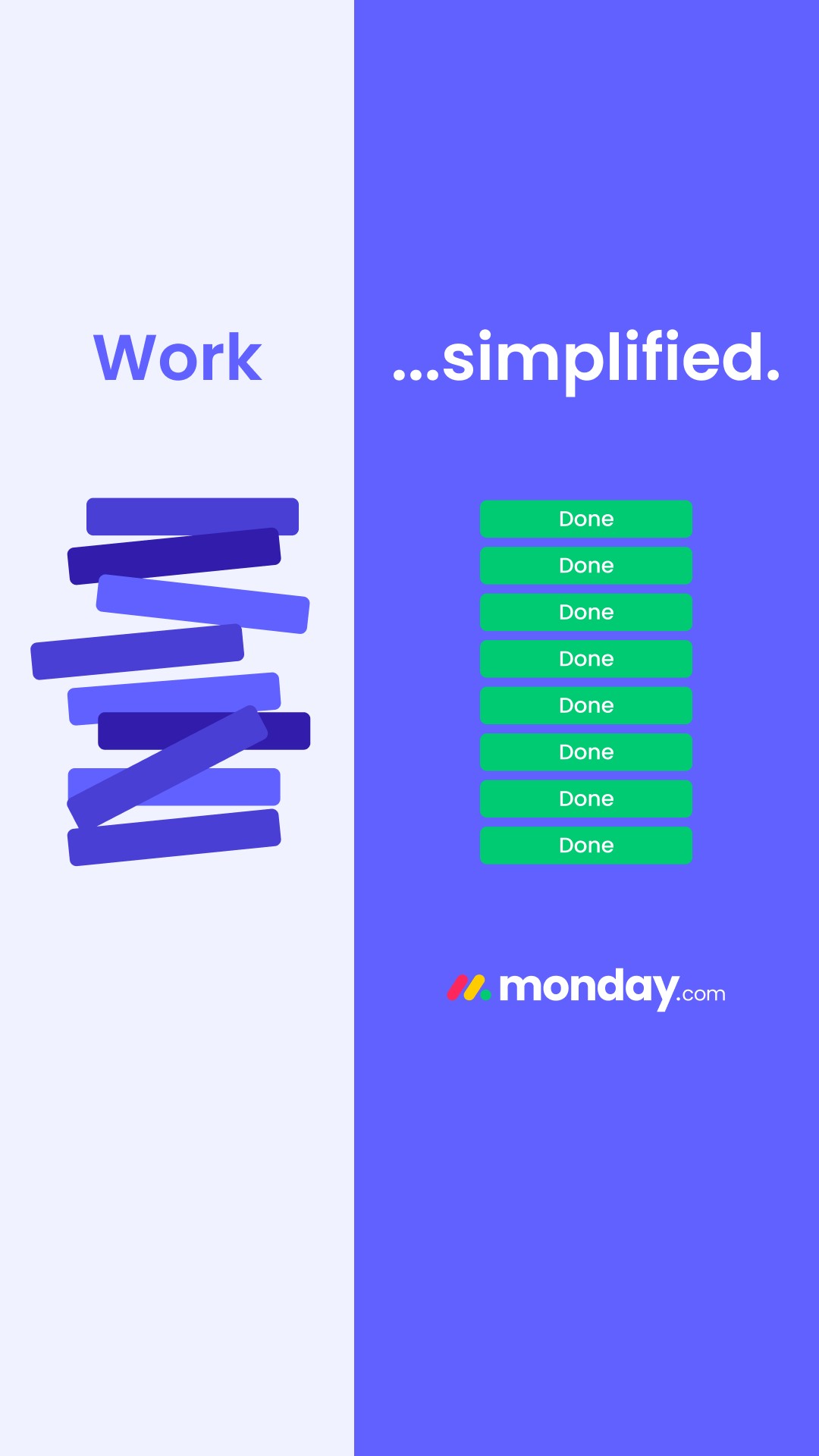
monday.com takes the opposite tack for the same self-serve motion: one line, a hard social-proof number ("225K+ customers"), a "Start your free account today" headline and a Sign up button. When your brand is known and the plan is free to start, brevity plus proof does the work a feature list cannot.

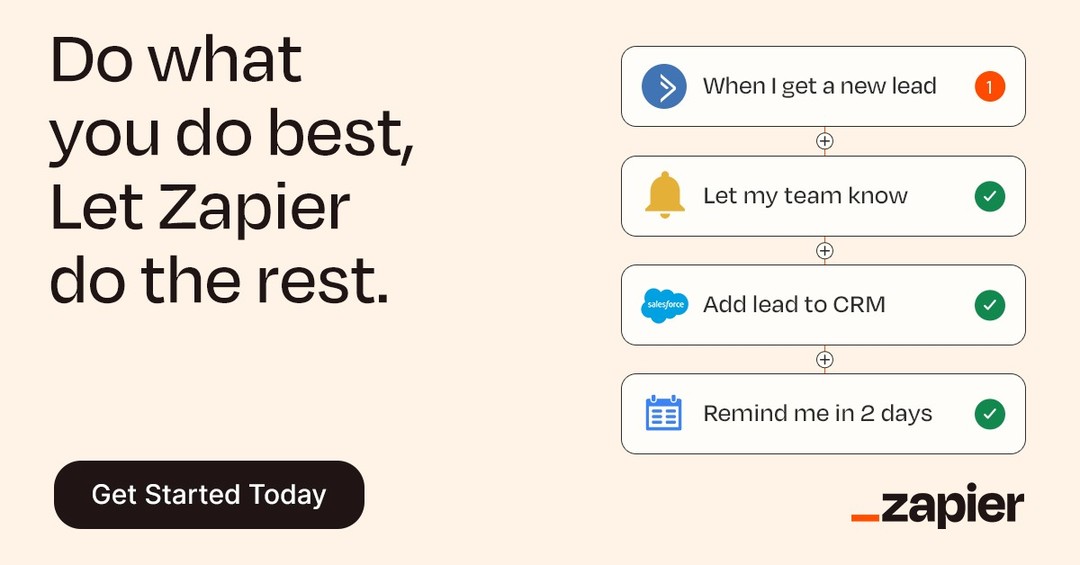
Zapier keeps the self-serve promise outcome-first: "give you more time for what matters most," then removes the two biggest objections in five words, "for free-no code required." The lesson worth copying is that a PLG ad should sell the result and the low commitment, not the feature.

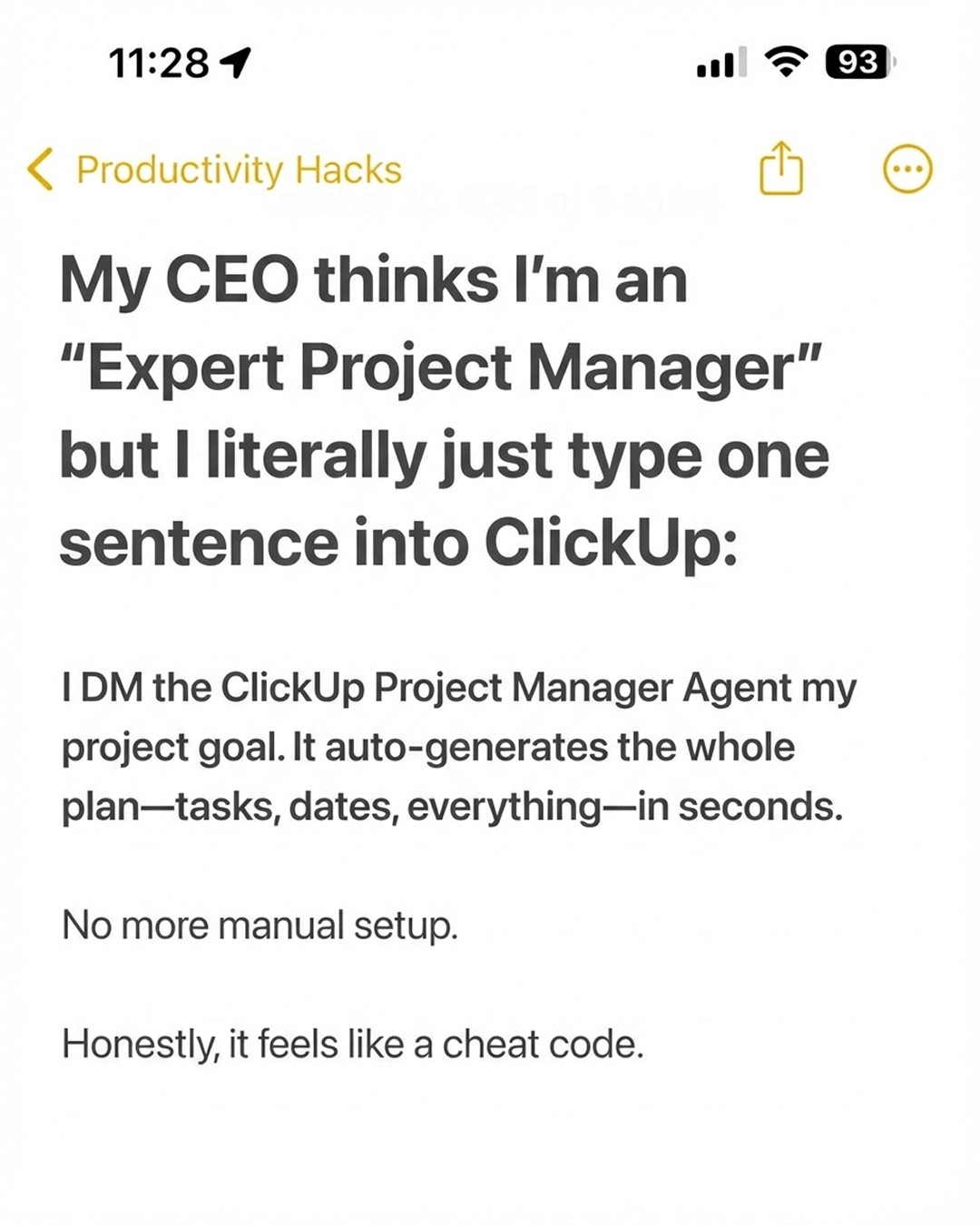
ClickUp shows the feature-led static ad: a scroll-stopping promise ("Projects that manage themselves in seconds"), then a plain-language explanation of the AI agents behind it, closing on a free-workspace offer. It is a clean template for testing a single capability cheaply before you commit budget to video.

GlossGenius runs the founder-and-customer video: a stylist tells her own "how I became a six-figure stylist" story to camera, then lands on the product and a free-trial signup. Vertical UGC-style video like this is the format to test when you need a self-serve audience to feel the outcome before they trust the tool.

HubSpot uses video for a top-of-funnel lead magnet, not a product pitch: the clip explains what its free "Instagram for Business Kit" contains, then asks for the download. This is the ladder-the-offer idea in practice, giving a cold audience a genuinely useful asset instead of a demo request.

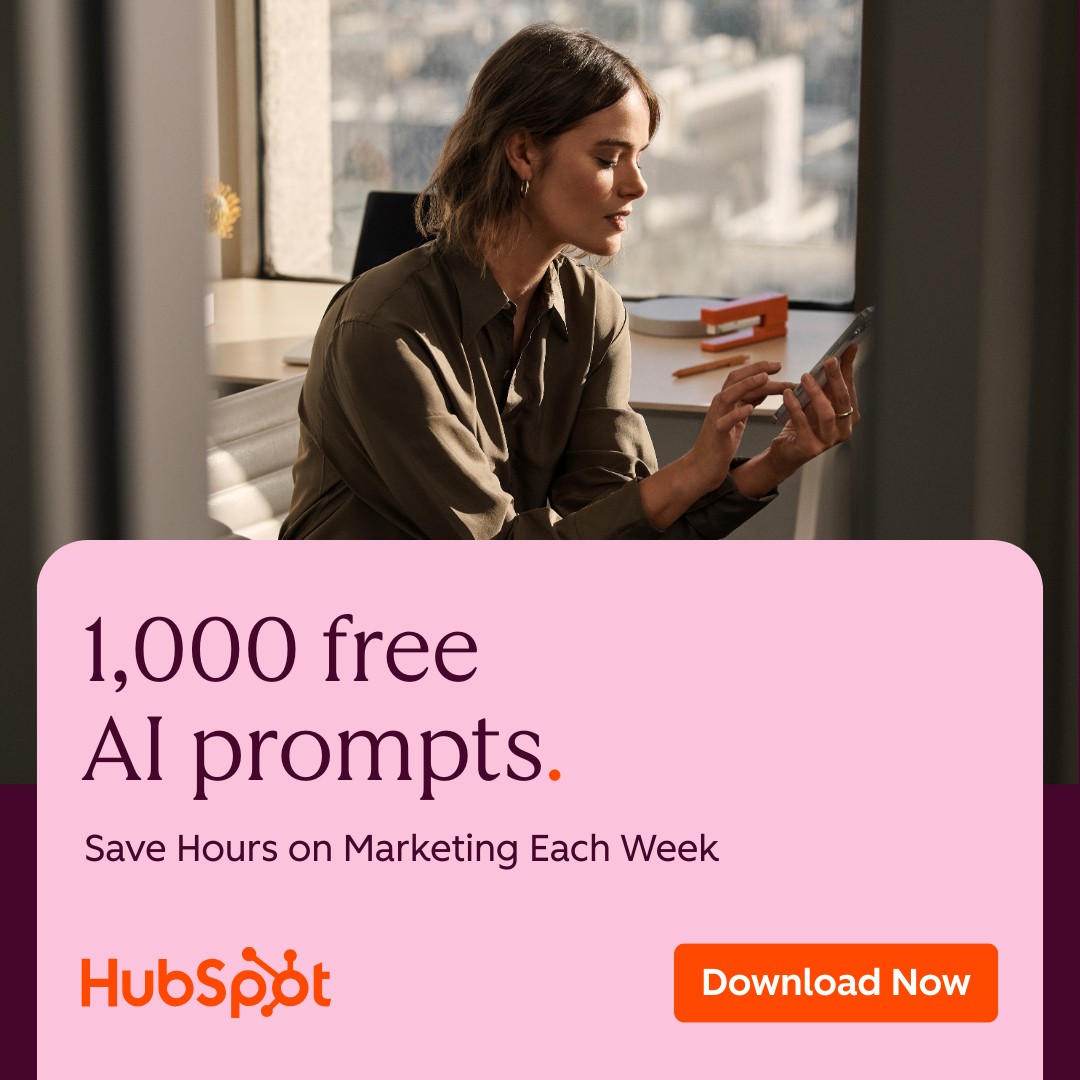
The static version of the same lead-magnet play: HubSpot offers "1,000+ free prompts" behind a Download button. A gated asset like this feeds the top of a sales-led funnel with contacts you can nurture toward a demo, which is exactly why the optimization event matters more than the click.

LeadByte shows the sales-led end of the spectrum: a straight "Book a Demo Now" with a Book now button, aimed at a buyer who is ready to talk. A demo-booking ad like this converts a much smaller, warmer slice of traffic, which is why it belongs to a bottom-of-funnel audience and a Leads objective rather than cold reach.

Frequently Asked Questions
Do Facebook Ads Work for B2B SaaS?
Yes, when Meta can find enough of your prospects and gets a real conversion signal. Metadata's 2025 B2B data showed Facebook at a $15.50 CPM and $145 CPL versus LinkedIn's $63.19 CPM and $202 CPL, so the channel clearly generates B2B leads at lower cost. It shines for demand creation, broad-role and founder targeting, product-led trials, and retargeting. It struggles when your market is tiny, the sale needs exact job-title targeting, or you cannot feed CRM outcomes back to Meta.
How Much Should a SaaS Company Spend on Facebook Ads per Month?
Ignore the circulating $758 and $1,810 medians; they have no disclosed source. Build the budget from your optimization event: desired weekly events times expected cost per event times 4.33. Meta wants roughly 50 optimization events per ad set per week to exit the learning phase. If that math is uneconomic on your true conversion, consolidate ad sets and optimize to a cheaper upstream event rather than fragmenting a small budget across many starved ad sets.
Save Hours on Creative Testing
Stop uploading ads one by one. Bulk process unlimited creatives with automatic media matching and direct API publishing.
Try Ads Uploader FreeNo credit card required • 7-day free trial
What Is a Good Cost per Lead for SaaS Facebook Ads?
The one your economics can support. Published references range from $27.66 (WordStream all-industry Facebook) to $145 (Metadata B2B) to $94 (TripleDart SaaS agency), and they use different lead definitions, so none is your answer. Calculate your ceiling instead: maximum acceptable CAC times your real lead-to-customer rate. A business that can pay $2,000 to acquire a customer and closes 10% of comparable leads has a $200 CPL ceiling.
Should I Use Facebook or LinkedIn for SaaS Ads?
Often both, for different jobs. Use Meta for broad ICPs, product-led and SMB motions, cheaper reach, video, and retargeting. Use LinkedIn when company, seniority, or job-title precision is essential and the account list is small and high value. LinkedIn cost far more per click in Metadata's 2025 data but converted clicks to leads at a higher rate, so decide on cost per qualified pipeline, not on CPC.
What Facebook Ad Format Works Best for SaaS?
There is no single winner. Start with a short vertical demo, a founder-led explainer, a customer-proof concept, a static pain-and-benefit ad, and a carousel for steps or integrations. Use website forms when the offer needs qualification or scheduling, and instant forms when mobile friction is the bigger problem. Test video and UGC against strong static concepts rather than assuming they win.
Should I Optimize for Leads or Conversions With Low Demo Volume?
Consolidate delivery first, then optimize for the deepest event that occurs often enough and predicts revenue. If demos are too rare, an activated trial, qualified signup, or MQL is usually a better temporary optimization event, while you keep sending SQL, opportunity, and closed-won events through the Conversions API so Meta still learns quality. Do not fall back to link clicks when a real signup or lead event exists.
Is My SaaS a Special Ad Category on Meta?
Usually not. The categories are Housing, Employment, Financial Products and Services, and Social Issues, Elections or Politics, and the ad's offer decides classification, not the word software. Ordinary SaaS acquisition ads sit outside them. The exceptions: consumer-facing lending, banking, insurance, investing, or payment offers can trigger Financial Products and Services even as software, and a hiring ad triggers Employment. B2B-only financial infrastructure is generally excluded.
How Do I Track Facebook Ad Leads Through to Revenue?
Tag every ad with UTMs, capture Meta click identifiers and instant-form lead IDs, and store them against the contact, account, and opportunity in your CRM. Define MQL, SQL, opportunity, and closed-won stages consistently, then send those stage changes back through the Conversions API so Meta optimizes for quality. Report by acquisition cohort, keep cohorts open for a three-to-twelve-month buying cycle, and validate periodically with a lift test.
Bringing It Together
Facebook ads for SaaS reward a different discipline than ecommerce or local lead gen. The targeting question that dominates most guides matters less than two things they gloss over. First, pick an objective and an optimization event your conversion volume can actually feed, and consolidate delivery so Meta can learn instead of starving across a dozen ad sets. Second, close the loop to your CRM so you optimize toward pipeline and measure over the real buying cycle, not toward form fills in a monthly dashboard.
Do those, seed your lookalikes from your best customers rather than every signup, check the Special Ad Category trap before it removes your best levers, and ladder your offers to awareness stage, and Meta becomes a genuine demand engine for software rather than a lead-count vanity metric. Treat Ads Manager as your delivery and diagnostic layer, and let your CRM and finance data decide whether Facebook ads for SaaS are building profitable customers.