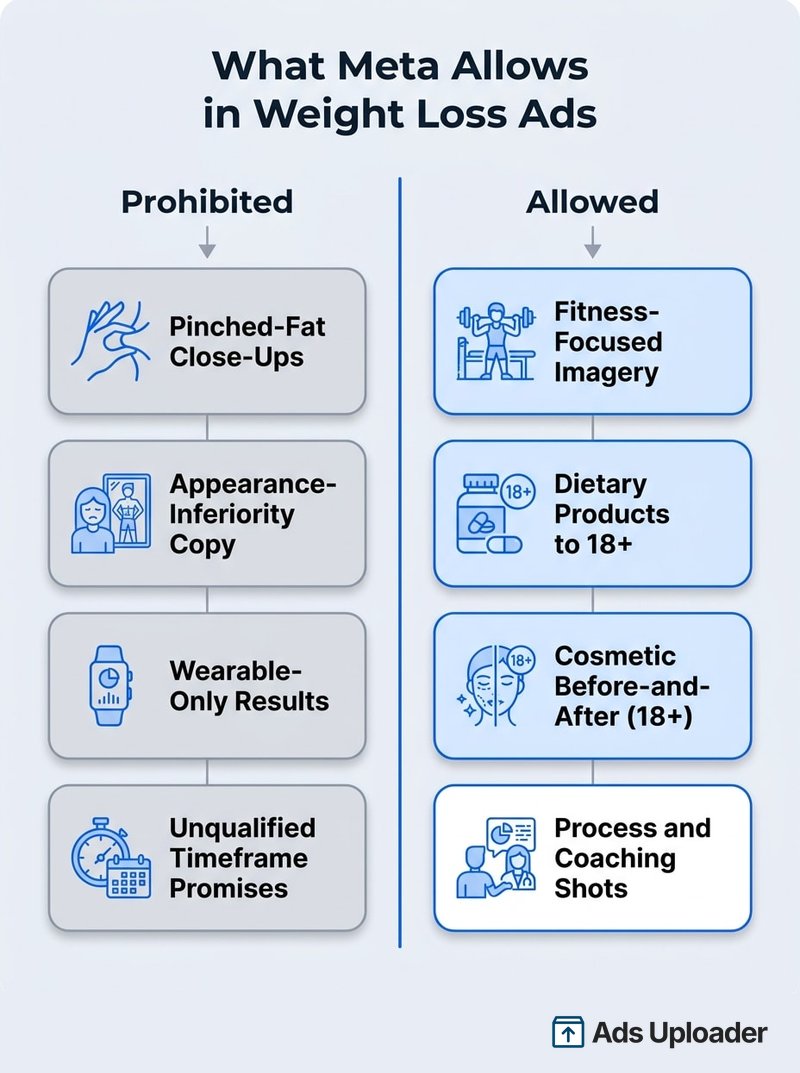
Weight loss ads on Facebook are Meta campaigns promoting diet, fitness, program, clinic, supplement, or medication offers, governed by Meta's Health and Wellness, Personal Attributes, and Personal Health advertising standards. Dietary weight-loss products may run only to audiences aged 18 or older, and creative cannot use appearance-inferiority language or pinched-fat close-ups. Before-and-after images and timeframe promises are restricted by claim rather than banned outright since a July 2026 policy revision. Getting the policy right is what keeps the ad account running.
Weight loss is one of the most heavily reviewed verticals on Meta, and the top search result for this query is Meta's own policy page, which tells you how the platform treats it. Yet most guides still describe rules that no longer exist. They repeat a blanket before-and-after ban that Meta revised in July 2026, cite the retired 20% image-text limit, and skip the single most concrete requirement of all: dietary weight-loss ads must target adults.
The result is advertisers building creative against a policy from three years ago, then wondering why the account keeps getting flagged.
This guide covers what Meta actually allows in 2026, the copy and creative that clears review, how prescription weight-loss offers like GLP-1s are gated, compliant example ads you can model, and the real economics. Where a rule is easy to get wrong, the source is linked so you can verify it before launch.
Why Weight Loss Is a High-Scrutiny Vertical on Meta
Three separate Meta policies stack on weight-loss creative, and an ad has to satisfy all of them. The Health and Wellness standard governs weight-loss and weight-gain products directly. The Personal Attributes standard governs whether your copy implies something about the viewer's body. The former Personal Health rules, now folded into Health and Wellness, governed negative self-perception and before-and-after imagery.
On top of Meta's review sits US law. The FTC treats weight-loss claims as a priority enforcement area and requires competent, reliable scientific evidence for any objective health claim. The FDA regulates anything that names or promotes a prescription drug. State attorneys general have been active too.
Notably, weight loss is not a Meta Special Ad Category. The categories are Housing, Employment, Financial Products and Services, and Social Issues, Elections or Politics. Weight loss is none of them, so you keep normal targeting and need no category declaration. What binds instead is the content of the ad, and that is where almost all rejections happen. Our walkthrough of Meta's ad guidelines covers the rules that apply across every vertical.
What Meta Actually Allows in Weight Loss Ads
Start with the rule nobody surfaces, because it is the most actionable one.
Dietary Weight Loss Ads Must Target 18+
Meta's Advertising Standards require ads for dietary weight-loss or weight-gain products and services to be shown only to people aged 18 or older, a restriction Meta confirmed publicly in January 2023. This is the fastest fix for a rejected weight-loss ad, and the one most often missed.
The category is defined by the claim, not the product label. "Daily protein powder for general nutrition" can sit in general food and wellness. "Fat-burning protein for weight loss" is a weight-loss product and must be 18+. Separate your general supplement SKUs from anything with a weight-management claim, or the whole set inherits the restriction.
Set the minimum age to 18 in the ad set's audience controls yourself. Do not assume Meta will recognize a weight-loss ad and repair an under-18 audience automatically. Check duplicated ad sets, Advantage+ audience settings, imported campaigns, and any ad sets created through the API, because the age floor is one of the first things lost when an ad set is copied.
What Meta Prohibits Outright
Meta's Health and Wellness advertising standard lists the hard prohibitions. These get an ad rejected regardless of how good the offer is.
| Prohibition | What it means for weight-loss creative |
|---|---|
| Pinched-fat close-ups | No close-up of a specific body area with fat being pinched. The classic hand-on-belly, thigh or arm shot is out, even with no text. |
| Wearable-only results | No claim that weight loss comes solely from a wearable. A patch, belt, ring, wrap or watch can track or support a plan, not cause the loss by itself. |
| Appearance inferiority | No statements that attack a person's appearance, body parts or hygiene. "Fix your disgusting belly" fails; service-led language does not. |
| Permanent skin bleaching | No whitening or bleaching products that cause permanent skin-color change. A Health and Wellness rule that catches some cosmetic advertisers. |
| Incurable-disease cures | No claim to cure, heal or eliminate Diabetes, Herpes, Thyroid, Psoriasis, Ebola, Cancer, Autism, Alzheimer's, Parkinson's, ALS or HIV. Credentials do not exempt it. Symptom-management claims are carved out but still need proof. |
| Clickbait and sensational claims | No "miracle", "melt fat", "secret doctors hate", "effortless" or shocking-transformation framing. |
| Unqualified timeframe promises | "Lose 20 lb in 30 days" is not rescued by an asterisk. Use a substantiated typical result with the population and program stated. |
What Meta Allows
When the audience is restricted to adults, Meta's own permitted examples include dietary weight-loss and weight-gain products and services that show a person using the product, illustrate the impact of use, or clearly indicate how long the depicted result took. Fitness-focused imagery is allowed. General cosmetic procedures depicting before-and-after transformations are allowed to 18+.
That is a real shift: Meta now acknowledges outcome and transformation creative as potentially permissible. It is not a safe harbour, because everything in the prohibited table still applies on top.
One naming trap catches people. "Health and wellness" is also a data-source classification Meta uses in Events Manager, separate from the Health and Wellness advertising policy. The two get conflated constantly. The policy governs your creative; the data classification governs which pixel and Conversions API events your dataset may send.
The Personal Attributes Rule Is Why Most Ads Get Rejected
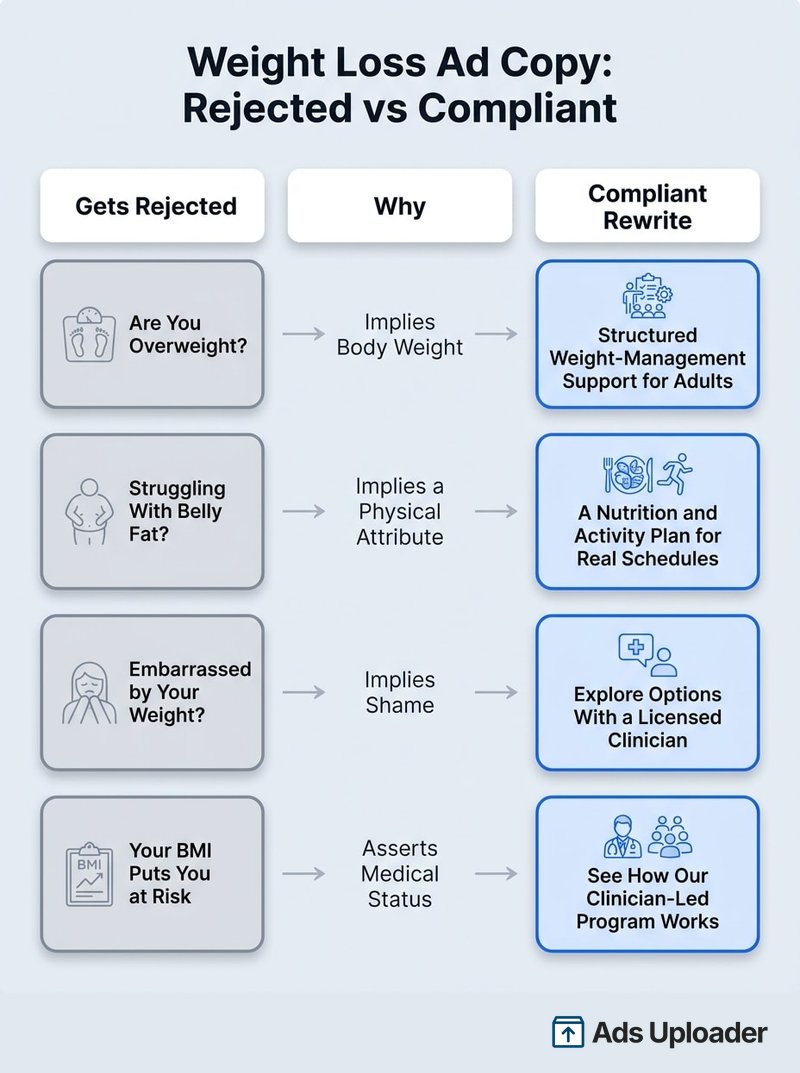
Most weight-loss rejections are not about the offer. They are about one sentence of copy that, as far as Meta's reviewer and its algorithm can tell, implies you already know something about the viewer's body.
Meta's Personal Attributes standard prohibits ads that assert or imply personal attributes. Physical and mental health, medical conditions, and body weight are all protected. The classic direct-response weight-loss hook is built on exactly the assumption the policy forbids.
It is widely misread as a ban on the word "you". It is not. "You" and "your" are fine where they do not attach to a sensitive fact. "Book your consultation" is compliant. "Your embarrassing stomach" is not. The test: does the ad sound as though the advertiser already knows the viewer is overweight, insecure, or unwell?
| Copy that gets rejected | Why it fails | Compliant rewrite |
|---|---|---|
| "Are you overweight?" | Implies the viewer's body weight | "Structured weight-management support for adults." |
| "Struggling with belly fat?" | Implies a physical attribute and struggle | "A nutrition and activity plan built around real schedules." |
| "Embarrassed by your weight?" | Implies shame and a personal attribute | "Explore adult weight-management options with a licensed clinician." |
| "Women over 40: your hormones are why you're heavy." | Implies age, gender and a health condition | "Weight-management coaching designed for busy adults." |
| "Your BMI is putting you at risk." | Asserts the viewer's medical status | "Learn how our clinician-led program works." |
| "Lose the body you hate." | Appearance inferiority | "Progress tracking, coaching and check-ins in one plan." |
The right column follows one pattern: describe the service and who it is for, and let readers who need it recognize themselves. Campaigns rarely lose performance from that change, and it removes the single most common rejection reason.
Meta reviews the headline, any text inside the image or video, your lead-form questions, and the destination page. Moving "Are you overweight?" into the image or the landing page does not cure the violation, and Meta re-reviews live ads, so something that ran for three weeks can still be pulled.
Before-and-After, Claims and Timeframes in 2026
This is the area where the SERP is most out of date, so it is worth stating the current position plainly.
There is no longer a blanket ban on weight-loss before-and-after images. For years Meta's rules were read as prohibiting before-and-after imagery and any content implying negative self-perception, language Facebook gave to a UK Parliamentary committee in 2020. A Health and Wellness revision dated 22 July 2026 removed that format-based wording and replaced it with claim-based restrictions. Independent policy monitors recorded the change the following day. Because Meta's policy page is client-rendered and updates without a dated public changelog, verify the live wording before you rely on it.
A weight-loss before-and-after can now be policy-eligible when it has all of the following: an 18+ audience, a real consenting subject rather than stock imagery, comparable lighting and framing, a truthful time interval, no pinched-fat or shaming crop, no guarantee that everyone achieves the result, a clear disclosure of the result consumers generally should expect, and evidence for both the individual and the typical result. That it is running is not hypothetical. Motion's 2026 creative index shows WeightWatchers actively running before-and-after and case-study creative on Meta after the shift, with typical-result context attached.
It still fails when the visual conveys an unlikely or guaranteed outcome, uses a "before: undesirable, after: desirable" frame, attributes a surgery, diet or drug result entirely to a supplement, or when the landing page adds claims the ad avoided.
Meta approval is not legal clearance. The FTC's Gut Check guidance lists seven weight-loss claims that are always false for supplements, over-the-counter drugs, and products worn on or rubbed into the body, including losing weight without diet or exercise, permanent loss after stopping use, and substantial loss for every user. If your copy makes one of them, no disclaimer saves it. And under the FTC's Health Products Compliance Guidance from December 2022, an objective claim needs competent and reliable scientific evidence on the actual product, at the advertised dose and population, not one favourable ingredient study. A testimonial is a claim, not evidence, and "results may vary" does not substitute for disclosing the typical result.
Advertising GLP-1s, Semaglutide and Telehealth Weight Loss
The GLP-1 boom created a whole compliance surface most weight-loss guides ignore. It has its own gate.
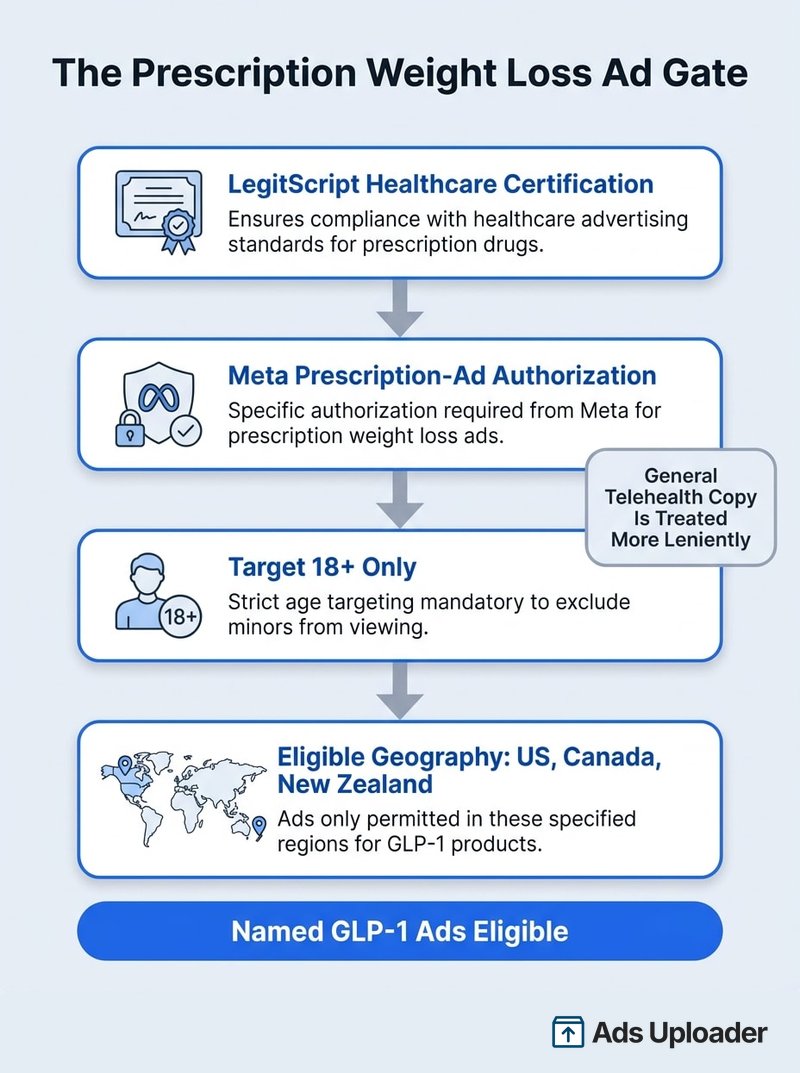
Named prescription-drug promotion is restricted to authorized advertisers. Under Meta's prescription drugs advertising policy, the eligible types are online pharmacies, telehealth providers, and pharmaceutical manufacturers. For pharmacies and telehealth sellers the route generally requires active LegitScript healthcare certification, Meta authorization and onboarding, 18+ targeting, and eligible geography, which currently means the United States, Canada, and New Zealand, and only where the certification applies.
There is an important line between general and named promotion. General telehealth messaging such as "Online consultations for adult weight-management care" is treated more leniently. "Get Wegovy delivered after an online visit" names a drug and triggers the prescription gate. Meta reviews the destination as well as the ad, so wrapping a hard drug sales page in vague copy does not work, and cloaking can escalate to account-level enforcement.
Compounded semaglutide and tirzepatide are a separate legal risk from Meta policy. The FDA determined the tirzepatide shortage resolved in December 2024 and the semaglutide injection shortage in February 2025, and the enforcement-discretion periods that supported mass copy-compounding have expired. On 3 March 2026 the FDA warned 30 telehealth companies against marketing compounded GLP-1s as generic, the same as, or clinically equivalent to approved drugs. Meta certification does not create a compounding-law exemption. If you advertise this category, the safe copy sells access, clinical experience, convenience, and transparent pricing, never sameness with a branded drug.
Launch More. Click Less.
Upload hundreds of creatives at once, auto-match thumbnails to videos, and publish straight to your ad accounts through Meta's API.
Try Ads Uploader FreeNo credit card required • 7-day free trial
Compliant Weight Loss Ad Examples
The example ads that rank for this query are a mixed bag. Several quoted "winners" use hooks that would fail review today: "melt fat quickly without starvation", "look wonderful within just 7 days". Rather than reproduce those, here are compliant models built on the current rules, the kind you can adapt and expect to clear review. To study live creative in your niche, our guide to the Meta Ad Library shows how to pull competitor ads and see how long they have been running.
Program and coaching, process-led. A static or short video that names the components: nutrition planning, weekly check-ins, progress tracking. Copy leads with the method, not the viewer's body. "A structured weight-management program for adults: nutrition, weekly coaching, and habit tracking in one plan. See what's included." No guarantee, no timeframe promise, 18+ targeting set.
Testimonial done right. A real, consenting participant with the actual result, the time it took, the material program components, a paid-participant disclosure, and the typical expected result on screen next to the transformation. "Sarah lost 10 lb over 12 weeks on the nutrition and coaching program. Paid participant. Typical result: X over Y weeks." The disclosure sits in the same visual field, not behind "Learn more".
Quiz or assessment lead ad. A low-friction entry point: "Answer 6 questions to see which plan fits your goals." It converts well and stays identity-safe because it asks about goals and preferences, not about what is wrong with the reader. Keep the lead form fields non-clinical.
General telehealth access. "Adult weight-management care from home. Meet a licensed clinician online to discuss options, nutrition support, and follow-up. Prescriptions issued only when medically appropriate. View eligibility, risks, and full pricing." Compliant as long as it does not name a drug, targets 18+, and the landing page matches.
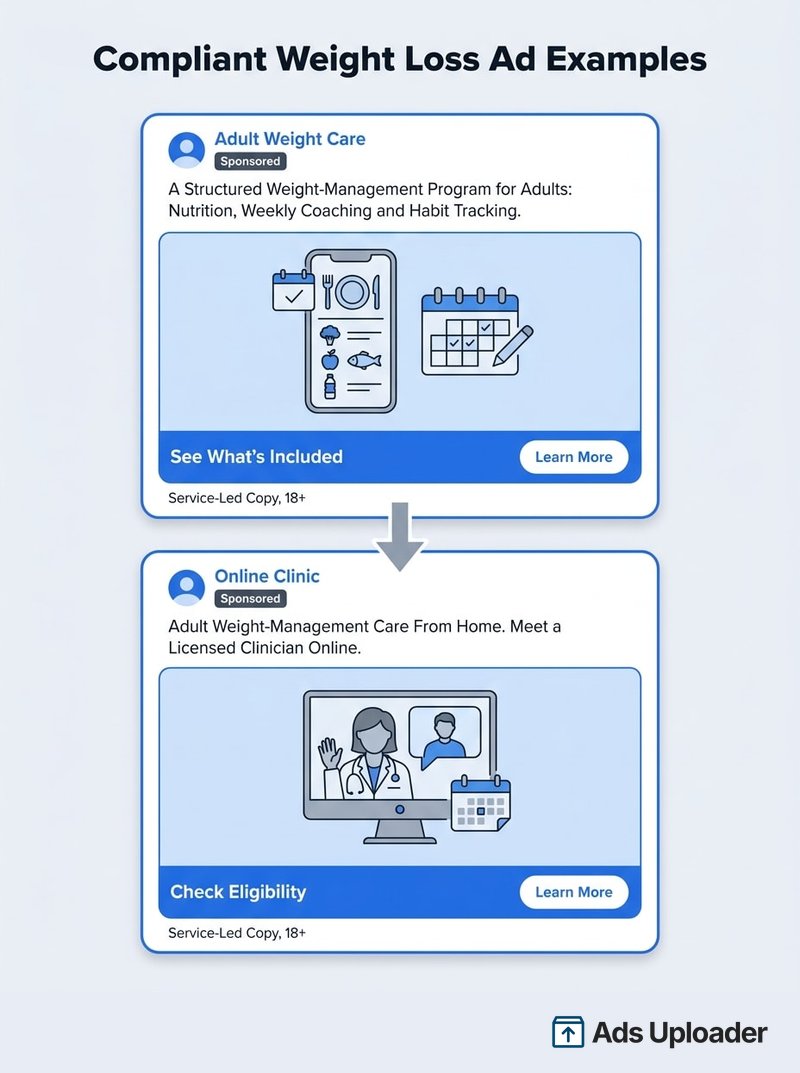
The through-line across all four: sell the process, the access, and the credibility stack, a named clinician, real program components, honest pricing, disclosed proof, rather than a promise about the reader's body. That is also what survives ad fatigue, which arrives fast in this saturated category. Rotate genuinely different concepts and watch for the signals that a weight-loss ad has fatigued rather than tweaking one hook.
Building the Campaign
Objective and Structure
For programs, clinics, and telehealth, the Leads objective fits forms, calls, and Messenger conversations. Sales suits DTC supplement or app purchases where a compliant pixel or Conversions API event exists. Traffic optimises for clicks rather than enquiries, so it rarely earns its place here. Whatever the objective, the 18+ age floor is mandatory, not a targeting preference.
Targeting
Weight loss is not a Special Ad Category, so you keep lookalikes, interests, and broad targeting. In practice broad plus Advantage+ audience does the work, and stacking narrow weight-loss interests on top mostly shrinks reach without improving quality. A YouGov profile of US adults focused on weight management skews slightly female and toward the 35 to 55 range, useful as directional context rather than a hard targeting spec. Our guide to Meta audience targeting covers what still works after the detailed-targeting changes.
Instant Form or Landing Page
Instant forms lower friction and produce more, cheaper leads; landing pages give room for credentials, pricing, program details, and real booking, which tends to qualify better. Test both and judge them on booked consultations. Either way, keep the form fields non-clinical. Do not ask for BMI, diagnosis, medications, or treatment history as a lead-quality tactic, because Meta reviews form questions and those turn an ordinary lead record into something closer to health data. Move any real clinical intake to a consented, protected environment after the lead.
Creative and Copy
Put the offer and who it is for in the first line, before the truncation point; our reference on Meta ad copy specs has the current character limits. Favour process proof: a clinician to camera, an app-screen walkthrough, a "what's included" explainer, an honest packaging shot. Real footage beats stock, and it carries less policy risk than a tight body crop.
What Weight Loss Facebook Ads Cost
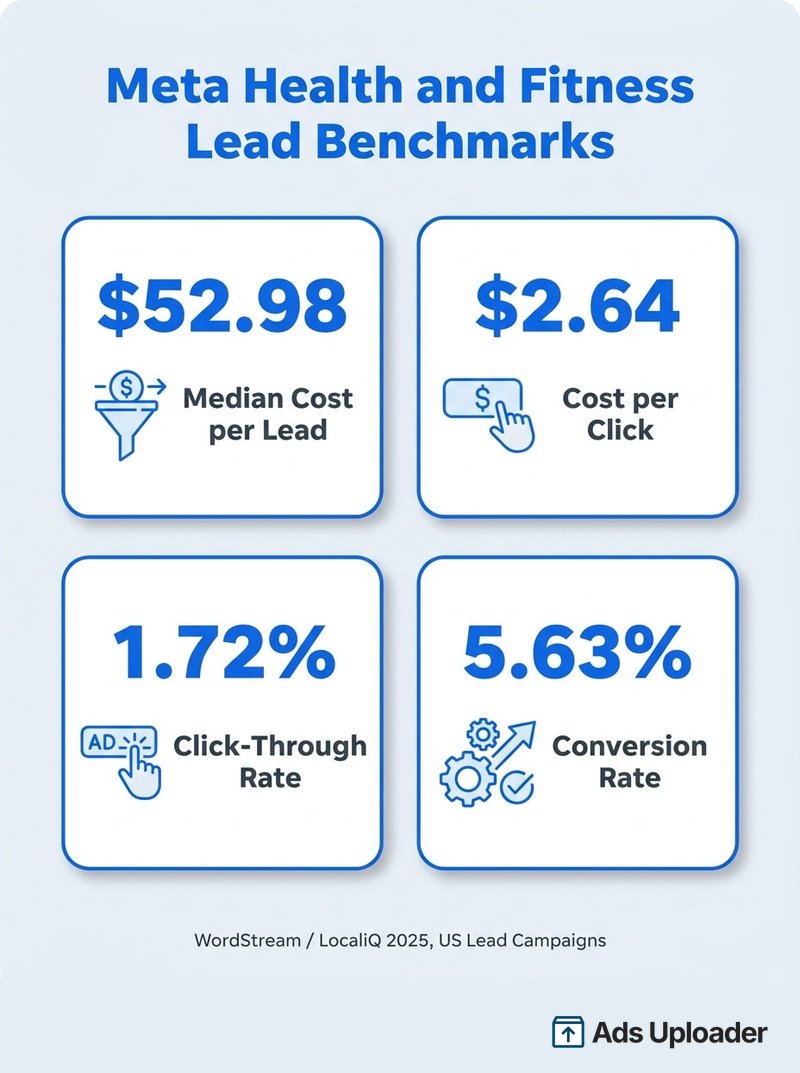
There is no published Meta benchmark specific to weight loss, and the $27.66 figure that circulates is the all-industry lead median, not a weight-loss number. The nearest published category in WordStream and LocaliQ's 2025 Facebook advertising benchmarks is Health and Fitness, drawn from US lead campaigns running April 2024 through June 2025.
| Health and Fitness, lead campaigns | Median |
|---|---|
| Click-through rate | 1.72% |
| Cost per click | $2.64 |
| Conversion rate | 5.63% |
| Cost per lead | $52.98 |
Treat those as planning baselines, not promises. Clinics, GLP-1 telehealth, DTC supplements, and coaching offers behave very differently from each other, so compare campaigns only when the objective, geography, attribution window, and lead definition match. The market itself is large and growing: Grand View Research put the global weight-loss services market near $38.9 billion in 2024, and the WHO reports roughly 43% of adults were overweight in 2022, so demand and competition are both high. Judge a campaign on qualified leads, booked consultations, and show rate, not on cost per lead alone. Our breakdown of what drives cost per lead on Meta covers the levers behind the number.
Frequently Asked Questions
Save Hours on Creative Testing
Stop uploading ads one by one. Bulk process unlimited creatives with automatic media matching and direct API publishing.
Try Ads Uploader FreeNo credit card required • 7-day free trial
Are Weight Loss Ads Allowed on Facebook?
Yes. Meta permits dietary weight-loss products and services, fitness offers, programs, clinics, and, for authorized advertisers, prescription weight-loss treatment. The vertical is not banned, but it is heavily reviewed, and ads are rejected on copy and creative far more often than on the offer itself. Dietary weight-loss products and services must target people aged 18 or older.
Why Do My Weight Loss Ads Keep Getting Rejected?
Usually the Personal Attributes policy, which prohibits copy that implies the viewer's body weight or health, such as "Are you overweight?". Other frequent causes are pinched-fat close-ups, appearance-inferiority language, unqualified timeframe promises, missing 18+ targeting, and landing pages that claim more than the ad. Meta reviews the headline, image text, form questions, and destination page.
Can You Use Before-and-After Photos in Weight Loss Ads on Facebook?
Since a revision dated 22 July 2026, before-and-after is no longer banned purely as a format. A truthful transformation with a real consenting subject, a disclosed timeframe, and a substantiated typical-results statement can be eligible. It still fails if it implies an unlikely or guaranteed result, uses shaming or pinched-fat imagery, or omits the generally expected result.
Do Weight Loss Ads Have to Target 18+?
Yes. Meta requires ads for dietary weight-loss or weight-gain products and services to be shown only to people aged 18 or older, confirmed publicly in January 2023. Set the minimum age to 18 yourself, and re-check it on duplicated, Advantage+, and API-created ad sets, because the control is easily lost when an ad set is copied.
Can You Advertise Ozempic, Semaglutide or GLP-1s on Facebook?
Named prescription drugs can be advertised only by authorized advertisers with active LegitScript certification, Meta prescription-ad authorization, 18+ targeting, and eligible geography, currently the US, Canada, and New Zealand. General telehealth messaging that does not name a drug is treated more leniently. Compounded semaglutide and tirzepatide carry separate legal risk and must not be called generic or the same as approved drugs.
What Is a Good Cost per Lead for Weight Loss Facebook Ads?
There is no weight-loss-specific Meta benchmark. The nearest category, Health and Fitness, recorded a $52.98 median cost per lead in WordStream's 2025 data, with a $2.64 cost per click and 5.63% conversion rate. The $27.66 figure often quoted is the all-industry median. Use these as planning baselines and judge on qualified leads and booked consultations.
What Ad Copy Gets Weight Loss Ads Approved?
Copy that describes the service, method, or offer rather than the viewer's body. "Structured weight-management coaching for adults, with nutrition planning and weekly check-ins" passes where "Fix your embarrassing belly fat" fails. Avoid guarantees, miracle language, and fixed-time promises. Name real program components and disclose paid testimonials and typical results.
The Short Version
Weight loss is not a restricted category on Meta the way housing and employment are. There is no Special Ad Category to declare, and you keep full targeting. What binds instead is the content policy, and it is stricter and more specific than the SERP suggests.
The rules that actually matter: dietary weight-loss ads must target 18+, and you set that yourself. Copy cannot imply the viewer's body or attack their appearance, which rules out the second-person hooks this vertical has always leaned on. Pinched-fat close-ups, wearable-only claims, and unqualified timeframe promises are out. Before-and-after is restricted by claim, not banned, since the July 2026 revision. And named GLP-1 promotion needs LegitScript and Meta authorization before you can run it.
Build identity-safe, process-led creative, substantiate every outcome claim, keep the landing page consistent with the ad, and measure on qualified leads. Do that and weight loss ads on Facebook are one of the highest-intent, most scalable verticals on the platform, rather than a source of endless rejections.