The full month-by-month archive of 2026 Meta Ads changes. Months roll off the live Meta Ads Updates page when more than three are on it; they land here in full for historical review.
July 2026
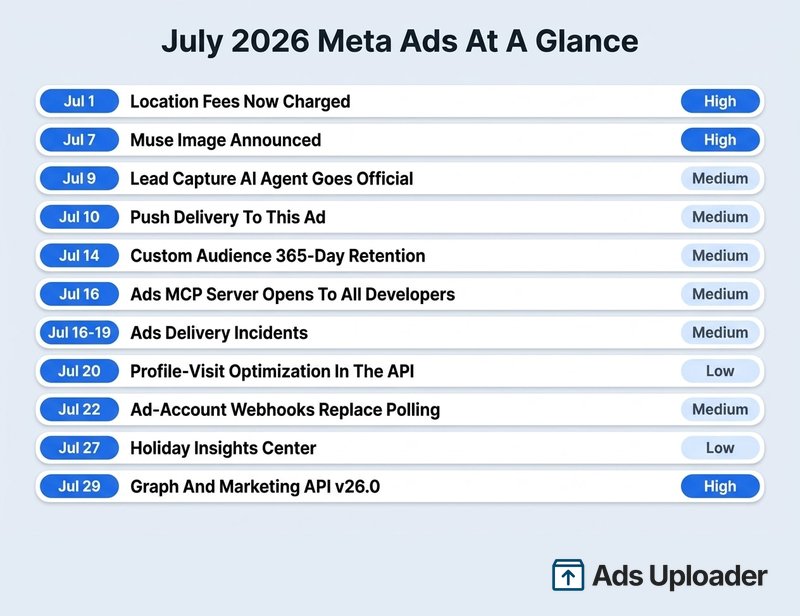
July was a developer-heavy month that still reached the account. The Graph and Marketing API v26.0 release on July 29 retired several ad placements and paths, Meta opened its ads MCP server to any developer and documented ad-account webhooks that replace API polling, the location fees started landing on invoices, an official Lead Capture AI agent arrived for Instant Forms, and the status page logged two Ads Delivery incidents.
| Date | Change | Impact | Who's affected |
|---|---|---|---|
| Jul 1 | Location fees now charged (UK 2%, FR/IT/ES 3%, AT/TR 5%) | High | Advertisers delivering in six markets |
| Jul 7 | Muse Image announced; Advantage+ creative rollout "in the coming weeks" | High | All advertisers using AI creative |
| Jul 9 | Lead Capture AI agent for Instant Forms goes official | Medium | Lead-gen advertisers |
| Jul 10 | "Push Delivery to This Ad" surfaced (no official page yet) | Medium | Advertisers running multiple ads per ad set |
| Jul 14 | Website custom audience retention: 365-day max appears in developer-doc FAQ | Medium | Retargeting and exclusion audiences |
| Jul 16 | Ads MCP server opened to all developers | Medium | Developers, ad tools |
| Jul 16 & 19 | Ads Delivery incidents logged on Meta's status page | Medium | All advertisers |
| Jul 20 | Profile-visit optimization goals added to the Marketing API (docs-only) | Low | Developers, ad tools |
| Jul 22 | Ad-account webhooks documented as the replacement for API polling on ads changes | Medium | Developers, ad tools |
| Jul 27 | Meta Holiday Insights Center launched | Low | Small-business advertisers planning Q4 |
| Jul 29 | Graph and Marketing API v26.0 released with ad-API deprecations | High | Developers, ad tools, some advertisers |
Graph and Marketing API v26.0 (July 29): The Deprecations That Could Break Your Setup
On July 29, Meta shipped Graph API v26.0 and Marketing API v26.0, and the version changelog carries the most ad-facing batch of deprecations of the year. Several land on advertisers, not just developers: the Instagram Explore Feed is removed as an ad placement, so any campaign that hardcoded it now redistributes to other placements; the Advantage+ Audience flag must be set explicitly or calls fail; Shop Ads creatives default to a website-and-shop destination unless you opt out; poll ad creation and the Messenger Stories placement are deprecated; and web-only destinations are banned for Web-plus-App campaigns. Two more matter for tooling: the delivery-estimate fields (daily_outcomes_curve, budget_guardrail, estimate_dau) are gone, and the Commerce Order Management API is sunset with no replacement (47 endpoints, blocked in v26.0 now and across all versions on October 27). On the additive side, ads in WhatsApp Status expanded, with carousels up to 10 cards and offsite-conversion optimization for Sales, Leads, and Engagement.
The practical work is an audit, not a panic. Check which API version every integration is pinned to, since apps left on an unsupported version get force-upgraded into these changes without warning. Review any placement logic that named Explore or Messenger Stories, set advantage_audience explicitly wherever you build targeting, and put the October 27 Commerce Order Management cutoff on the calendar if you touch Shops order data.
Get Meta Ads Updates In Your Inbox
Two emails a month rounding up what actually changed in Meta Ads. No fluff, unsubscribe anytime.
Two emails a month • Unsubscribe anytime
Muse Image: Meta's New Image Model Is Heading Into Advantage+ Creative
On July 7, Meta introduced Muse Image, the first image generation model from Meta Superintelligence Labs, and the business post is explicit about where it lands: Advantage+ creative image generation, rolling out to advertisers and agencies "in the coming weeks". Meta says the model brings agentic reasoning and iterative refinement - it parses a creative brief, adjusts individual elements, swaps styles, and produces on-brand variations with fewer round trips. Meta cites more than 8 million advertisers already using its AI creative tools. As of the end of July, no official post confirms the Advantage+ integration has shipped, so treat it as announced-not-live and watch Advantage+ creative for the rollout.
Today, we’re introducing Muse Image: our first image generation model from Meta’s Superintelligence Labs. It uses advanced reasoning to understand prompts and lets you turn your ideas into high-quality, relevant visuals that you can share directly to your chat, story, or feed.…
— Meta Newsroom (@MetaNewsroom) July 7, 2026
This is the model layer underneath June's brand-memory announcement getting a serious upgrade, and it sharpens the same trade-off. Image variations get better and cheaper, which raises the output floor for everyone, while the delivery system keeps grouping structurally similar creative into one entity and one audience pool. When Muse variants hit your account, treat them as variation fuel inside a concept, not as new concepts. And if your creative uses AI-generated people, remember the New York disclosure law from the June section applies to Muse output too.
Meta Location Fees Are Now on Your Invoice (July 1)
The fees announced in March are now being charged: United Kingdom 2%, France, Italy and Spain 3%, Austria and Turkiye 5%, applied to impressions delivered in those countries regardless of where your business is based, billed as a separate line item outside your campaign budget per Meta's location fees help page. Your first invoices containing them arrive this month: reconcile the line item against delivery by country and reforecast Q3 CPMs for affected markets. Full breakdown in our Meta location fees guide.
Meta's Ads MCP Server Is Now Open to Every Developer (July 16)
On July 16, Meta announced that its ads MCP server is now available to any developer with their own Meta app. April's AI Connectors put a no-code MCP server in front of end users; this opens the build-your-own layer, so any AI application can let its users create and optimize campaigns, manage product catalogs, and pull performance data through natural language. Business portfolio administrators also get controls to scope how much access an AI agent gets.
The direction is consistent: Meta is making the ad account addressable by agents at every layer, from the end user who just wants to talk to their campaigns to the developer building the tool that does it. If you build software on top of Meta Ads, this is the sanctioned path to an AI interface without waiting on partner status. For the practitioner-facing version of the same shift, our Meta Ads MCP guide covers what the connectors do and where they fit.
Profile-Visit Optimization Arrives in the Marketing API (July 20)
A docs-only addition we picked up from the out-of-cycle changelog after the July close: since July 20, ad sets created through the Marketing API can optimize for Instagram profile and Facebook Page visits, with optimization_goal set to PROFILE_VISIT or PROFILE_AND_PAGE_ENGAGEMENT and matching destination and call-to-action types, including a dual Instagram-plus-Facebook destination. Creator-adjacent and local-business tooling that could only build these ads in the UI can now script them.
Ad-Account Webhooks Now Replace Polling for Ads Changes (July 22)
Around July 22, Meta documented webhooks for ad accounts as the sanctioned way to get real-time notifications when ads change, instead of polling the API on a timer. The ad_account object now exposes standalone webhook fields: ad_recommendations (marked improved), creative_fatigue, in_process_ad_objects, with_issues_ad_objects, and product_set_issue. A new effective_status field, reported to fire on delivery blocks, policy rejections, and sync delays, appears in coverage of the launch but is not yet listed on Meta's field-reference page, so treat it as reported until the reference catches up. The same coverage puts the full ads subscription at more than 88 ad-object and insights notifications and says push delivery does not spend your rate-limit allowance on the receiving side; both of those figures come from the announcement rather than the reference doc, so hold them with that caveat. You turn a field on by subscribing your app, then authorizing the specific ad account.
The practical point for anyone running tooling on Meta Ads is that this is the way off polling loops. If your stack wakes every few minutes to diff ad statuses, recommendations, or fatigue, you can move that to push and stop spending rate limit on checks that usually return nothing. It fits the same month's agent-addressable direction and the v26.0 removal of the delivery-estimate fields: fewer scheduled reads, more event-driven reactions. Audit where you poll today and convert the noisiest loops first.
Custom Audience Retention: 365 Days Now Appears in Meta's Developer Docs
Still partially confirmed, reported here with that caveat. Meta's website custom audiences developer documentation, updated July 14, now states in its FAQ that "the longest duration can be set for 365 days" before audience members drop off unless they match the rule again. The catch is internal: the same page's retention_days API parameter still reads "between 1 and 180 days", and the Business Help Center gives no maximum number at all. So the 365-day figure is now in official documentation, but the API field and the Help Center have not caught up. The 730-day number circulating in practitioner posts appears nowhere official. If a full-year window holds, retargeting and exclusion audiences can reach a year of purchasers; until the field and Help Center align, build as if 180 is the enforced ceiling and revisit next update.
"Push Delivery to This Ad": Steer More Delivery Toward One Ad You Choose
Around July 10 a new "Push Delivery to This Ad" option began appearing, and it looks fully rolled out. It lets you push more of an ad set's or campaign's delivery toward one specific ad you select, rather than leaving the split entirely to Meta's delivery system. We are noting it from what advertisers are seeing in the interface. Meta has not published a help page for it yet, so treat the exact mechanics as provisional and watch for official documentation to confirm the details.
The trade-off is a familiar one. Meta's delivery system optimizes the ad split on signal you cannot see, so overriding it toward a favorite can help when you have a clear winner the system is under-serving, and hurt when your read is worse than the algorithm's. If you try it, change one variable, give it enough spend to judge fairly, and compare against an ad set where you left delivery alone.
Lead Capture AI Agent for Instant Forms: Meta Turns the Form Into a Conversation
The conversational lead flow that practitioners started spotting in early July is now official. Meta's Lead Capture AI agent for instant form ads Help Center page documents it: instead of always showing a static form, Meta decides per person whether an AI chat or the standard form is more likely to convert, and the agent asks and follows up in a back-and-forth to collect the lead. Meta says conversations are not stored, only the final submitted lead is shared. You turn it on with an ad-level "Enable lead capture AI agent" toggle. At launch it is English-only, does not support conversion-leads optimization, conditional logic, or appointment requests, and is gated for regulated verticals like financial services, health, and employment/housing/credit.
This is the natural next step after June's embedded appointment booking: Meta is turning the Instant Form from a form into a conversation. A chat-style capture can lift completion when a static form feels like work, but it also hands your qualifying questions to an AI, so if you test it, read the transcripts and check lead quality, not just lead volume, before you scale it. The regulated-vertical exclusions are the tell about where Meta is least confident, so keep that flow static if you sell in one of them.
Ads Delivery Incidents on July 16 and 19, 2026: When to Suspect the Platform
Meta's status page logged Ads Delivery incidents on July 16 and July 19, both since resolved. The July 19 event lined up with a wider Facebook and Instagram disruption that users reported in the early hours, US time. No Ads Manager, Ads Reporting, or Marketing API incidents were logged in the window beyond these two.
If delivery or pacing looked off on either day, that is the first place to check before you touch a campaign. Annotate both dates in your reporting so a delivery dip does not get mistaken for creative fatigue or an audience problem, and as a standing habit on odd days, read the status page's Ads section first, then trust your own MER and CRM numbers over in-platform reporting on incident days.
Meta's 2026 Holiday Insights Center: Plan Q4 Before the CPM Ramp
On July 27, Meta launched a 2026 Holiday Insights Center, a free hub of consumer research and platform benchmarks aimed at small businesses getting ready for the holiday season. It is a marketing resource, not an ad-mechanics change, but the timing is the useful part: it is the cue to lock your Q4 plan before auction prices climb into the back-to-school and holiday windows. Build your creative and budget calendar now, while CPMs are still at their summer floor.
Meta Reported Q2 2026 Earnings (July 29): Price per Ad Up 12% Again
Meta's Q2 2026 results, reported July 29, put average price per ad up 12% year over year, the second consecutive quarter at that rate, on 14% more ad impressions delivered. Ad revenue reached $59.36 billion, up 27%. For advertisers the regional split matters more than the blend: price rose 20% in US & Canada against 1% in Asia-Pacific. The full quarter-by-quarter read, and what it means for your CPMs, is in our Meta earnings for advertisers tracker.
What to Do After the July 2026 Meta Ads Changes: Action Checklist
This week
- Confirm which Graph and Marketing API version every integration is pinned to before an unsupported version force-upgrades you into the v26.0 changes.
- Annotate July 16 and 19 in reporting dashboards as platform delivery incidents.
- Check any campaign that named the Instagram Explore Feed or Messenger Stories placement; both are gone in v26.0.
This month
- Set the Advantage+ Audience flag explicitly anywhere your tooling builds targeting.
- Lead-gen: test the official Lead Capture AI agent against your current static form, and read the transcripts for quality, not just volume.
- Reconcile the location-fee line items on your July invoices against delivery by country.
- Developers: move status, recommendation, and fatigue polling to
ad_accountwebhooks, and stop spending rate limit on checks that return nothing.
Before next quarter
- Calendar the October 27 Commerce Order Management API cutoff if you touch Shops order data.
- Lock your Q4 creative and budget plan before holiday CPMs climb.
- Watch for the Muse Image rollout into Advantage+ creative and plan variations as concept fuel, not new concepts.
June 2026
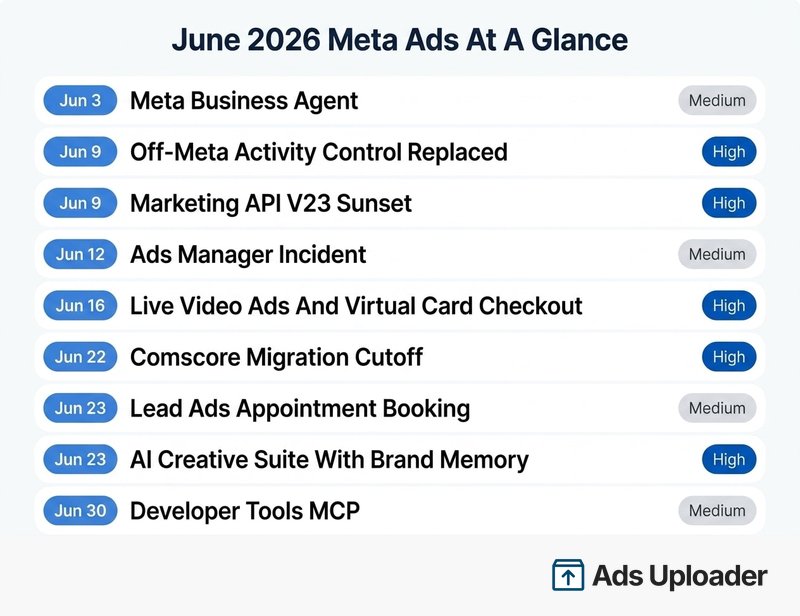
June was Meta's loudest month of 2026 so far. A Cannes double-header pushed commerce and AI creative hard, a quiet privacy-settings change widened what your Pixel data personalizes, two API deadlines landed, and Ads Manager had its roughest day of the year.
| Date | Change | Impact | Who's affected |
|---|---|---|---|
| Jun 3 | Meta Business Agent announced (Conversations 2026) | Medium | Click-to-message advertisers |
| Jun 9 | Off-Meta activity control replaced; business data personalizes Feed and AI | High | All advertisers |
| Jun 9 | Marketing API v23.0 sunset | High | Developers, ad tools |
| Jun 12 | Ads Manager multi-component incident + Marketing API incident | Medium | All advertisers |
| Jun 16 | Cannes: Live Video Ads, virtual-card checkout, affiliate expansion | High | Ecommerce and retail |
| Jun 22 | Nielsen DMA to Comscore cutoff for automotive model ads | High (niche) | Automotive advertisers |
| Jun 23 | Lead ads: embedded appointment booking in Instant Forms | Medium | Lead-gen advertisers |
| Jun 23 | Cannes: AI creative suite with brand memory, translations, Creator Marketing Hub | High | All advertisers |
| Jun 30 | Developer Tools MCP | Medium | Dev teams, API tools |
Meta's "Activity From Other Businesses" Change: Your Pixel Data Now Personalizes Feed and AI
On June 9, Meta announced it is retiring the "Your activity off Meta technologies" control. The activity that businesses share with Meta through tools like the Pixel and Conversions API will now personalize Feed recommendations and Meta AI responses as well as ads, all governed by a single "Activity from other businesses" setting. The change starts rolling out in July 2026 in the US and other countries. Meta says no new data is collected; existing signals are being used on more surfaces.
This cuts both ways. The events you already send now influence organic and AI surfaces, which should compound the value of clean signal setup without you configuring anything. At the same time, it is a new, simpler opt-out surface: users who never found the old control will see the new one. Signal quality work keeps rising in value while the audience that allows it may narrow slightly at the edges. Nothing to change in your setup this week, but if you handle customer privacy questions, brief that team on the new setting's name and scope.
Meta Live Video Ads and Virtual-Card Checkout: The June 2026 Commerce Push
Meta's first Cannes announcement was a commerce package: Live Video Ads expanding globally on Facebook and Instagram with in-stream product browsing, virtual one-time card numbers with Mastercard and Visa rolling out to checkout this summer, and affiliate-creator expansion into 22 countries with retail partners across India, Brazil, Mexico and Southeast Asia.
The line that matters most sits lower in the post: product data becomes "foundational" across all Sales campaigns this summer, with Meta's AI matching products to likely buyers even outside catalog-first formats.
Catalog hygiene is no longer just a catalog-ads concern. If your feed has stale prices, missing attributes, or thin product data, that quality now propagates into every Sales campaign. Fixing the feed is the highest-leverage boring task on this month's list. Live Video Ads are worth a structured test if you sell demonstrable products, but treat the virtual-card checkout as a signal of where Meta wants transactions to happen: closer to the ad, with less friction and more measurable purchases.
Meta AI Creative Suite and Brand Memory: What Launched in June 2026 (And Why Distinct Concepts Still Win)
A week later Meta announced an end-to-end AI creative suite. The centerpiece is "brand memory": generation that learns from your existing ads so output stays on-brand, launching first through an agency integration and reaching broader rollout "in the coming months". Alongside it: text-on-media translation in five languages, AI video voiceover in eleven, an in-platform creative approval workflow in testing, and a Creator Marketing Hub that merges Creator Marketplace with the Partnership Ads Hub and adds Facebook creators later in 2026.
The floor for creative volume keeps dropping, which makes the Andromeda logic from April more important, not less. When everyone can produce brand-consistent variations cheaply, structurally distinct concepts remain the scarce input, because the delivery system groups lookalike creative into one entity and one audience pool. Practitioners are already documenting the sharp edge of that mechanic: duplicating a creative under a new ID does not reset its delivery history, so the "fresh" ad restarts mid-fatigue, recovers briefly, then decays faster than the original. That observation, from a Japanese media buyer at a major agency, was one of the most-shared operator posts of the window:
Metaは複製したクリエイティブを「新規」として扱わないんですよね。
— 野嶋友博@オプト (@LAPPER_s_HIGH) July 4, 2026
入稿上は別のIDでも、過去の配信履歴を引き継いだ状態で配信が始まる。
つまり摩耗の途中からの再スタート。
これが実績にどう出るか。
出し直した直後はCTRもCVRも一時的に回復する。
管理画面だけ見れば復活に見えるわけだが、…
Rough translation of the key point: "Meta does not treat a duplicated creative as new. Even under a different ID, delivery starts with the past delivery history carried over, so you are restarting mid-decay. CTR and CVR recover briefly after a re-upload, and the dashboard makes it look like a comeback." Duplication is maintenance, not testing. Budget your pipeline for genuinely new concepts.
Facebook Lead Ads Appointment Booking: The Instant Forms Update That Closes the Show-Rate Gap
Meta added embedded appointment booking to Instant Forms. Paste a scheduling link and a calendar widget loads on the thank-you page with the lead's contact details pre-filled. Calendly and HighLevel work at launch, HubSpot arrives in early August, and global availability is expected in October. On Instagram and other unsupported placements, leads get a "Book time" button that opens the scheduler in an in-app browser.
The biggest leak in lead-gen funnels is the gap between form submission and a booked call, and this closes most of it for services businesses. If you run lead ads with any appointment-based follow-up, this is the single most testable change of the month: same campaign, booking link added, watch show-rate. Setup details for forms are in our Instant Forms guide.
Meta Business Agent: AI Now Answers Your Click-to-Message Ads
At Conversations 2026, Meta introduced Meta Business Agent, an AI agent that answers customers, recommends catalog products, qualifies leads, and closes sales across WhatsApp, Messenger, and Instagram. It is expanding globally to businesses of all sizes, free at first with paid membership tiers planned "within months", and Shopify and Zendesk integrations are on the roadmap.
If you spend on click-to-message, the responder on the other end of that spend can now be Meta's own agent. That can lift conversion on volume you currently drop after hours, but it also puts an AI in front of paying customers with your brand on it. Test it on a low-risk segment, read the transcripts, and note the pricing signal: free is a launch state, not the deal.
Meta Ads Manager Outage on June 12, 2026: Why That Day's Numbers Look Wrong
Meta's status page logged simultaneous incidents across Ads Creation and Editing, Ads Reporting, and Ads Delivery on June 12, alongside a Marketing API incident, all since resolved. Smaller single-component Ads Delivery incidents were also logged on May 5 and June 23.
Annotate June 12 in every reporting dashboard the way you annotated the March 3 attribution change. If delivery, editing, or reporting looked broken that day, it was the platform. And as a standing habit when delivery behaves oddly: check the status page's Ads section first, then verify against your own MER and CRM numbers rather than trusting in-platform reporting alone on incident days.
Get Meta Ads Updates In Your Inbox
Two emails a month rounding up what actually changed in Meta Ads. No fluff, unsubscribe anytime.
Two emails a month • Unsubscribe anytime
Meta API Changes June 2026: v23 Sunset, Comscore Cutoff, and What Could Break Your Setup
Three dated items for API teams. Marketing API v23.0 sunset on June 9; apps pinned to it were force-upgraded, and v24.0 follows on October 6, so put the migration on the calendar now. For automotive advertisers, Nielsen DMA targeting stopped working on June 22: campaigns still using DMA codes stop delivering until they move to Comscore Markets. And on June 30, Meta shipped a Developer Tools MCP, an MCP server that lets AI coding agents query Meta's developer platform for API discovery, error troubleshooting, app health, and compliance deadlines.
April made the ad account agent-addressable; June did the same for the developer platform. The practical win is mundane and real: an agent that can look up why a call failed and which deadline is about to break your integration shortens exactly the kind of debugging that eats afternoons.
New York's Synthetic Performer Law: AI Ad Disclosure Required From June 9, 2026
Not a Meta change, but it lands on Meta advertisers. New York's synthetic performer disclosure law took effect on June 9, 2026: the first US state law requiring a conspicuous disclosure when an ad uses an AI-generated human performer. It applies based on where the ad is seen, not where your business sits.
This collides directly with the AI creative wave above. If your pipeline generates human likenesses, whether through Meta's new tools or your own stack, ads delivered in New York need a disclosure workflow now, and more states are expected to follow the template. Get legal's read on your AI creative before scaling it, and label proactively rather than retrofitting under enforcement.
What to Do After the June 2026 Meta Ads Changes: Action Checklist
This week
- Reconcile the new location-fee line items on your first July invoices against delivery by country.
- Annotate June 12 in reporting dashboards.
- Confirm which Marketing API version every integration is pinned to.
- If any live creative uses AI-generated people, flag New York delivery for disclosure review.
This month
- Clean your product feed: data quality now propagates into all Sales campaigns, not just catalog formats.
- Lead-gen: test embedded appointment booking against your current thank-you flow.
- Brief support and compliance teams on the "Activity from other businesses" setting.
Before next quarter
- Build the creative pipeline around distinct concepts, not variations; brand-memory tools will make sameness cheaper and therefore more common.
- Evaluate Meta Business Agent on a low-risk message segment before pricing arrives.
- Plan the v24.0 migration ahead of the October 6 sunset.
May 2026
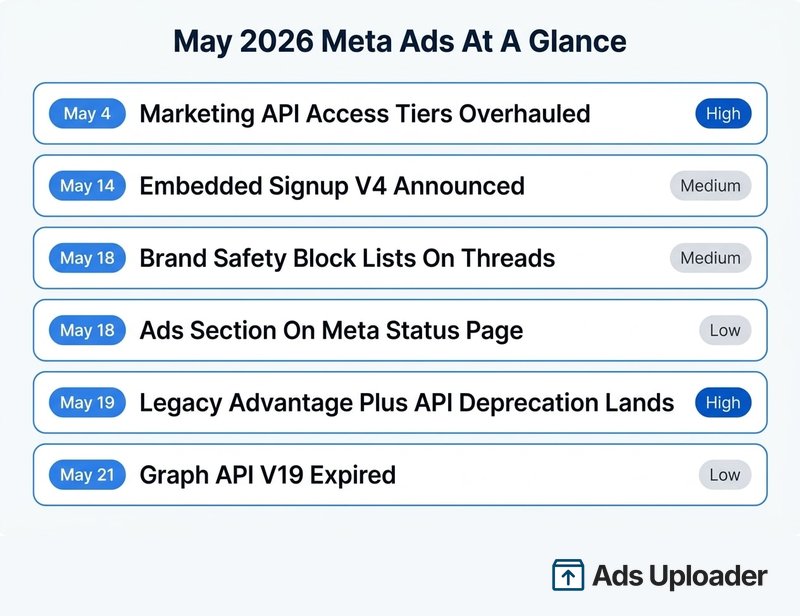
May was a plumbing month. Nothing changed in the ads you see, but the access rules underneath every ad tool shifted, two legacy API paths hit their end dates, and Threads picked up brand-safety controls.
| Date | Change | Impact | Who's affected |
|---|---|---|---|
| May 4 | Marketing API access tiers overhauled | High | Developers, ad tools |
| May 14 | Embedded Signup v4; v2/v3 deprecation set for Oct 15 | Medium | Messaging and CTWA stacks |
| May 18 | Brand-safety block lists extended to Threads Feed ads | Medium | Brand advertisers |
| May 18 | metastatus.com adds a dedicated Ads section | Low | Anyone triaging delivery issues |
| May 19 | Legacy Advantage+ Shopping and App campaign API deprecation landed | High | Developers |
| May 21 | Graph API v19.0 expired | Medium | Developers |
Marketing API Access Tiers Update (May 2026): Full Access Just Got Easier
An out-of-cycle Marketing API changelog entry overhauled access tiers. "Ads Management Standard Access" is now the "Marketing API Access Tier", with "Standard" relabeled "Limited access" and "Advanced" relabeled "Full access". The auto-approval threshold for full access dropped from 1,500 to 500 calls in 15 days, the error-rate requirement is now assessed on a rolling 500-request window (below 15%), and the screen-recording requirement was dropped from tier-upgrade applications.
Full access got meaningfully easier for small tools and in-house scripts, which is good news if you have ever been stuck in limited-access purgatory. The flip side is that a rolling error-rate window punishes sloppy retry logic faster. If you run anything against the Marketing API, check your current tier label (it changed under you) and your error rate.
Meta API Deadlines That Landed in May 2026: ASC/AAC Deprecation and v19 Expiry
The May 19 deprecation of the legacy Advantage+ Shopping and App campaign API paths, flagged here since March, took effect: creation, duplication, and updates through the old paths are done. Graph API v19.0 expired two days later on May 21. If a script or third-party tool started failing mid-May, these two dates are the first suspects.
Threads Ads Brand Safety Update (May 2026): Block Lists Remove the Adoption Blocker
Meta extended third-party content block lists to Threads Feed ads, with DoubleVerify, IAS, Scope3, and Zefr supported at launch and Channel Factory and Protected by Mediaocean onboarding in the coming months.
If brand-safety controls were the reason Threads placements stayed off your plan, that reason expired in May. Threads inventory is still cheap relative to Feed; a controlled placement test is now defensible to the most conservative brand team.
Other May 2026 Meta Updates
Meta added a dedicated Ads section to its status page on May 18, grouping Ads Manager, Marketing API, Messaging Ads, Catalog, Audience Network, Instagram Boost, and Shops in one place; it earned its keep on June 12. For messaging stacks, Embedded Signup v4 arrived on May 14 with v2/v3 deprecation set for October 15: most integrations auto-upgrade, but only_waba_sharing, marketing_messages_lite, and coex flows need manual migration. And metastatus logged a single-component Ads Delivery incident on May 5, since resolved.
What to Do After the May 2026 Changes: Action Checklist
This week
- Check your Marketing API tier label and rolling error rate against the new thresholds.
This month
- If any automation still references legacy ASC/AAC paths or v19, treat every mid-May failure as this and migrate.
- Bookmark the status page's Ads section next to this page.
Before next quarter
- Messaging/CTWA stacks: calendar the October 15 Embedded Signup migration and check whether your flow auto-upgrades.
April 2026
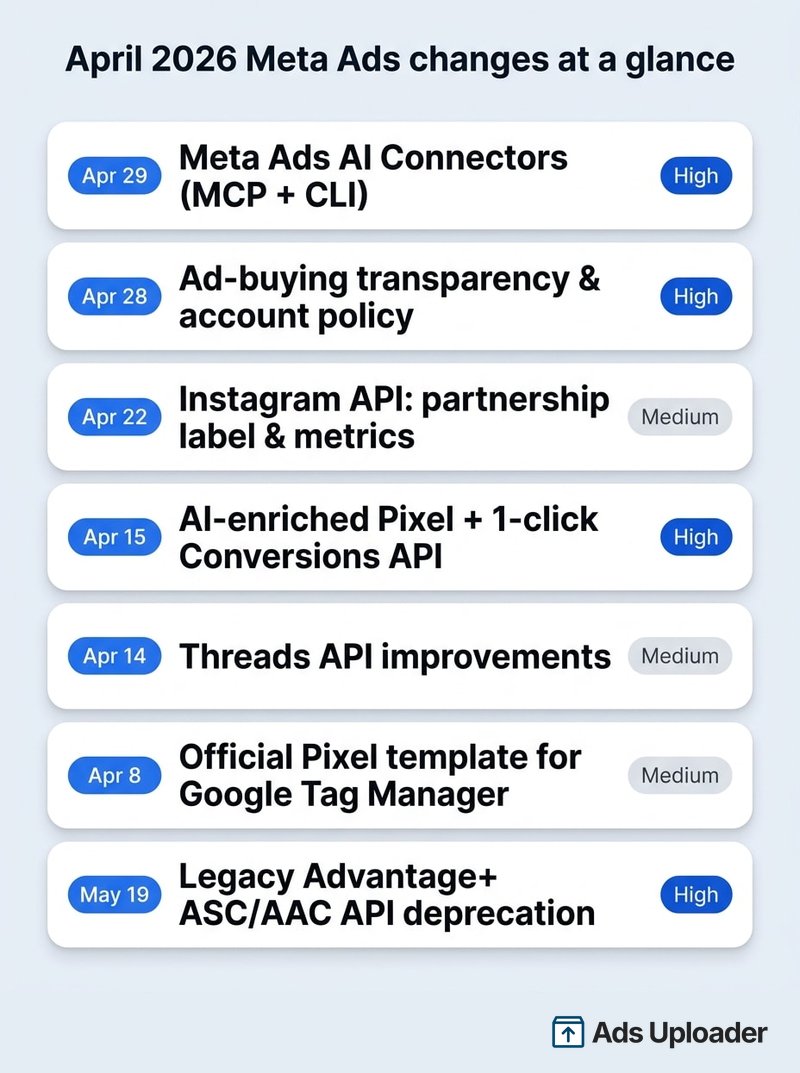
April was about removing friction and handing more of the ad account to AI. Meta opened up agent access to campaigns, automated the most technical parts of signal setup, and tightened the rules for agencies and resellers. None of it is a flashy new ad format. All of it changes how you work.
| Date | Change | Impact | Who's affected |
|---|---|---|---|
| Apr 29 | Meta Ads AI Connectors (MCP server + CLI) in open beta | High | Agencies, in-house teams, automation/dev teams |
| Apr 28 | Developer policy: ad-buying transparency and account structure | High | Agencies, white-label resellers, ad-buying platforms |
| Apr 22 | Instagram API: partnership label, new metrics, collaboration, engagement | Medium | Creator/partnership teams, API and scheduling tools |
| Apr 15 | AI-enriched Meta Pixel and one-click Conversions API | High | All advertisers, especially smaller teams |
| Apr 14 | Threads API improvements | Medium | App marketers, social and API teams |
| Apr 8 | Official Meta Pixel template for Google Tag Manager | Medium | Advertisers running GA4 and GTM |
| May 19 | Legacy Advantage+ Shopping and App campaign API deprecation deadline | High | Teams with legacy ASC/AAC API paths |
Meta Ads AI Connectors: Agent Access to Your Ad Account
On April 29, Meta announced Meta Ads AI Connectors in open beta. This is the month's biggest change because it shifts where ad management happens.
A connector is a secure, Meta-authenticated link from your ad account to an AI agent. It comes in two parts:
- The ads MCP server. No developer credentials, API setup, or coding. You connect through standard Meta login and then drive campaigns from AI tools you already use, such as ChatGPT or Claude. It covers comprehensive reporting, campaign management in natural language, catalog management, and signal diagnostics, all reflecting your real campaign data rather than generic advice.
- The ads CLI. A command-line tool for developers and AI agents working with the Marketing API, documented in Meta's developer blog post. It needs Python 3.12+, creates campaigns, ad sets, ads, and creatives in paused status by default, outputs table, JSON, or plain text, and is built to run unattended in CI/CD pipelines.
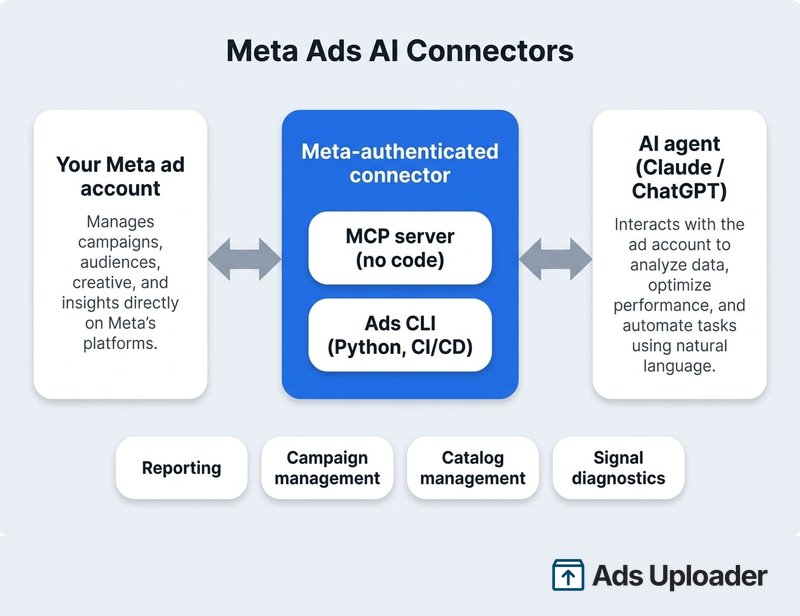
Meta frames this as complementary to the in-Ads-Manager Meta AI business assistant: the assistant for guidance inside Ads Manager, your own AI tools for cross-channel work and custom workflows. Together they point clearly at Mark Zuckerberg's stated goal of advertising becoming "input a budget and a goal, AI does the rest."
Practitioners treated it as the start of genuinely agentic media buying rather than another automation toggle. The reception was less about novelty and more about scope: native, authorized account access through the tools people already use, with the four capabilities laid out plainly.
🚨 Meta released their Ads MCP and CLI today. What makes this announcement so interesting is that it gives AI tools direct, authorized access to help manage your Meta Ads account through natural language: comprehensive reporting, campaign management, catalog management, and signal diagnostics. This is a huge step forward in agentic media buying.
— Bryan Cano (@BryanECano) April 30, 2026
The operational layer of Meta advertising is now agent-addressable by default, not just through custom API code. The upside is speed: pulling a report or spinning up a paused campaign structure becomes a sentence instead of an afternoon. The flip side is equally real: an AI agent with write access to your ad account is a new attack and error surface, and unattended budget or campaign edits are exactly the actions you want gated behind a human. Before you let an agent touch live spend, treat this like any other integration that can move money. For context on the protocol behind it, see our explainer on the Meta Ads MCP.
This direction is not new to me. A few weeks before Meta's announcement, Ads Uploader shipped its own CLI, mirroring the workflow of the web application that teams already use to launch ads at volume. So the tooling is here and it works. The thing to be honest about is fit: a general-purpose agent is excellent for reporting and analysis, but high-volume, repeatable ad creation across objectives, formats, and destinations carries far more edge cases than a demo suggests. That gap is exactly why we built dedicated tooling for it rather than leaving it to a generic agent. Make sure the glove fits the job before you wire it into anything that touches live spend. There has also been a lot of fear lately about connecting AI to the Meta API and accounts being banned for it; that is not a pattern I have seen, and my take on what is actually going on is here.
AI-Enriched Meta Pixel and One-Click Conversions API
On April 15, Meta announced updates to the Meta Pixel and Conversions API aimed at removing technical setup work.
The Pixel can now use AI to automatically include extra page and product information, such as product names, availability, and business details, with the events you already send. This is data that well-resourced advertisers maintained with dedicated developers; automating it narrows that gap for smaller teams. Existing Pixel users get a notification with a 30-day window before the feature switches on. You can review and manage which data categories are shared, and adjust or turn it off any time in Events Manager.
Alongside it, Meta added a one-click "Meta-enabled" Conversions API setup that needs no technical expertise, no cost, and no ongoing maintenance. Existing partner or custom Conversions API setups are unaffected. Meta cites advertisers running the Conversions API alongside the Pixel seeing an average 17.8% lower cost per result.
This sits in a wider April theme. On April 8, Meta also released an official Pixel template for Google Tag Manager that reuses your existing GA4 dataLayer and auto-maps enhanced e-commerce events, replacing community-built workarounds.
Signal quality is becoming a default rather than a project. That is good for performance, but the 30-day auto-enable means doing nothing is a decision. If your site exposes anything sensitive in page or product data, silence opts you in. For the mechanics underneath this, see our guides to the Meta Conversions API and the Meta Pixel Helper.
Developer Policy: Transparency and Account Structure for Ad-Buying Solutions
On April 28, Meta updated its developer policies on ads transparency and account structure. Two parts matter.
Section 10.5 keeps the rule that end advertisers stay in separate ad accounts, but adds relief: if you implement a vendor_id and/or brand field in your Product Catalog and/or your Pixel and Conversions API integrations, you are not required to maintain a separate ad account per end advertiser. That is meaningful for anyone managing many clients at volume.
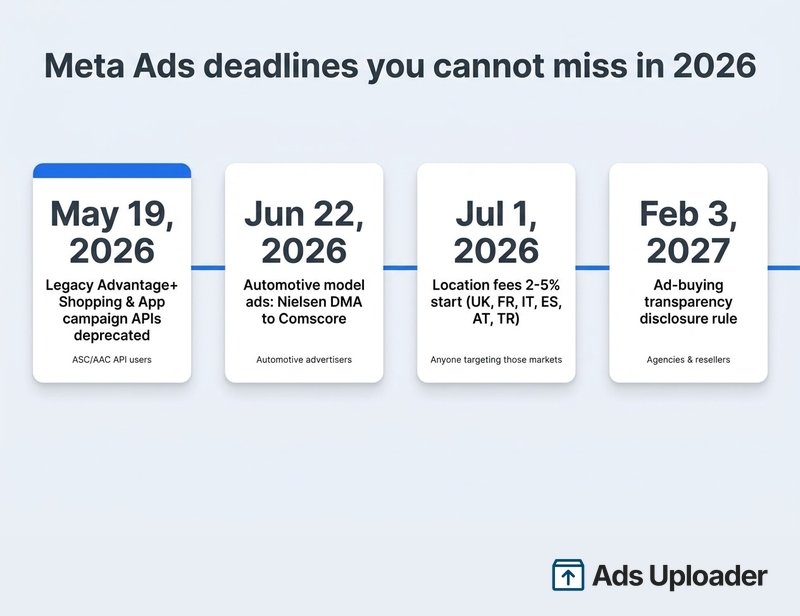
Section 10.6.a, effective February 3, 2027, formalizes a reactive transparency model. If an end advertiser requests it, an ad-buying solution must disclose the amount spent on Meta advertising separate from its fees, the fee structure charged, and the campaign configuration, settings, and post-campaign reporting, all in Meta's terminology. Meta does not disclose this proactively, but may do so on the end advertiser's request if it suspects a violation.
Agencies, white-label resellers, and ad-buying platforms whose margin depends on opacity have until early 2027 to decide how they will handle a spend-and-fee disclosure request without it becoming a crisis. It is far enough out to plan calmly and close enough that "later" is not a plan.
Instagram API: Partnership Label, Metrics, Collaboration, Engagement
On April 22, Meta shipped a batch of Instagram API updates. The most useful for advertisers: the "Paid partnership" disclosure label can now be applied through the Content Publishing API at publish time, with or without naming the brand, across photos, Reels, carousels, and Stories. Previously, creators using third-party scheduling tools had to add the label manually in the app after posting.
The release also adds engagement counts (reposts, saves, shares) via the Media endpoint, aggregated cross-placement metrics that match the totals shown in the app, expanded facebook_views, collaborative media list and search endpoints, and a Like Media and Like Comments API behind a new instagram_manage_engagement permission.
Partnership-ad and creator-collaboration workflows that run through tools instead of the app get cleaner compliance and better measurement parity. If you scale creator content, this removes a manual step and a reporting blind spot.
Threads API Improvements
On April 14, Meta published a major set of Threads API improvements covering richer content publishing, deeper app integration, and interaction management. This follows March's Threads Marketing API expansion that brought global app ads and reply moderation. The direction is consistent: Threads is being built out as a properly tool-supported surface, not a checkbox placement.
If you parked Threads as "too early," the tooling argument for that is getting weaker each month. App advertisers in particular now have real API support to test it with discipline.
Worth Noting: The Andromeda Creative-Volume Reality
Not an April announcement, but the defining backdrop, and the loudest practitioner conversation of the month. April reporting plus a Meta spokesperson confirmed Andromeda changes made in Q3 2025 produced a roughly 14% improvement in ad quality on Facebook, and that opting out of Advantage+ creative now persists across future campaigns.
The mechanic that matters: Andromeda groups ads by structural similarity, not by ad ID. Same narrator, same scene, same edit rhythm reads as one entity, served to one audience pool. So an account with 50 ads that are all "creator in a kitchen holding the product" does not have 50 ads. It has one ad shown 50 times to the same people, which is why CPA climbs while you keep "testing." A structurally different concept (a podcast cut, a skit, a problem-unaware explainer) is a new entity ID and opens a new pool.
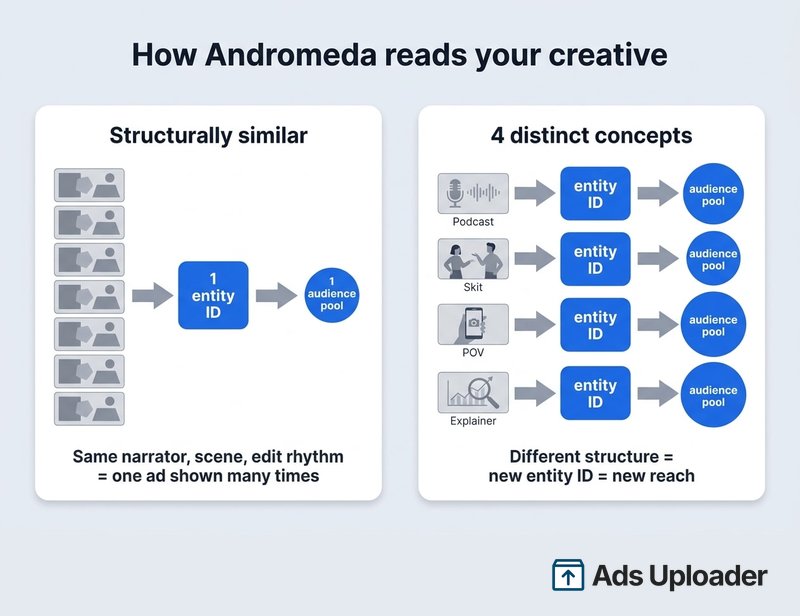
This is the post that crystallised the debate in April:
Andromeda groups ads by structural similarity. Same narrator, same scene, same edit rhythm = same entity ID = same audience pool. If 80% of your library is "creator in their kitchen holding the product talking about benefits," you don't have 80 ads. You have 1 ad shown 80 times to the same people. ... One brand we started running these for went from $220k to $330k in monthly ad spend within 41 days. The ads had a frequency of 1.9 against the account average of 3.56.
— Lorenzo | Meta Ads & Performance Creatives (@lorenzo_pravata) April 29, 2026
The number that proves the point is the frequency gap: 1.9 on the structurally distinct ads versus a 3.56 account average means those ads reached people the rest of the library had barely touched. That is incremental reach, not a better hook.
The operational squeeze of 2026 is volume of distinct concepts, not variations of one. Audit your library by structure, not count: if most of it shares a narrator and scene, you have a coverage problem masquerading as a creative-quality problem. Pair that with a structured testing approach. Our notes on Meta Andromeda and split testing landing pages cover how to test without drowning in variants.
March 2026
March was the heaviest month for Meta Ads changes since Advantage+ became the default the previous November. The theme was measurement and plumbing, not new formats.
| Date | Change | Impact | Who's affected |
|---|---|---|---|
| Mar 3 | Click attribution redefined; engage-through introduced | High | All website/in-store conversion advertisers |
| Mar 10 | Location fees of 2–5% announced for July 1 | High | Advertisers targeting UK, FR, IT, ES, AT, TR |
| Mar 13 | Nielsen DMA to Comscore migration for automotive | Critical | Automotive model advertisers |
| Mar 18 | Manus AI connectors in Ads Manager (beta) | Medium | All advertisers |
| Mar 24–26 | Shoptalk and NewFronts: Reels trending ads, Partnership Ads Hub redesign, AI creative tools | Directional | All advertisers |
| Mar 31 | Webhooks mTLS certificate authority change | High for devs | Teams using webhook integrations |
Click Attribution Redefined
On March 3, Meta changed click-through attribution for website and in-store conversions to count only link clicks. Non-link interactions (likes, shares, saves, comments, image expansions) moved into a new engage-through attribution bucket with a 1-day window, and the video engaged-view threshold dropped from 10 seconds to 5. Billing is unaffected; only reporting classification changed. The practical risk is a "phantom drop" in click-through conversions that is reclassification, not a performance decline. The fix: annotate March 3 in every affected dashboard, split pre- and post-change reads, add engage-through columns, and brief clients before they panic. Full background in our guide to Meta click attribution.
Location Fees From July 1
On March 10, Meta announced it will pass European Digital Services Taxes to advertisers from July 1, 2026: United Kingdom 2%, France, Italy and Spain 3%, Austria and Turkey 5%. The fee is based on where impressions are delivered, not where the business is based, so a US advertiser targeting France pays the French rate. This directly changes effective CPM and CPA in those markets. Audit affected spend and reforecast Q3 budgets now. Details in our Meta location fees breakdown.
Manus AI Connectors and the Automation Push
On March 18, Meta launched beta Manus AI connectors for Ads Manager (reporting and dashboards), Instagram Creator Marketplace, Instagram content, and WhatsApp Business. Combined with Advantage+ as the default and a wave of AI creative tools from Shoptalk and IAB NewFronts (AI voiceover, translation, catalog-to-video, expanded Reels trending ads, a redesigned Partnership Ads Hub), the clear signal was that Meta is automating the platform by default. April's AI Connectors are the natural next step from this.
API Plumbing: mTLS and ASC/AAC
For developers, March carried a Webhooks mTLS certificate authority change effective March 31, and the ongoing Advantage+ Shopping and App campaign API deprecation continued toward its May 19, 2026 deadline (now imminent). For automotive teams, the Nielsen DMA to Comscore migration set a hard June 22, 2026 cutoff after which unmigrated campaigns stop delivering.
What March Meant
Attribution got more honest, costs started rising in regulated markets, and automation became the default posture rather than an option. Every one of those threads continued into April.