Duplicator Panel Overview
The Duplicator copies ads that already exist in your Meta ad account into another campaign or ad set. It reuses each ad's post ID (the ID of the post that sits behind the ad), so every copy shows the same likes, comments and shares as the original. That social proof is often what makes a winning ad keep winning.
Use the Duplicator when you want to:
- Move a winning ad into a new ad set to test another audience
- Scale a proven ad into a bigger campaign without losing its engagement
- Copy several ads into one fresh ad set, or give each one its own ad set
The Duplicator only copies existing ads. To build brand-new ads from new media, use the Uploader instead.
Before You Start
You need three things to use the Duplicator:
- A connected Meta account. Until you connect, the page is greyed out and shows a Connect with Facebook banner. See Facebook Accounts.
- An active trial or paid plan. When your trial has ended, the page shows Your Free Trial Has Ended instead of the workflow.
- An ad account. Pick it under Account Selection at the top of the page. The source ads and the destination always come from this same ad account.
Open the Duplicator from the dashboard navigation. The page is titled Meta Ads Duplicator.
Step 1: Select Source Ads
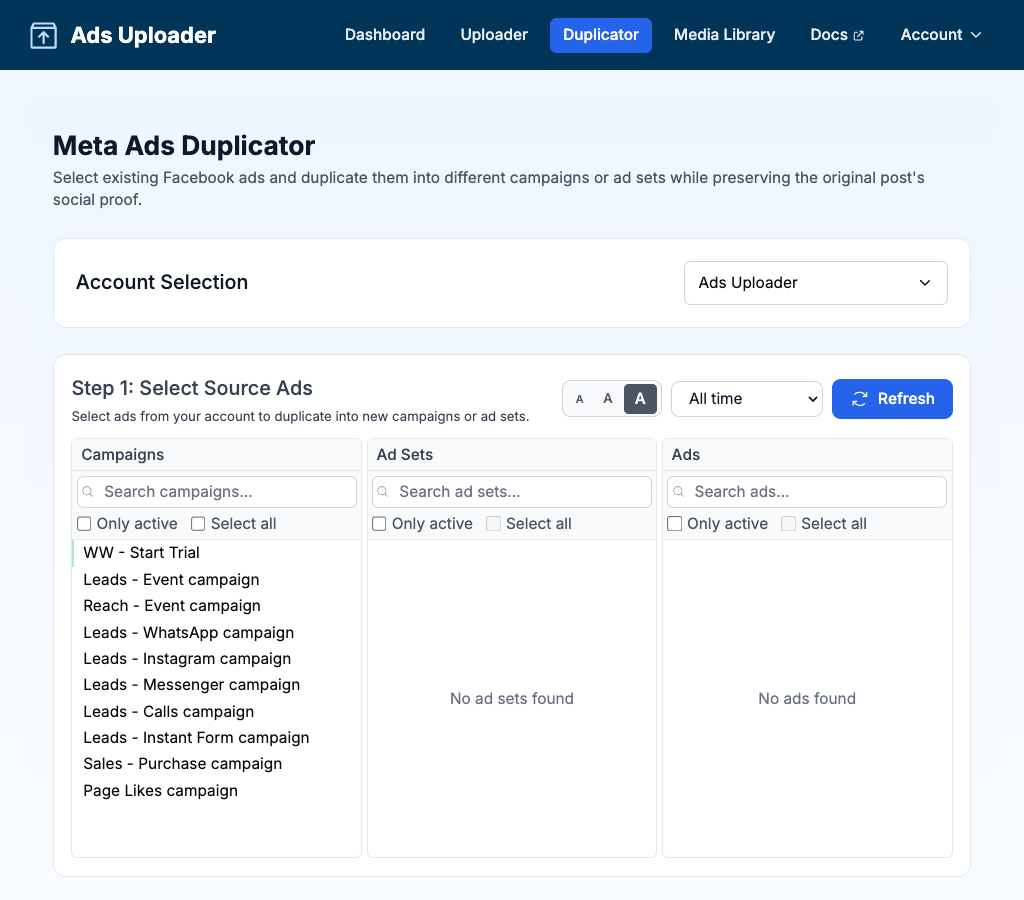
The source selector uses three columns, the same layout as the Uploader:
| Column | What it shows |
|---|---|
| Campaigns | The campaigns in your ad account |
| Ad Sets | The ad sets inside the campaigns you clicked |
| Ads | The ads inside those ad sets. Tick the ones you want to copy. |
Click a campaign to load its ad sets, then click an ad set to load its ads.
Filters and Controls
- Search boxes (Search campaigns..., Search ad sets..., Search ads...): filter each column by name.
- Only active: show only items with an active status. It is off by default.
- Select all: tick every item in a column at once.
- Ad activity period: a date picker with All time, Last 7 days, Last 30 days (the default), Last 90 days, Last 180 days and Last 365 days.
- Text size (the three A buttons): make the text in the selector smaller or larger.
- Refresh: reload the lists from Meta, for example after you change something in Ads Manager.
Select Several Ads at Once
You can copy many ads in one run:
- Shift-click selects a range: click one item, then Shift-click another to select everything in between.
- Ctrl-click (Windows) or Cmd-click (Mac) adds or removes one item without clearing the rest.
- Select all ticks the whole column.
These shortcuts work in all three columns, so you can also pull ads from several campaigns or ad sets at the same time.
Step 2: Configure Destination
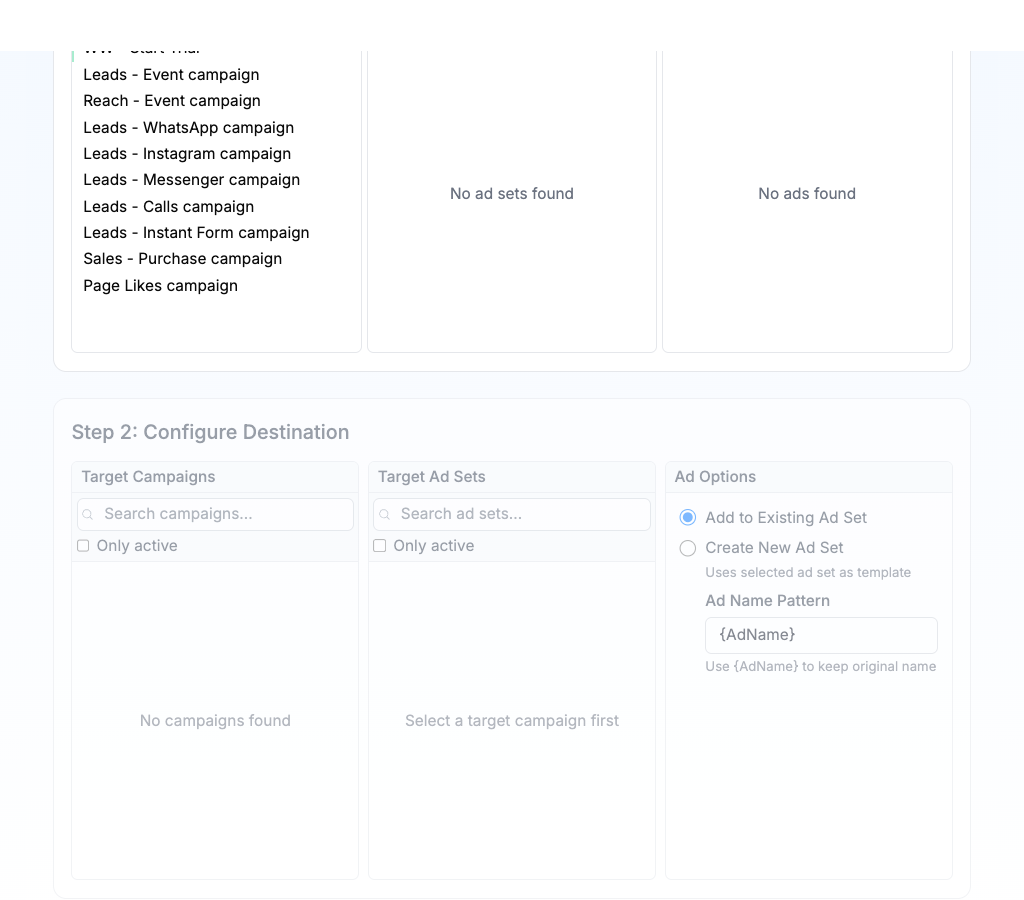
Now choose where the copies go. Step 2 has three columns: Target Campaigns, Target Ad Sets and Ad Options.
Pick a Target Campaign
Click a campaign in Target Campaigns. The copies are created inside it.
The Duplicator only copies into a campaign that already exists. There is no "create new campaign" option here. This is on purpose: you can load ads from several source campaigns at once, so the tool cannot know which campaign settings a brand-new campaign should use. If you need a new campaign, create it first (in the Uploader or in Meta Ads Manager), then duplicate into it.
Choose an Ad Set Option
Under Ad Options, pick how the copies are grouped:
| Option | What it does |
|---|---|
| Add to Existing Ad Set | Puts the copies into the ad set you click in Target Ad Sets. |
| Create New Ad Set | Creates one new ad set for all the copies. It uses the ad set you click in Target Ad Sets as a template, so it gets that ad set's targeting, budget and schedule. Name it in Ad Set Name. |
| Create New Ad Set per Ad | Creates one new ad set for each copied ad. This option only appears when you select two or more ads. Name the ad sets with Ad Set Name Pattern. |
When one new ad set holds several ads, {AdName} in the Ad Set Name is replaced with "Multiple Ads", because there is no single ad name to use. With Create New Ad Set per Ad, each ad set gets its own ad's name.
Name the Copied Ads
Every option has an Ad Name Pattern field. {AdName} inserts the original ad's name, and it is the default.
For example:
{AdName}keeps the original name.{AdName} Scaleadds a word after the name.Scale {AdName}adds a word before the name.
Step 3: Review Duplications
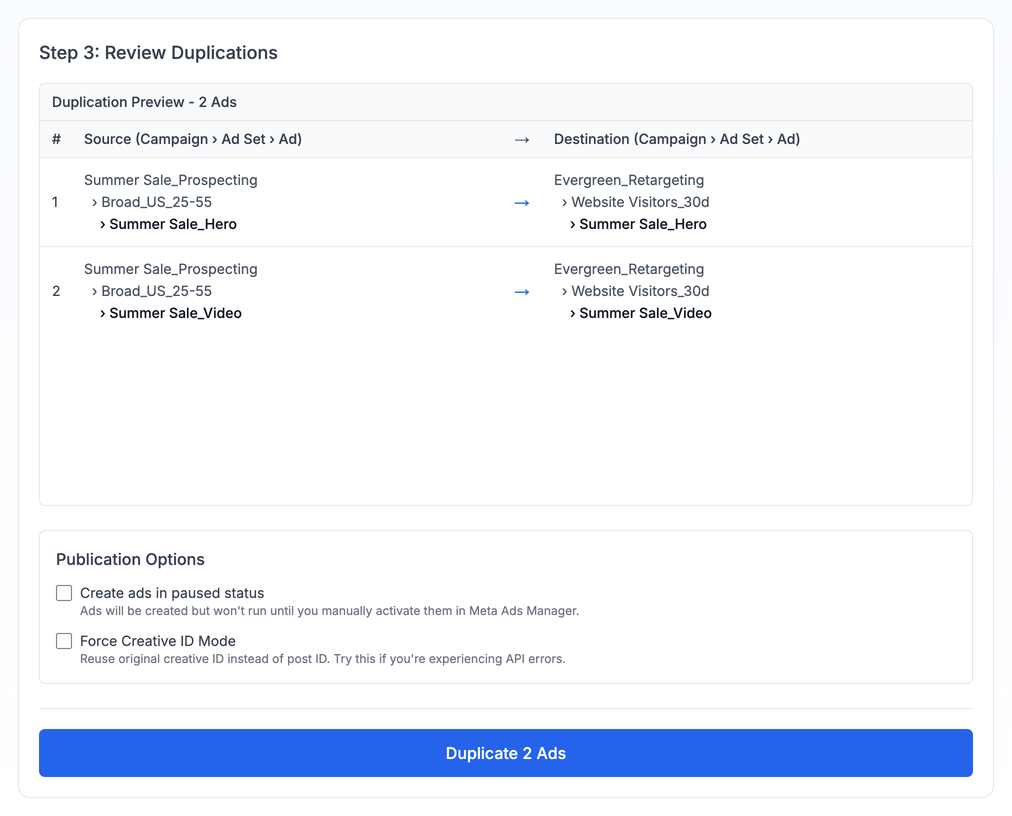
Step 3 appears once you have picked source ads, a target campaign and an ad set option. Check it before you create anything.
Check the Preview Table
The Duplication Preview table lists one row per ad. The Source column shows where the ad lives now (campaign, ad set and ad). The Destination column shows where the copy will go and the name it will get. If a name or ad set looks wrong, go back to Step 2 and change it; the table updates straight away.
Set the Publication Options
Under Publication Options:
- Create ads in paused status: the copies are created but do not run until you switch them on in Meta Ads Manager. It is off by default, so copies go live straight away unless you tick it.
- Force Creative ID Mode: copies the ad's creative ID instead of its post ID. Only tick this if you keep getting API errors. The copies then start with the original's engagement but no longer share it (see Dynamic creative ads below).
Duplicate the Ads
Click Duplicate N Ads (for example, Duplicate 3 Ads). A progress window shows how the run is going.
When it finishes, a green banner says Successfully duplicated ads in Meta Ads Manager and lists how many ad sets and ads were created. Click View in Meta Ads Manager to open them.
Post ID vs Creative ID
The Duplicator tries to copy each ad by its post ID. This is what keeps the engagement together.
Post ID duplication (the normal case). A standard ad with one image or video and one set of text has a single post ID. The copy points at the same post, so:
- All existing likes, comments and shares show on the copy.
- New engagement on the original or the copy shows on both.
Creative ID duplication (the fallback). Some ads have no single post ID, so the Duplicator copies their creative ID instead. The creative ID is Meta's reference to the ad's media, text and settings. In this case:
- The copy starts with the engagement the original had at that moment. It does not start from zero.
- From then on, each ad collects its own engagement. New likes and comments on the original do not show on the copy, and the other way round.
Dynamic Creative Ads
Ads with several text or media options (flexible or dynamic creative ads) have no single post ID, because Meta treats every combination as its own post. The Duplicator copies these ads with their creative ID.
When your selection includes one of these ads, a warning window opens before anything is created. It tells you how many of the selected ads are affected and explains Forked Engagement: the copy keeps the engagement built up so far and grows its own on top, instead of sharing one post. Open How does this affect my ads? for more detail. Click Continue with Duplication to go ahead, or Cancel to change your selection.
Tip: if you need engagement to stay in sync across every copy, duplicate single-creative ads.
How Many Ads to Copy at Once
The Duplicator does not enforce a batch limit. These are suggestions that keep large runs reliable:
| Number of ads | Suggestion |
|---|---|
| 1 to 30 | Duplicate them in one batch |
| 30 to 50 | Think about splitting them into 2 batches |
| More than 50 | Split them into batches of 20 to 30 |
Duplicate from the CLI or MCP
You can also duplicate ads by post ID from the CLI or an MCP agent. Start with a preview, which shows the source-to-destination mapping and creates nothing:
ads duplicator:post-id:preview --account act_123 --post 1234567890_9876543210 --campaign 120200000000000000 --new-adset "Winners {AdName}" --paused
In MCP, the matching tools are ads_duplicate_by_post_preview, ads_duplicate_by_post and ads_get_duplication. As in the web app, the destination must be an existing campaign. For every flag, the spec file format and how to confirm the exact source ads, see Post-ID Duplication Flags in the CLI Full Reference.
Limitations
No Cross-Account Duplication
You cannot duplicate ads between different ad accounts. The source ads and the destination must be in the same ad account.
Workaround: use the copy feature in Meta Ads Manager, or build the ad again with the Uploader in the other ad account.