Presets
A preset is a saved starting point. Instead of finding the same source ad in the selector every time, or uploading the same XLSX file again, you save it once and pick it from a dropdown next time.
What a Preset Saves
A preset remembers where your settings come from, not the choices you make in the uploader:
- An API preset remembers a source ad: its campaign, ad set, ad and creative. When you load it, your new ads copy that ad's own settings, just as if you had picked it in the selector.
- An XLSX preset remembers the template row from an XLSX file you uploaded.
A preset does not save what you change afterwards, such as new campaign or ad set options, budget changes, text, schedule or creative enhancement choices. To save all of that and come back to it later, use Saved Builds. To reuse ad text, use a text preset.
Presets belong to one ad account. You only see them when you work in that account.
Save a Preset
From a Source Ad
- Pick your source ad in the Select Ad from Facebook selector (see Configure Your Ads).
- Click Save as Preset under the Configuration Source box.
- In the Save Ad Configuration Preset dialog, enter a Preset Name. It starts with the campaign name.
- If you are part of a team, tick Share with team to let team members with access to this ad account use it.
- Click Save Preset.
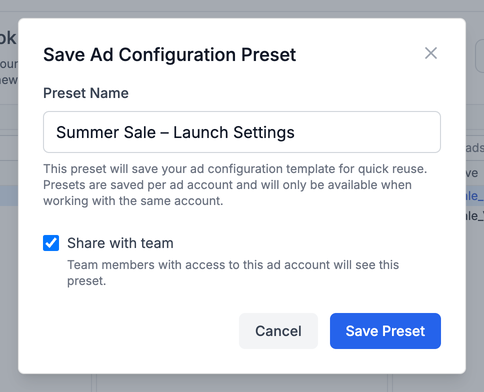
From an XLSX File
- Tick Upload Ad Configuration XLSX and choose your file.
- Click Save as Preset next to the file button.
- Enter a name (it starts with the campaign name from the file), then click Save Preset.
Load a Preset
Presets appear in the Configuration Method list once you have at least one:
- Select a saved API preset holds your source ad presets.
- Select a saved XLSX preset holds your XLSX presets. It is hidden when Hide XLSX Configuration is on in User Defaults.
Open the dropdown and click a preset. The source ad or template loads, and you can carry on with the rest of the configuration.
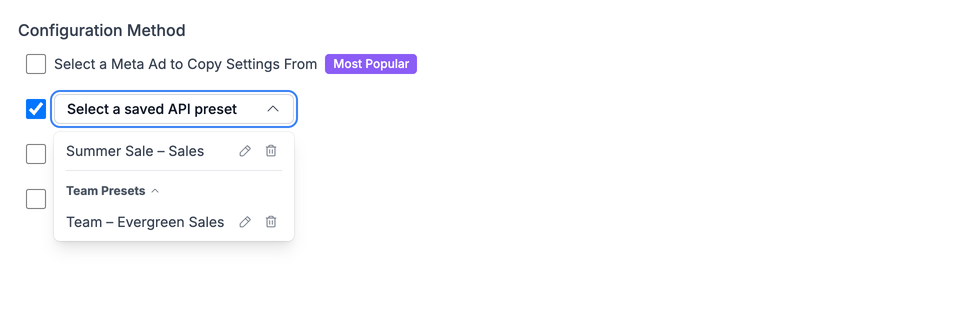
Presets you share, and presets your team shares with you, are listed under Team Presets. Presets from teammates show who shared them. Click the Team Presets heading to collapse or expand the list.
Rename, Share or Delete a Preset
Next to each of your own presets in the dropdown:
- Click the pencil icon to open Edit Preset. You can change the name, tick or untick Share with team, then click Save Changes.
- Click the bin icon to delete the preset. You are asked to confirm first.
You can only edit or delete presets you created.
Where a Preset Sends Your Ads
An API preset carries its source ad's campaign and ad set. If you leave every campaign and ad set option unticked, your new ads go into that existing ad set. You do not choose a destination separately; it follows the preset.
To upload into a particular existing ad set, start from a source ad that already lives in that ad set (or a preset made from one), and leave the ad set options unticked. There is no field to send a preset's ads into a different existing ad set. This is on purpose: ad sets are often set up differently, and copying one ad set's setup into another can fail. To use a new ad set instead, tick one of the new ad set options.
Text Presets
A text preset saves only ad text, not a source ad. It has no campaign, ad set or destination of its own, so you can apply it to any upload.
To save one, fill in the common text in Ad Texts & Settings and click Save as Preset below the fields. In the Save Common Ad Text Preset dialog:
- Preset Name: a name you will recognise.
- Preset Scope: This Ad Account keeps it in the current account. Global (All Accounts) makes it available in every ad account you use.
- Share with team: shown if you are part of a team.
- Select Fields to Include: tick the fields to save, such as Headlines, Primary Texts, Link Description, Call to Action, Website URL, Display URL and URL Parameters.
To use a text preset, tick Load Common Text Preset in Ad Texts & Settings and pick it from the dropdown. You can edit its name, scope and sharing, or delete it, from the same dropdown.