Uploader Panel Overview
The Uploader is where you turn new images and videos into Meta ads. You pick an ad account, add your media, and then copy settings from an existing ad (or a spreadsheet, preset, or saved build) so every new ad is set up the same way.
This page walks through each part of the panel from top to bottom.
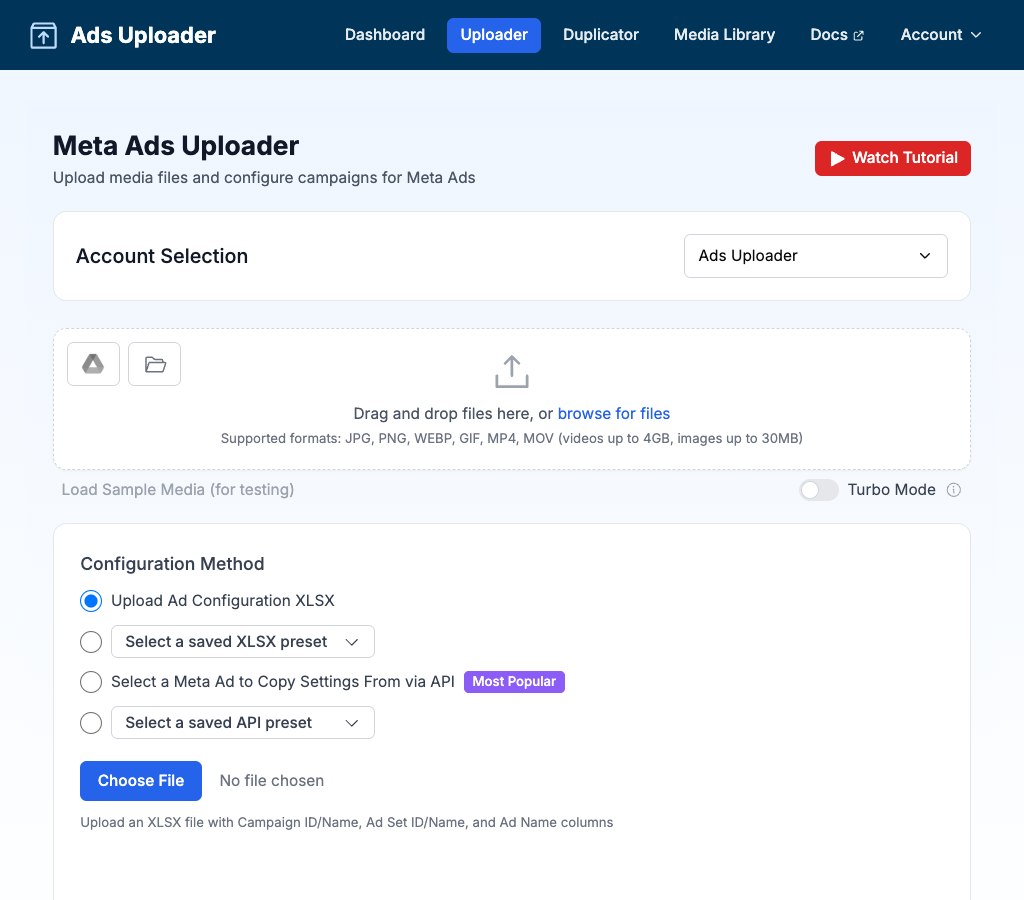
Pick an Ad Account
The Account Selection bar sits at the top of the panel. Use it to:
- Choose the ad account you want to create ads in.
- Search accounts by name or ID.
- Move through the list with the arrow keys and press Enter to select.
Switching accounts clears all uploaded media and configuration. This stops you from mixing media from one account into ads for another.
Open a Saved Build
If you have saved builds, a Saved builds icon appears next to the account selector. A saved build is a snapshot of an Uploader session (media plus settings) that you can reopen later. Click the icon to pick one and pick up where you left off. See Saved Builds.
Add Your Media
Drag files into the upload area, or click it to browse your computer. You can select many files at once.
Supported Formats
The upload area accepts:
- Images: JPG, PNG, WebP, GIF (up to 30MB each)
- Videos: MP4, MOV, M4V (up to 4GB each)
WebP images are converted to JPEG in your browser before they upload.
Other Ways to Add Media
Three icon buttons sit in the top left corner of the upload area. Hover over an icon to see its name:
| Icon tooltip | What it does |
|---|---|
| Import from Google Drive | Pick files from your Google Drive. See Google Drive Import. |
| Import by Link | Paste a public Google Drive folder link, or up to 250 file links. See Import From Links. |
| Load from Media Library | Reuse media you uploaded before. See Use in Uploader. |
Review, Then Upload
Files you add are not uploaded straight away. They first appear in a Selected Files list, so you can check them and remove any you do not want. When you are ready, click Upload Files. The button shows how many files will upload, for example Upload Files (12 files).
The Selected Files list can also show two notices:
- Large Upload Batch: appears when you select more than 20 files. It explains that uploads are paced to stay within Meta's limits, that you will see live progress for each file, and that any failed uploads are listed at the end with a button to retry them.
- Variant Grouping Conflicts: appears when two files would fill the same aspect ratio slot in one group (for example two
9x16files with the same base name). Ads Uploader keeps the closer fit and lists the other file. Remove the conflicting files or upload them separately. See Aspect Ratio Variations.
While files upload, a progress panel shows:
- Progress for each file, with transfer speed
- A live activity log
- A button to minimize the panel so you can keep working (not available once an error occurs)
- A Cancel button to stop the upload
Turbo Mode
The Turbo Mode toggle sits just below the upload area, on the right, when no files are selected. Turbo Mode sends your files through a staging network close to you for faster, more reliable uploads. See Turbo Mode.
Partnership Ads Mode
If you turn on Partnership Ads Mode in the Import by Link dialog, the Uploader switches to partnership posts instead of new media. Local uploads, Google Drive and the Media Library are turned off while it is on, and the upload area reads "Use Import by Link to add partnership posts or switch to media uploads." Turn the mode off to upload your own files again.
Check the Uploaded Media Table
After upload, your files appear in the Uploaded Media table.
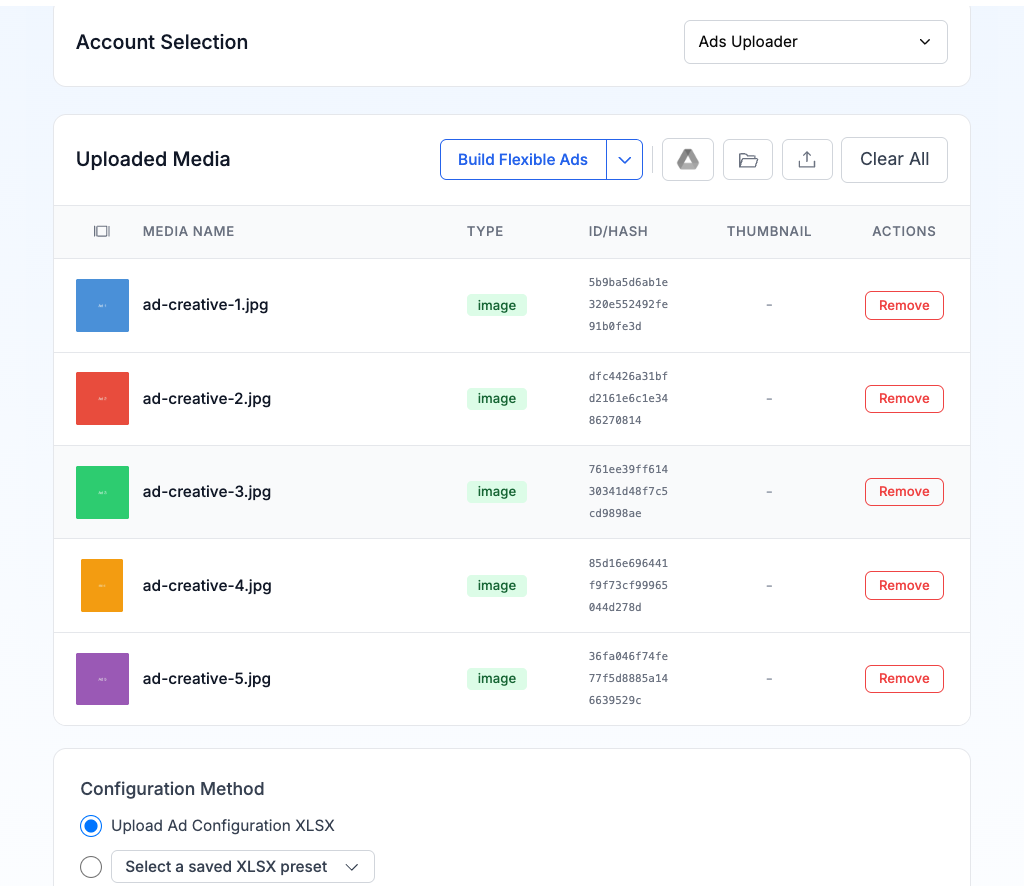
| Column | What it shows |
|---|---|
| Preview | A thumbnail. Hover for a larger view, or click to open the preview. |
| Media Name | The original file name. |
| Type | Image, video, or a built ad type (flexible, carousel, Multi Media), plus aspect ratio chips. |
| ID/Hash | The Meta image hash or video ID. |
| Thumbnail | The thumbnail used for a video. |
| Actions | Remove a single file. |
Read the Aspect Ratio Chips
When files are grouped as aspect ratio variations, the main file's row shows small chips for the extra ratios linked to it. Hover a chip to see the linked file name and its ratio.
| Chip | Meaning |
|---|---|
v | One vertical version is linked: either 9:16 or 4:5. |
v1 | 4:5 vertical version. Shown only when both vertical versions are linked. |
v2 | 9:16 vertical version. Shown only when both vertical versions are linked. |
h | 16:9 horizontal version. |
w | 1.91:1 wide version. |
Use the Toolbar
The toolbar above the table has a Build split button, four icon buttons, and Clear All.
The Build split button opens one of three builders. These combine several uploaded files into one ad:
- Build Flexible Ads: see Flexible Ads.
- Build Carousel Ads: see Carousel Ads.
- Build Multi Media Ads: see Multi Media Ads.
Click the main part of the button to open the builder it shows. Click the arrow next to it to choose one of the other two. The button remembers the builder you chose last (in this browser), so next time it shows that one. The first time you use it, it shows Build Flexible Ads.
The icon buttons, identified by their tooltips:
| Icon tooltip | What it does |
|---|---|
| Import from Google Drive | Add more files from Google Drive. |
| Import by Link | Add more files from links. |
| Load from Media Library | Add more files from your Media Library. |
| Upload More Media | Add more files from your computer. |
Clear All removes every file from the table.
Let File Names Do the Organizing
Ads Uploader reads your file names to save you manual work:
- Thumbnails: a video called
promo.mp4picks uppromo_thumbnail.jpgas its thumbnail. See Thumbnail Attachment. - Aspect ratios:
promo_1x1.mp4,promo_4x5.mp4andpromo_9x16.mp4become one ad with three versions. See Aspect Ratio Variations.
You can also group files into ad sets by a shared part of their name, such as video1-hook1.mp4 and video1-hook2.mp4. This is not automatic. You turn it on later with the Group variations ad set option. See Ad Grouping.
For the full naming rules, see File Naming Conventions.
Choose a Configuration Method
Below the media, under Configuration Method, choose where your new ads get their settings (campaign, ad set, page, text, and more):
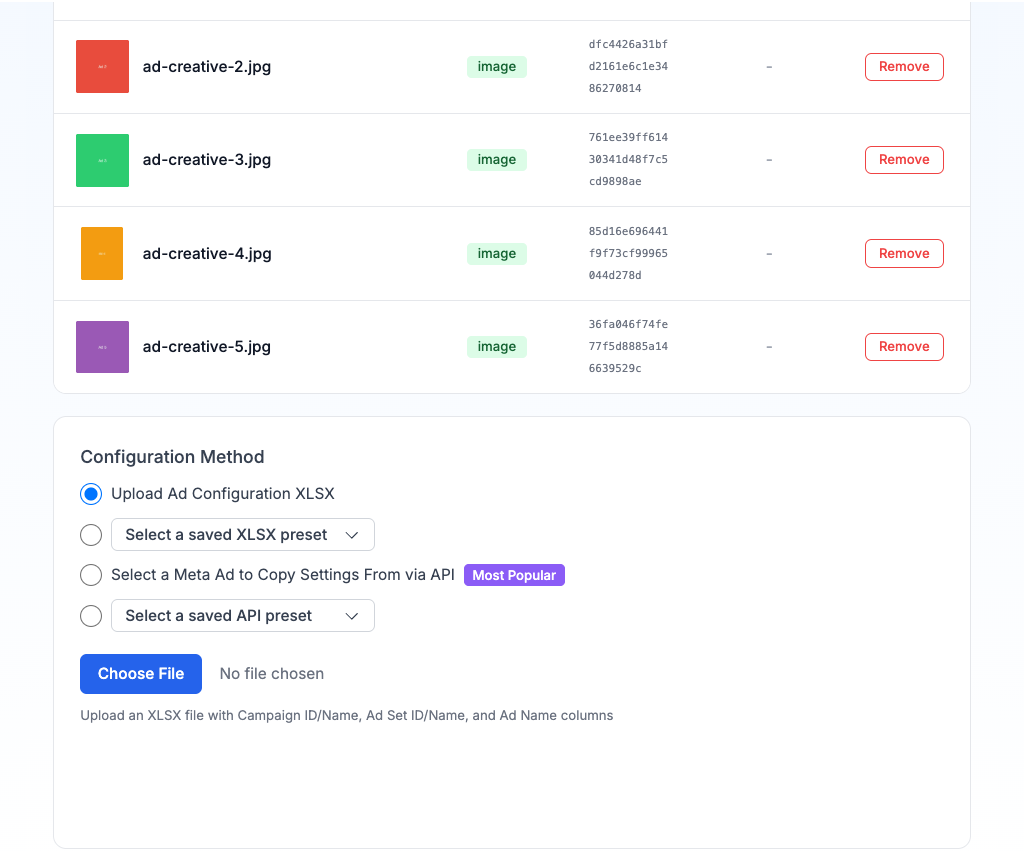
| Method | What it does |
|---|---|
| Select a Meta Ad to Copy Settings From (Most Popular) | Browse your account and pick an existing ad as the template. |
| Select a saved API preset | Reuse a setup you saved earlier from a Meta ad. Shown once you have saved one. |
| Upload Ad Configuration XLSX | Upload an ad exported from Meta Ads Manager as an XLSX file. |
| Select a saved XLSX preset | Reuse an XLSX setup you saved earlier. Shown once you have saved one. |
If you never use spreadsheets, turn on Hide XLSX Configuration in Account > Defaults > General. Both XLSX options then disappear from the list. See User Defaults.
A saved build is a fifth way in. It restores media and settings together from the Saved builds icon at the top of the panel.
Learn more about each method:
Next Step
With your media uploaded and a configuration method chosen, move on to Configure your ads to set the campaign, ad sets, page, text and enhancements.